
27 min 58 sec
The Art Of Thinking Clearly: The International Bestseller That Improves Decision Making and Counters Faulty Reasoning with Research-Backed Good Sense
By Rolf Dobelli
Explore the subtle cognitive traps that cloud our judgment every day. This summary reveals why humans are naturally irrational and provides practical strategies to navigate the many fallacies of the mind.
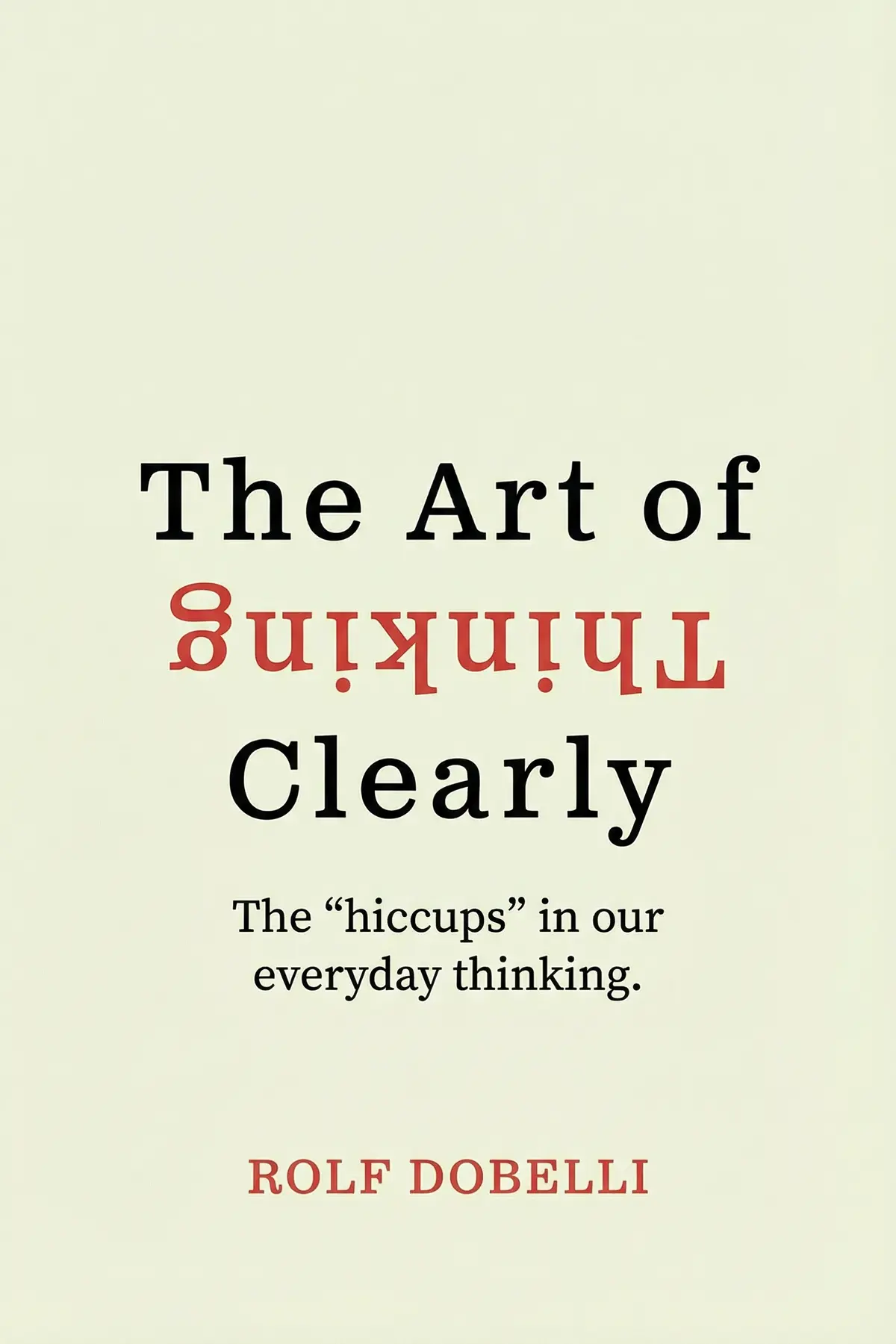
Table of Content
1. Introduction
1 min 53 sec
Most of us like to believe that we are the captains of our own souls, steering our lives with a steady hand and a rational mind. We imagine that our decisions are based on cold, hard logic and that we see the world exactly as it is. But what if that sense of clarity is actually an illusion? What if your brain is constantly playing tricks on you, filtering reality through a lens of ancient survival instincts that are no longer suited for the modern world?
In our exploration today, we are going to peel back the layers of human psychology to reveal the ‘hiccups’ in our everyday thinking. These aren’t just random mistakes; they are systematic errors that we all fall for, regardless of our intelligence or education. We call these cognitive biases. They are the mental shortcuts, or heuristics, that our ancestors used to make split-second decisions on the African savannah. Back then, if you saw a shadow in the grass, it was safer to assume it was a lion and run than to sit and analyze the probability.
In the twenty-first century, however, these same shortcuts can lead us to buy things we don’t need, trust the wrong people, and overestimate our own abilities in ways that are statistically impossible. Throughout this journey, we will look at how we view ourselves, how we interact with others, and how we process the overwhelming amount of information thrown at us every day. By the time we finish, you will have a much sharper sense of when your brain is trying to take a shortcut—and how you can step in to take the long, rational road instead. We’ll cover everything from why we follow the crowd to why we struggle to make simple choices when there are too many options. This isn’t just about pointing out flaws; it’s about learning to think more clearly so you can live more effectively. Let’s begin by looking at how we perceive the person we think we know best: ourselves.
2. The Overconfidence Effect
2 min 12 sec
We often believe we are far more capable than the average person, but statistically, we can’t all be at the top. Discover why our self-perception is so frequently distorted.
3. The Illusion of Control
2 min 18 sec
From casino dice to elevator buttons, we often think we are in the driver’s seat when we aren’t even on the bus. Explore the comfort of imagined influence.
4. The Herd Instinct and Groupthink
2 min 17 sec
Following the crowd felt safe for our ancestors, but in the modern world, social proof can lead us right off a cliff. Learn why we struggle to stand alone.
5. Confirmation Bias and the Echo Chamber
2 min 22 sec
We like to think we are open-minded, but our brains are actually masters at filtering out anything that disagrees with us. See how you might be building your own prison of thought.
6. The Power of Relativity and Scarcity
2 min 29 sec
Our brains can’t judge value in a vacuum. We rely on comparisons and the fear of missing out to decide what’s worth having. Learn how to spot these retail traps.
7. The Narrative Fallacy and the Allure of the Exotic
2 min 30 sec
A good story can be more dangerous than a lie. Find out why our love for drama leads us to ignore the most likely explanations for the events in our lives.
8. Selective Attention and the Gorilla in the Room
2 min 20 sec
You might think you see everything happening in front of you, but your brain is actually a master of tunnel vision. Learn why you can’t always trust your eyes.
9. Decision Fatigue and the Paradox of Choice
2 min 39 sec
In a world of infinite options, why do we find it so hard to pick just one? Discover why ‘less is more’ when it comes to preserving your mental energy.
10. The Halo Effect and the Liking Bias
2 min 23 sec
A beautiful face or a well-timed compliment can blind us to someone’s true character. Uncover the social shortcuts that lead us to trust the wrong people.
11. The Affect Heuristic and the Power of Emotion
2 min 29 sec
We think we’re cold and calculating, but our feelings are often the ones making the big calls. See how the weather can move markets and how emotions cloud logic.
12. Conclusion
2 min 06 sec
As we have seen, the human brain is a magnificent but deeply flawed instrument. It was forged in a world of immediate physical threats and small social groups, and it carries those ancient survival strategies into a modern world of complex data, global markets, and infinite choices. We are naturally prone to overestimating ourselves, following the herd, and seeing patterns where none exist. We are suckers for a good story and a pretty face, and we are easily exhausted by the simple act of choosing.
However, being aware of these cognitive biases is the first and most important step toward overcoming them. You cannot turn off these mental shortcuts entirely—they are hardwired into your biology—but you can learn to recognize the situations where they are most likely to lead you astray. Thinking clearly is not about being a perfect, emotionless robot; it’s about having the humility to know that your first impression is often wrong and the discipline to double-check your own logic.
As you move forward from this summary, try to implement two simple practices. First, seek out ‘disconfirming’ evidence. If you have a strong belief, go find the smartest person who disagrees with you and listen to them. It will sharpen your mind and protect you from the echo chamber. Second, watch out for the ‘scarcity’ and ‘contrast’ traps in your daily life. When someone tells you an offer is ‘limited time only’ or shows you an expensive option first to make the second one look cheap, recognize the game they are playing.
The art of thinking clearly is a lifelong practice. It requires us to slow down, to question our ‘gut,’ and to accept that the world is far more random and complex than we’d like to believe. But by doing so, you will make better decisions, experience less regret, and see the world with a clarity that few ever achieve. The next time you feel absolutely certain about something, take a breath, look for the ‘gorilla’ in the room, and remember that the most important person to be skeptical of is yourself.
About this book
What is this book about?
Have you ever wondered why smart people make questionable decisions or why we consistently repeat the same mental mistakes? This summary dives into the fascinating world of cognitive biases, exposing the invisible scripts that guide our thoughts and actions. From the illusion of control to the dangers of social proof, we examine the evolutionarily hardwired shortcuts that once kept us alive but now often lead us astray. By the end, you will have a toolkit for recognizing these flaws in real-time, allowing for more rational choices and a clearer perspective on life's many complexities.
Book Information
About the Author
Rolf Dobelli
Rolf Dobelli is a versatile writer and entrepreneur who holds a PhD in philosophy. He is widely recognized as the founder of Zurich.Minds, a prestigious community bringing together some of the world's most influential thinkers. Beyond his entrepreneurial work, Dobelli is a respected voice in European media, frequently contributing to prominent newspapers such as FAZ and Die Zeit. He is also a prolific author with six novels to his credit.
Ratings & Reviews
Ratings at a glance
What people think
Listeners find the work insightful, noting it is full of stimulating concepts that spark deep reflection and discussion, while praising its very accessible layout. Furthermore, the material is presented in a straightforward way, serving as a practical guide complete with beneficial illustrations. The title also includes brief chapters, succinct overviews, and narrative components, with one listener mentioning that the writing style is anecdotal.
Top reviews
Sarocha
Finally got around to finishing this, and I’m genuinely impressed by how Dobelli distills complex psychological concepts into bite-sized chunks. Each of the 99 chapters is roughly two pages long, making it perfect for morning reading sessions where you only have a few minutes to spare. Truth is, many people find Kahneman or Taleb too dense to get through, so this serves as a fantastic "greatest hits" compilation of cognitive errors. Some might argue it’s a bit shallow, but the simplicity is actually the book's greatest strength for a general audience. The storytelling elements and relatable anecdotes help the lessons stick much better than a dry textbook ever could. It really makes you pause and consider how often we fall for the sunk cost fallacy or social proof in our daily lives. If you want a quick reference guide to help you make slightly better decisions, this is a must-buy.
Show moreDuangjai
Wow. I didn't think a book about logic and probability could be this engaging! This is essentially a manual for the human brain, laid out in short chapters that are incredibly easy to digest. Personally, I think this should be mandatory reading for students. It covers everything from the sunk cost fallacy to the fear of regret in a simple manner that anyone can understand. It’s not just a book; it’s a toolkit for life. The storytelling elements used to explain things like social proof and the contrast effect are brilliant. It makes you realize how often we are just following the crowd or making choices based on feelings rather than logic. If you want to make smarter choices and avoid common pitfalls, this is the book you need on your shelf. It’s concise, insightful, and very practical.
Show moreAhmed
This book acts like a mirror for your mind. It’s insightful and incredibly easy to read, with simple explanations that don't make you feel stupid for not knowing these things already. Each of the 99 chapters serves as a quick reminder to stay alert to our natural mental flaws. Frankly, I found the concise summaries at the end of each section to be very helpful for reinforcing the main points. The book is written in a way that provokes both thought and conversation, making it a great choice for a book club. It taught me to think more in terms of probabilities and to be wary of the "survivorship bias" that we see in the media all the time. If you want a readable, entertaining, and highly educational book on critical thinking, this is definitely the one to get.
Show moreRungrat
As someone who enjoys metacognition, I found this to be a highly readable summary of the various ways our brains tend to sabotage us. Dobelli doesn't claim to be a psychologist, yet he manages to explain these biases with a clarity that is often missing from academic writing. Frankly, the book functions like a categorized list of mental traps, ranging from the confirmation bias to the overconfidence effect. While it lacks a central, cohesive argument, the individual entries are insightful enough to provoke meaningful conversation at the dinner table. I did notice that some of the 99 biases feel a bit repetitive or could have been grouped together for more impact. However, the short chapters and concise summaries make it an excellent resource for anyone looking to sharpen their critical thinking skills without getting bogged down in heavy theory. It's a solid, practical guide.
Show moreElena
The structure here is what really makes the book work for a busy professional. Instead of a 400-page deep dive into neurological pathways, you get 99 sharp, punchy chapters that highlight specific errors like the scarcity error or the halo effect. In my experience, reading one or two of these a day is more effective than binge-reading the whole thing at once. The author uses anecdotes to illustrate his points, which makes the content feel less like a lecture and more like a helpful chat with a well-read friend. While it’s true that he borrows heavily from other thinkers, he does credit his sources at the end. I appreciated the simple manner in which he tackled the regression to the mean concept, even if the examples were a bit brief. It’s an insightful reference book that I’ll likely revisit when I need a mental reset.
Show moreLillian
After hearing about this book for years, I finally picked it up to see what the hype was about. It is a very useful reference book for those of us who don't have the time to sift through academic journals. The author explains things in a simple manner, providing concise summaries of 99 different ways we mess up our thinking. Look, it’s not perfect—some chapters feel like filler—but the overall impact is very positive. It forces you to question your own assumptions and stay humble about what you think you know. I particularly enjoyed the sections on how we misjudge probabilities and the importance of knowing when to walk away from a bad project. It’s a great conversation starter and provides plenty of food for thought for anyone interested in self-improvement. Highly recommended for a casual but educational read.
Show moreDuang
Picked this up on a whim at the airport and it turned out to be a great decision. The book is filled with thought-provoking ideas that actually make you look at your daily habits differently. I loved the short chapters because they prevent you from feeling overwhelmed by the sheer number of errors being discussed. Dobelli’s use of anecdotes makes the information very accessible, even if you don't have a background in science or philosophy. It acts as a great mirror for our own behavior. For instance, the chapter on the confirmation bias really hit home for me. While it does feel a bit like a "listicle" in book form, the content is valuable enough to overlook the simplistic structure. It’s a helpful guide for anyone who wants to start thinking more clearly and logically about their future.
Show moreGabriel
Ever wonder why you keep making the same bad choices? This book tries to answer that by listing nearly a hundred thinking errors, but it feels a bit like a collection of blog posts stapled together. Not gonna lie, I was expecting a bit more depth and scientific context. It reads very much like a BuzzFeed listicle for the intellectually curious, which isn't necessarily a bad thing, but it can feel quite superficial. The brevity of the chapters is a double-edged sword; you can finish them in three minutes, but you never really get to the bottom of why these biases occur. Some chapters, like the ones on the dubious efficacy of consultants, felt more like personal gripes than actual cognitive science. It's a decent introduction to the subject if you've never read anything else, but seasoned readers will find it a bit redundant.
Show moreChanpen
Look, I appreciate the effort that went into compiling this list, but 99 biases is just too many for one book. By trying to cover everything, the author ends up covering nothing in real detail. Each chapter is almost exactly the same length, which feels artificial and prevents more complex errors from getting the space they deserve. I found myself losing interest about halfway through because the formulaic writing style became repetitive. Gotten say, the tone is a bit cynical at times, which might turn some readers off. It’s definitely a light read, and you might learn a few new terms, but don't expect it to radically change your life. It’s better as a bathroom book where you can read a snippet at a time rather than a serious study on human psychology. It’s okay, just not groundbreaking.
Show moreOmar
Not what I expected. I bought this because I saw some high praise, but the book feels like a pale imitation of much better works by actual psychologists. To be fair, Dobelli is well-read, but his attempt to summarize 99 biases in under 300 pages results in a lack of nuance that borders on dangerous. For instance, comparing a professional golfer’s practice to an investment adviser’s "rain dance" under the label of regression to the mean is just sloppy logic. The writing is often dull and the attempt at wit frequently falls flat. I found the lack of proper endnotes within the chapters frustrating, as the "Note on Sources" at the end is organized poorly. If you actually want to understand how your brain works, go read Daniel Kahneman's work instead. This book is a hollow list that robs these important concepts of their real meaning.
Show moreFeatured in
Readers also enjoyed
A Liberated Mind: How to Pivot Toward What Matters
Steven C. Hayes

Acting with Power: Why We Are More Powerful Than We Believe
Deborah Gruenfeld
Age of Propaganda: The Everyday Use and Abuse of Persuasion
Anthony Pratkanis
AUDIO SUMMARY AVAILABLE
Listen to The Art Of Thinking Clearly in 15 minutes
Get the key ideas from The Art Of Thinking Clearly by Rolf Dobelli, plus 5,000+ more titles in English and Thai.
- 5,000+ titles
- Listen as much as you want
- 7-day free trial
- Cancel anytime







