Emotional: How Feelings Shape Our Thinking
Leonard Mlodinow
Explore the hidden forces of the unconscious mind. Leonard Mlodinow reveals how subliminal processes shape our perceptions, relationships, and decisions, challenging our assumptions about free will and conscious control.
1 min 57 sec
Every single day, you make thousands of choices. You decide what to eat for breakfast, how to respond to an email, which route to take to work, and who to trust in a conversation. In our modern world, we pride ourselves on being rational, conscious actors. We like to believe that we are the captains of our own ships, steering through life based on logic, evidence, and clear-headed intention. But what if that feeling of control is largely an illusion? What if the vast majority of your thoughts, feelings, and behaviors are actually being dictated by a silent partner operating just beneath the surface of your awareness?
This is the central premise of Leonard Mlodinow’s exploration into the hidden world of the brain. The term ‘subliminal’ might conjure up images of hidden messages in advertisements, but Mlodinow uses it to describe the massive, complex, and vital workings of the unconscious mind. This isn’t the mysterious, dark basement of the mind that earlier psychologists imagined. Instead, it is a highly efficient, evolutionary toolkit designed to help us survive and thrive. It handles everything from the way we perceive light and shadow to the way we interpret the subtle tilt of a friend’s head.
In the pages ahead, we are going to look at the transition from ancient philosophy to modern neuroscience. We will see how technology like fMRI has allowed us to finally map the ‘ghost in the machine.’ We will explore why our memories are more like creative stories than video recordings, and why we are often the most confident when we are the most mistaken. By understanding the ‘throughline’ of this book—the idea that our unconscious is the primary driver of our existence—we can start to look at our own lives with a new sense of humility and curiosity. We are not just thinking beings who occasionally have feelings; we are deeply unconscious beings who occasionally think. Let’s dive into the hidden mechanisms that truly rule our behavior.
2 min 50 sec
From philosophical guesses to high-tech brain scans, discover how our understanding of the hidden mind has shifted from dark myths to measurable science.
2 min 30 sec
Our senses provide a chaotic mess of information, but the unconscious mind smooths it all out to create the stable world we see.
2 min 24 sec
We communicate far more through gestures and facial expressions than words, using an ancient system we share with our primate cousins.
2 min 26 sec
The pitch and pace of your speech say more about your character and attractiveness than the actual words you choose.
2 min 24 sec
Memory isn’t a recording; it’s a reconstructed story. Your unconscious fills in the gaps, sometimes with startling inaccuracies.
2 min 17 sec
We are often the last to know why we feel the way we do, frequently misinterpreting our body’s physical reactions as different emotions.
2 min 14 sec
Our brains often act more like defense attorneys than objective researchers, bending facts to support what we already believe.
2 min 18 sec
Almost everyone thinks they are better than the average person, a protective delusion that helps us stay motivated and resilient.
2 min 21 sec
Our brains are built for socializing. We are so attuned to others that social rejection actually registers as physical pain.
2 min 22 sec
Much of our behavior is dictated by hormones like oxytocin and ‘automatic’ social habits that we follow without thinking.
2 min 33 sec
Even the most open-minded people carry implicit biases that affect how they judge others based on appearance and labels.
2 min 20 sec
We naturally divide the world into ‘us’ versus ‘them,’ favoring our own group even when the grouping is completely meaningless.
2 min 19 sec
From the music in a store to the name of a company, the smallest details can steer our major life decisions without us knowing.
2 min 11 sec
As we wrap up our journey through the hidden layers of the mind, the picture that emerges is one of a vast, underwater iceberg. Our conscious thoughts are merely the visible tip, while the massive bulk of the unconscious lies beneath, silently directing our path through the dark waters of life. Leonard Mlodinow has shown us that from the way we perceive the colors of a sunset to the way we choose a life partner, our ‘subliminal’ mind is always at work. It filters out the noise, fills in the gaps of our memory, and uses ancient biological scripts to keep us safe and connected.
This realization brings with it a certain sense of humility. We are not the perfectly rational machines we once thought we were. We are prone to biases, we misinterpret our own emotions, and we are easily swayed by the music in a store or the pitch of a politician’s voice. But this knowledge is also a form of power. By understanding the ‘why’ behind our irrationalities, we can begin to build a more accurate map of ourselves. We can learn to slow down when we are emotional, knowing that our ‘internal lawyer’ might be leading us astray. We can work to expand our social circles, overriding the ‘us versus them’ instinct. And we can become more skeptical of our own certainties, recognizing that our memories and beliefs are often creative reconstructions.
To put these ideas into action, start by paying attention to your own physiological state. Before making a major decision, ask yourself if you are tired, hungry, or stressed. Your unconscious might be using that physical discomfort to bias your choice. Secondly, practice ‘visual dominance’—be mindful of your eye contact and posture to project the confidence your unconscious mind naturally respects. Finally, try to look past the ‘packaging’ of life. Whether you are buying wine or evaluating a new colleague, consciously remind yourself that your brain is being influenced by superficial factors like labels and appearance. You can’t silence your unconscious mind, but you can become a much better partner to it. By acknowledging the hidden ruler of your behavior, you can finally start to lead a more conscious, intentional life.
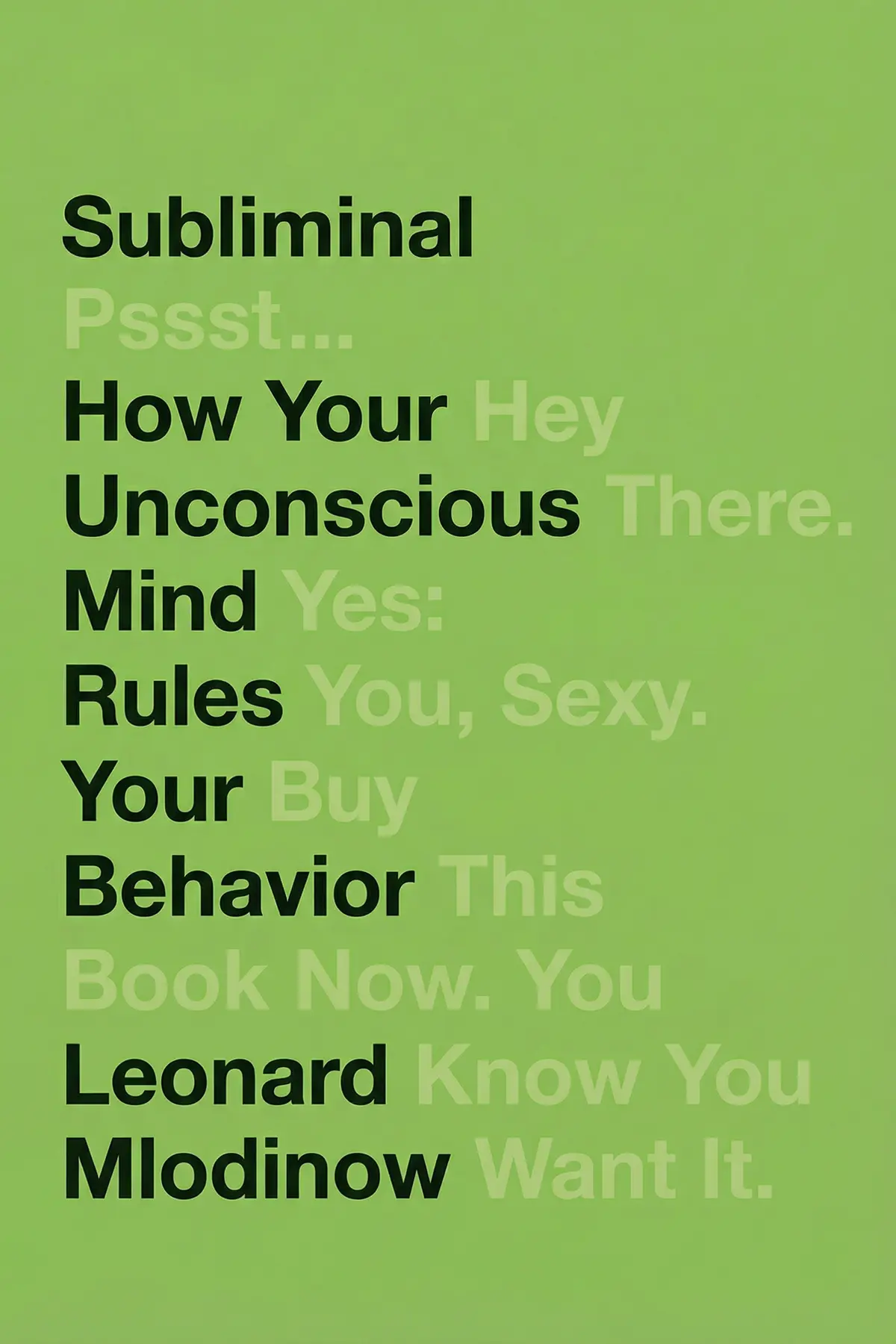
Have you ever wondered why you made a specific purchase, felt an immediate spark with a stranger, or misremembered a significant event? In Subliminal, physicist Leonard Mlodinow takes us on a deep dive into the hidden world of the unconscious mind. Far from the dark, repressed impulses suggested by early psychoanalysis, the modern 'subliminal' mind is a sophisticated processing powerhouse that manages the vast majority of our lives without us ever noticing. This book bridges the gap between historical philosophy and cutting-edge neuroscience. By exploring how our brains filter sensory data, construct memories, and navigate social hierarchies, Mlodinow demonstrates that our conscious 'self' is often the last to know what we are doing and why. The promise of this summary is to help you peel back the curtain on your own behavior, offering a clearer understanding of the biological and psychological mechanisms that dictate your daily reality. From the influence of background music to the evolutionary roots of our social groups, you will learn how to better navigate a world where your unconscious mind is often the one behind the wheel.
Leonard Mlodinow is a physicist and author of bestselling science books such as The Drunkard’s Walk: How Randomness Rules Our Lives. He has a PhD in theoretical physics from the University of California and teaches at the California Institute of Technology. His parents were concentration camp prisoners during World War II and their stories feature in Subliminal. In the past he has collaborated with luminaries like Deepak Chopra and Stephen Hawking. He has also written scripts for TV science fiction series including Star Trek.
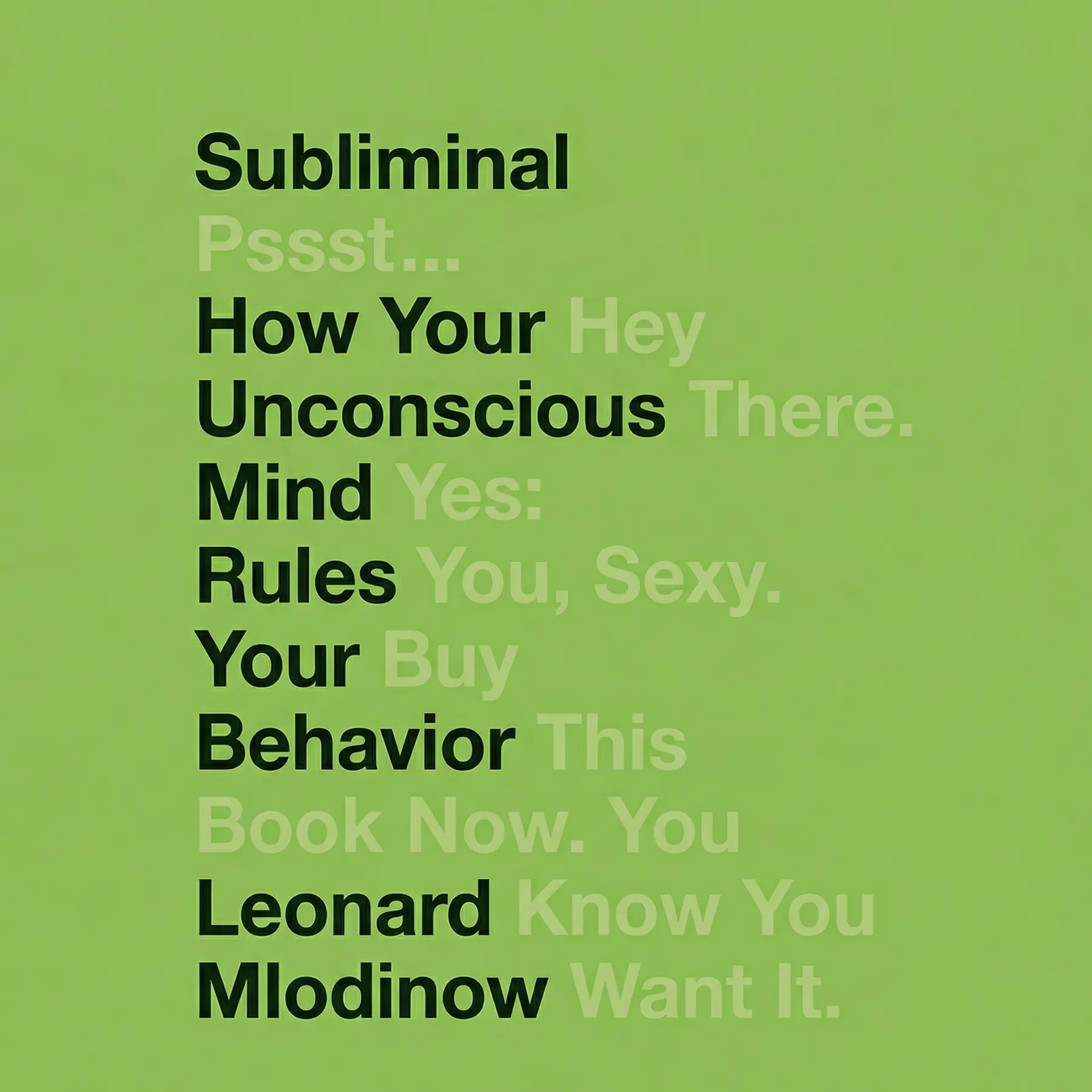
Listeners find this work to be a captivating and eye-opening experience that offers deep understanding into the inner workings of our minds. The prose is approachable for beginners, simplifying intricate ideas, and listeners enjoy the engaging psychological studies mentioned. They consider the book funny and skillfully composed, with one listener highlighting how the author connects advanced theories to daily life. Listeners appreciate the informative nature, especially for individuals just starting to explore psychology.
Mlodinow has a gift for translating dense neuroscience into something that feels like a late-night conversation with a very smart friend. I've always been skeptical of the Freudian subconscious, but this book presents a much more modern, data-driven view of how our brains handle the heavy lifting behind the scenes. The discussion on how we perceive reality—or rather, how our brains construct a useful fiction for us—was genuinely mind-blowing. Honestly, the way he explains our blind spots and how the brain fills in the gaps makes you question every single thing you see. It’s accessible, funny, and grounded in actual research rather than just self-help fluff. If you're looking for a rigorous yet readable entry point into social psychology, start here. It’s an enlightening journey into why we do what we do without even knowing it.
Show moreWow, this was exactly the kind of science writing I’ve been craving lately. Mlodinow manages to balance complex evolutionary biology with hilarious anecdotes about human behavior that kept me turning pages way past my bedtime. I particularly loved the exploration of "theory of mind" and how our brains are essentially social calculators constantly reading nonverbal cues from everyone around us. The science feels robust, yet the author’s voice remains light and engaging throughout the entire narrative. It’s rare to find a book that discusses fMRI scans and the reptilian brain without feeling like a textbook, but he pulls it off with ease. If you enjoyed Thinking, Fast and Slow, you’ll find this to be a much more conversational and digestible companion piece. It’s a brilliant look at the hidden architecture of the human experience.
Show moreThe chapter on group dynamics alone makes this book a mandatory read for anyone interested in social psychology or human behavior. Mlodinow explores how our subliminal minds are constantly sorting people into "us" vs. "them," even over the most trivial differences. It’s fascinating and a little bit scary to realize how much our unconscious biases dictate our political and social interactions. The author’s background as a physicist brings a refreshing level of precision to the psychological concepts without making the prose feel stiff or unreachable. I especially loved the section on how we justify our actions after the fact—our brains are basically just high-end lawyers for our subconscious whims. This is top-tier science writing that manages to be both profoundly educational and consistently entertaining.
Show moreEver wonder why you pick one laundry detergent over another, or why you're so convinced your memories are 100% accurate? Mlodinow dives deep into these quirks, using the Pepsi vs. Coke blind tests to illustrate how our brand preferences are literally hardwired into our pleasure centers. While I found the sections on memory and eyewitness testimony slightly terrifying, they were incredibly necessary for understanding human fallibility. The writing is punchy and stays away from overly dry academic jargon, though it does get a bit technical when discussing the prefrontal cortex. Personally, I would have liked a few more tips on how to actually override these biases in daily life. Regardless, it’s a fascinating read that will make you rethink every gut feeling you've ever had. Truth is, we aren't nearly as in control as we like to think.
Show moreAfter hearing so much about the invisible forces shaping our lives, I finally picked this up to see if the hype was real. Mlodinow’s breakdown of the three regions of the brain—reptilian, limbic, and neocortex—is one of the clearest explanations I’ve ever encountered in popular science. He shows how these layers often work in concert, sometimes to our benefit and sometimes to our total confusion. I found the section on in-groups and how easily we form prejudices based on superficial markers to be particularly sobering and relevant to today’s world. The book is well-written and flows smoothly, though some of the experiments mentioned have been covered in other popular psych books. Still, the way he ties everything back to our evolutionary survival makes the concepts stick in a way others don't.
Show moreAs someone who isn't a scientist, I really appreciated how Mlodinow broke down the complexities of the dorsal striatum and other brain structures. The experiment involving the Xerox machine and the mental scripts we follow was a highlight for me because it's so relatable. We really do operate on autopilot most of the time, and this book provides a solid roadmap for understanding those automatic processes. My only minor gripe is that the tone oscillates between being very casual and suddenly very technical, which can be jarring. But frankly, the insights into how we perceive others based on their voice or appearance made the whole thing worthwhile. It’s an eye-opening read that proves we’re all just woolly around the edges when it comes to logic.
Show morePicked this up on a whim during a long flight and ended up finishing it before we landed. The truth is, I’ve always known my memory wasn't perfect, but seeing the data on how we reconstruct the past to favor our own self-image was a real wake-up call. Mlodinow’s discussion on how we see ourselves as above average in almost everything is both funny and deeply humbling. The book is packed with interesting studies, like the one about gifted children and how teacher expectations literally change a student's IQ over time. It’s a well-paced read that manages to be informative without being overwhelming, making it perfect for a general audience. I walked away with a much better understanding of the hidden part of my personality.
Show moreFinally got around to reading Subliminal, and I have to say, Mlodinow is a master at making the mundane feel miraculous. He takes everyday experiences—like why we trust a certain doctor or how we fall in love—and peels back the curtain to reveal the complex neural machinery underneath. The book is witty, well-researched, and doesn't shy away from the fact that our conscious minds are often the last to know what's actually going on. While I agree with some reviewers that it’s heavy on the science and light on the how-to, the content is so fascinating that I didn't mind much. It’s an excellent bridge between hard neuroscience and human interest. Definitely worth the read if you want to understand the invisible forces driving your daily choices.
Show moreTo be fair, the author does a decent job of explaining the new unconscious through various studies and historical context. However, for a book titled about how the mind rules your behavior, it feels frustratingly light on actionable advice or application. I felt like I was wading through endless descriptions of brain physicality and evolutionary history without ever reaching a "so what?" moment. If you're looking for something that helps you change your habits or influence others, you’re better off sticking with Dan Ariely or The Power of Habit. The anecdotes are folksy and fun, but the heavy focus on the weeds of neuroscience eventually became a bit of a slog for me. It’s definitely educational for a novice, but seasoned readers of the genre might find it a bit redundant.
Show moreLook, I enjoyed the trivia and the humorous way Mlodinow presents these experiments, but I couldn't help feeling like I'd read half of this before. If you've spent any time with Blink or Strangers to Ourselves, many of the core concepts like blindsight and implicit bias will feel very familiar. To be fair, the writing style is more accessible than some of the more academic alternatives, which is a plus for newcomers. But for me, the middle sections felt a bit repetitive, and I found myself skimming through the more minute descriptions of brain anatomy. It's a good primer, but it doesn't quite break enough new ground to be a standout in the field. I'd recommend it to someone just starting their journey into psychology.
Show more

Richard Wiseman
Steven C. Hayes
Deborah Gruenfeld
Anthony Pratkanis
AUDIO SUMMARY AVAILABLE
Get the key ideas from Subliminal by Leonard Mlodinow, plus 5,000+ more titles in English and Thai.