
21 min 33 sec
Thank You for Arguing: What Aristotle, Lincoln, and Homer Simpson Can Teach Us About the Art of Persuasion
Thank You for Arguing explores the ancient art of rhetoric, showing how techniques from Aristotle and Lincoln can help anyone master the art of persuasion and reach meaningful consensus in daily life.
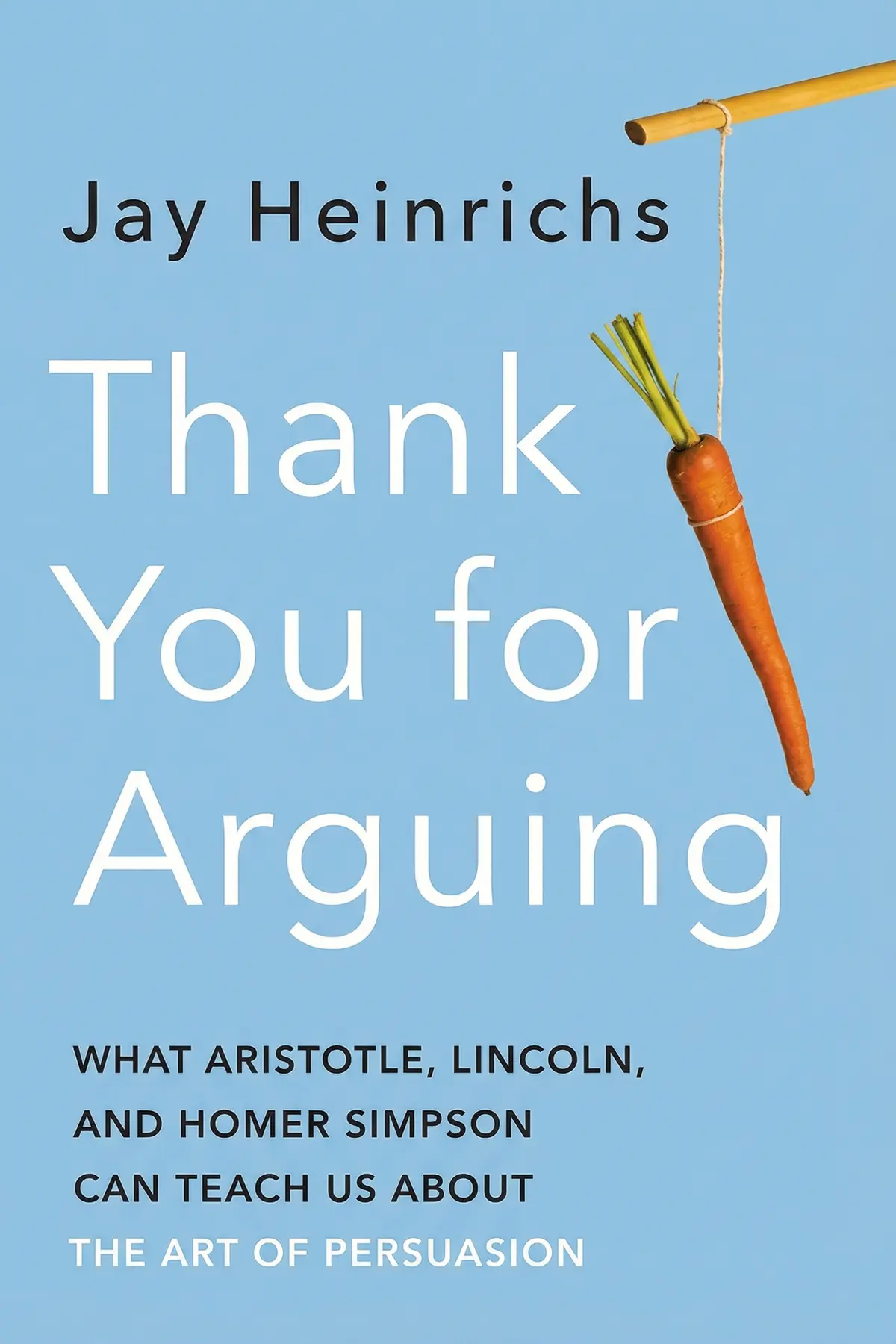
Table of Content
1. Introduction
1 min 56 sec
Imagine the last time you found yourself in a heated disagreement. Maybe it was in the kitchen, arguing over whose turn it was to do the dishes, or perhaps it was at work, debating the direction of a major project. For most of us, these moments feel like battles where we either win or lose. We tend to think of arguments as verbal warfare, a clash of egos where the goal is to beat the other person into submission. But what if that’s entirely the wrong way to look at it?
In our look at Thank You for Arguing, we are going to explore a very different perspective. The author, Jay Heinrichs, invites us to revisit the ancient world of rhetoric—an art form that was once the backbone of a proper education but has largely been forgotten in our modern age. Rhetoric isn’t about yelling; it’s about the sophisticated and often subtle art of persuasion. It’s about moving people from one position to another, not through force, but through a masterful blend of logic, emotion, and character.
Over the course of this summary, we will see how historical figures like Aristotle and Abraham Lincoln used these techniques to change the world, and even how modern figures like Homer Simpson or Eminem apply these principles in surprising ways. We’ll learn that the most effective debaters aren’t the loudest ones; they are the ones who understand human psychology and know how to guide a conversation toward a desired outcome. Whether you want to convince your boss of a new idea, negotiate more effectively with your spouse, or simply understand how political speeches are designed to influence you, the principles of rhetoric offer a powerful new lens. The throughline here is simple: persuasion is a skill that can be studied, practiced, and mastered. By shifting our focus from winning a fight to winning over an audience, we can transform the way we communicate in every area of our lives. So, let’s begin this journey into the art of persuasion and see how we can turn our next argument into a successful consensus.
2. The Distinction Between Fighting and Arguing
2 min 53 sec
Discover why winning an argument isn’t about proving you’re right, but about reaching a consensus that moves everyone forward.
3. The Strategic Use of Time and Tense
3 min 14 sec
Learn how the simple act of shifting your conversation into the future tense can resolve even the most stubborn conflicts.
4. The Three Pillars of Persuasion: Logos, Pathos, and Ethos
3 min 12 sec
Unlock the classic toolkit of logic, emotion, and character that forms the foundation of every successful message.
5. Building Authority Through Virtue and Wisdom
2 min 44 sec
Explore the three essential qualities that make your character a powerful tool for winning trust and influence.
6. Harnessing Logic and the Art of Concession
2 min 58 sec
Discover how to use your opponent’s own points to your advantage and why agreeing can sometimes be the best way to win.
7. Spotting Fallacies and Rhetorical Dirty Tricks
2 min 55 sec
Arm yourself against the common logical traps that people use to manipulate conversations and cloud your judgment.
8. Conclusion
1 min 41 sec
As we wrap up our journey through Thank You for Arguing, it’s clear that rhetoric is far more than just a collection of ancient terms; it is a vital, living skill that we use every single day, whether we realize it or not. We’ve seen that the most important shift we can make is to stop viewing arguments as battles to be won and start seeing them as opportunities for persuasion and consensus. By moving away from blame and the past, and instead focusing on choice and the future, we can resolve conflicts that previously seemed impossible.
We’ve explored the classic triad of logos, pathos, and ethos—the logic that structures our thoughts, the emotion that connects us to our audience, and the character that builds the trust necessary for anyone to listen. We’ve learned that our reputation and our ability to fit into a group’s decorum are often more influential than the most perfectly crafted sentence. And perhaps most importantly, we’ve seen how to protect ourselves from the logical fallacies and emotional traps that often derail productive conversation.
The core lesson here is one of empowerment. You don’t have to be the loudest person in the room to be the most influential. In fact, the most persuasive people are often the ones who listen best, who concede points gracefully, and who always keep their eye on the ultimate goal. The next time you find yourself in a disagreement, remember the power of the future tense. Instead of asking ‘Who’s to blame?’, ask ‘What do we do now?’ By practicing these techniques, you’ll not only find that you win more arguments, but that your relationships and your professional life become more harmonious and productive. Persuasion is an art, and with the tools of rhetoric in your hand, you are ready to master it.
About this book
What is this book about?
Thank You for Arguing is an insightful guide to the world of rhetoric, the art of persuasion that has shaped human history from the forums of ancient Greece to modern political stages. It moves beyond the idea of arguments as mere shouting matches, reframing them as essential tools for communication, negotiation, and building agreement. The book promises to equip readers with a toolkit of logical, emotional, and character-based strategies that turn conflicts into opportunities for resolution. Through various examples involving historical figures and pop culture icons, the text explains how to control the direction of a debate by using the right tense, how to build a persona that others naturally trust, and how to spot the common logical traps that others use to mislead. By the end, the promise is clear: you will not just learn how to argue, but how to win over your audience and achieve your goals with grace and strategic skill.
Book Information
About the Author
Jay Heinrichs
Jay Heinrich is a former editor and publishing executive who dropped his first career in order to make rhetoric his full-time job. He blogs about rhetorical techniques and holds workshops aimed at popularizing argumentation.
Ratings & Reviews
Ratings at a glance
What people think
Listeners find the text accessible and value the educational insights into rhetoric, with one mentioning its benefits for developing speech skills. The caliber of the writing earns praise, as one listener notes how the author incorporates solid argument inventions. While some listeners believe it is worth the 6 dollars spent, others find the content tedious.
Top reviews
Wichai
As a parent, I never expected a book on rhetoric to change my household dynamics so drastically. The section on how to teach your children to debate instead of just screaming 'no' was a revelation. I actually tried some of the techniques when my daughter was angling for a late-night dessert, and she managed to persuade me using a perfectly constructed argument about nutrition and rewards. It was impressive! Heinrichs makes these concepts incredibly accessible, moving away from the stuffy atmosphere of a textbook. The book is filled with wit and real-world examples that bring Aristotle into the twenty-first century. Look, it might be a bit cheesy at times, but the practical value is undeniable. It teaches you to look for the 'sweet spot' in any discussion. This is hands down the most interesting 'child-rearing' book I’ve ever picked up, even though it wasn't originally intended to be one.
Show moreChatri
Who knew Aristotle could be this much fun? I picked this up for six dollars, and it has already paid for itself in the confidence I’ve gained during work meetings. The concept of 'verbal ju-jitsu' is brilliant—learning to use an opponent's momentum against them rather than just clashing heads. Heinrichs writes with a lot of energy and humor, which keeps the material from feeling like a chore. I particularly loved the chapters on humor and how it can be used to defuse a hostile audience. Some reviewers complain about the anecdotes, but I found the stories about his kids to be the perfect way to illustrate the techniques in a relatable setting. It’s not just a book for scholars; it’s for anyone who wants to navigate life more effectively. Truly enlightening and incredibly practical for everyday situations. If you want to learn how to be more persuasive without sounding like a robot, this is the one.
Show moreWararat
Truth be told, I bought this on a whim and it is easily one of my best investments this year. Rhetoric usually gets a bad rap, but Heinrichs cleans it up and shows how it can be a tool for empathy and understanding. He explains how to find common ground with an audience that doesn't necessarily agree with you, which is a skill we desperately need right now. The writing is snappy and the pop culture references actually helped me remember the terms better. I didn't mind the family stories at all; they made the 'art' of arguing feel human rather than just academic. Whether you're a student or a professional, there is something in here for you. It's a rare book that is both educational and genuinely entertaining. It's a shield and a sword for the modern age. Highly recommended for everyone.
Show moreWipada
Finally sat down with this one after hearing it was the go-to for improving speech skills and general persuasion. It is surprisingly easy to read for a book that delves into ancient Greek concepts like ethos and logos. Heinrichs manages to take the dry, dusty world of rhetoric and give it a modern facelift, making it feel applicable to the boardroom and the dinner table. While some might find the heavy reliance on pop culture references a bit much, I think it helps the medicine go down. The truth is, the book serves as a fantastic shield against the shady tactics of politicians. You start seeing the 'verbal ju-jitsu' everywhere you look. It isn't just about winning fights; it’s about understanding the mechanics of how we communicate and influence others every single day. Some chapters felt a bit longer than necessary, but the information provided is genuinely top-tier for anyone wanting to sharpen their tongue.
Show moreDarawan
If I had this in high school instead of a dry textbook, I might have actually paid attention during English class. It makes the core concepts of ethos, pathos, and logos feel alive and relevant to modern life. The author’s expertise is clear, and he does a great job of breaking down complex Latin terms into something manageable. I especially appreciated the focus on the 'future tense' for problem-solving, which is a tip I’ve already started using at my job. Not gonna lie, the author's wit can be a little much at times—he definitely thinks he's the funniest guy in the room. That said, the actual strategies for solid argument invention are excellent. It’s a breezy read that manages to pack in a ton of information without being daunting. It’s a solid 4-star resource for anyone looking to improve their communication skills.
Show moreSupaporn
The concept of arguing in the future tense alone makes this book worth the price of admission. Heinrichs does a stellar job of distinguishing between 'fighting' to win and 'arguing' to reach a conclusion. This distinction is vital. While the author's persona is a bit 'language maven' for my taste, the quality of the rhetorical tools he provides is undeniable. He takes you through the basics of persuasion in a way that is modern and colloquial. You’ll find yourself recognizing these tactics in every advertisement and political speech you see. My only real gripe is that it feels a bit sporadic in the middle sections, jumping around between topics without a clear transition. Still, for an accessible guide to a complex subject, it’s very successful. It’s a much better alternative to a standard textbook and actually gives you things you can use in a real conversation.
Show moreNuk
There is no denying that Heinrichs knows his stuff when it comes to the ancient art of persuasion. The book is a highly competent introduction to rhetorical terms, and I did walk away with a better grasp of the difference between an argument and a fight. However, the tone is a major hurdle. One minute he's being self-deprecating, and the next he's acting like a smug 'maven' who has mastered the human psyche. It’s a strange mix. I appreciated the modern examples, like using Homer Simpson to explain logical fallacies, but the sarcasm eventually wears thin. I found myself skipping the sidebar text boxes because they were often just repetitive jokes. It's a decent read for a college student needing a supplement for AP English, but for a casual reader, the narrative voice might be too condescending. It’s useful, but proceed with a bit of patience for the author's ego.
Show moreFort
Reading this is like being trapped at a cocktail party with an incredibly smart, incredibly smug professor. On one hand, you’re learning a lot about how to explain yourself clearly and how to spot a logical fallacy from a mile away. On the other hand, you kind of want to walk away because he won't stop cracking one-liners. The information is dense and valuable, but the presentation is hit-or-miss. I found the layout with the constant text boxes to be a bit chaotic, making it hard to maintain focus on the main points. Is it informative? Absolutely. Is it a bit boring and repetitive by the halfway mark? Yes. It’s a good reference book to keep on the shelf, but I wouldn't recommend trying to power through it in one sitting. Take it in small doses so the narrative voice doesn't grate on your nerves too much.
Show moreIce
The author is clearly a fan of his own voice, and that becomes apparent within the first fifty pages. I was looking for a serious exploration of logic, but instead, I got a memoir about his kids and a lot of self-congratulatory anecdotes. He calls himself a 'language maven,' but his style feels more like a guy at a party who won't stop making dad jokes. To be fair, the actual content regarding rhetorical inventions is solid, but you have to dig through mountains of filler to find it. The constant text boxes are distracting and often redundant, breaking the flow of what could have been a much tighter argument. If you enjoy a very conversational, almost arrogant narrative voice, you might like this. Personally, I found the lack of structure frustrating. There are better, more concise books on rhetoric that don't involve this much fluff or smugness about 'manipulating' family members.
Show moreKiattisak
I really wanted to learn the mechanics of logic, but this felt like a handbook for sociopaths. The author doesn't just explain rhetoric; he actively praises the art of manipulation as if it's a moral virtue. When he starts talking about how 'happy couples' manipulate each other to get their way, I almost threw the book across the room. It’s cynical and frankly exhausting. Beyond the ethics, the writing quality is quite grating. It is stuffed with pop culture references that will likely be dated in five years and excessive text boxes that add nothing but clutter. He spends more time bragging about his own rhetorical prowess than actually teaching the reader how to construct a sound, honest argument. If you value truth and straightforwardness, avoid this. It’s all about winning at any cost, even if it means redefining terms or being intentionally vague. Not what I was looking for at all.
Show moreReaders also enjoyed
AUDIO SUMMARY AVAILABLE
Listen to Thank You for Arguing in 15 minutes
Get the key ideas from Thank You for Arguing by Jay Heinrichs, plus 5,000+ more titles in English and Thai.
- 5,000+ titles
- Listen as much as you want
- 7-day free trial
- Cancel anytime







