
60 Seconds & You’re Hired!
Robin Ryan
Explore the profound shifts in work, finance, and personal identity required to thrive in an era where living to one hundred is the new normal and traditional life stages are being rewritten.
1 min 34 sec
Imagine for a moment that you are standing at the beginning of a journey that will last an entire century. For most of human history, the idea of living to one hundred was a rare miracle, an outlier reserved for a lucky few. But today, the data suggests that for many of us—and certainly for our children—the hundred-year life is no longer a fantasy; it is a statistical probability. This shift is one of the most significant transformations in human history, yet our social structures, our career paths, and our financial systems are still designed for a world where people died much younger.
In this exploration of longevity and its consequences, we are forced to confront a throughline that connects our biology to our bank accounts and our personal identities. The old roadmap, which dictated that we learn in our youth, work in our middle years, and rest in our final decade, is becoming obsolete. As we move into an age where 100 is the new 80, we have to ask ourselves: how do we fill those extra twenty or thirty years? Is it just more of the same, or is it a chance to reinvent what it means to be human?
This summary will guide you through the practical and psychological shifts required to thrive in an age of longevity. We will look at why the current pension models are failing, how artificial intelligence is rewriting the rules of the labor market, and why your most valuable assets might not be the ones in your savings account. By the end, you’ll see that a longer life isn’t just about adding years to the end of your time on Earth; it’s about rearranging the very fabric of how you live every single day. Prepare to challenge your assumptions about retirement, work, and who you really are.
2 min 40 sec
Discover how modern medicine and public health have fundamentally altered human life expectancy, turning the rare milestone of a century into a common reality for future generations.
2 min 21 sec
Learn why the traditional model of education, work, and retirement is no longer financially or socially sustainable in a world where we live much longer.
2 min 24 sec
Explore how technology is redefining the labor market and why uniquely human traits like creativity and social intelligence are becoming your most valuable professional assets.
2 min 22 sec
Shift your focus from bank balances to the hidden drivers of long-term success: physical health, mental agility, and deep self-knowledge.
2 min 10 sec
Break free from the rigid ‘school-work-retirement’ trap and embrace new stages of life focused on discovery, experimentation, and personal autonomy.
2 min 09 sec
Master the essential principles of finance to ensure your hundred-year life is defined by security and freedom rather than scarcity and stress.
2 min 16 sec
In a world of constant change, discover why building a life around your personal values and deep social connections is the key to lasting fulfillment.
1 min 45 sec
As we close our look at the hundred-year life, the central message is clear: the rules have changed, and the old maps no longer lead to the destination we desire. Longevity is a double-edged sword. On one hand, it offers us the most precious resource of all—time. We have more time to learn, more time to love, and more time to contribute to the world. On the other hand, it demands a level of foresight, flexibility, and responsibility that previous generations never had to face.
We have seen that the three-stage life is a relic of the past and that the multi-stage life is our new reality. This transition requires us to be proactive in maintaining our health, ruthless in our pursuit of financial literacy, and brave in our willingness to explore new identities. We must recognize that our intangible assets—our relationships, our skills, and our self-knowledge—are just as vital as the balance in our bank accounts.
To make this actionable, start by looking at your social circle. Are you surrounding yourself with ‘regenerative’ friendships? These are the people who nourish you, challenge you, and will be there through your various life transitions. Invest time in these bonds now, as they are the emotional safety net for the decades to come.
Living to one hundred isn’t just about survival; it’s about thriving. It’s about ensuring that the person you are at eighty is just as excited about the future as the person you were at twenty. By embracing experimentation and letting go of the rigid expectations of the past, you can build a life that is not just long, but deep, meaningful, and uniquely yours. The century is waiting for you—make sure you’re ready to live every year of it.
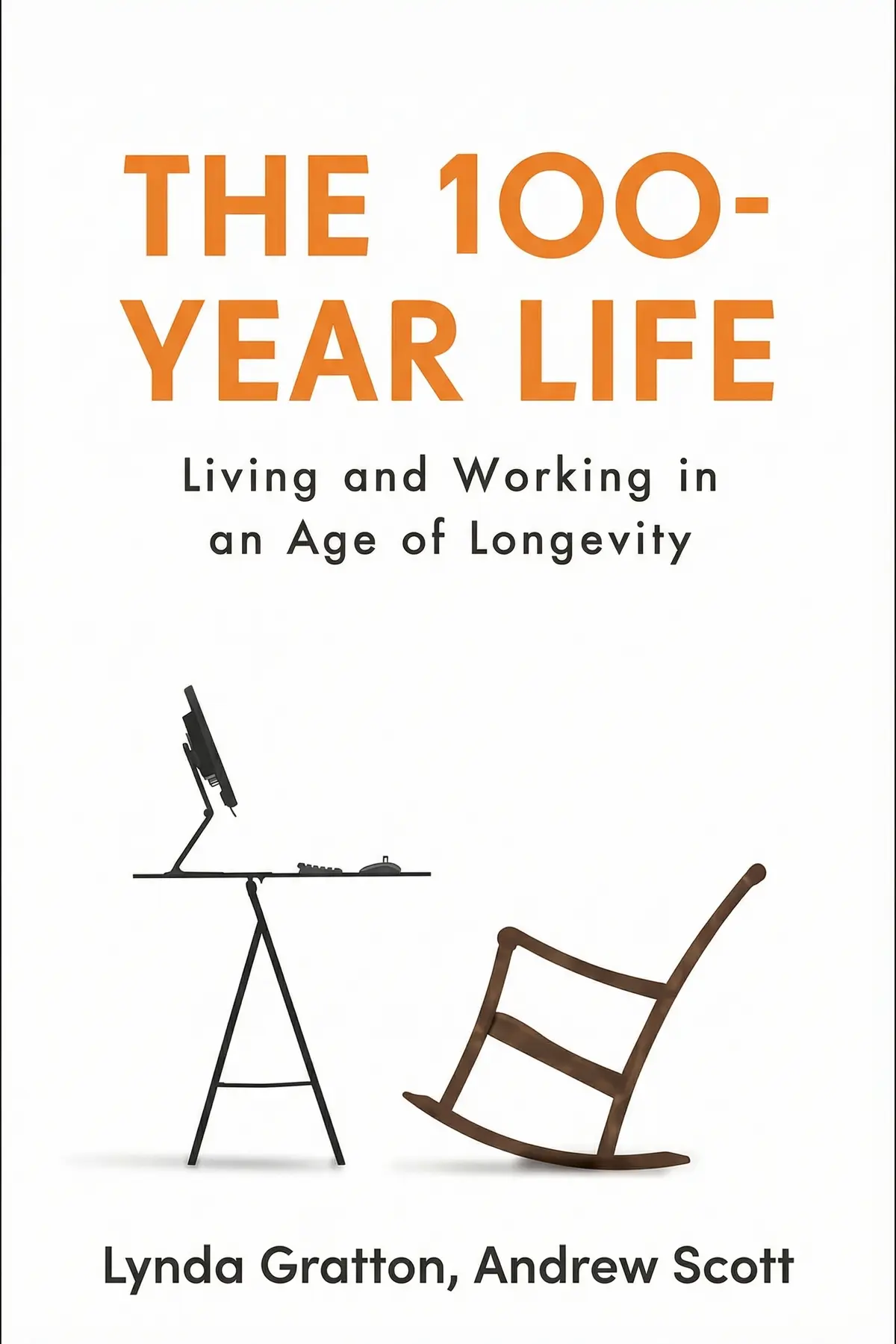
The 100-Year Life examines the radical implications of increased human longevity. For decades, society has followed a predictable three-stage model: education, followed by a career, and ending with retirement. However, as life expectancies climb toward a century, this old framework is beginning to crumble. The book provides a roadmap for navigating this new reality, highlighting the necessity of lifelong learning, financial literacy, and the cultivation of intangible assets like health and relationships. Readers will discover how to transition from a rigid career path to a multi-stage life that includes periods of exploration, independent production, and frequent skill updates. By rethinking how we manage our time and finances, the authors promise a vision of the future where a longer life is not a burden of extended old age, but a gift of increased opportunity and personal fulfillment.
Lynda Gratton is a professor of management practice at the London Business School and the founder of the Future of Work Consortium, which brings together business leaders to discuss evolving workplace trends. Andrew Scott is a professor of economics at the London Business School and has held prominent roles as an adviser to the Bank of England, the HM Treasury, and the House of Commons. He earned his PhD from Oxford University and an MSc from the London School of Economics.
Listeners find the work stimulating and perceptive, noting its thorough research and variety of viewpoints. They view it as a must-read for anyone over 20 and value its exploration of the consequences of living longer. Feedback on the caliber of the writing is divided.
Ever wonder why the old retirement model feels so broken? This book provides a brilliant framework for understanding why the traditional three-stage life—education, work, retirement—is becoming obsolete. Lynda Gratton and Andrew Scott argue convincingly that as we approach the 100-year life, we must transition to a multi-stage existence. I found the concept of 'intangible assets' like productive, vitality, and transformational assets to be a total game-changer for my career planning. While the financial advice is solid, it is the focus on personal flexibility and lifelong learning that really resonated. If you are anywhere between 20 and 60, you need to read this to prepare for the marathon ahead. It is not just about living longer; it is about living better through constant re-creation. This is an essential roadmap for a future that is already unfolding around us.
Show moreThis book is a roadmap for a future that's already here, whether we like it or not. I've been feeling behind in my career because I've switched fields twice, but this book made me realize I'm actually ahead of the curve. The authors' focus on 'keeping options open' as a rational financial and life strategy was incredibly validating. I particularly enjoyed the discussion on how our identities will need to become more fluid as we take on different roles over ten decades. It’s a very optimistic book, which is rare for something written by an economist and a psychologist. They don't ignore the challenges of funding a long retirement, but they emphasize the opportunities for experimentation and personal growth. I’ve already recommended this to several friends who are feeling 'stuck' in their 30s. It’s a perspective-shifting masterpiece.
Show moreWow, I didn't realize how much I needed to rethink my definition of 'middle age' until I read this. The 100-Year Life is an incredibly empowering look at the future of humanity. Instead of fearing old age, I now see the potential for a life filled with different chapters—some for learning, some for earning, and some for exploring. The authors are brilliant at connecting economic trends with psychological needs. I loved the advice to engage in 'challenging conversations' with partners about how roles will shift over time. It’s not a light read, but it is a deeply rewarding one if you’re willing to put in the mental effort. It has changed the way I look at my career, my health, and my relationships. Truly an essential guide for the 21st century.
Show moreFinally got around to finishing this after it sat on my nightstand for months, and I'm glad I did. The authors do a fantastic job explaining how a longer life isn't just a 'long old age,' but rather a chance to stretch out our younger years. I loved the section on the 'Yahoos'—the young adults holding options who are delaying traditional milestones like marriage or homeownership. It made me realize that what looks like indecision in the younger generation is actually a strategic response to a century-long lifespan. The book is very encouraging, though it does lean heavily toward a middle-class perspective with plenty of career choices. Not everyone has the luxury of taking a 'gap year' at age 50 to reskill. Despite that limitation, the insights on maintaining social networks and health as 'assets' are worth the cover price alone.
Show moreAs someone staring down the barrel of a forty-year career, I found this perspective incredibly refreshing and necessary. Gratton and Scott successfully shift the conversation from the 'burden' of aging to the 'gift' of time. I was particularly struck by the idea of 're-creation' instead of just 'recreation.' Instead of just chilling out on weekends, we need to use our downtime to build new skills and networks. The breakdown of how Jane (born in 1998) will navigate her life compared to Jack (born in 1945) was eye-opening. It made me rethink my own retirement timeline completely. My only gripe is that it can be a bit repetitive, and the authors spend a lot of time on macro-economics that might bore some people. Still, the core message is vital: we need to stop living like our parents and start planning for a much longer, more fluid journey.
Show morePicked this up because I wanted to understand how my kids' lives will differ from my own, and it delivered. The statistics are mind-blowing—the fact that a child born today has a 50% chance of reaching 100 changes everything about how we should approach education. I appreciate that the authors didn't just focus on money; they looked at the 'vitality assets' like health and friendships that actually make a long life worth living. Some of the chapters on corporate structures were a bit dense, but the overall message about the death of the three-stage life is hard to ignore. It is a call to action for governments and individuals alike. It gave me a lot to think about regarding my own 'middle-aged' transition. It’s a solid 4-star read that would be a 5 if it were about fifty pages shorter.
Show moreThe academic tone of this book might be a bit of a hurdle for some casual readers. While the core premise—that we need to rethink our life stages due to increased longevity—is fascinating, the delivery often feels like a dry textbook. To be fair, the authors provide a lot of data, which I appreciated, but the narrative felt padded in several places. I especially struggled with the repetitive nature of the 'Jane, Jack, and Jill' personas. They were useful at first to illustrate cohort differences, but by the middle of the book, I found myself skimming those sections. There is a lot of focus on financial planning and government policy, which is important, yet I wanted more on the psychological shifts required for such a long life. It is a thought-provoking read, but honestly, you could get 80% of the value just by reading the introduction and the final summary.
Show moreTruth is, I have mixed feelings about this one. On one hand, the central argument about the 'multi-stage life' is one of the most important ideas I’ve encountered this year. It explains so much about current social shifts. On the other hand, the prose is quite dry and feels like a series of interconnected white papers. I found myself agreeing with the authors' points but getting bored with the delivery. They also tend to gloss over the demographic issues of shrinking populations and the actual difficulty of 're-skilling' when you’re 60. It’s easy to say 'go back to school,' but the logistics and costs are daunting. It’s a good book to skim for the big ideas, but don't expect a fast-paced or emotional read. It’s more of a strategic manual than a self-help book, which is both its strength and its weakness.
Show moreAfter hearing so much about the 'multi-stage life,' I was surprised by how much the book focused on rigid financial planning. While the authors mention intangible assets, they always seem to circle back to the 'bottom line.' It feels very geared toward HR professionals and policy makers rather than the average person looking for life advice. The case studies of Jack, Jill, and Jane felt a bit like cardboard cutouts rather than real people with messy lives. However, the data on life expectancy and the 'cohort effect' is genuinely interesting and well-researched. I’d say it’s a necessary read for anyone in a leadership position, but for a general reader, it might feel a bit clinical. It’s a solid 3 stars for the information, even if the 'soul' of the book is a bit lacking.
Show moreNot what I expected given the hype surrounding the longevity economy. Frankly, the authors seem to be writing for a very narrow, elite audience of high-earning professionals. They suggest becoming a 'personal entrepreneur' and constantly pivoting your career, but they offer very few solutions for the average worker who doesn't have a massive financial cushion. I found the writing style quite clinical and detached, which made it hard to stay engaged for nearly 300 pages. Most of the actionable advice is common sense: save more money, exercise, and keep learning. Also, for a book revised in 2020, its skepticism about remote work felt outdated almost immediately. If you have a PhD and work in a corporate office, you might find this revolutionary. For the rest of us, it feels like a lot of academic fluff surrounding a very simple observation that we are all living longer.
Show moreRobin Ryan
Marianne Cantwell
William Vanderbloemen
AUDIO SUMMARY AVAILABLE
Get the key ideas from The 100-Year Life by Lynda Gratton, plus 5,000+ more titles in English and Thai.







