Four Thousand Weeks: Time Management for Mortals
Oliver Burkeman
Explore why the relentless pursuit of positivity often backfires and how embracing failure, uncertainty, and negative emotions can lead to a more resilient and authentic sense of well-being and happiness.
1 min 50 sec
Step into any modern bookstore and you are immediately greeted by a wall of bright, glossy covers promising the secrets to a perfect life. The titles shout at you: be more effective, win more friends, think more positively, and manifest your wildest dreams. This is the multi-billion dollar happiness industry, a juggernaut dedicated to the idea that if we just try hard enough, we can eliminate all negativity from our lives. But there is a nagging question at the heart of this movement: if these methods are so effective, why are we still so stressed, anxious, and unfulfilled?
What if our frantic scramble for happiness is actually the very thing keeping it out of reach? This is the central provocation we are exploring today. We often assume that the path to a good life is a straight line paved with optimism, but there is a compelling case for a different route—a ‘negative path’ that embraces the very things we usually try to avoid.
In this journey, we will look at how the self-help industry often relies on myths and shallow platitudes that don’t stand up to scrutiny. We will see how trying to force a smile can actually make us feel worse and why the most resilient among us are often those who have made peace with failure and uncertainty. We will travel from the bustling subways of New York to the vibrant celebrations of death in Mexico, and back through time to the ancient philosophies of Greece and Rome.
The goal isn’t to become pessimistic or gloomy. Instead, it’s about finding a more grounded, sustainable kind of peace. By the end of this exploration, you might find that the ‘antidote’ to your problems isn’t a new set of goals or a more positive mindset, but a willingness to stop running away from the reality of being human. Let’s look at why the best way to move forward might be to stop pushing so hard for the ‘positive’ and start looking at the ‘negative’ in a whole new light.
1 min 52 sec
Discover why the most popular self-help advice is often grounded in myths and how the relentless pursuit of wealth rarely leads to lasting satisfaction.
1 min 46 sec
Learn about the psychological trap where trying to suppress negative thoughts only makes them stronger and why positive affirmations can actually damage self-esteem.
1 min 52 sec
Examine why the culture of ‘never giving up’ ignores the role of luck and how acknowledging failure can lead to a healthier perspective on success.
1 min 43 sec
Explore how different cultures use the awareness of death to enhance the joy of living and why avoiding grief only increases suffering.
1 min 41 sec
Discover the power of ‘negative capability’ and why the need for constant closure can hold us back from growth and creativity.
1 min 55 sec
Learn how deliberate embarrassment and ‘negative visualization’ can break the power of anxiety and prove that our fears are often exaggerated.
1 min 40 sec
See how the Stoics used indifference and the ‘premeditation of evils’ to maintain peace of mind regardless of their external circumstances.
1 min 39 sec
Understand the Buddhist metaphor of the ‘sky and weather’ to help manage procrastination and emotional reactivity through detachment.
1 min 49 sec
As we wrap up our exploration of the ‘negative path’ to happiness, it’s clear that the popular vision of a life without struggle is not only unrealistic but perhaps even undesirable. The self-help industry’s promise of constant positivity is a thin veneer that often crumbles when faced with the actual complexities of human existence. By trying to force happiness, we only highlight our lack of it. By trying to avoid failure and death, we live in a state of fragile denial.
Oliver Burkeman’s insights suggest that the real antidote to our modern malaise isn’t more optimism, but more realism. It’s the willingness to sit with uncertainty, to look our fears in the eye, and to accept that failure is a fundamental part of growth. We’ve seen how ancient Stoics used the premeditation of evils to find deeper gratitude and how Buddhists use the sky-and-weather metaphor to find peace amidst emotional storms. We’ve learned that the most resilient people aren’t those who never feel negative, but those who aren’t afraid of those feelings.
The takeaway for your daily life is simple but profound: stop trying to fix your internal weather. The next time you feel anxious, or unmotivated, or fearful, don’t reach for a positive affirmation to drown it out. Instead, try to practice that ‘negative capability.’ Observe the feeling. Acknowledge the uncertainty. Realize that you can coexist with discomfort and still move forward with what matters to you.
True happiness—or perhaps a better word is tranquility—doesn’t come from getting everything you want or feeling good all the time. It comes from the quiet confidence that you can handle life even when it doesn’t go your way. It comes from realizing that you don’t need to be perfect to be okay. So, stop running after happiness, and you might just find that it was right there all along, waiting in the very places you were most afraid to look.
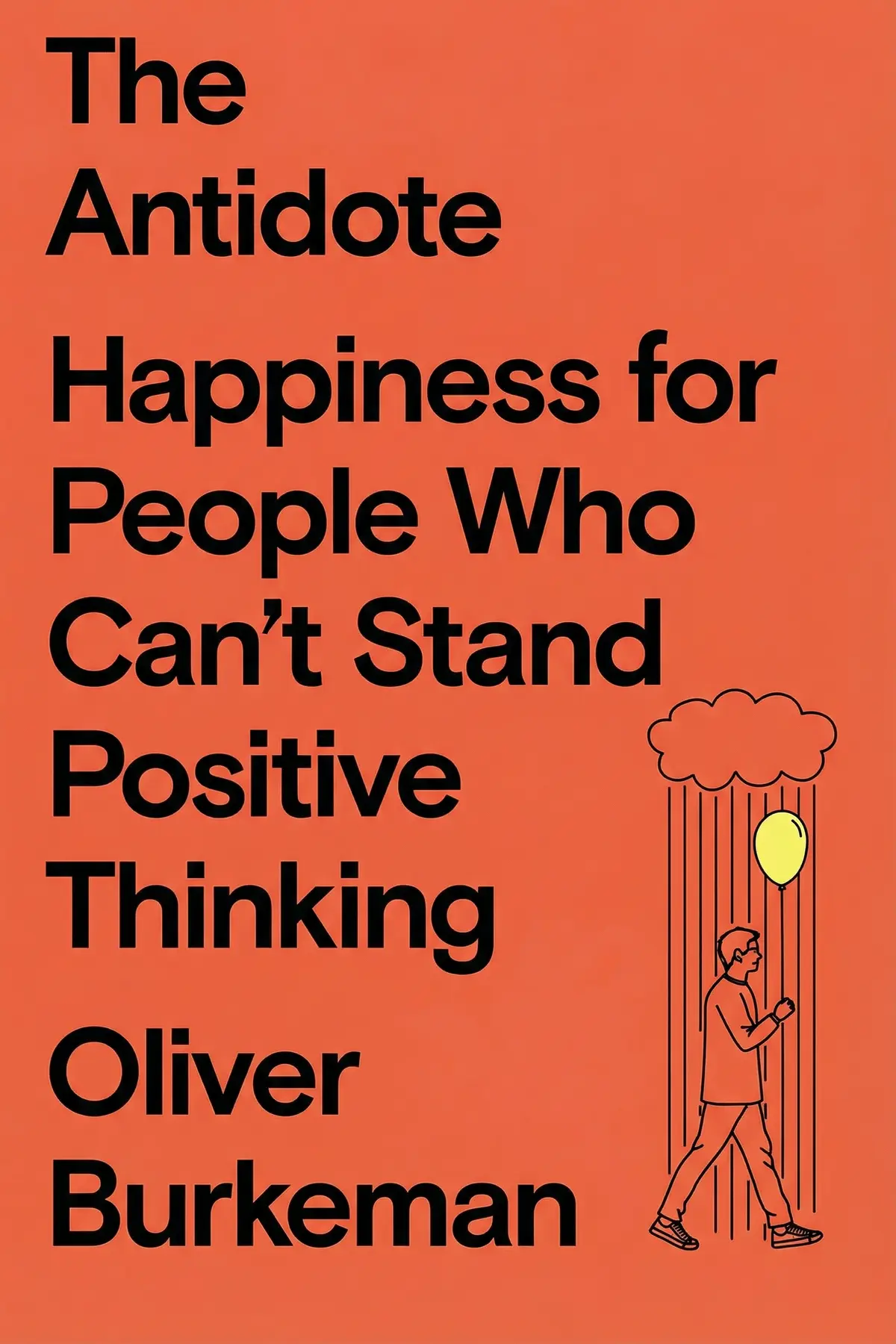
The Antidote offers a refreshing departure from the usual self-help rhetoric. Instead of promising that a bright smile and a positive attitude will fix your life, it suggests that our very obsession with being happy is what makes us miserable. Drawing on insights from ancient Stoicism and Buddhism to modern psychology and cultural traditions, the book explores the 'negative path' to happiness. You will learn why positive affirmations often fail those who need them most, why setting rigid goals can be counterproductive, and how confronting our mortality can actually make life more vibrant. The promise of this book is not a shortcut to a perfect life, but a realistic guide to finding tranquility by accepting life’s inherent messiness, failure, and uncertainty. It is a guide for the skeptics and the realists who find traditional 'glass-half-full' advice shallow and ineffective.
Oliver Burkeman is an accomplished British journalist known for his long-standing weekly column in The Guardian titled This Column Will Change your Life. His insightful writing has earned him the Foreign Press Association’s Young Journalist of the Year award and a shortlisting for the prestigious Orwell Prize. The Antidote is his second book, further establishing his reputation as a thoughtful critic of the self-help movement.
Listeners find this work intellectually stimulating and accessible, featuring captivating prose that offers an intriguing perspective on the concept of happiness. They enjoy its unique approach to positive thinking, as one listener points out how the material assists in coexisting with both pleasant and unpleasant feelings. The book earns praise for its self-improvement content, with one review emphasizing its useful meditation instructions, while listeners also treasure the title's humor and easy-to-follow style.
Picked this up after years of failing at 'manifesting' and feeling like a failure because I couldn't visualize my way into a better life. The story about the cancer patient who felt guilty for her relapse because her 'positive thoughts' weren't strong enough broke my heart and clarified everything for me. Burkeman writes with a dry, British wit that makes heavy topics like death and failure feel approachable rather than depressing. I especially loved the sections on Stoicism and how imagining the worst-case scenario can actually lower your anxiety. This isn't just another self-help book; it’s a necessary correction to a toxic culture of optimism. It provides a toolkit for finding contentment by taking in the totality of life, rather than filtering out the bad parts.
Show moreWow, this was exactly what my cynical heart needed to hear this month. Burkeman explores why our relentless drive for security and 'closure' actually makes us feel more precarious and anxious. One of the most fascinating parts was the 'Museum of Failure,' which reminds us that success is often just the final iteration of many, many mistakes. To be fair, some of the Buddhist concepts were simplified, but for a popular psychology book, it strikes a great balance between research and storytelling. It helped me realize that I don't need to be 'motivated' to get things done; I just need to show up regardless of my mood. It’s liberated me from the pressure of constant cheerfulness and allowed me to embrace the 'strange, excited comfort' of life's mysteries.
Show moreTruth is, I’ve spent way too much money on books that promised to change my life in ten easy steps, and none of them worked. 'The Antidote' doesn't promise a miracle; it suggests that 'not-doing' and sitting with discomfort might be the real key to a better life. I loved the concept of 'openture'—the idea of staying open to the messy, unresolved parts of existence instead of constantly seeking closure. Burkeman’s narration on the audiobook is excellent, making the complex philosophical arguments feel like a conversation at a pub. It’s a refreshing reminder that it’s okay to be human, to fail, and to not have everything figured out. Truly life-changing in a quiet way that respects the reader's intelligence.
Show moreEver wonder why the more you try to be happy, the more miserable you feel? Burkeman dives deep into this paradox, arguing that our cultural obsession with 'positive thinking' is actually the problem. Instead of forcing a smile, he explores the 'negative path'—embracing uncertainty and even failure as legitimate parts of a well-lived life. The chapter on the dangers of goal-setting, using the 1996 Everest disaster as a cautionary tale, was particularly chilling. It’s a refreshing, intellectual take on a genre that is usually filled with fluff. While some of the philosophical bits felt a little rushed, the overall message is incredibly grounding. To be fair, he relies heavily on his background as a Guardian journalist to keep things readable, which makes the complex psychological research far more digestible for a casual reader.
Show moreFinally, someone had the guts to say that 'the secret' to happiness is mostly nonsense. This book argues that true contentment comes from 'negative capability'—the ability to stay in uncertainty without reaching for facts or reason. The truth is, sometimes life is just hard, and trying to 'positive-think' your way out of it only adds a layer of shame to your suffering. I found the section on meditation particularly helpful because it focused on observing thoughts rather than trying to silence them. It’s a bit repetitive in the middle, but the insights into how we handle failure make it worth the price of admission. Highly recommended for the skeptics among us who want a healthier, more realistic way of living without the saccharine sweetness of traditional motivational speakers.
Show moreAfter hearing so much about the 'cult of optimism,' I found this deep dive into the benefits of pessimism surprisingly uplifting. Burkeman suggests that by confronting our mortality and the possibility of failure, we actually strip them of their power over us. The chapter on 'Memento Mori' was a standout, showing how different cultures, like those in Mexico during the Day of the Dead, embrace death as a part of life rather than a taboo. My only gripe is that some of the solutions seem geared toward a very specific, disciplined personality type. As a procrastinator, I found the advice to 'just work regardless of mood' much easier said than done. Nonetheless, it’s an incredibly thought-provoking read that challenges the modern obsession with safety and security.
Show moreThis book is a cogent synthesis of psychology and philosophy that offers a much-needed reality check for the modern world. I loved the reference to 'The Wire' at the start of a chapter—it set the tone perfectly for a book that values realism over hokum. Burkeman explains how our obsession with setting rigid goals can lead to 'goalodicy,' where we pursue a target even when it’s clearly become destructive or deadly. It’s a fascinating look at how Murphy’s Law applies to our mental states: the more we try to control our feelings, the more out of control they become. It’s witty, well-researched, and thankfully devoid of the usual 'rah-rah' energy found in this genre. It's a toolkit for a more genuine existence.
Show moreFrankly, this should be required reading for anyone who feels exhausted by the pressure to 'stay positive' during difficult times. The book explores the 'negative path' to happiness, which involves embracing insecurity rather than trying to outrun it. I was particularly struck by the discussion on how our pursuit of safety often makes us objectively less safe, referencing security expert Bruce Schneier. While the author can be a bit of a curmudgeon at times, his insights into the futility of thought-suppression are backed by solid psychological research. It’s not a perfect guide—the ending feels a bit abrupt—but it’s an engaging and often hilarious look at the 'mystery' of being alive. It definitely changed my perspective on what it means to be successful.
Show moreIt’s a bit ironic to read a self-help book that spends its first fifty pages mocking the entire concept of self-help books. Burkeman is a talented writer, and his journalistic background shines through in his interviews, but the transition from criticizing others to offering his own 'antidote' felt a little bumpy. He relies heavily on Alan Watts and ancient Stoics, which is fine, but if you’ve already read primary sources like Seneca or Marcus Aurelius, you might find this a bit redundant. Look, it’s a great introduction for the uninitiated, but the 'negative path' isn't quite as revolutionary as the marketing suggests. Still, it’s a readable and occasionally funny critique of the optimism industry that might help you stop suppressing negative thoughts, even if it doesn't offer a perfect solution.
Show moreLook, I really wanted to like this, but the author’s tone frequently crossed the line from 'skeptical' to just plain 'obnoxious.' He spends so much time deriding motivational speakers that he forgets to build a cohesive argument of his own. The inconsistency is frustrating: he mocks others for a lack of rigor while building his entire thesis on cherry-picked anecdotes and pop-philosophy. If you want to learn about Stoicism, you are much better off reading primary sources or more focused commentary like 'A Guide to the Good Life.' It felt like a collection of magazine columns stretched out into a book length without enough new material to justify the page count. Personally, I found the constant 'ra-ra-ra' of his anti-optimism just as tiresome as the optimism he hates.
Show more
Andrew D. Thompson
Deepak Chopra
Richard Wiseman
William B. Irvine
AUDIO SUMMARY AVAILABLE
Get the key ideas from The Antidote by Oliver Burkeman, plus 5,000+ more titles in English and Thai.