
21 min 25 sec
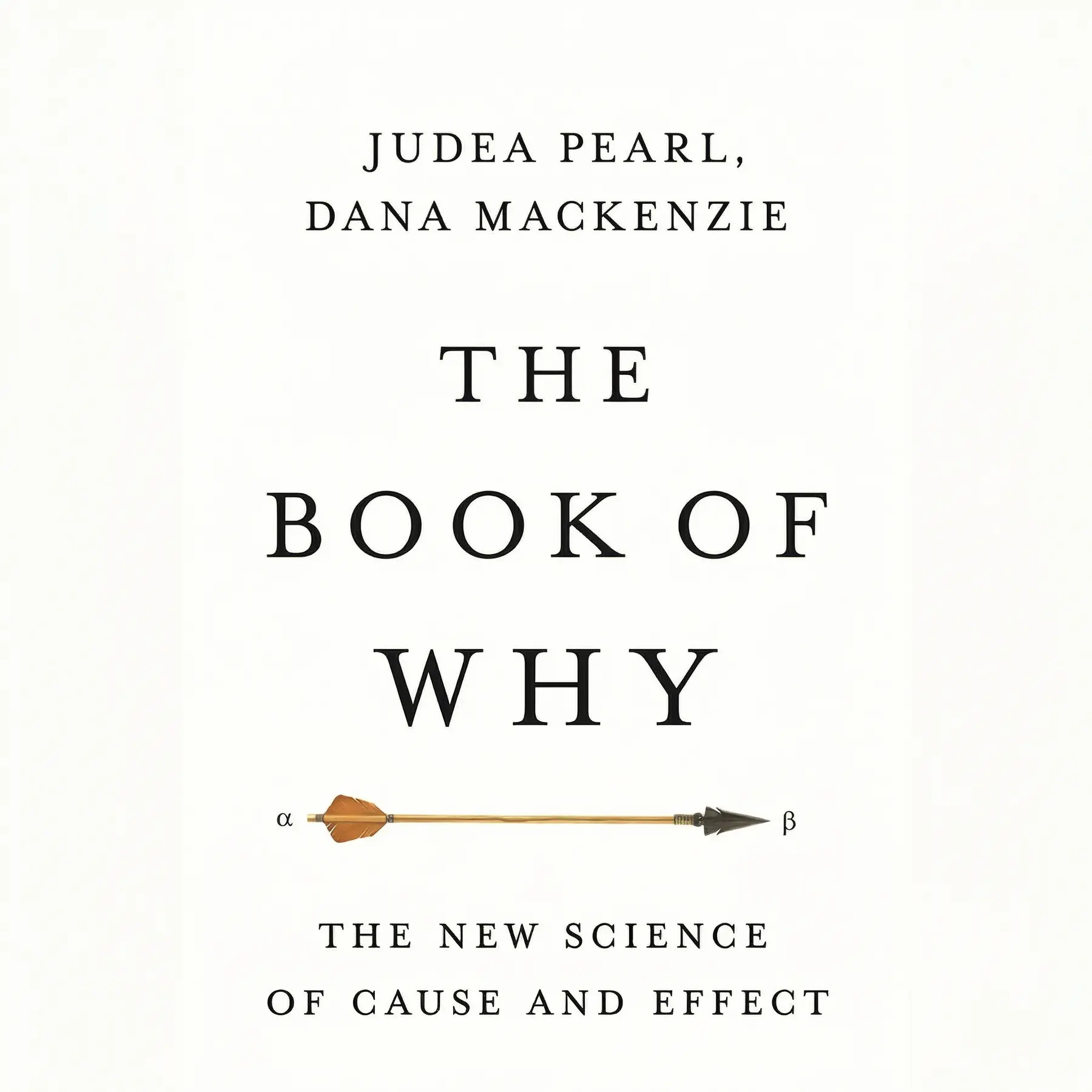
The Book of Why: The New Science of Cause and Effect
Explore the revolutionary shift from simple correlation to a true science of causality. This summary explains how understanding cause and effect transforms everything from medical research to the future of artificial intelligence.
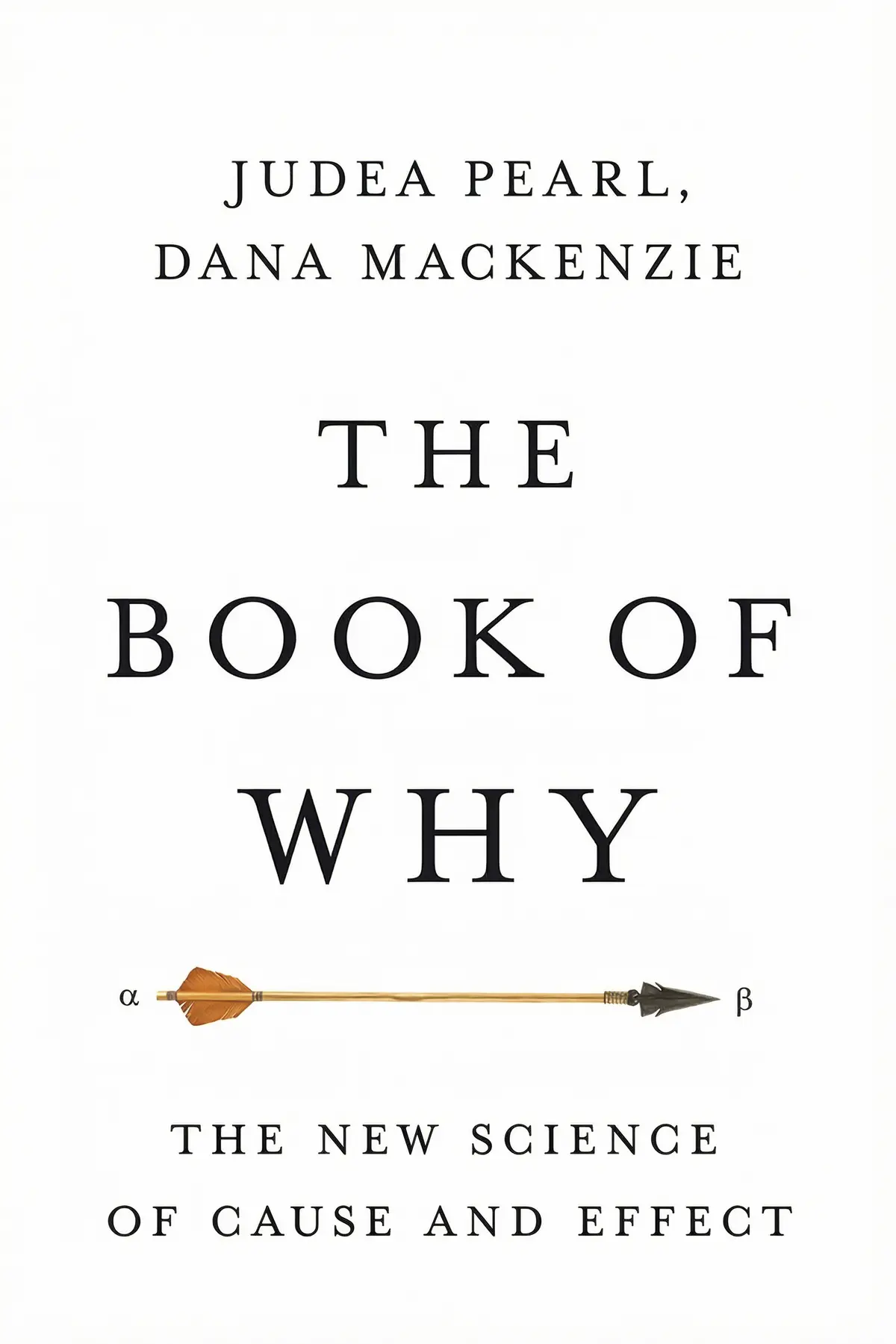
Table of Content
1. Introduction
2 min 15 sec
Have you ever looked at a series of events and felt a desperate need to know exactly how one thing led to another? Perhaps you’ve stood at an airport gate, watching your plane pull away, and wondered: If only I had taken the other route to the terminal, would I have made it? Or maybe you’ve looked at your successes and questioned whether they were the result of a brilliant strategy or just a string of lucky coincidences. These aren’t just idle musings; they are the foundation of how humans perceive the world. We are wired to seek out the ‘why’ behind every ‘what.’
Yet, for much of the last century, the world of formal science and mathematics has tried to steer us away from those questions. You’ve likely heard the classic warning that ‘correlation does not imply causation.’ While this mantra was designed to keep researchers honest, it eventually became a roadblock. It created a world where data was king, but the meaning behind the data was treated as something unscientific and off-limits.
In The Book of Why, authors Judea Pearl and Dana MacKenzie argue that it is time to move past this limitation. They introduce us to the ‘Causal Revolution,’ a shift in thinking that allows us to treat cause and effect with the same mathematical rigor we use for probabilities and percentages. This isn’t just about winning arguments at dinner parties; it’s about a new way of solving problems in medicine, policy, and even artificial intelligence.
Over the course of this summary, we will explore the ‘Ladder of Causation’—a three-step process that explains how we move from mere observation to deep, counterfactual reasoning. We’ll see why even the most advanced computers are currently stuck on the bottom rung and what it would take to teach them to think like us. We’ll also look at historical mysteries, like the fight against scurvy and the debate over smoking and lung cancer, to see how a better understanding of causality could have saved thousands of lives. By the end, you’ll see that data is just a collection of numbers until we apply the human lens of causation to give it life and meaning.
2. The War Against Causality
2 min 58 sec
Discover how early statisticians dismissed the idea of cause and effect as unscientific and how a lone geneticist fought to bring logic back into the numbers.
3. Observation: The First Rung
2 min 18 sec
Explore the lowest level of causal reasoning, where most animals and current AI reside, focusing solely on patterns and probabilities.
4. Intervention: The Second Rung
2 min 25 sec
Learn why true understanding requires action and how ‘doing’ something changes the data in ways that mere observation never can.
5. Counterfactuals: The Third Rung
2 min 15 sec
Step into the highest level of human thought, where we imagine alternate realities and ask ‘what if’ about things that never happened.
6. The Danger of Confounders
2 min 34 sec
See how hidden factors can make a lifesaving vaccine look dangerous and learn the techniques scientists use to uncover the truth.
7. The Role of the Mediator
2 min 30 sec
Understand the ‘how’ behind the ‘why’ by identifying the silent mechanisms that carry a cause to its effect.
8. Mapping the Future of AI
2 min 16 sec
Imagine a world where computers can finally ask ‘why’ and explore how causal diagrams could lead to the next great leap in technology.
9. Conclusion
1 min 54 sec
As we reach the end of our journey through the science of cause and effect, it becomes clear that we are standing at the threshold of a major intellectual shift. For too long, we have allowed the fear of ‘unproven’ causes to keep us trapped in a world of mere observation. We have treated data as a destination when it should have been a starting point.
The Book of Why serves as a manifesto for reclaiming our innate human ability to ask ‘why.’ By understanding the Ladder of Causation, we gain a clear framework for seeing the world. We recognize that while observation is a start, it is through intervention and counterfactual imagination that we truly gain mastery over our environment. We’ve seen how these tools could have prevented tragedies like the mismanaged scurvy outbreaks and how they are currently being used to solve the mysteries of modern medicine.
The key takeaway is that data is never self-explanatory. Numbers can show us that two things are moving together, but only a causal model can tell us if one is pulling the other. Whether you are a scientist, a business leader, or just someone trying to make better decisions in your daily life, the message is the same: don’t just look for patterns. Look for the arrows. Look for the hidden factors that connect the dots.
As we move forward into an era increasingly dominated by big data and artificial intelligence, this shift in perspective is more than just an academic exercise. It is a necessity. If we want machines to be more than just powerful calculators, we must give them the gift of causal reasoning. And for ourselves, we must continue to embrace the curiosity that leads us to ask not just what is happening, but why it is happening. By doing so, we don’t just observe the world—we gain the power to change it for the better.
About this book
What is this book about?
The Book of Why introduces the Causal Revolution, a movement aimed at moving beyond the limitations of traditional statistics. For decades, scientists were taught that correlation does not imply causation, which often hindered their ability to answer the most fundamental questions of "why." Judea Pearl and Dana MacKenzie provide a framework to move past these restrictions using the Ladder of Causation and causal diagrams. This summary promises to clarify the distinction between seeing connections and understanding the mechanisms behind them. By exploring historical examples like the smallpox vaccine and the search for the cause of scurvy, the text reveals why data alone can be misleading. Ultimately, it offers a vision of the future where machines can reason like humans, asking counterfactual questions and potentially solving complex problems in medicine, climate science, and technology.
Book Information
About the Author
Judea Pearl
Judea Pearl is a computer scientist and philosopher. In 2011, he won the Turing Award, the most prestigious prize in computer science. He is the author of Causality, Probabilistic Reasoning in Intelligent Systems and Causal Inference in Statistics. Dana Mackenzie is a writer and mathematician. He is the author of The Universe in Zero Words and The Big Splat, or How Our Moon Came to Be.
Ratings & Reviews
Ratings at a glance
What people think
Listeners find the material captivating and skillfully written, praising its intriguing look into causal logic and its ability to make difficult ideas easy to grasp. Furthermore, the storytelling earns high marks, as one listener points out its compelling timeline of causal inference. Listeners also find the text highly practical, including one who mentions its specific value for software engineers. On the other hand, there are varying perspectives on the difficulty; while some feel it excels at clarifying intricate topics, others perceive the information as rudimentary. Likewise, sentiments regarding its treatment of statisticians are split, as some think the approach is not scientific at all.
Top reviews
Divya
As someone who works in machine learning, this was the missing piece of the puzzle for understanding how AI might actually evolve beyond mere pattern matching. Pearl presents the 'Ladder of Causation' in a way that feels both intuitive and revolutionary, moving from simple observation to intervention and finally counterfactuals. It’s not just a math book; it’s a philosophical shift in how we interpret data. While his critiques of traditional statistics can feel a bit sharp at times, the clarity he brings to the 'why' instead of just the 'how' is invaluable. Software engineers will find the Directed Acyclic Graph (DAG) approach particularly satisfying as it mimics logical flows we already use. The history of how the field ignored causality is genuinely eye-opening.
Show moreMax
Ever wonder why we have so many medical studies that seem to contradict each other every few years? This book provides the answer by exposing the flaws in how we traditionally control for variables. Pearl’s 'Book of Why' is a fascinating journey into the heart of human reasoning. I found the concept of 'mediators' and 'confounders' explained via simple diagrams to be a total game-changer for my own critical thinking. It makes you realize that data is 'dumb' without a model of the world to give it meaning. Personally, I think this should be required reading for anyone in policy-making or social science. It’s dense, yes, but remarkably rewarding if you take your time.
Show moreElise
This book completely changed the way I think about 'big data.' Pearl argues convincingly that more data doesn't help if you don't have a causal model to interpret it, and that's a message the tech industry desperately needs to hear. The 'Ladder of Causation' framework is one of those rare ideas that seems obvious once you hear it, but you realize it was missing from your thinking all along. I loved the blend of philosophy and hard math. It’s a meaty, challenging book that demands your full attention, but the payoff is a much sharper understanding of how the world actually works. It's easily one of the most important science books of the decade.
Show moreChee
Finally got around to reading this, and I was struck by how much of our scientific history was hindered by the 'correlation is not causation' mantra. The chapter on the link between smoking and lung cancer is a masterclass in science writing, showing how researchers were paralyzed because they lacked the mathematical language to prove what they already knew. Pearl and MacKenzie make a compelling case for the 'do-calculus' as a necessary tool for modern research. It’s not a light read by any means, and the notation gets a bit dense in the middle sections. Still, the insight into how we can answer 'what if' questions using observational data alone is worth the struggle.
Show moreNannapat
Picked this up on a whim after a colleague mentioned it, and it really opened my eyes to the limitations of standard regression. The way Pearl explains the 'collider' effect—how conditioning on a common result can create fake correlations—is a lightbulb moment. I’ll never look at a 'study finds' headline the same way again. Look, it’s a bit of a dense slog in the later chapters when they dive into the do-calculus, but the first half is quite accessible to anyone with a basic grasp of logic. The narrative tone is generally engaging, though Pearl's ego occasionally takes up more space than the actual theory. It's a solid four-star read for the intellectual stimulation alone.
Show moreFelix
Truth is, I never thought I’d find a book about statistics so emotional. Pearl's passion for the subject is infectious, even when he's being a bit of a curmudgeon about his peers. The explanation of counterfactuals—the ability to ask 'what would have happened if I had acted differently?'—as the defining feature of human intelligence is just brilliant. It has profound implications for the future of AI. The book is well-written for the most part, though some of the diagrams are a bit cluttered and hard to follow on an e-reader. If you’re interested in the intersection of logic, math, and psychology, you really can't skip this one.
Show moreTakeshi
After hearing Pearl interviewed on a podcast, I expected a very dry academic text, but this was surprisingly conversational. The collaboration with Dana MacKenzie was a smart move because it keeps the history of the 'Causal Revolution' moving at a brisk pace. I particularly enjoyed the breakdown of the Monty Hall Paradox using causal diagrams; it’s the only time that brain-teaser has ever actually made sense to me. My only real gripe is that the book gets a bit repetitive in its criticism of 'model-blind' statistics. We get the point: correlation isn't enough. Still, the do-calculus is a powerful tool and this is a great introduction to it.
Show moreDavid
The core concepts here are undoubtedly brilliant, but the delivery feels like it’s being shouted by a man with a massive chip on his shoulder. Pearl spent decades fighting for causal inference to be taken seriously, and every page of this book reminds you of that struggle through constant jabs at 'old guard' statisticians. It’s a bit exhausting. To be fair, the explanation of Simpson’s Paradox and collider bias—using the dating example—is the clearest I’ve ever encountered. However, the book meanders too much through historical anecdotes when I just wanted more depth on the do-calculus. It sits in a weird middle ground where it’s too complex for a casual reader but too narrative-driven for a scientist.
Show moreOlivia
In my experience, books co-written by famous scientists usually fall into two traps: they are either too simple or far too technical. This one manages to fall into both at different points. The history of causal inference is genuinely interesting, especially the parts about how R.A. Fisher’s influence steered the whole field away from causality for a century. But the transition from historical storytelling to actual methodology is jarring. One minute I'm enjoying a story about Sewall Wright and his guinea pigs, and the next I'm expected to grasp the front-door criterion based on a vague diagram. It’s worth reading for the big ideas, but don’t expect to come away feeling like an expert in the math.
Show moreJin
I really wanted to like this, but the structure is a complete mess that fails to bridge the gap between popular science and technical manual. One moment you’re reading a lighthearted anecdote about a student, and the next you’re drowning in conditional probability expressions with nested sums that aren't explained well. Frankly, the writing feels disjointed, as if the science writer was frequently overruled by the academic’s desire to settle old scores. It’s repetitive, too—Pearl reminds us every ten pages that he revolutionized the field. While the underlying math is likely profound, this is a poor vehicle for it. I’d recommend looking for a distilled summary online instead.
Show moreReaders also enjoyed

Alien Earths: The New Science of Planet Hunting in the Cosmos
Lisa Kaltenegger

A Life Decoded: My Genome: My Life
J. Craig Venter
A Planet of Viruses
Carl Zimmer
A Short History of Nearly Everything
Bill Bryson
AUDIO SUMMARY AVAILABLE
Listen to The Book of Why in 15 minutes
Get the key ideas from The Book of Why by Judea Pearl, plus 5,000+ more titles in English and Thai.
- 5,000+ titles
- Listen as much as you want
- 7-day free trial
- Cancel anytime







