
18 min 14 sec
The Checklist Manifesto: How to Get Things Right
By Atul Gawande
Explore how the humble checklist can solve the problem of modern complexity, helping professionals in medicine, aviation, and finance avoid fatal errors and achieve consistent excellence through discipline and teamwork.
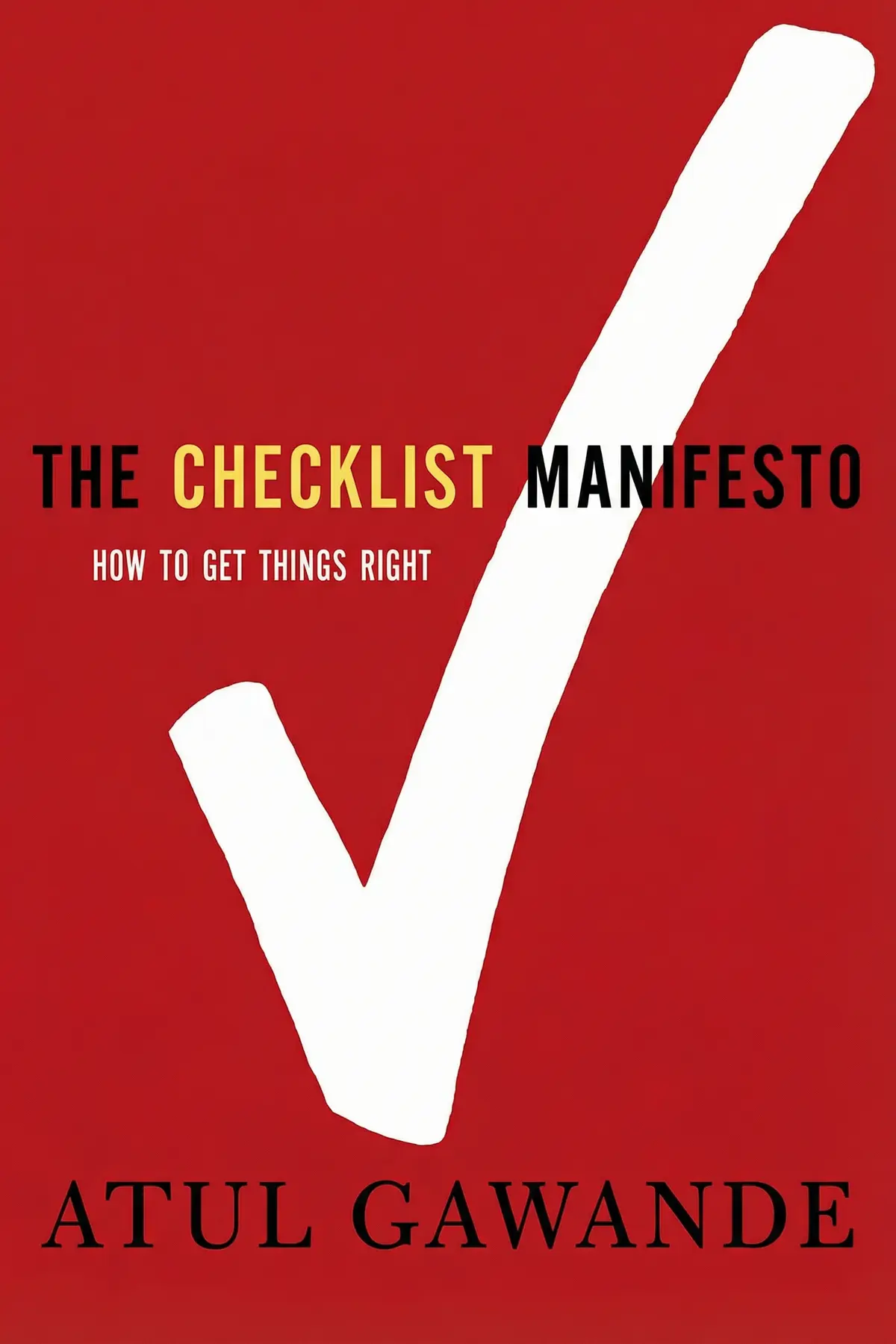
Table of Content
1. Introduction
2 min 06 sec
Imagine for a moment that you are a patient in the middle of the 20th century. If you suffered a heart attack in the 1950s, the medical response was shockingly minimal compared to today’s standards. Back then, a doctor might simply prescribe you some bed rest, give you something for the pain, and perhaps even allow you to continue smoking while you recovered. The truth was that we simply didn’t know much about how the heart functioned or how to stop it from failing.
Fast forward to the present day, and the landscape of human knowledge has transformed beyond recognition. We have decoded thousands of diseases, developed sophisticated drugs to manage cholesterol and blood pressure, and mastered intricate surgeries that were once considered science fiction. But this explosion of understanding has created a new, modern dilemma. Today, the problem isn’t that we don’t know enough; it’s that we know so much that no single person can possibly manage it all.
In this summary of Atul Gawande’s work, we are going to explore the idea that our greatest challenge in the 21st century is ‘ineptitude.’ This isn’t a lack of skill, but rather a failure to consistently apply the massive amount of knowledge we already have. When surgeons, pilots, or engineers are faced with high-pressure, complex environments, the human brain often misses the small, ‘obvious’ details that lead to catastrophe.
We will see how a tool as humble as a checklist can bridge the gap between our expertise and our performance. This isn’t just about making to-do lists; it’s about a fundamental shift in how we approach professional excellence. By the end of this journey, you’ll understand why the most sophisticated systems in the world—from Boeing aircraft to intensive care units—rely on simple pieces of paper to save lives and ensure success. Let’s dive into how structure can liberate us from the chaos of complexity.
2. Preventing Catastrophe Through Simple Verifications
2 min 18 sec
Discover how a terrifying surgical surprise in San Francisco revealed the dangerous gaps in professional memory and why the most basic questions are often the most important.
3. The Architecture of an Effective Checklist
2 min 24 sec
Not all lists are created equal; learn the specific design principles that turn a simple piece of paper into a powerful professional instrument for high-stakes environments.
4. Moving Beyond the Hero Myth to Collaborative Systems
2 min 30 sec
Explore why the image of the solitary expert is no longer sufficient for modern challenges and how construction and aviation prove that teams are our best defense.
5. Communication as a Technical Requirement
2 min 18 sec
Learn why the simple act of introducing yourself to your teammates can significantly lower the risk of failure and how checklists facilitate this vital human connection.
6. Empirical Evidence of the Checklist's Power
2 min 26 sec
Witness the staggering statistics and personal stories that prove how a simple 19-item list can slash mortality rates and save hundreds of millions of dollars.
7. Versatility Across Every Professional Field
2 min 21 sec
From the high-intensity kitchens of top restaurants to the cutthroat world of finance, see how checklists maintain standards and drive efficiency in diverse industries.
8. Conclusion
1 min 51 sec
As we wrap up our exploration of Atul Gawande’s insights, the central message is clear: our world has become so complex that we can no longer rely on memory and individual talent alone. The checklist is not a tool for the beginner; it is a tool for the expert who has the humility to recognize their own fallibility. It is a safeguard against the ‘ineptitude’ that plagues modern professional life—not because we don’t know what to do, but because we occasionally fail to do what we know.
The throughline of this work is the idea that true professionalism requires a combination of high-level skill and rigorous discipline. By adopting checklists, we don’t just prevent errors; we foster a culture of teamwork and open communication. We move away from the dangerous myth of the ‘lone hero’ and toward a more reliable, collaborative way of working.
The takeaway for you is simple but profound: whatever your field, there is likely a ‘dumb’ part of your job that is actually essential for success. Identify those ‘killer items’—the steps that are easy to overlook but disastrous to miss—and put them on a list. Use a ‘huddle’ at the start of your next team project to make sure everyone is activated and ready to speak up. It takes a certain kind of courage to admit that we need a piece of paper to help us do our jobs, but as the data shows, that humility is exactly what leads to excellence. Start your own checklist today, and see how much more effective you can become when you have a safety net beneath you.
About this book
What is this book about?
The Checklist Manifesto explores the staggering complexity of the modern world and why even the most highly trained experts struggle to manage it. As human knowledge has expanded, the volume of information required to perform tasks in fields like surgery or engineering has surpassed the capacity of the individual mind. This book argues that we are no longer failing because of ignorance, but because of ineptitude—the inability to consistently apply the knowledge we already possess. Atul Gawande presents a surprisingly simple solution: the checklist. By breaking down intricate procedures into essential, verifiable steps, checklists act as a cognitive safety net. They ensure that basic but critical tasks aren't skipped in the heat of the moment. Beyond just being a list of tasks, the checklist fosters a culture of communication and teamwork, proving that in a world of high-stakes pressure, humility and structure are more effective than relying on a lone hero.
Book Information
About the Author
Atul Gawande
Atul Gawande is a general surgeon at Brigham and Women’s Hospital in Boston, Massachusetts, and a professor of surgery at Harvard Medical School. As well as writing for The New Yorker, he is also author of Better and Complications, the latter of which was a National Book Award finalist. In 2010, Gawande was named one of the world’s 100 most influential thinkers by TIME magazine.
Ratings & Reviews
Ratings at a glance
What people think
Listeners find this book to be an intriguing and swift experience featuring engaging writing and deep case studies. They admire the way the author expands on the basic idea of checklists and demonstrates their utility in a variety of fields. Listeners commend the book’s hands-on method, with one pointing out its relevance to numerous scenarios and another emphasizing its success in refining workflows. They appreciate the author's narrative style, especially the remarkable medical accounts, and find the content stimulating, with one observer noting how it encourages people to enhance their own systems.
Top reviews
Pong
Rarely does a book about such a mundane tool feel this urgent. Dr. Gawande manages to turn a simple piece of paper into a life-saving instrument through gripping surgical anecdotes and historical parallels. I was particularly struck by the Boeing Model 299 story, which illustrated how even the most expert pilots can be overwhelmed by sudden complexity. It makes you realize that our brains simply aren't wired to handle the sheer volume of data in the modern world without some external guardrail. While the concept seems basic—just write it down—the execution and the cultural shift required to actually use these lists in a hierarchy-heavy environment like a hospital is the real story here. It’s a quick, thought-provoking read that will make you look at your daily routines through a completely different lens.
Show moreHazel
The genius of this book lies in its ability to humble the expert. Gawande distinguishes between 'errors of ignorance' and 'errors of ineptitude,' arguing that in our modern age, we usually have the knowledge but fail to apply it consistently. As a project manager, I found the chapters on the construction of massive skyscrapers incredibly relevant to my own workflow. It’s not about being a 'dumb-down' tool; it’s about freeing up the cognitive load so professionals can focus on the truly complex, unpredictable problems. The writing is crisp and the pacing is excellent, moving quickly between high-stakes surgery and the logistical triumphs of Walmart during Hurricane Katrina. It’s a fascinating look at how small, disciplined changes can prevent catastrophic systemic collapses. Truly essential reading for anyone managing teams in a high-stakes environment.
Show moreMind
Life-changing simplicity. That’s the only way I can describe the impact this book has had on my professional life. Gawande is a master at taking a concept that seems 'obvious' and proving why it is actually revolutionary when applied with discipline. The medical case studies are gripping—some are even heart-wrenching—and they serve as the perfect evidence for his argument. I finished this in two sittings because the prose is just so fluid and engaging. Some might say it’s too basic, but the truth is that most of us are too arrogant to use the simple tools that actually work. If you want to improve your efficiency and reduce unforced errors, stop looking for complex software and just read this. It’s a masterpiece of practical non-fiction.
Show moreGun
Wow. I didn't expect a book about administrative tools to make me feel so much. Dr. Gawande shares some incredibly vulnerable moments from his own career, including mistakes that nearly cost lives. That level of honesty is rare, especially from a high-profile surgeon. It makes his argument for checklists so much more compelling because he’s not just talking down to the reader; he’s in the trenches with us, fighting against his own fallibility. The stories are the real stars here, from the flight deck of a crashing plane to the chaos of a trauma center. It’s a quick, punchy read that challenges the idea that 'expertise' means you don't need a safety net. This should be required reading in every medical school and business program in the country. It is absolutely brilliant.
Show moreRyan
I picked this up on a whim after seeing it on a 'must-read' list for productivity. To be fair, a book about checklists sounds about as exciting as watching paint dry, but Gawande’s storytelling is surprisingly addictive. He takes you inside the operating room and shows you exactly how a tiny oversight—like forgetting to check a patient's blood type—can lead to disaster. It’s a bit scary to think about how much we rely on the fallible memories of doctors and pilots every day. My only gripe is that it feels a little repetitive toward the end, as if he was struggling to hit a certain word count. Still, the message about teamwork and breaking down professional hierarchies stayed with me long after I put it down. It definitely motivated me to tighten up my own processes at the office.
Show moreElan
What surprised me most wasn't the efficacy of the lists themselves, but the social resistance to using them. Gawande explores the 'cowboy culture' of medicine, where surgeons feel that following a list is beneath their expertise. This book is less about the paper and more about the psychology of human error and the ego that prevents us from admitting we need help. The way he describes the 'PAUSE' before surgery, where everyone in the room introduces themselves, is a powerful lesson in team dynamics. It shifts the power balance just enough so a nurse feels comfortable speaking up if they see a mistake. While I wish there were more diverse examples outside of medicine and aviation, the core philosophy is sound and incredibly well-articulated. It’s a quick read that packs a significant punch in terms of perspective.
Show moreAroon
Ever wonder why we can build a skyscraper but still struggle with basic hospital infections? This book answers that question by breaking down the nature of different types of problems: simple, complicated, and complex. Gawande shows that checklists aren't just for simple tasks; they are the communication glue that holds together teams facing complex, unpredictable situations. I loved the section on how investment bankers use 'mental checklists' to avoid emotional bias during trades. It’s a fascinating cross-disciplinary study. The only reason I’m not giving it five stars is that it can feel a bit repetitive, but the quality of the writing and the depth of the research make it more than worth your time. It’s a profound look at how we can better navigate a world that has become too complicated for the human mind.
Show moreSomsak
Does a 200-page book really need to exist to tell me that lists are useful? Frankly, the core message of The Checklist Manifesto could have been a long-form New Yorker essay, and in fact, it started as one. While Gawande is a gifted prose stylist, the repetition becomes a bit exhausting by the middle chapters. We get it: checklists work in aviation, they work in skyscraper construction, and they work in the operating room. That being said, the anecdote about David Lee Roth and the brown M&Ms was a highlight that perfectly illustrated how a 'junk' item can signal systemic failure. If you're looking for a deep technical manual on how to build your own systems, you might be disappointed as this leans more toward the 'why' than the 'how.' It's a solid, interesting read, but perhaps a bit bloated for such a singular premise.
Show moreWitthaya
As someone who lives and breathes by my calendar, I thought this would be my new bible. Instead, it felt more like a very long justification for something I already do. The stories about the 'Miracle on the Hudson' and the construction of massive hospitals are undeniably fascinating, but they don't necessarily provide a 'how-to' for the average person. I appreciate Gawande's mission to make surgery safer—it's noble and clearly necessary—but the translation to everyday life felt a bit thin. I found myself skimming through the later chapters because the point had already been hammered home multiple times. It’s a good book to borrow from the library, but I don’t think it’s one I’ll feel the need to keep on my shelf for reference. Interesting, but definitely not a 'revelation' in the way I expected.
Show moreDimitri
Maybe my expectations were too high given the massive hype surrounding this title. I was hoping for a practical guide with actual templates or a methodology I could implement immediately, but instead, I got a collection of surgical 'war stories.' Gawande is clearly a brilliant surgeon, but at times the narrative felt a bit self-congratulatory, disguised as a humble quest for safety. There isn't a single sample checklist included in the pages, which feels like a major oversight for a book titled a 'manifesto.' It’s a lot of 'this worked here' and 'that worked there' without giving the reader the tools to build their own. If you’ve ever used a grocery list or followed a recipe, you already understand 90% of what this book is trying to sell you. Save your time and just read a summary online.
Show moreReaders also enjoyed
7 Powers: The Foundations of Business Strategy
Hamilton Helmer

A Bigger Prize: How We Can Do Better Than the Competition
Margaret Heffernan
AUDIO SUMMARY AVAILABLE
Listen to The Checklist Manifesto in 15 minutes
Get the key ideas from The Checklist Manifesto by Atul Gawande, plus 5,000+ more titles in English and Thai.
- 5,000+ titles
- Listen as much as you want
- 7-day free trial
- Cancel anytime







