
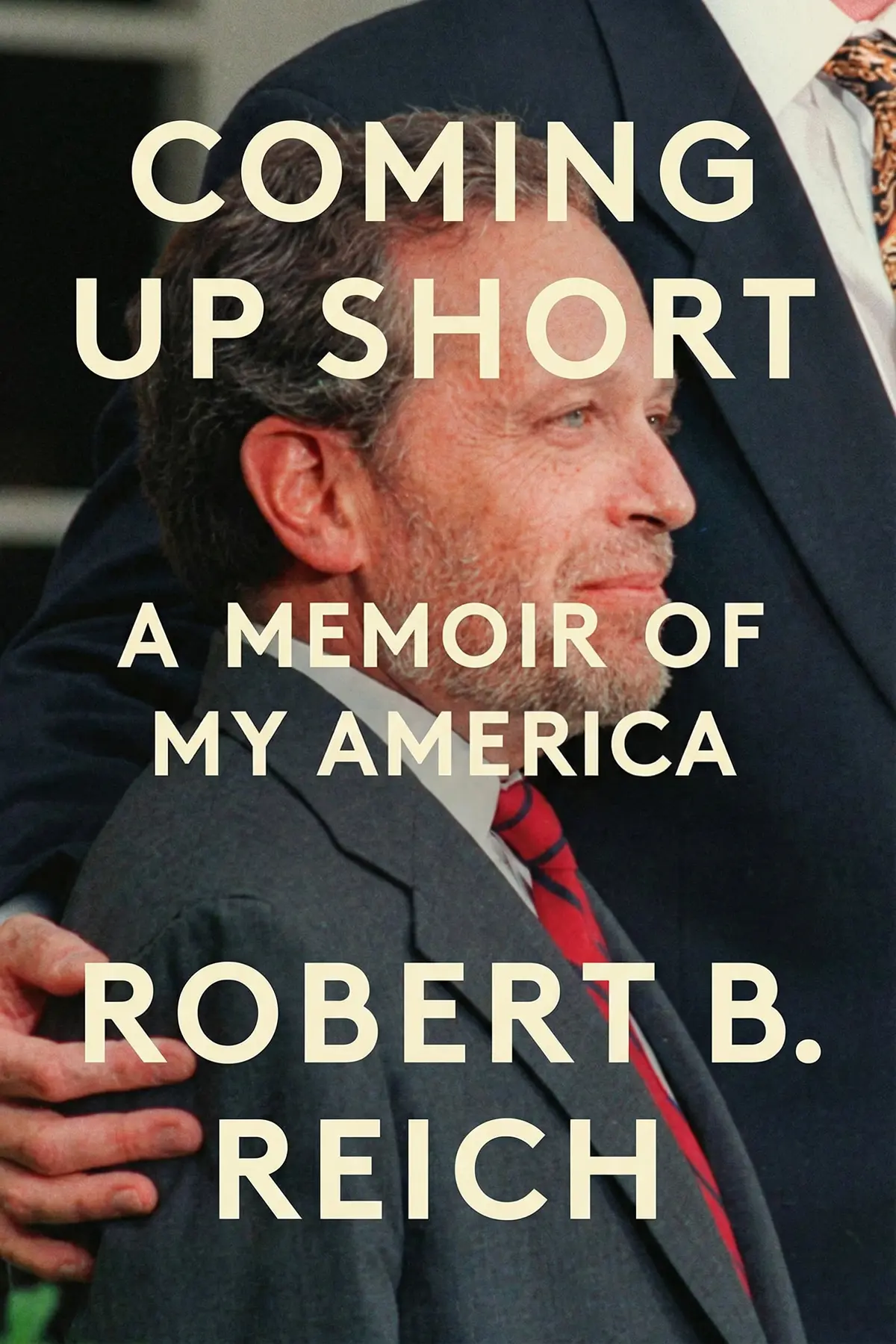
Coming Up Short: A Memoir of My America
Robert B. Reich
Robert B. Reich explores the erosion of civic virtue in America, arguing that reclaiming a shared commitment to the public welfare is essential for restoring trust, equality, and a functioning democracy.
1 min 25 sec
Have you ever stopped to consider what actually keeps a society from falling apart? We often focus on the hard structures—the concrete of our highways, the bricks of our schools, and the digital code that runs our banking systems. But there is another, more fragile infrastructure that is just as vital: the unwritten rules and shared expectations that we have for one another. This is what we call the common good. It is the invisible glue that makes a community more than just a collection of individuals competing for resources.
There’s an old sentiment that we don’t truly appreciate what we have until it begins to slip away. For many, that is exactly what is happening in the United States today. We look around and see a landscape defined by deep division, a staggering gap between the rich and the poor, and a pervasive sense that the system is rigged. The sense of being ‘all in this together’ seems to have been replaced by a much harsher reality: ‘you’re on your own.’
In this exploration of Robert B. Reich’s insights, we are going to trace the history of this shift. We will look at how the ideals of the common good were once the cornerstone of American life and how they were slowly traded for a ‘whatever-it-takes’ approach to business and politics. But more importantly, we will look at what can be done to bring those values back. Reclaiming the common good isn’t just a nostalgic dream; it is a practical necessity if we want a future that is both equitable and stable. Let’s dive into how we can move from a culture of exploitation back to a culture of contribution.
1 min 56 sec
Discover the unwritten moral laws that allow a society to function and why these shared ideals are more important than the laws written in our statute books.
1 min 43 sec
Explore the arguments against the common good, from thinkers who believe that collective welfare is a path to tyranny and that individualism is the only rational path.
1 min 47 sec
See how a single act of exploitation can destroy a system of trust that took generations to build, using a powerful metaphor of an unlocked door.
1 min 53 sec
Follow the shift in corporate culture from community stakeholder to profit-at-any-cost, featuring the story of a $750 pill and the decline of the American worker.
1 min 44 sec
Learn how the ‘win-at-all-costs’ strategy moved from the boardroom to the halls of power, starting with the scandals of the 1970s.
1 min 39 sec
Understand the staggering statistics of inequality and the psychological toll of living in a society where trust in institutions has reached an all-time low.
1 min 39 sec
Explore why we need to change who we celebrate and who we castigate to rebuild a culture that values the public good.
1 min 51 sec
Discover why the defense of factual truth and the rebranding of education as a public investment are the keys to a stable future.
1 min 33 sec
As we look back at the landscape of the modern world, it is clear that we are at a crossroads. The ‘whatever-it-takes’ mentality that has dominated our business and politics for decades has reached its natural conclusion, leaving us with a society that is wealthier at the top but more divided and distrustful at its core. We have seen how the erosion of the common good isn’t just a philosophical problem; it is a practical crisis that affects everything from the price of our medicine to the stability of our democracy.
But the story doesn’t have to end here. The common good is not a relic of the past; it is a living commitment that we can choose to renew every single day. By demanding virtuous leadership, by being willing to shame those who exploit the public trust, and by fiercely defending the truth, we can begin to weave the social fabric back together. We must remember that we are more than just consumers or voters; we are members of a community who are responsible for one another.
The path forward requires us to move beyond the narrow focus of individual gain and recognize that our own well-being is inextricably linked to the well-being of our neighbors. It means seeing education not just as a career move, but as a civic foundation. It means choosing leaders who respect the unwritten rules that keep us safe and fair. Rebuilding the common good is the great task of our time, and it starts with the simple realization that we truly are all in this together. Let’s take that first step toward a more equitable, prosperous, and connected future.
The Common Good examines the invisible threads that hold a society together—the shared values, unwritten rules, and mutual trust that allow a community to thrive. Robert B. Reich argues that over the last several decades, the United States has traded this collective foundation for a culture of extreme individualism and a win-at-all-costs mentality. This shift hasn't just changed politics; it has fundamentally altered the economy, the legal system, and our social fabric. Through an analysis of historical precedents and modern examples, the book reveals how the pursuit of personal profit and power at the expense of others has led to staggering inequality and a total breakdown in public trust. However, the promise of the book is one of restoration. Reich provides a roadmap for how citizens can revitalize the common good by demanding virtuous leadership, prioritizing the truth, and redefining what it means to be a successful society. It is a call to action to move beyond self-interest and rebuild the institutions that serve everyone.
Robert Reich is a distinguished professor of public policy at the University of California, Berkeley. With a career spanning several decades in public service and academia, he notably served as the Secretary of Labor during the presidency of Bill Clinton. Reich is the author of more than twelve influential books on economics and policy, including the acclaimed best seller Saving Capitalism.
Robert B. Reich
Robert B. Reich
Listeners find this work an essential read that is both accessible and engagingly crafted. Furthermore, the book is extensively researched and offers a historical look at increasing disrespect, with one listener observing it serves as an excellent conscience of the country. They also value its core message, with one person noting it inspires civic engagement, and its precision, as one review highlights its thorough documentation of facts and truths.
Robert Reich has managed to articulate exactly what has felt 'off' about our national discourse for decades. By revisiting the moment he heard JFK’s famous 'ask not' speech, he sets a high bar for what it means to be a citizen. The book serves as an essential conscience of the country, reminding us that society is a project we build together rather than a competition for resources. I found his historical perspective on the growth of disrespect in politics deeply enlightening. It is a compellingly written call to action that doesn't just complain about the state of the world but offers a genuine path toward civic engagement. If you are looking for a moral compass in these confusing times, this is a must-read.
Show moreWow. I finished this feeling more hopeful than I have in years. Reich is clear-eyed about the 'rigged' nature of our current economy, but he refuses to give in to despair. He argues that even the most divisive figures in our current landscape are just symptoms of a deeper loss of common purpose. The way he ties together the history of the 1971 Powell Memo and the 2009 bailouts is masterfully done. It’s a quick read, but it packs a heavy emotional punch. He ends with a beautiful quote by Reinhold Niebuhr about being saved by hope, which really resonated with me. This is the kind of book you want to buy ten copies of and leave in little free libraries all over town.
Show moreFinally got around to reading this, and it’s easily the most relevant book for our current moment. Reich is a master at taking dense economic concepts—like the shift from stakeholder to shareholder capitalism—and making them feel personal. He explains how we’ve moved from a society of 'we're all in this together' to a 'whatever it takes to win' culture. The book is heavily researched yet incredibly easy to read in a few sittings. It provides a much-needed historical perspective on why we’ve become so polarized. Most importantly, it reminds us that the common good isn't some abstract idea; it's the air we breathe and the water we drink. It's a fundamental truth that we ignore at our own peril.
Show morePicked this up after seeing several of the author’s videos, and the book definitely captures his signature style—it almost feels like reading the detailed notes for a world-class TED talk. Reich breaks down the 'whatever it takes to win' mentality that has infected both our political and corporate spheres. While he is tough on figures like Shkreli and various Wall Street CEOs, he is surprisingly even-handed when discussing how both parties have eroded public trust. The prose is easy to understand and flows quickly, though a few sections felt slightly repetitive as he hammered home the three main structural breakdowns. Still, the core message about restoring leadership as a form of trusteeship is incredibly timely and necessary for our survival as a democracy.
Show moreEver wonder why our institutions feel like they are crumbling? This book provides a heavily researched look at the facts and truths behind our current social fragmentation. Reich’s analysis of the late 1970s shift—moving from mutual duty toward the Ayn Rand-style glorification of selfishness—is brilliant. I was particularly intrigued by his discussion on using 'Honor and Shame' as tools for social cohesion; it’s a concept you don’t hear much about in political science these days. The book is short and punchy, making it accessible for people who don't usually read political economy. My only gripe is that it skips over some of the nuances of the Vietnam era’s impact on trust, which I feel was the true tipping point for our current cynicism.
Show moreAs a student of public policy, I found this to be an exceptionally thorough documentation of how we lost our way. Reich doesn't just blame one side; he takes a hard look at the Democratic party’s own role in weakening the separation of powers. The chapter on exploitation is especially harrowing, detailing fifty major civic violations that have eroded our confidence in the system. He presents these facts and truths with a level of clarity that is rare in modern political writing. Truth is the bedrock of his argument, and his plea for renewed civic education in schools is something I hope every legislator reads. It's a bit repetitive in its key points, but the core message is too important to ignore.
Show moreThe chapter on leadership as trusteeship should be mandatory reading for every CEO and politician in the country. Reich does a fantastic job of illustrating how our norms—the unwritten rules of behavior—are actually more important than our laws. When those norms are violated by people in power, the whole structure starts to fail. I appreciated the specific examples, from Jack Welch’s tenure at GE to the Robert Bork hearings. It’s a very timely essay that looks at Adam Smith’s original designs through a modern lens. While I found his solutions for protecting the free press a bit idealistic, the overall message about restoring our shared values is incredibly compelling. It definitely inspired me to get more involved in my local community.
Show moreFrankly, our society has forgotten what it means to be bound together by something other than a transaction. Reich’s book is a powerful reminder that if there is no common good, there is effectively no society at all. He tracks the erosion of trust from the 1960s to the present with the precision of a surgeon. I liked that he narrated the audiobook himself, as you can hear the genuine passion and concern in his voice. The book is a bit of a rant at times, but it’s a justified one. He successfully argues that we can't just blame one person for our problems—we have to look at the structural decay of our shared ideals. It's an insightful, quick read that actually points a way forward.
Show moreWhile the premise of restoring the common weal is vital, I think Reich falls headfirst into a bit of a nostalgia trap here. He suggests that America was a unified paradise of civic virtue until about fifty years ago, which overlooks many of the systemic exclusions of that era. To be fair, he makes excellent points about how the shift toward shareholder value over all else has gutted the middle class. However, the book sometimes descends into a stream-of-consciousness rant about everything he finds wrong with modern life. The diagnosis is spot on, but the prescriptions for how we actually fix the system felt a bit amorphous and thin. It’s a good starting point for a conversation, but I wanted more concrete policy and less idealistic longing for the past.
Show moreTo be fair, Reich is an excellent writer, but this book felt like it needed one more solid revision to truly hit the mark. He provides a long list of corporate crimes and political scandals, ranging from the Gulf of Tonkin to Wells Fargo, but it starts to feel like a scattergun approach after a while. I felt he downplayed the specific trauma of Vietnam and the systematic disinformation from the LBJ era, which did more to destroy the 'common good' than almost anything else. Instead, we get a lot of focus on Watergate, which feels like petty theft in comparison to the millions of lives lost in Southeast Asia. It’s an interesting review of citizenship, but it occasionally misses the forest for the trees by focusing on too many disparate villains.
Show more
Miles Taylor
Tracy Rosenthal
Jessica Valenti

Yanis Varoufakis
Yuval Noah Harari
AUDIO SUMMARY AVAILABLE
Get the key ideas from The Common Good by Robert B. Reich, plus 5,000+ more titles in English and Thai.







