
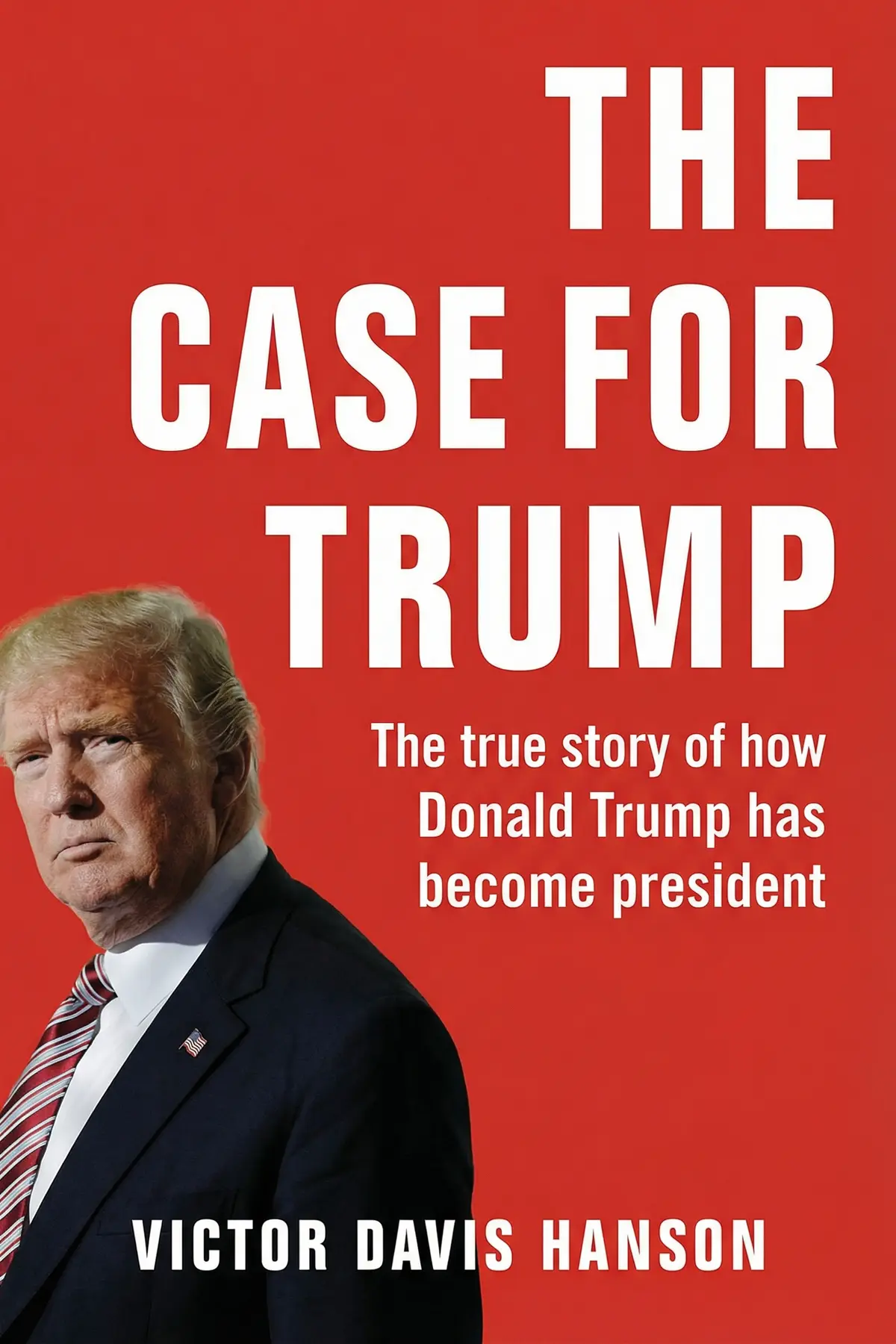
The Case for Trump
Victor Davis Hanson
The Dying Citizen explores the erosion of American democratic foundations. Victor Davis Hanson examines how globalization, unchecked bureaucracy, and identity politics are transforming active citizens into passive residents, threatening the nation's future stability.
1 min 45 sec
In the modern political landscape, we often hear the word “citizen” used interchangeably with “resident,” “person,” or even “global inhabitant.” But for most of Western history, being a citizen was a rare and precious status, carrying with it specific duties, rights, and a unique sense of belonging to a sovereign community. Today, that status is under a sustained and multi-pronged assault. In the following pages, we will explore the core thesis of Victor Davis Hanson’s analysis: the idea that the American citizen is becoming an endangered species.
At the heart of this discussion is the realization that a functioning democracy is not a default setting for humanity. It requires a specific set of conditions to survive. It needs a stable middle class, a shared cultural identity, a transparent government accountable to the voters, and a commitment to the rule of law over the whims of the powerful. However, as we look around today, we see these pillars being chipped away. From the hollowing out of the economy through globalization to the rise of identity politics that prioritizes the tribe over the individual, the very fabric of American life is being rewoven into something far less democratic.
This journey will take us through the history of ancient Greece, the halls of the modern administrative state, and the gated communities of the global elite. We will examine why the middle class is the essential backbone of any free society and what happens when that backbone is broken. We’ll also look at the dangers of tribalism and how it replaces the concept of individual merit with group grievance. Finally, we will consider the impact of globalization—the idea that our primary loyalty should be to the world at large rather than our own neighbors. By the end, you’ll have a clearer understanding of why the survival of the republic depends on the revival of the citizen.
3 min 00 sec
Explore why the disappearance of a robust middle class is more than just an economic trend—it is a direct threat to the stability of a democratic republic.
2 min 48 sec
Discover how the move away from cultural assimilation and a common language is breaking the ties that bind a diverse nation together.
2 min 40 sec
Uncover how the real power in Washington has shifted from elected representatives to a massive, unelected bureaucracy that is often unaccountable to the public.
2 min 46 sec
Analyze why the resurgence of identity politics is a backward step toward a more divided and dangerous way of organizing society.
2 min 43 sec
Examine why the very rules of the American game are being questioned and how the push for ‘equity’ is threatening individual liberty.
2 min 56 sec
Understand the tension between national sovereignty and globalization, and why the dream of being a ‘citizen of the world’ is often a nightmare for the local worker.
1 min 39 sec
The death of the citizen is not an inevitable outcome of history, but it is the current trajectory of American society. We have seen how the economic foundations of the middle class are being eroded, how our shared national identity is being replaced by tribalism, and how our democratic processes are being usurped by an unelected administrative state and global elites. Each of these trends alone would be a serious challenge; together, they represent an existential threat to the American experiment.
However, the throughline of Victor Davis Hanson’s work is that the status of the citizen is something that can be reclaimed. It starts with a return to the fundamentals: valuing the independent landowner and the small business owner, insisting on a common language and an orderly immigration system, and demanding accountability from our government officials. It requires us to reject the easy path of tribalism and return to the more difficult, but more rewarding, path of judging people as individuals. Most importantly, it requires a renewed appreciation for the US Constitution—not as a living document to be manipulated, but as a firm anchor for our liberties.
Being a citizen is a heavy responsibility. It requires vigilance, sacrifice, and a commitment to something larger than oneself. It means being more than just a consumer or a resident; it means being an active participant in the preservation of freedom. If we want the republic to survive for another two centuries, we must decide that the title of “citizen” is still worth fighting for. The choice is ours: we can continue to slide toward a world of subjects and peasants, or we can stand up and revive the great, noble idea of the American citizen.
The Dying Citizen offers a profound look at the decline of the traditional American citizen. Victor Davis Hanson argues that the unique status of the citizen—once defined by economic independence, shared culture, and legal equality—is being dismantled by a combination of elite-driven globalization and internal tribalism. The book investigates the shift from a middle-class-led democracy to a society divided between a wealthy technocratic elite and a growing class of dependent residents. Hanson provides a historical and contemporary analysis of the forces at play, including the rise of an unelected 'deep state' and the abandonment of the melting pot ideal in favor of racial and ethnic silos. By connecting ancient Greek political philosophy with modern American crises, the book promises to reveal why the survival of the republic depends on reclaiming the virtues of citizenship. It serves as both a warning and a call to action for those concerned about the preservation of the U.S. Constitution and the middle-class values that have historically sustained Western freedom.
Victor Davis Hanson is the Martin and Illie Anderson Senior Fellow at Stanford University. He is also a professor emeritus of classics at California State University, Fresno. Hanson has authored over 20 books, including The Case for Trump.
Victor Davis Hanson
Listeners consider this book a vital resource that provides distinctive viewpoints on a variety of subjects. The work is exceptionally well-crafted and thoroughly investigated, with one listener pointing out that it contains over 50 pages of documentation notes. They value the thoroughness of the analysis and rank it among the most essential volumes of the current era. Listeners commend the author's prose and describe it as stimulating, with one review emphasizing Hanson's illuminating point of view.
Victor Davis Hanson provides a staggering amount of evidence to support his thesis that the American citizen is becoming an endangered species. He masterfully connects the dots between the agrarian middle class of Ancient Greece and the modern-day hollowed-out heartland of the United States. The research here is beyond reproach, with over 50 pages of documentation that prove he isn't just speaking from a place of partisan emotion but from a deep understanding of historical cycles. Frankly, the way he breaks down the shift from 'citizens' to 'residents' or 'subjects' is some of the most sobering commentary I have read in years. It’s a dense, intellectually demanding book that refuses to pull punches about the state of our institutions. If you want to understand why our current political climate feels so fractured, this is the definitive roadmap.
Show moreFinally got around to finishing this, and the chapter on 'Peasants' alone is worth the price of admission. Hanson writes with the authority of a classicist but the urgency of a man watching his house burn down. He highlights how California has become a sort of 'medieval' society, with a tiny elite at the top and a massive, struggling underclass, while the middle class simply flees. It is a terrifying but necessary look at how progressive policies and globalism have eroded the very foundations of self-governance. I especially appreciated his take on the 'Davos Man'—those transnational elites who feel more at home in a Swiss boardroom than in their own communities. The book is meticulously researched and offers a perspective on tribalism that you just won't find in mainstream media. Truly an essential read for anyone worried about the future of the Republic.
Show moreEver wonder why the middle class feels like it's disappearing? Hanson answers that question with the precision of a surgeon. He argues that without a stable, property-owning middle class, democracy simply cannot survive. The book is a 'drinking from a fire hose' experience because the information comes at you so fast, but it’s all grounded in historical fact. I found his analysis of the administrative state—the unelected 'Deep State'—to be particularly enlightening. He shows how these bureaucracies have taken power away from the voters and given it to 'experts' who are never held accountable. While some might find his tone a bit dry at times, the sheer weight of the 400+ pages of analysis makes it impossible to ignore. This isn't just another political rant; it's a scholarly defense of the American experiment.
Show moreThe chapter on the 'Evolutionaries' really hit home for me. Hanson details how modern elites are trying to dismantle the Constitution through the back door, attacking the Electoral College and the First Amendment under the guise of progress. It's a wake-up call. I love how he uses his background as a military historian to show how civilizations fail when they lose their shared identity. He isn't just complaining; he's warning us that we are repeating the mistakes of Rome. The documentation in the back of the book is incredible—over 50 pages of notes! It shows that he actually did the work instead of just throwing out talking points. It's a dense read, and you might need to take it in small chunks, but it's easily one of the most important books of the decade.
Show morePicked this up because of the buzz surrounding Hanson’s take on the 'dying' middle class. I wasn't disappointed. The way he traces the concept of the citizen from the Greek city-states to the American founding is masterclass level. He highlights how we are currently being squeezed between a transnational elite that doesn't care about borders and an impoverished underclass that is being encouraged to remain dependent on the state. It's a provocative argument, but he backs it up with cold, hard data. Some might find his defense of the Trump presidency polarizing, but he makes a compelling case that the reaction from the permanent bureaucracy was a threat to the Constitution itself. This is a thought-provoking, meticulously researched book that challenges the current 'progressive' narrative at every turn. It's refreshing to read something this intellectually rigorous.
Show moreAs someone who values the idea of the 'citizen' over the 'subject,' I found this book to be an absolute tour de force. Hanson is one of the few intellectuals left who isn't afraid to call out the 'woke' insanity of our current institutions. He demonstrates how identity politics is effectively 'Balkanizing' the country, turning neighbors against each other based on immutable characteristics. The book is incredibly comprehensive, covering everything from illegal immigration to the loss of our common history. I was particularly struck by his discussion on how we are losing our 'freedom of speech' to a new kind of soft totalitarianism. It's a dark book, but it ends with a glimmer of hope that the American citizen can still be revived. With over 50 pages of documentation, it’s a heavy-duty piece of scholarship that belongs on every patriot's bookshelf.
Show moreWhile I don't agree with every political conclusion Hanson reaches, his analysis of tribalism is spot on. He explains how we’ve moved away from the 'color-blind' ideal of MLK toward a neo-Marxist view where everyone is defined by their racial or ethnic group. It's a recipe for social disaster, and he provides the historical context to prove it. The writing can be a bit repetitive, and he definitely has a 'protectionist' bent that I wasn't always on board with, but the core message is vital. We are losing the shared values that make us Americans. The book is a bit of a marathon to get through—the audiobook is over 15 hours—but it’s worth the effort for the insights into how the 'administrative state' has usurped the role of the citizen. Solid 4 stars for the depth of research alone.
Show moreThis isn't exactly a light beach read, but it’s a rewarding one. Hanson explores how globalism has effectively turned American citizens into 'subjects' of a global elite. I found his focus on California particularly interesting—it serves as a grim preview of what happens when you prioritize ideology over the needs of the actual people living there. The book is very well-written, though it definitely skews toward a right-wing audience. I appreciated the way he treated the 2020 protests and the COVID-19 response as symptoms of a larger decline in the rule of law. My only real complaint is that it can feel a bit like a litany of grievances at times. However, the historical framing makes it much more substantial than your average political bestseller. If you value the idea of national sovereignty, you need to read this.
Show moreTo be fair, Hanson’s historical parallels are brilliant, but the book often feels like it's trapped in a conservative echo chamber. I picked this up hoping for a non-partisan deep dive into the philosophy of citizenship. Instead, I got a lot of complaints about the Left and a defense of Trump that felt a bit one-sided. He spends a lot of time criticizing 'Trump Derangement Syndrome' without really acknowledging the behaviors that caused the reaction in the first place. That said, his points about the loss of the middle class and the dangers of globalism are very well-made. He’s clearly an intelligent man, and the first half of the book regarding Ancient Greece is fascinating. I just wish the second half didn't feel so much like a Fox News monologue. It’s a 3-star read for me—valuable for the history, but too partisan for a general recommendation.
Show moreLook, I appreciate a good history lesson as much as the next person, but this felt less like an objective analysis and more like a 400-page grievance session. I’ve read Hanson’s work on the Peloponnesian War and loved it, so I expected more of that scholarly detachment. Instead, this felt like he was just 'bitching' at me about the Left for 15 chapters. He claims that the Right is being victimized by the 'Deep State' and the media, but he completely ignores the divisiveness coming from the other side. The stuff about the ancient Greeks is great, but then he tries to twist those historical facts to fit a very specific, modern political agenda. It felt like propaganda wrapped in a history degree. If you're looking for a balanced view on the challenges facing America, this isn't it. It's a cry-fest for the Right.
Show more
Miles Taylor
Tracy Rosenthal
Jessica Valenti

Yanis Varoufakis
Yuval Noah Harari
Jacinda Ardern
AUDIO SUMMARY AVAILABLE
Get the key ideas from The Dying Citizen by Victor Davis Hanson, plus 5,000+ more titles in English and Thai.







