

Adults in The Room: My Battle With Europe’s Deep Establishment
Yanis Varoufakis
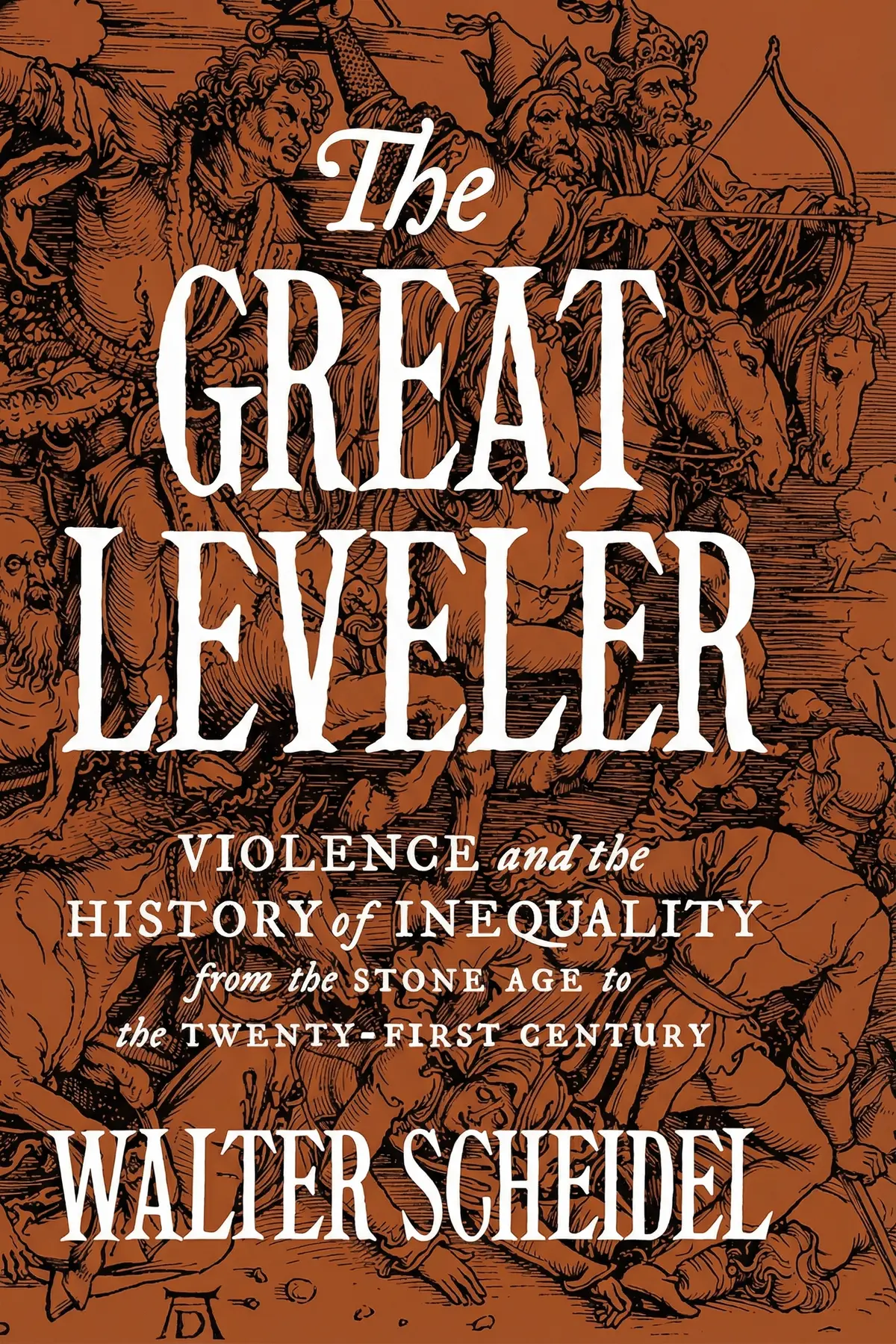
A provocative exploration of economic history, revealing how massive inequality is rarely solved by peaceful means, but rather by the violent shocks of war, revolution, state collapse, and plague.
1 min 35 sec
In our modern era, we often hold onto a comforting narrative. We tell ourselves that as societies become more democratic, as markets expand, and as technology advances, the gap between the wealthy and the impoverished will naturally narrow. We view inequality as a temporary glitch in an otherwise upward trajectory toward fairness. However, when we look back across the vast sweep of human history, a much darker and more persistent pattern emerges. It turns out that stability is not the friend of equality; it is actually the incubator of concentration.
This summary takes us on a journey through the deep history of our species to understand a disturbing truth: the most significant instances of wealth redistribution have rarely happened through polite debate or legislative reform. Instead, they have been driven by what can be described as the four horsemen of leveling. These are the massive, often terrifying shocks that upend the social order: war, revolution, state failure, and disease.
We will explore how the shift from wandering to farming first set the stage for hierarchy and how ancient civilizations struggled with the same issues of debt and land ownership that we face today. We will see how the fall of empires and the arrival of the plague inadvertently gave the poor more leverage. Finally, we will examine why our modern tools—like democracy and left-wing politics—have struggled to repeat these leveling effects without the accompanying violence. By the end of this exploration, you will have a new perspective on the forces that shape our economic world and a better understanding of the daunting challenge that lies ahead for those seeking a more equitable future.
2 min 17 sec
Discover how the end of the Ice Age and the birth of agriculture forever altered the human social landscape, transforming an egalitarian species into a hierarchical one.
1 min 58 sec
Explore the shift from communal land use to private ownership and the mechanisms of debt that allowed ancient elites to consolidate wealth at the expense of the poor.
2 min 04 sec
Learn why the collapse of the Roman Empire and the devastation of the Black Death actually resulted in a more equal distribution of wealth for the survivors.
2 min 03 sec
Examine how the total mobilization of the 20th century, particularly in Japan, forced states to dismantle the wealth of the elite to fund national survival.
2 min 19 sec
Trace the impact of violent social upheavals and state failures, showing how they forcibly reset the economic clock in Russia and Somalia.
2 min 09 sec
Analyze why modern democratic systems and left-wing policies have largely failed to curb rising inequality in the absence of major shocks.
1 min 54 sec
The historical evidence is as clear as it is uncomfortable: for thousands of years, the gap between the rich and the poor has only been closed by the most catastrophic events imaginable. From the collapse of the Roman Empire to the fires of the World Wars and the terror of the Russian Revolution, true economic leveling has been a byproduct of suffering. In the absence of these ‘Four Horsemen,’ the natural tendency of human society is toward the concentration of wealth. This is because stability allows the powerful to entrench their positions, use their capital to gain more capital, and influence the very laws that are supposed to govern them.
Today, we find ourselves in a unique position. We live in a world that is, by historical standards, remarkably peaceful and stable. Yet, this very stability has allowed inequality to reach levels not seen since the Gilded Age. The challenge we face is whether we can break the cycle of history. Can we find a way to achieve the leveling effects of war or plague without the accompanying death and destruction? Economists like Anthony Atkinson have proposed radical reforms—universal basic income, aggressive capital gains taxes, and strengthened labor protections—but these remain largely untested on a global scale.
The throughline of our history suggests that the fight for equality is not a gentle slope upward, but a constant struggle against a heavy tide. While we shouldn’t wait for a disaster to save us, we must realize that small, incremental changes may not be enough to counteract the massive structural forces that drive wealth to the top. The most important action you can take is to stay engaged and support local efforts that secure basic rights—education, healthcare, and fair pay—within your own community. By building these foundations of fairness from the bottom up, we may yet find a peaceful way to level the playing field for the next generation.
For much of human history, the gap between the rich and the poor has tended to widen during periods of peace and stability. This book challenges the optimistic view that democracy or market reforms are sufficient to bridge this divide. Instead, it posits that throughout the millennia, true economic leveling has almost exclusively been the result of four catastrophic forces: mass-mobilization warfare, transformative revolutions, the collapse of entire states, and devastating pandemics. By examining thousands of years of data, from the end of the Ice Age to the modern era, the narrative uncovers a sobering pattern. While we often view stability as a universal good, history suggests that prolonged stability creates an environment where wealth naturally concentrates at the top. The promise of this analysis is not a call for violence, but a necessary reality check. It forces us to confront the limitations of our current political and economic systems in the face of growing global disparity and asks what a peaceful solution might look like in a world where the historical drivers of equality have been so destructive.
Walter Scheidel is a distinguished academic who brings a unique interdisciplinary perspective to history. He combines training in ancient history with work in human biology, which informs his data-driven approach to human development. Currently, he serves as a professor of humanities at Stanford University. Scheidel is a prolific author whose previous works include the highly regarded study, Death on the Nile: Disease and Demography of Roman Egypt.
Listeners find the material thoroughly researched and intriguing, with one listener pointing out the depth of historical information. Furthermore, they value its take on political economy and believe it is a worthwhile read. However, opinions on the prose and accessibility are split; some find the text easy to follow, whereas others struggle with the writing. Additionally, listeners are divided over the amount of detail, with one listener describing the specifics as excruciating.
Scheidel has produced a monumental work that demands attention from anyone interested in the mechanics of human civilization. This isn't just another political rant; it's an exhaustive, evidence-based journey from the hunter-gatherer era to the present. The author meticulously demonstrates that inequality is the default state of stable societies once agriculture and property rights take root. I found the chapters on the 'Great Compression' during the 20th century particularly enlightening for understanding our current world. Personally, I think the level of detail is exactly what is needed to prove such a provocative thesis. While the conclusion—that only catastrophe brings equality—is terrifying, the logic behind it appears nearly bulletproof. This book changed how I view the relationship between peace and economic disparity. It is easily one of the most significant works of economic history I have encountered in years.
Show moreFinally got around to reading this, and it’s basically the ultimate reality check for modern political optimism. Scheidel’s core argument is that we’ve been living in a rare, anomalous period of relative equality that is now ending. The 'Four Horsemen' concept is a great way to frame how history actually works. I loved the casual translation of some of the more academic points: basically, if you have a sword, you become king and take the money. It’s a thick, heavy book, but the insights into the origins of property and power are fascinating. Even if you don't agree with his dismal outlook, you have to respect the scholarship. It makes you realize that most of our 'solutions' for inequality are just nibbling at the edges. This is a must-read for anyone who wants to stop being naive about how wealth is distributed. Be prepared for a long haul, but it's worth every minute.
Show moreThe central premise here is as fascinating as it is deeply unsettling. Walter Scheidel argues that throughout the vast expanse of human history, only massive shocks have truly leveled the playing field of wealth. He identifies these as mass mobilization warfare, transformative revolutions, state failure, and lethal pandemics. To be fair, the research is impeccable. He draws on data from ancient Rome to the modern day. You won’t find any easy policy fixes here. This makes the reading experience feel quite grim. Some sections get bogged down in technical jargon and Gini coefficient charts that might test your patience. However, if you can push through the density, the rewards are immense for understanding our current economic predicament. It’s a sobering reminder that our relatively peaceful era might actually be the primary driver of the inequality we complain about.
Show moreAfter seeing so much buzz about Piketty's Capital, I found this to be the necessary historical counter-balance. Scheidel goes much further back, proving that the concentration of wealth isn't just a quirk of modern capitalism. It is, instead, a fundamental feature of human social organization itself. The way he breaks down the 'Four Horsemen'—war, revolution, collapse, and plague—is both brilliant and horrifying. I did find the writing style a bit academic at times, which makes it a slow burn. Still, the insights into how the ancient Greeks managed inequality versus the Roman experience were worth the effort. It’s a dense read, but the historical breadth is simply staggering. This book provides a cold, hard look at reality that most politicians would probably prefer to ignore. It is a necessary, if uncomfortable, addition to any bookshelf on political economy.
Show moreWhat makes this study stand out is the sheer weight of the evidence provided for the 'Four Horsemen' of leveling. Walter Scheidel doesn't just make assertions; he backs every claim with mountains of archaeological and historical data. I was particularly gripped by the sections on how state collapse in the Roman Empire led to a temporary equalization. It turns out that when the government disappears, the rich have a lot more to lose than the poor. The book is certainly challenging and requires a significant time investment to process properly. Some might find the detail excruciating, yet I found it reinforced the author’s credibility. It’s a refreshing departure from the usual partisan bickering over taxes and spending. This is a scholarly work that forces you to confront the darker patterns of human development. Highly recommended for history buffs who don't mind a little gloom.
Show moreEver wonder why the gap between the rich and poor seems like an unbreakable law of nature? This book provides a chilling answer by looking at the last ten thousand years of human experience. Scheidel shows that as soon as we stopped being hunter-gatherers, we started accumulating wealth in the hands of a few. I was amazed to learn that 21st-century wealth distribution isn't that different from ancient Egypt. Frankly, the author’s ability to synthesize so much information into one coherent (if depressing) thesis is remarkable. Some of the technical appendices are a bit over my head, but the main text is accessible enough. My only real gripe is that it feels a bit one-note after a while. Every chapter essentially tells you that things are bad and only get better when everything falls apart. It’s a heavy read, both physically and emotionally, but deeply informative.
Show morePicked this up on a recommendation and found it to be a masterclass in historical analysis. The focus on the 'Great Compression' of the mid-20th century was especially relevant for our current times. Scheidel argues convincingly that the equality of that era was a byproduct of the World Wars, not just good policy. This perspective is a bit of a cold shower for those of us hoping for a peaceful fix to inequality. The book is dense and occasionally repetitive, which might turn off some casual readers. However, the rigor with which he examines the Gini coefficients of pre-modern societies is truly impressive. It’s a sobering, thick volume that refuses to offer the reader any false hope or easy exits. If you want the truth about why the rich stay rich, this is where you’ll find it. Just don’t expect to feel good when you finish the last page.
Show moreIs it possible for a book to be both incredibly important and a total slog to read? Scheidel's thesis is powerful, but the prose is so dry it often feels like reading a textbook on desert irrigation. I appreciated the deep dive into how the Black Death and World War II were the only real mechanisms for wealth redistribution. However, the sheer volume of statistics and graphs became mind-numbing after the first few hundred pages. Truth is, I had to take several breaks just to maintain focus on the core arguments. It’s a natural follow-up to Piketty, though it takes a much more pessimistic view of our ability to change things through simple legislation. If you have the stamina for academic writing, there is a lot of value here. Just make sure you are prepared for a very long, very data-heavy journey through the darker side of history.
Show moreLook, the data is undeniably impressive, yet the presentation feels designed to bury the reader under a mountain of Gini coefficients. I struggle to decide if I’m better off for having read it or just more depressed. The idea that only mass-mobilization warfare truly narrows the wealth gap is a tough pill to swallow. Scheidel’s analysis of Japan after World War II was a standout moment for me, though. It showed how total state control and destruction actually worked to reset the economic clock. To be fair, the book is quite repetitive as it moves through different historical eras with the same conclusion. You get the point pretty early on, and then it’s just hundreds of pages of reinforcement. It’s a solid 3-star read because while the information is vital, the delivery is fairly dry. It definitely isn't a page-turner for your summer vacation.
Show moreI really wanted to like this, but I left the experience feeling utterly hopeless and drained. Scheidel basically argues that we are stuck with extreme inequality unless millions of people die in a war or a plague. While the historical research is clearly extensive, the lack of any practical solutions makes the whole exercise feel a bit futile. Not gonna lie, reading page after page of Gini coefficients for ancient Egypt or the Han Dynasty got tedious very quickly. The author seems to take a perverse pride in dismissing every modern policy tool as useless. It’s more of a data dump than a cohesive narrative, and the tone is incredibly bleak. I understand that history doesn't owe us a happy ending, but the 'all-out nuclear war' suggestion in the final chapter was a bit much. If you want to feel miserable about the future of humanity, this is the book for you.
Show moreYanis Varoufakis

Ben Macintyre


James Shapiro
Pankaj Mishra
Charles C. Mann

Ben Macintyre

Fay Bound Alberti
AUDIO SUMMARY AVAILABLE
Get the key ideas from The Great Leveler by Walter Scheidel, plus 5,000+ more titles in English and Thai.







