
25 min 12 sec
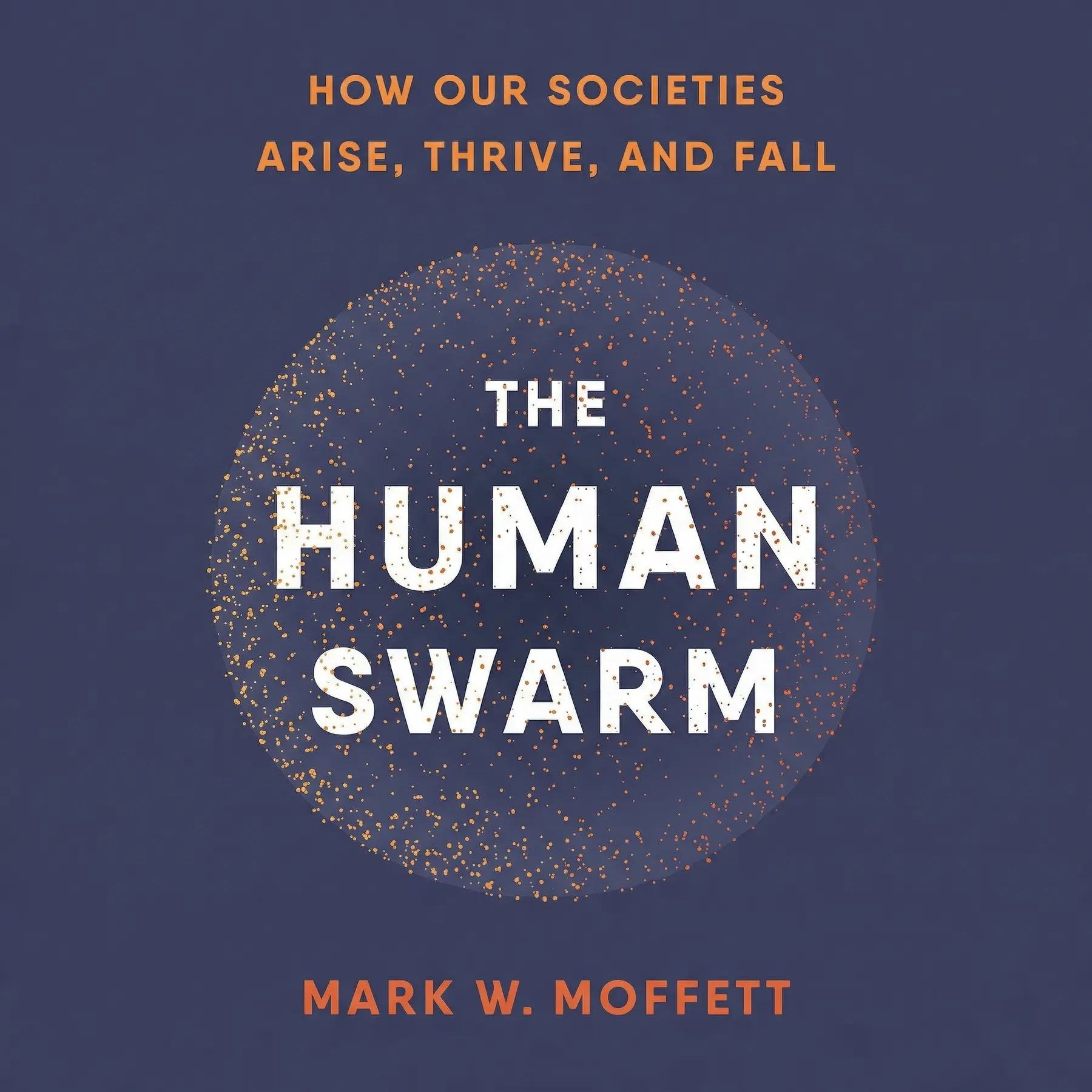
The Human Swarm: How Our Societies Arise, Thrive, and Fall
Explore the fascinating biology of human societies. This summary reveals how anonymous cooperation, identity markers, and our evolutionary history allow us to live in massive groups similar to ant colonies rather than ape tribes.
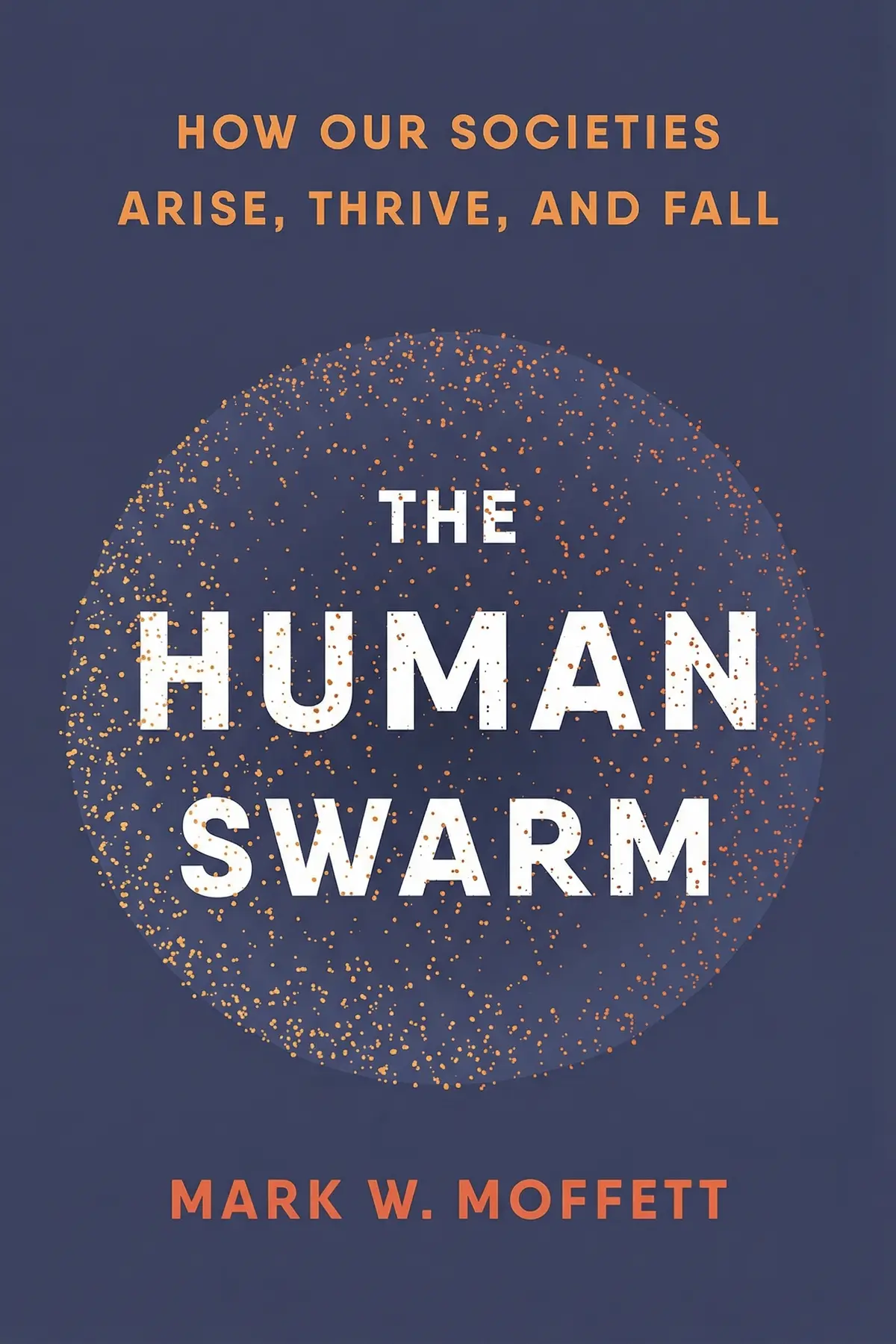
Table of Content
1. Introduction
2 min 03 sec
Have you ever paused to consider the sheer improbability of a morning commute? You might board a train or walk down a city street surrounded by hundreds, even thousands, of people you have never met before. You don’t know their names, their histories, or their intentions. Yet, for the most part, you feel safe. You trust that they will follow the unspoken rules of the road and the social contracts of your community. This ability to exist in a sea of strangers is one of the most defining and unusual characteristics of the human species.
We often take our societies for granted, viewing them as simple geographical or political realities. But societies are much more than lines on a map; they are powerful psychological entities that shape our identity, our loyalty, and our survival. We feel a surge of pride when we see a specific flag or hear a particular anthem, even though the vast majority of the people represented by those symbols are complete strangers to us. Outside of our immediate families, these large-scale societies are the primary groups to which we pledge our ultimate allegiance. People have fought and died for the sake of these anonymous collectives, showing a level of devotion that is rare in the natural world.
In the following narrative, we are going to explore the mechanics of how these societies actually function. We will look at why humans are biologically distinct from our closest relatives, like chimpanzees, when it comes to group size. We will discover that our social structures actually have more in common with the miniature worlds of ants than they do with other primates. By understanding the role of social markers, the hardwired nature of our tribal instincts, and the way we assimilate outsiders, we can gain a deeper perspective on how our civilizations arise, why they thrive, and why, eventually, they might change or fall apart. This is a journey into the heart of the human swarm, investigating the invisible threads that bind us together and the markers that set us apart.
2. The Limits of Individual Recognition
2 min 31 sec
Most animals can only form societies as large as their memory allows, but humans found a way to break through this biological ceiling.
3. The Ant Parallel and Social Sophistication
2 min 34 sec
While we share genes with chimps, our complex social infrastructure and labor systems are much closer to the world of ants.
4. The Power of Identity Markers
2 min 50 sec
How do ants and humans know who belongs to the group? The secret lies in a system of biological and cultural markers.
5. Hardwired Tribalism and Early Development
2 min 30 sec
Our tendency to favor our own group and categorize others isn’t just learned behavior—it begins in the earliest stages of life.
6. The Legacy of the Hunter-Gatherer Band
2 min 23 sec
Ancient societies were smaller, but they still possessed the same sense of identity and belonging that defines modern nations.
7. The Mirage of Superiority and the Danger of the Other
2 min 40 sec
Every society thrives on a collective belief in its own excellence, a trait that fosters both unity and devastating conflict.
8. The Human Achievement of Assimilation
2 min 54 sec
Unlike our primate cousins, humans have mastered the art of bringing outsiders into the fold, provided certain social costs are paid.
9. The Lifecycle of the Swarm and the Need for Contrast
2 min 49 sec
Societies are not eternal; they follow a predictable cycle of rise and fall, driven by the very tribalism that created them.
10. Conclusion
1 min 58 sec
In the end, we find that the human experience is inextricably linked to the societies we inhabit. We are not just solitary individuals or members of small families; we are participants in a massive, anonymous swarm that functions with the complexity of an ant colony and the emotional intensity of a primate troop. Our ability to scale our cooperation to the level of millions is a biological marvel, made possible by our ingenious use of social markers and our capacity to accept strangers into our fold.
But this gift comes with a responsibility. The same instincts that allow us to build cathedrals, launch rockets, and create complex economies also give rise to the biases and dehumanization that lead to our greatest tragedies. We are hardwired to favor ‘us’ and fear ‘them,’ a trait that served our ancestors well but requires constant conscious management in the modern world. Recognizing that our sense of superiority is often a ‘mirage’—a necessary psychological tool for group cohesion—can help us navigate the tensions of a globalized society with more empathy and less hostility.
As you walk through your own world today, take a moment to look at the ‘strangers’ around you. Notice the subtle markers—the clothing, the language, the shared gestures—that tell you you’re in your home territory. And remember that while the specific societies we belong to today may eventually change or give way to something new, our fundamental need for that sense of belonging is a permanent part of the human condition. We are, and will always be, a species defined by the groups we form and the invisible lines we draw between ourselves and the rest of the world. By understanding the nature of our swarm, we can better appreciate the fragile, beautiful, and complex structures that allow us to thrive together.
About this book
What is this book about?
Humanity has achieved something unique in the animal kingdom: the ability to live peacefully among millions of strangers. While most mammals are limited to small groups where everyone knows each other, humans have developed a system of anonymous cooperation that allows for the creation of vast, complex nations. This book investigates the biological and psychological foundations of this phenomenon, drawing striking parallels between human civilizations and the sophisticated societies of ants. Through a blend of entomology, anthropology, and psychology, the narrative explains how we use subtle markers—like language, dress, and gestures—to identify who belongs to our group and who doesn't. You will learn why these tribal instincts are hardwired into our brains from infancy and how they both enable our greatest social achievements and fuel our most persistent conflicts. Ultimately, the book promises to change how you view your place in the global hive, exploring the rise, maintenance, and inevitable shifting of the societies we call home.
Book Information
About the Author
Mark W. Moffett
Mark W. Moffett is a distinguished scientist and explorer, frequently described as the Indiana Jones of entomology. He holds the position of research associate in the Entomology Department at the Smithsonian Institute’s National Museum of Natural History. Moffett has a profound passion for insects, animal behavior, and human sociology, which he has shared with broad audiences through appearances on major programs like The Colbert Report and Late Night with Conan O’Brien.
Ratings & Reviews
Ratings at a glance
What people think
Listeners find the work beautifully composed and consider it an exceptional read. They also value the author’s observations, as one listener mentions how it provides a valuable perspective on modern society. Furthermore, the book earns praise for its wit, with one listener characterizing it as an exciting romp through psychology.
Top reviews
Aey
Wow, what a brilliant exploration of the biological ties that bind us. Moffett provides a masterful look at how identity markers—from tattoos to national flags—allow humans to function in massive, anonymous groups. I was particularly struck by the quote: 'Chimpanzees need to know everybody. Ants need to know nobody. Humans only need to know somebody.' It perfectly encapsulates the hybrid nature of our social structures. Frankly, this book changed how I view everyday interactions in a crowded city. It’s an exhilarating journey through social dynamics that manages to be both realistic about our tribalistic flaws and hopeful about our capacity for reason. The prose is exceptionally crafted, peppered with a wit that keeps the dense scientific data from feeling overwhelming. Highly recommended for anyone trying to make sense of our polarized modern world. It is a truly valuable addition to the macro-history genre.
Show moreNoi
Finally got around to finishing this, and I have to say it’s a much more complex work than the title suggests. Moffett doesn't shy away from the "inner demons" of our psychology. He tackles difficult topics like slavery, racism, and xenophobia through a biological lens, which might be uncomfortable for some readers. But the truth is, understanding the evolutionary roots of these behaviors is the only way we can hope to use reason to overcome them. I appreciated his honesty. He acknowledges that we aren't just "cooperative" by nature; conflict is baked into how societies define themselves against outsiders. The prose is dense, requiring your full attention, but the payoff is a much deeper understanding of the "human swarm." It’s an analytical journey that refuses to sugarcoat the messy reality of being a social animal in a world of anonymous strangers.
Show moreYam
Picked this up on a whim and was pleasantly surprised by how much wit Moffett managed to inject into a book about social evolution. It’s an exhilarating journey through social dynamics that manages to make the study of "anonymous strangers" feel like a detective novel. I loved the parts about how societies "fragment along geographical fault lines" and how we use everything from accents to haircuts to signal who we are. Personally, I found the comparison between humans and the Argentine ant to be the most compelling part of the whole narrative. It’s not just a dry academic text; it’s a vibrant, well-written exploration of what it means to be part of a swarm. If you want a book that challenges your assumptions about identity while keeping you entertained, this is the one. A brilliant read from start to finish.
Show moreNiphon
After hearing several comparisons to Harari, I decided to dive into Mark Moffett’s work. This isn't just another dry history book; it's a deep biological investigation into why we congregate the way we do. Moffett uses his expertise in entomology to draw fascinating parallels between ant colonies and our modern "swarms." Some sections on markers and identity were genuinely eye-opening, especially the discussion on how flags and anthems trigger our limbic systems. To be fair, the prose is a bit dense in the middle, and I found the pacing a bit sluggish during the hunter-gatherer chapters. However, the insights into "anonymous societies" are worth the effort. It’s a refreshing take that moves beyond simple sociology. If you enjoy big-picture science that doesn't shy away from the darker aspects of human nature, you'll appreciate this. It offers a unique vantage point on the structures we take for granted.
Show moreMan
As someone who has always been fascinated by social insects, I found this take on human history fascinating. Mark Moffett brings his deep knowledge of ants to the table to explain how humans managed to scale up from small tribes to massive civilizations. The concept of the "anonymous society" is the backbone of the book, and it’s argued quite convincingly. I loved the details about how Argentine ants use chemical scents the same way we might use a flag or a specific accent. My only gripe is that it can be a bit of a slog; some chapters on primate behavior felt a bit repetitive if you’ve already read a lot in this genre. Still, the unique perspective of an "ant-man" turned historian is refreshing. It’s a solid addition to any bookshelf dedicated to evolution and the peculiar ways we identify with strangers.
Show moreTak
The chapter on the author’s time in the field really set the tone for me. Moffett writes with the soul of a naturalist, and you can tell he’s spent a lot of time "waiting out tropical downpours under a tarp." This slower, more observant pace carries over into his analysis of human societies. He looks at us the way a biologist looks at a rare species, noting our "markers" and our "territorial boundaries" with a detached but keen eye. Gotta say, the section on how children learn to respect flags by age six was particularly illuminating. It’s a book that asks you to slow down and consider the "empty intervals" of history. While it’s a thick read with a lot of data to digest, the quality of the insights makes it a worthwhile investment for any serious student of human behavior and biology.
Show moreNoah
Not what I expected from the flashy title. While the premise of comparing humans to ants is intriguing, I felt Moffett struggled to bridge the gap between hard biology and complex social science. At times, it felt like an amateur playing at being a sociologist without the proper grounding in the humanities. Truth is, the book is quite a trudge to get through. The sentences are long and often repetitive, hammering home the same point about ingroups and outgroups until you want to skip ahead. I did enjoy the specific anecdotes about the Yellowstone wolves and the Argentine ants, but these gems were buried under layers of academic jargon. It offers a unique lens, but it lacks the narrative drive of a book like Guns, Germs, and Steel. It's okay, just be prepared for a slow burn and some very belabored concepts regarding tribalism.
Show moreHazel
Ever wonder why we can walk through a crowd of thousands without feeling threatened? Moffett attempts to answer this by looking at the "markers" that define our societies. It’s a beautifully written book, but it doesn't quite reach the heights of Sapiens for me. While the parallels between human and animal societies are interesting, they sometimes feel like a collection of trivia rather than a cohesive new theory. In my experience, the chapters on hunter-gatherer societies were the strongest, providing a much-needed deep dive into the 97% of human history we usually ignore. However, the later sections on modern nationalism felt a bit rushed. It’s a decent read for the facts alone, but don’t expect a world-altering shift in your perspective. It’s more of a side-by-side comparison than a groundbreaking synthesis of biology and culture.
Show moreJames
This book feels incredibly cynical and backward-looking. I went in hoping for a roadmap for our globalized future, but instead, I got a 300-page lecture on why humans are naturally xenophobic. Moffett seems convinced that we are perpetually stuck in a cycle of "us vs. them" with no real hope for change. He dismisses major progress made in the last two centuries as mere blips rather than fundamental shifts in cooperation. Look, the science regarding ant colonies is interesting, but applying it so rigidly to human politics feels reductive and paranoid. It’s a narrative that reinforces the idea of permanent division and irreconcilable differences. If you’re a policy maker or someone looking for a positive outlook on human potential, you should probably skip this one. It's a collection of facts with a very depressing, limited conclusion about our future.
Show moreMax
Honestly, I found this to be a bit of a disappointment given the glowing blurbs on the back. The author is clearly a brilliant biologist, but his transitions into sociology felt clunky and lacked rigorous scientific proof. Much of the book felt like a series of reinforced, tedious concepts about how humans are inherently tribal and aggressive. Yes, we know that history is full of conflict! I was looking for a new perspective on how we might overcome these divisions in the digital age, but Moffett seems more interested in looking backward at ants and chimps. The book is also surprisingly hard to read; the sentence structures are often convoluted, making it difficult to maintain interest for more than a few pages at a time. It’s a strange book that misses the mark on providing actionable insights for today’s world.
Show moreReaders also enjoyed

A Life Decoded: My Genome: My Life
J. Craig Venter
A Planet of Viruses
Carl Zimmer

A Short History of Nearly Everything
Bill Bryson

A Thousand Brains: A New Theory of Intelligence
Jeff Hawkins

AUDIO SUMMARY AVAILABLE
Listen to The Human Swarm in 15 minutes
Get the key ideas from The Human Swarm by Mark W. Moffett, plus 5,000+ more titles in English and Thai.
- 5,000+ titles
- Listen as much as you want
- 7-day free trial
- Cancel anytime







