
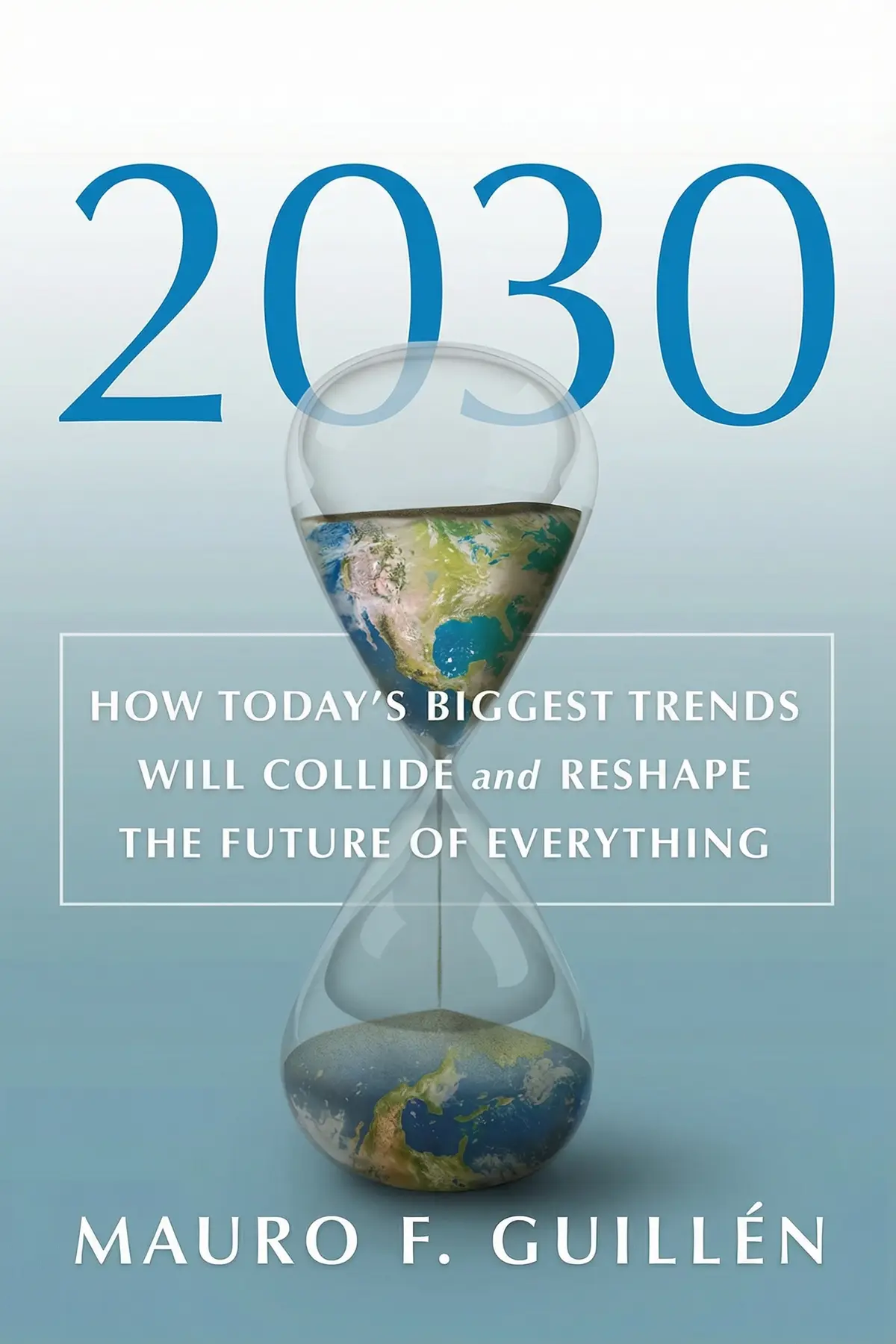
24 min 17 sec
The Model Thinker: What You Need to Know to Make Data Work for You
The Model Thinker explores how using a diverse toolkit of mathematical and social models leads to better decision-making, more accurate predictions, and a deeper understanding of our complex, interconnected world.
Table of Content
1. Introduction
2 min 23 sec
In our modern age, we are constantly told that data is the new oil. We are surrounded by more information than any generation in human history, yet we often find ourselves more confused than ever. Why is it that despite all our spreadsheets, sensors, and statistics, we still fail to predict market crashes, social upheavals, or the long-term impact of new technologies? The answer, according to Scott E. Page in his book, The Model Thinker, is that data without a framework is just noise. To truly understand the world, we don’t just need more information; we need better ways to organize it.
This is where the concept of ‘modeling’ comes in. Most of us use models every day without realizing it. When you assume that a high price implies high quality, or that a busy restaurant must serve good food, you are using a mental model. However, these informal models are often flawed or too simplistic for the challenges we face. Page argues that the most successful people—the true ‘thinkers’ of our time—rely on a structured ensemble of formal models. These are mathematical and logical representations of how the world works, covering everything from economics to biology to sociology.
But here is the catch: no single model is ever perfect. Every model is a simplification, which means every model is inherently ‘wrong’ in some way. The secret to wisdom, then, isn’t finding the one ‘true’ model; it’s using many of them. By looking at a problem through several different lenses at once, the strengths of one model can compensate for the weaknesses of another. This ‘many-models’ approach allows us to navigate the vast complexity of our lives with a level of nuance that a single perspective simply cannot provide.
Over the course of this summary, we will explore how this approach works in practice. We’ll look at why diversity of thought is a mathematical necessity, how different types of distributions shape our reality, and how we can use specific logical structures to make better predictions and strategic choices. By the end, you’ll see that becoming a model thinker isn’t about being a math genius; it’s about building a versatile toolkit for your mind, allowing you to see the hidden patterns that govern our complex world.
2. The Power of the Many-Models Mindset
2 min 43 sec
Discover why relying on a single expert or a lone framework is a recipe for error and how combining diverse perspectives creates a more accurate picture.
3. The Mathematical Necessity of Diversity
2 min 33 sec
Explore the logic behind the idea that a diverse group of thinkers will consistently outperform a single high-performing expert in solving complex puzzles.
4. Understanding the Shape of Our World
2 min 36 sec
Learn to distinguish between the predictable ‘Normal’ distribution and the volatile ‘Power Law’ distribution to avoid being blindsided by extreme events.
5. The Hidden Logic of Social Behavior
2 min 31 sec
Dive into how individual incentives often lead to collective disasters and why understanding game theory is vital for solving societal dilemmas.
6. Path Dependence and the Weight of History
2 min 23 sec
See how small, early choices can lock us into long-term trajectories and why the past is often the best predictor of the future.
7. The Architecture of Connection
2 min 29 sec
Uncover how the structure of a network—rather than just the individuals within it—determines how information, wealth, and viruses spread.
8. Models as Tools for Strategy and Design
2 min 23 sec
Learn how models serve as more than just predictive tools; they are essential for designing better policies and navigating competitive landscapes.
9. From Data to Wisdom: The Hierarchy of Knowledge
2 min 14 sec
Discover the final goal of model thinking: moving beyond mere information to achieve the deep, actionable wisdom needed for a complex life.
10. Conclusion
2 min 02 sec
In The Model Thinker, Scott E. Page has provided us with more than just a list of mathematical tools; he has given us a new way to interact with reality. We have seen that the traditional approach of relying on a single expert or a lone ‘gut feeling’ is insufficient for the challenges of the twenty-first century. Our world is defined by complexity, and complexity requires a diverse ensemble of models.
As you move forward, the most important takeaway is to start building your own ‘mental gallery’ of models. Don’t just settle for what you already know. If you are an artist, learn a little bit about game theory. If you are an engineer, explore the models of social contagion. The goal isn’t to become a world-class expert in every field, but to understand the fundamental logic that these different disciplines use to explain the world. This ‘diversity of thought’ is your greatest asset.
Remember the ‘Many-Models’ mantra: any single model is a simplification, but a collection of models is a powerhouse. When you face a difficult decision—whether it’s in your career, your personal life, or your community—ask yourself: ‘What other models could I apply here?’ Look for the shapes in the data, consider the networks of influence, and be mindful of the historical paths that led to this moment.
By adopting this disciplined, multi-faceted approach, you will find that the fog of information begins to lift. You will start to see the hidden structures that others miss, and your predictions and decisions will become more robust and reliable. Being a model thinker doesn’t mean you will always be right, but it ensures that you will never be blinded by a single perspective. It is the ultimate guide to navigating the beautiful, messy, and infinitely fascinating complexity of the modern world. Embrace the many, and you will find the wisdom that lies within.
About this book
What is this book about?
In an era defined by an overwhelming flood of data, simple intuition is no longer enough to navigate the complexities of the modern world. The Model Thinker presents a transformative approach to reasoning, suggesting that the key to wisdom lies not in mastering a single perspective, but in cultivating a 'many-models' mindset. By layering different frameworks—from bell curves and power laws to game theory and social networks—we can see what others miss. This book promises to equip readers with the mental scaffolding necessary to solve intricate social, economic, and political problems. It moves beyond abstract theory to provide a practical guide for anyone looking to refine their judgment. Whether you are a business leader, a policy maker, or a curious citizen, Scott E. Page demonstrates how a diverse ensemble of models can help you filter noise, identify patterns, and make more robust choices in an increasingly unpredictable environment.
Book Information
About the Author
Scott E. Page
Scott E. Page is a highly respected American social scientist based at the University of Michigan. He holds the prestigious position of John Seely Brown Distinguished University Professor of Complexity, Social Science, and Management. Page is widely recognized for his research on the role of diversity in complex systems and has authored several influential books, including The Diversity Bonus and The Difference.
Ratings & Reviews
Ratings at a glance
What people think
Listeners consider the work highly educational and skillfully authored, aiding their ability to express intricate concepts while offering an overview of essential modeling techniques. Furthermore, they value the content and find it engaging, with one listener characterizing it as a weighty subject handled with systematic clarity. The opening section also earns praise, as one listener points out it serves as a superb guide to modeling both social and natural occurrences. On the other hand, the prose style draws varied opinions, including one listener who finds the mathematical formulas somewhat daunting.
Top reviews
Nan
Working as a data scientist, I often find myself searching for a comprehensive reference that bridges the gap between raw data and actionable wisdom. Scott Page delivers a masterclass in how to look at the world through diverse lenses rather than relying on a single, flawed perspective. The 'Many Model' approach is revolutionary because it forces you to acknowledge that no single framework can capture the complexity of human behavior or natural systems. I particularly appreciated the sections on signaling and spatial models; they offered immediate utility for my current projects. While the math can feel dense for a casual reader, the real-world examples in every chapter keep the concepts grounded. Frankly, this isn't a book you read once and put away. It’s a desk reference that I’ll be returning to whenever I feel stuck in a linear thinking rut. Truly an essential guide for anyone working in analytics or strategy.
Show moreDream
Wow, this is easily one of the most organized and informative overviews of systems thinking I've ever encountered. Page manages to survey an incredible amount of ground, from game theory to random walks, without it feeling like a disjointed mess. Every chapter follows a logical structure: definition, math, and application. This consistency makes it an excellent reference book for when you're trying to frame a difficult problem. The introduction alone is worth the price of admission for its explanation of why 'many-model' thinking is superior to expertise in a single niche. Personally, I found the examples regarding social inequality and population growth to be particularly enlightening. It’s a dense read, but the value you get out of it is immense. If you’re a geek for graphs and logical frameworks, you need this on your shelf.
Show moreAroon
Directly stating my opinion: this is one of the most important books on thinking I’ve read in the last decade. It treats a serious topic with the organization and gravity it deserves without becoming totally inaccessible. Page’s 'Many-Model' approach has completely changed how I consume news and analyze business trends. Instead of looking for a single cause, I now look for the interaction of different systems. The book is dense, yes, but it’s dense with actual substance, not fluff. Not gonna lie, I had to read several chapters twice to really 'get' the mathematical nuances, but the effort was rewarded. It’s a survey of human ingenuity in understanding the world. Whether you're a programmer, a manager, or just a curious person, this book offers a set of mental tools that are worth their weight in gold. A must-read for the modern age.
Show morePisit
The chapter on the Global Financial Crisis was what finally made all these abstract concepts click for me. Scott Page has a unique talent for taking high-level modeling techniques and applying them to messy, real-world events. I loved how the book moves from simple distributions to complex adaptive systems without losing the narrative thread. It’s a serious treatment of a complex topic, yet it remains accessible if you’re willing to put in the mental work. My only gripe is the Kindle formatting, which makes some of the diagrams nearly impossible to read. To be fair, that’s a technical issue rather than a content one, but it did impact my enjoyment. It provides a fantastic survey of important methods that most people never encounter in school. If you want to articulate complex ideas more clearly, this is a great starting point for your library.
Show morePrae
After hearing about Page's work in a management seminar, I decided to dive in and see if it could help my strategic planning. The book is essentially an encyclopedia of intellectual tools. In an era of big data, simply having information isn't enough; you need the right framework to interpret it. Page’s argument for leveraging multiple perspectives to solve 'wicked' problems is spot on. I’ve already started using some of the signaling models to rethink our marketing approach. My one caution is that you shouldn't try to read this cover to cover in a weekend. It took me nearly two months to digest because the content is so concentrated. Some sections on the mathematical breakdowns are a bit dense, but you can skim those if you're more interested in the conceptual application. It’s a solid 4-star resource for any professional analyst.
Show morePop
Ever wonder why some problems seem impossible to solve until you look at them from a completely different angle? Page explores that exact phenomenon by providing a massive toolkit of models. I was pleasantly surprised by the emphasis on creativity; it's not often you see a math-heavy book acknowledge the artistic side of data analysis. By teaching us how to switch between different frameworks, the author helps us see patterns we would otherwise miss. To be honest, I do wish there were more illustrations and diagrams to break up the text. Some of the more complex concepts, like the spatial models, would have been much easier to grasp with better visual aids. That said, the introduction is superb and the overall quality of the writing is high. It’s a great pick for anyone who wants to sharpen their logical reasoning.
Show moreOrawan
Picked this up as a supplement to my graduate stats course and it has been a lifesaver. While it doesn't have the deep-dive math of a specialized textbook, it provides the connective tissue that many academic courses lack. It explains the 'why' behind the models, which is something many professors gloss over in favor of pure calculation. The writing is clear and the chapters are short enough to be digestible in small bursts. I particularly liked the discussion on how to avoid the 'law of the instrument' by having a broad variety of tools at your disposal. Some of the formulas are a bit intimidating at first glance, but the real-life scenarios usually clarify things quickly. It’s a very practical guide for anyone who needs to make sense of natural and social phenomena. Definitely a worthwhile investment for students or researchers.
Show moreDaranee
Finally got around to this after seeing it recommended on Coursera, but I have mixed feelings. The core premise—that we need multiple models to understand the world—is incredibly powerful and well-argued. However, the execution feels like a dry encyclopedia that’s more concerned with breadth than depth. Truth is, the first hundred pages were a slog of definitions that I’d already encountered elsewhere. I found myself nodding off during the more repetitive sections on basic statistics. Some of the formulas are just dropped there without enough context for those who aren't already math-inclined. It’s caught in a weird middle ground where it’s too heavy for a pop-science book but not rigorous enough for a proper textbook. If you're a beginner, it's overwhelming; if you're an expert, it's review. Still, it’s a decent reference to keep on the shelf for when you need a quick refresh on a specific model.
Show moreAnucha
This book is like a five-course meal where every dish is just a different kind of potato. It’s good, solid, and nutritious, but eventually, you just want something else to happen. The content is undoubtedly important, but the delivery is so incredibly dry that it’s hard to stay engaged for more than a chapter at a time. I found the first half quite tedious because it covers a lot of ground that anyone with a basic social science degree already knows. However, the later sections on complex systems and hedonic models provide some interesting nuggets that I hadn't seen before. I think it works best as a reference book rather than a narrative. It’s not enjoyable to read, but it’s definitely useful to have. I’ll keep it nearby for work, but I won’t be reading it again for fun.
Show moreJai
Not what I expected at all given the catchy title and the hype surrounding the author's lectures. I found the writing style to be incredibly dry, almost like reading a technical manual for a piece of software I don’t own. The book seems to struggle with its identity, landing somewhere between a narrative and a textbook without succeeding at either. I was hoping for more practical guidance on how to actually apply these models to my daily life. Instead, I got a lot of intimidating formulas and very little 'so what?' factor. Look, I appreciate the intelligence behind it, but the lack of illustrations makes the numerical reasoning feel like a chore. It’s probably a great companion for a structured course, but as a standalone read, it’s a bit of a bore. I wouldn't recommend it unless you're already deeply invested in the subject matter.
Show moreReaders also enjoyed
23 Things They Don’t Tell You About Capitalism
Ha-Joon Chang

A Little History of Economics
Niall Kishtainy

A Splendid Exchange: How Trade Shaped the World
William J. Bernstein


Adults in The Room: My Battle With Europe’s Deep Establishment
Yanis Varoufakis
AUDIO SUMMARY AVAILABLE
Listen to The Model Thinker in 15 minutes
Get the key ideas from The Model Thinker by Scott E. Page, plus 5,000+ more titles in English and Thai.
- 5,000+ titles
- Listen as much as you want
- 7-day free trial
- Cancel anytime







