
19 min 03 sec
The Practice of Not Thinking
Discover how to quiet mental noise and reclaim focus through the power of sensory awareness. This guide offers a modern Buddhist approach to ending overthinking and finding lasting inner peace.
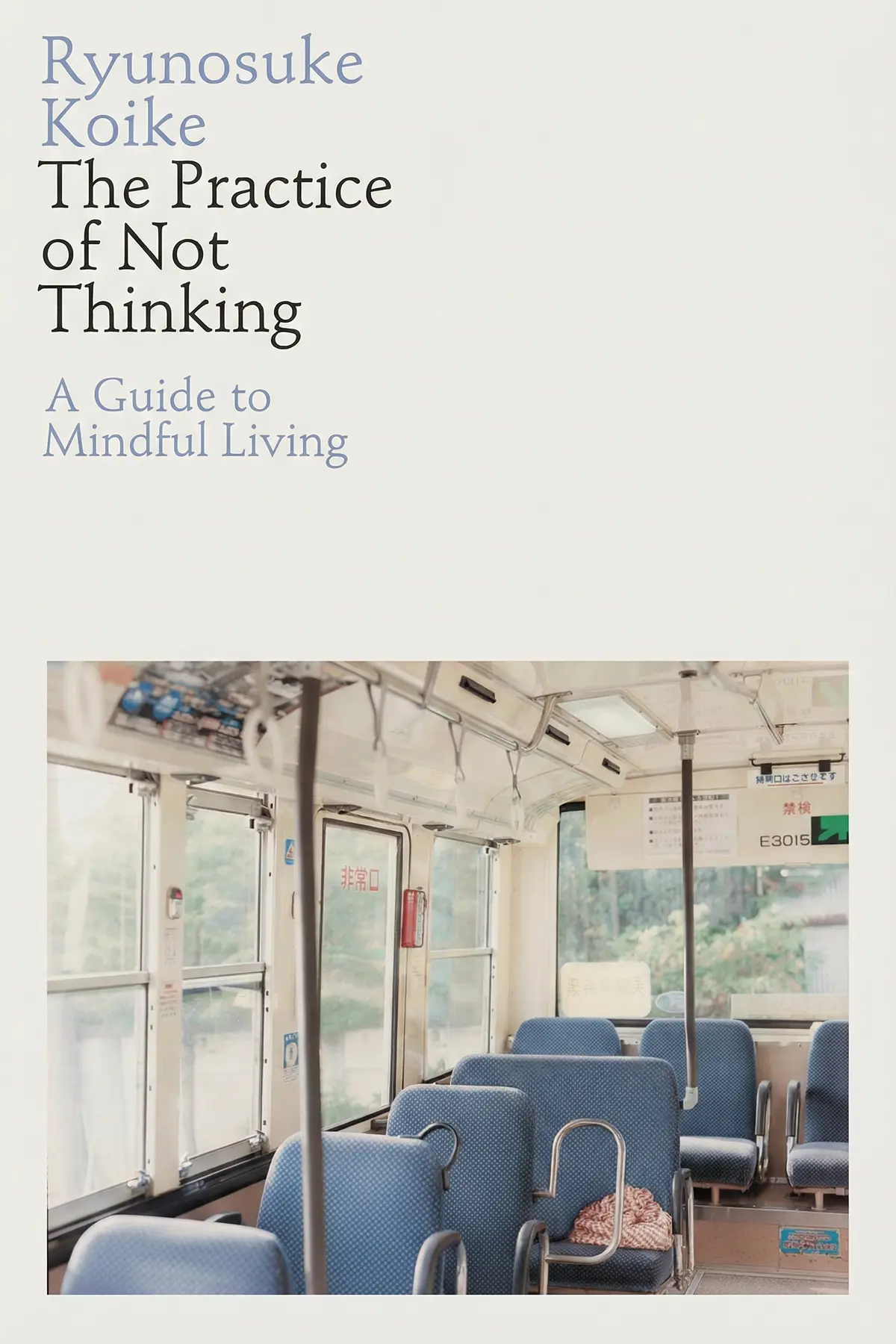
Table of Content
1. Introduction
1 min 41 sec
Have you ever started your morning with a clear plan, feeling energized and ready to take on the world, only to find that by noon, your mind is a tangled mess of worries? We have all been there. You are trying to finish a report or enjoy a meal, but a tiny voice in your head is replaying an awkward comment you made three days ago, or perhaps it is fretting about a deadline that is still weeks away. This is the reality of the modern mind: it is loud, it is restless, and it often feels like it is working against our own happiness.
The truth is that our brains are naturally wired for this kind of noise. We are biologically programmed to seek out stimulation, and unfortunately, our minds find negative thoughts far more engaging than quiet, peaceful ones. This creates a relentless feedback loop where overthinking becomes our default state. We second-guess our choices, obsess over the opinions of others, and lose the ability to actually inhabit the moments we are living. We are physically present, but mentally, we are miles away, lost in a fog of abstraction.
But what if you could simply turn it off? What if there was a way to step out of that internal monologue and back into the richness of the world? This is where the concept of sense-oriented mindfulness comes in. In this summary of The Practice of Not Thinking, we are going to explore how to regain control of your mental landscape. We will look at how focusing on what you see, hear, touch, taste, and smell can act as a circuit breaker for overthinking. By the time we are finished, you will understand the root causes of mental clutter and possess practical strategies to cultivate a calmer, clearer, and more intentional approach to every single day. Let’s begin this journey into the art of mental stillness.
2. Identifying the Three Roots of Mental Clutter
3 min 25 sec
Uncover how the hidden forces of desire, anger, and ignorance fuel your constant need to overthink and discover why your brain prioritizes negativity over peace.
3. Observing Emotions Without Reacting
2 min 56 sec
Learn a powerful technique to handle negative feelings like irritation and anger without letting them take control of your day or your personality.
4. Cultivating Concentration Through Hearing
2 min 49 sec
Discover how the simple act of listening to everyday sounds can train your brain to stay present and improve your relationships.
5. Protecting the Mind Through Visual Hygiene
3 min 05 sec
Examine the impact of high-intensity visual stimulation on your peace of mind and learn how to see the world with fresh, calm eyes.
6. Grounding Your Focus with the Sense of Touch
3 min 06 sec
Explore how physical sensations, from your posture to the movement of your hands, can serve as an instant reset for an overactive mind.
7. Conclusion
2 min 01 sec
In this exploration of The Practice of Not Thinking by Ryunosuke Koike, we have journeyed through the landscape of the modern mind to find a path toward stillness. We began by identifying the ‘three poisons’—desire, anger, and ignorance—that act as the invisible architects of our mental clutter. By understanding how these forces drive our need for stimulation and our resistance to the present, we gained the ability to recognize them when they arise. We then looked at the power of non-reactive observation, learning to ‘bracket’ our emotions so that we can acknowledge our feelings without letting them dictate our actions or define our identity.
From there, we delved into the practical application of our five senses. We learned how intentional listening can sharpen our focus and how ‘visual hygiene’ can protect our minds from the agitation of an overstimulated world. Finally, we explored how the sense of touch and physical grounding can serve as an immediate reset when our thoughts start to spin out of control. The throughline of all these practices is simple: whenever you find yourself lost in a maze of overthinking, the way out is always through your senses.
Mindfulness is not about achieving a state of permanent emptiness; it is about developing the skill to choose where your attention goes. It is about realizing that you don’t have to be a slave to every thought that passes through your head. As you move forward from this summary, try to pick just one sensory practice to incorporate into your day. Perhaps you will commit to truly listening to the sounds of your morning commute, or you will take a moment to feel the weight of your body in your chair during a stressful meeting. These small, consistent shifts toward sensory awareness are the building blocks of a quieter, more meaningful life. By practicing the art of not thinking when it no longer serves you, you open the door to a world that is richer, clearer, and infinitely more peaceful. Thank you for listening, and may your journey toward mental clarity be a steady and rewarding one.
About this book
What is this book about?
The Practice of Not Thinking explores the modern epidemic of mental clutter and offers a path toward clarity through sense-oriented mindfulness. We often find ourselves trapped in a loop of overthinking, where our brains are constantly chasing stimulation or dwelling on negative patterns. This mental noise separates us from our physical reality and drains our emotional energy, leading to stress and dissatisfaction. Ryunosuke Koike presents a compelling promise: by learning to intentionally shift our attention away from the internal chatter and toward our five physical senses, we can silence the destructive voices of desire and anger. This summary breaks down the traditional Buddhist concepts of the three poisons—desire, anger, and ignorance—and translates them into actionable techniques for the contemporary world. You will learn how to observe your emotions without being consumed by them, how to refine your listening and seeing to avoid overstimulation, and how simple physical sensations can ground you in the present moment. By the end, you will have a toolkit for navigating a chaotic world with a calm, focused, and truly mindful mind.
Book Information
About the Author
Ryunosuke Koike
Ryunosuke Koike is a Japanese monk known for his modern approach to the Buddhist way of life, blending traditional wisdom with contemporary insights. A graduate of the University of Tokyo with a specialization in philosophy, his work focuses on mindfulness and mental clarity. Koike leads courses in Zazen meditation and has written several best-selling books in Japan.
Ratings & Reviews
Ratings at a glance
What people think
Listeners view this title as a functional gateway to Zen Buddhism, and while perspectives on the author’s sometimes direct tone vary, many find value in the uncomplicated methods for attaining a tranquil mind. Furthermore, they respect the priority given to using mindfulness in daily life, with one listener remarking that the tips for decluttering physical objects helped them manage the anxiety of letting go. They also point to the featured conversation with a neuroscientist as a fascinating addition that delves into the intersection of meditative techniques and brain science.
Top reviews
Chiw
This book is a refreshing departure from the usual fluff you find in the self-help section of most bookstores. Ryunosuke Koike doesn't offer 'positive thinking' or affirmations; instead, he shows you how to stop the cycle of useless thoughts entirely. I found his description of 'thought disease' to be a perfect metaphor for the way my anxiety functions. The strategies for controlling the senses—like how to view 'neutral' objects to calm the mind—are brilliant in their simplicity. Even the dialogue with the neuroscientist was enlightening, as it explored the intersection of meditative states and brain waves without making overblown claims. It’s a short volume, but it’s packed with insights that I keep coming back to whenever I feel overwhelmed. This is the pure stuff, straight from a former monk who knows exactly how the mind tries to trick us into suffering.
Show moreJom
Wow, I didn't expect a short volume like this to have such a profound impact on my daily anxiety levels. The trick, according to Koike, is not to try to defeat your negative thoughts but to see them as the wisps they actually are. I’ve started using his technique for 'noticing' my senses when I’m eating, and it has completely changed my relationship with food. I’m much more present and far less stressed. The author’s pragmatic approach makes mindfulness feel like a skill you can actually master with practice. Truth is, I even appreciated the blunt sections because they forced me to examine my own ego and why I get offended so easily. If you are serious about a mindful living practice, I thoroughly recommend this authentic source. It’s a clear and straightforward marvel of a book that stays with you long after you finish it.
Show moreBank
Look, there are some undeniable gems hidden in these pages, and for me, they were absolutely life-changing. I especially loved the section on journaling and planning, which is something many mindfulness books tend to overlook. Koike shows how to organize your life without becoming attached to the outcomes, which is a difficult balance to strike. The emphasis on 'not thinking' isn't about becoming a zombie; it's about being so present in your actions that there's no room for the useless chatter of the ego. I found the advice on how to handle silence particularly moving. It’s not just about the absence of noise, but about how you relate to the world around you. While his tone is occasionally sharp, I think that’s necessary to wake the reader up from their habitual patterns. This is easily one of the most practical Zen books I’ve ever owned.
Show moreRosa
Finally got around to reading this, and I was surprised by how much the practical strategies resonated with my daily routine. The author argues that our brains are constantly overstimulated by internal noise, and he provides a step-by-step guide to quieting that chatter. I’ve started practicing the 'mindful listening' technique he describes, where you focus purely on the vibration of sounds rather than labeling them. It really helps when I'm feeling stressed at work or in a crowded area. Look, the guy is definitely blunt, and he doesn't sugarcoat his views on things like greed or laziness. Some people might find him rude, but I found the directness refreshing compared to the usual vague 'just breathe' advice. The chapters are short enough to read one per morning as a meditation. It’s a solid 4-star guide for anyone who actually wants to change their habits rather than just read about philosophy.
Show morePaisley
The chapter on discarding physical items was exactly what I needed to hear to finally clear out some clutter in my apartment. Koike explains that we often hold onto things out of a fear of the future, and that this 'stuff' eventually weighs down our minds. I finally let go of a bulky cabinet I hadn't used in years because I realized I was only keeping it 'just in case' my life changed. In my experience, the book works best when you treat it as a series of experiments rather than a rigid set of rules. The advice on breathing and walking with awareness is classic Zen but presented in a very modern, jargon-free way. Not gonna lie, some of the relationship advice is questionable, but the core message of decluttering your mind is powerful. It’s a pragmatic entry point into Buddhism that focuses heavily on action.
Show moreTong
After hearing a lot about this Japanese bestseller, I decided to give it a shot as a newcomer to Zen concepts. The book is divided into short, digestible sections that focus on the five senses, which makes the practice feel accessible. I appreciated the emphasis on doing one thing at a time, like fully noticing the act of swallowing your water or feeling the weight of your feet on the ground. However, some of the specific advice is incredibly blunt and might rub people the wrong way. For instance, the section on how to talk to a partner about their weight felt extremely harsh and socially awkward. Personally, I found the interview with the neuroscientist at the end to be the most compelling part of the book. It provided some much-needed scientific grounding for the monk’s more abstract claims. It’s a bit of a mixed bag, but worth a skim for the basic exercises.
Show moreSatit
Ever wonder how to actually apply Zen to your morning commute or your cluttered desk? This book attempts to bridge that gap with very specific, albeit sometimes strange, instructions for daily life. I liked the focus on 'sensory' living over 'thought' living, which did help me catch myself when I was spiraling into useless worries about the future. On the downside, the author's disdain for things like comedy and common social interactions felt a bit extreme and unnecessary for a layperson. Gotta say, the translation is smooth and the book is physically small enough to carry around, which is a plus. It’s not a life-changing masterpiece, but it serves as a decent reminder to slow down. Just be prepared to take some of his more eccentric opinions with a massive grain of salt. It’s a 3-star read that offers some utility if you can ignore the occasional judgmental remark.
Show morePlernpiriya
While the cover is beautiful and the title is very catchy, the actual content falls flat under any kind of scrutiny. Koike makes some truly wild claims, such as the idea that senility in old age is simply caused by 'noise' from past thoughts blocking new realities. That kind of victim-blaming for serious medical conditions is dangerous and highly irresponsible. To be fair, he does offer some basic tips on being present while eating or drinking, but these are buried under pseudoscience about how dull knives destroy the nutrients in vegetables. Truth is, most of this felt like a guide to overthinking rather than the opposite. The author seems to jump to massive conclusions based on very flimsy, anecdotal evidence that rarely applies to a modern, western context. If you are looking for a grounded introduction to Zen, I would suggest looking elsewhere and skipping this particular volume.
Show moreKanchana
To be fair, Koike provides a decent introduction to basic mindfulness, but his conclusions are often far too simplistic for complex modern lives. I found the writing style repetitive and the tone a bit too 'holier-than-thou' for my liking. It feels like the author is trying to create a 'thought disease' out of every normal human emotion. I was particularly put off by the dietary advice, specifically the claim that a vegetarian diet makes your stools smell less pungent as if that’s a primary reason to change your lifestyle. There are so many better reasons for plant-based living, like animal welfare or sustainability. The book tries to be a practical manual for everything from sleeping to talking, but it ends up feeling like a list of chores. It lacks the warmth and depth I’ve found in works by Thich Nhat Hanh. It’s a very quick read, but not necessarily a nourishing one.
Show moreSam
I really wanted to like this, but the author’s tone felt incredibly judgmental and borderline mean-spirited in several chapters. By the time I reached the part where Koike suggests telling an overweight partner that their body size causes you social embarrassment just to motivate them, I was ready to throw the book across the room. Frankly, this doesn’t feel like compassionate Zen Buddhism; it feels like a collection of personal biases disguised as ancient wisdom. He even attacks the concept of laughter, claiming it stems from a sense of superiority or ignorance, which is a bizarrely narrow view of human connection. The advice on parenting also felt completely detached from the reality of raising actual children. While the core idea of reducing mental noise is valuable, the delivery is so hectoring and blunt that it’s hard to extract anything positive. I've read much better books on mindfulness that don't make you feel like a failure for enjoying a joke or having a snack.
Show moreReaders also enjoyed
A New Earth: Awakening to Your Life’s Purpose
Eckhart Tolle
Aflame: Learning from Silence
Pico Iyer
Aware: The Science and Practice of Presence
Daniel Siegel
Be Here Now
Ram Dass


AUDIO SUMMARY AVAILABLE
Listen to The Practice of Not Thinking in 15 minutes
Get the key ideas from The Practice of Not Thinking by Ryunosuke Koike, plus 5,000+ more titles in English and Thai.
- 5,000+ titles
- Listen as much as you want
- 7-day free trial
- Cancel anytime







