
A Life Decoded: My Genome: My Life
J. Craig Venter
An evocative exploration of Earth's destiny following a hypothetical human disappearance. This summary reveals how nature would reclaim our cities, which man-made materials would endure, and the lasting scars of our industrial legacy.
1 min 52 sec
Imagine for a moment a world that has suddenly fallen silent. Not the silence of a quiet night, but a fundamental shift in the atmosphere of the planet. Every car has stopped, every factory has cooled, and every light has flickered out for the last time. In this scenario, there is no war, no plague, and no climate catastrophe—simply the abrupt disappearance of the human race. What remains is a vast, interconnected laboratory of steel, glass, and modified biology, left to the whims of the elements.
This is the central premise we are about to explore. It is a journey through time that starts hours after we are gone and extends billions of years into the future. By stripping away the human element, we gain a unique vantage point to see the true impact of our species. We often think of our cities as permanent fixtures, yet we will see how quickly the roots of trees and the flow of water begin to dismantle the foundations of our greatest metropolises.
We will also confront the more stubborn parts of our inheritance—the materials we created that nature has no vocabulary to describe, and the dangerous energies we’ve harnessed that require constant human vigilance to stay contained. This exploration isn’t just a morbid curiosity about the end of the world; it is a profound look at how life persists and adapts. It challenges us to think about which of our creations are fleeting and which will remain as silent witnesses to our existence long after our names are forgotten. As we move through this timeline, from the immediate decay of our homes to the eventual reclamation of the wild, we begin to understand the delicate and often destructive balance we hold with the natural world. Let’s look at the fascinating, sometimes shocking reality of an Earth that is finally left to its own devices.
2 min 14 sec
Explore why the miracle material of the twentieth century might be the most permanent scar on the planet, outlasting civilizations and infiltrating the most remote corners of the world.
2 min 07 sec
Discover how the minerals we extracted from the deep earth will continue to circulate through the atmosphere and soil for thousands of years after industry stops.
2 min 05 sec
Uncover the inevitable consequences for the world’s nuclear power plants once the humans required to maintain their cooling systems are gone.
2 min 15 sec
Witness the rapid decay of our greatest cities as nature exploits the weaknesses in our concrete and steel foundations.
1 min 51 sec
Learn which animals would thrive and which would vanish when the safety net of human agriculture is removed.
1 min 55 sec
Explore the potential for a biological renaissance as the pressure of hunting and habitat destruction is finally lifted.
2 min 07 sec
Identify the few remarkable objects that would survive for millions of years as the last evidence of our time on Earth.
2 min 01 sec
As we conclude this journey through a world without us, the picture that emerges is one of both incredible resilience and profound, lasting damage. It is a world where the scars of our industrial age—the radioactive cores, the heavy metals, and the indestructible plastics—remain as long-term reminders of our presence. These are the things that nature cannot easily digest, the elements of our legacy that will persist for thousands, or even millions, of years.
Yet, alongside those shadows, there is the vibrant, unstoppable power of life. We see that without our constant effort to maintain boundaries, nature would rush back in with breathtaking speed. Our cities would become forests, our rivers would break free, and the endangered species we nearly erased would find the space to flourish once again. It reveals a planet that is not fragile in its totality, but one that is perfectly capable of continuing its story without us.
The throughline of this exploration is clear: humanity has a heavy hand. We have created a world that requires our constant attention to keep it from either collapsing into decay or erupting into environmental hazard. The lesson here is not that we are irrelevant, but that we are deeply responsible. Knowing how long a plastic bag lasts or how a nuclear plant fails in our absence should change how we act while we are still here.
The actionable takeaway is simple yet deep. We must rethink our relationship with the materials we produce and the waste we leave behind. By choosing to reduce our reliance on permanent pollutants and respecting the natural boundaries of the ecosystems we inhabit, we can ensure that our legacy is not just a collection of toxic scars and stone faces, but a world that was better for our having been in it. We are the stewards of this planet, and the world without us serves as a mirror, showing us exactly what kind of mark we are currently making.
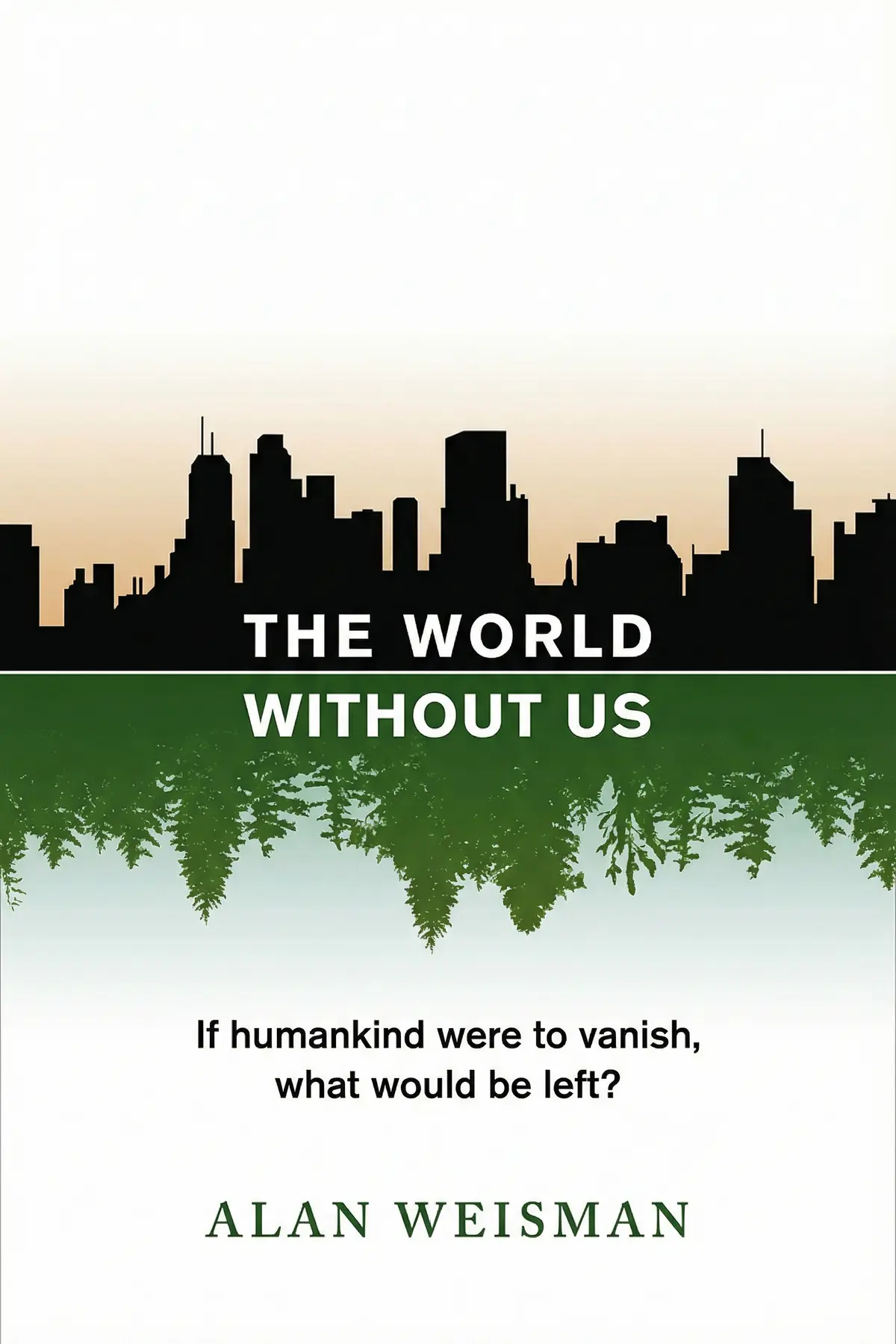
The World Without Us offers a thought-provoking thought experiment: what would happen to our planet if every human being suddenly vanished? It is not a story of a violent end, but a deep look at the aftermath. The narrative traces the immediate and long-term consequences for the structures we have built, the chemicals we have synthesized, and the animal species we have both nurtured and threatened. From the flooding subways of New York City to the silent, melting cores of abandoned nuclear reactors, this summary examines the timeline of Earth's recovery. It explores the persistence of plastics and heavy metals, the resurgence of wild predators, and the eventual erasure of almost every trace of human civilization. It provides a sobering yet fascinating perspective on our environmental footprint and the sheer resilience of the natural world, ultimately asking what our true legacy will be when we are no longer here to maintain it.
Alan Weisman is a distinguished American author and journalist who served as a professor of international journalism at the University of Arizona. His work often explores the intersection of humanity and the natural world. He first explored the themes of planetary recovery in his acclaimed article Earth Without People, which served as the foundation for his bestselling book, The World Without Us. Weisman has been recognized with numerous honors for his writing, including the Four Corners Award for the Best Nonfiction Book.
Listeners find this title a captivating experience, praising its thorough research and remarkable prose while calling it a masterpiece of journalistic writing. They value the stimulating subject matter and view it as an excellent choice for environmental literature, with one listener highlighting the striking depiction of humanity's impact on nature. While the concept earns high marks as a significant achievement in creative reporting, some find the narrative to be deeply repetitive.
The imagery in this book is hauntingly beautiful, though I’ll admit it's a bit of a gut-punch. Weisman paints a world where nature isn't just surviving, but actively dismantling our hubris. I was captivated by the idea of the "tooth of time" eating away at reinforced concrete, which isn't nearly as permanent as we like to think. From the mega-mammals of the Clovis era to the modern-day extinction of the American Chestnut, he connects history with a speculative future seamlessly. Truth is, it’s a bit of a wake-up call. We like to think of ourselves as the masters of the Earth, but this book proves we are just a blip on the radar. It’s fantastic environmental reading material that manages to be both informative and deeply philosophical. Highly recommended for any curious mind.
Show moreAs a bit of a science nerd, I appreciated how Weisman consulted actual experts instead of just weaving a fantasy. The book is less a "end-of-the-world" thriller and more a sobering look at our ecological legacy. The detail about the Voyager spacecraft carrying our music out of the solar system as our last standing monument was a beautiful way to wrap things up. I was particularly fascinated by the Korean DMZ examples—showing how nature thrives when we just leave it alone. It’s a haunting, vivid account of human pressure on the environment. Even the darker parts, like the "ocean sinks" filled with polymers, are handled with a journalistic precision that makes the information stick with you long after you close the cover. Truly an amazing read.
Show morePicked this up after seeing it on several 'must-read' environmental lists. Weisman does a tremendous job detailing how quickly the things we take for granted—like the Panama Canal or the New York subway system—would simply fail without human maintenance. The research feels exhaustive, almost to a fault at times. I found the sections on plastics and nuclear waste particularly chilling because they remind you how permanent our "temporary" conveniences actually are. While the writing is evocative, it does get a bit repetitive when he lists every single plant species that would take over a suburban yard. Still, it’s a masterfully written piece of journalism that forces you to look at a plastic bottle and see it for the thousand-year artifact it truly is. It's thought-provoking stuff.
Show moreEver wonder what happens to our pets if we just vanished? That’s the question that got me hooked, though the answer isn't exactly a happy one for the dogs. Weisman’s exploration of how feral hogs would thrive while cattle would likely perish was a fascinating dive into domestication. The book isn't just about animals, though; it’s a deep dive into the chemical and physical footprint we leave behind. The section on the "four pillars" and the Voluntary Human Extinction Movement was an eye-opener I hadn't expected. My only gripe is that it can feel a bit lopsided, with some chapters feeling like a massive environmental rant. However, the sheer depth of research makes it worth the effort. It’s a vivid account of human pressures on the environment.
Show moreFinally got around to reading this, and it’s definitely a masterclass in imaginative reporting. I was particularly struck by the contrast between the quick decay of the Panama Canal and the thousands of years it takes for plastics to break down in the ocean. Weisman has a way of making environmental science feel like a detective story. Not gonna lie, some of the political remarks felt out of place and a bit dated, but the core message is powerful. It’s a weirdly peaceful thought to imagine the world returning to a state of balance, even if we aren't there to see it. It definitely makes you rethink your relationship with "stuff" and how much maintenance our civilization requires just to stay upright. A solid, fascinating read.
Show moreWalking through a city after reading this feels completely different; you start seeing the cracks in the pavement as the beginning of the end. Weisman does an incredible job of making the invisible processes of decay visible to the reader. Whether it's the dioxins that will outlast us or the radio towers that kill millions of birds, he highlights the unintended consequences of our existence. Personally, I found the chapter on the Voyager spacecraft to be a needed bit of hope in an otherwise depressing narrative. The book is intensely repetitive in its middle section, but the Coda at the end ties it all together beautifully. It’s a vivid, albeit somewhat biased, account of our impact on the planet. Definitely worth a look for the tree-huggers among us.
Show moreWhat stayed with me after finishing this was the sheer fragility of our infrastructure. Weisman’s description of how water would reclaim the subways within days of the power going out is the stuff of nightmares. The book is a bit of a "snoozer" if you aren't into lists of biological successions, but the imaginative reporting here is second to none. I especially liked the exploration of the Turkish zone of Cyprus; seeing a real-world example of an abandoned city gives his theories much more weight. It isn't always a "fun" read—it’s actually pretty depressing to realize our most lasting contribution might be dioxins and bronze statues— but it’s an essential one for anyone interested in our planet's future. It serves as a great springboard for more research.
Show moreLook, I’m a fan of speculative non-fiction, but Weisman goes on some wild tangents that don't always land. The premise is a tremendous feat of imaginative reporting—who wouldn't want to know how long a Barbie doll lasts in a landfill? But the execution is frequently bogged down by the author’s obvious distaste for certain modern technologies. He rails against coal and nuclear power but barely mentions any viable alternatives, which felt a bit biased. The writing style is impressive, yet the repetition of "this plant grows here, then that plant grows there" becomes exhausting by the halfway mark. It’s a good book to skim for the "what-if" scenarios, but the preachy tone was a bit of a turn-off for me. Not a total waste of time, just unbalanced.
Show moreAfter hearing so much hype about this being a "fascinating read," I was surprised by how much of it felt like a textbook. The first few chapters are great—the immediate aftermath of human disappearance is high-stakes and interesting. But then it settles into a very slow rhythm. To be fair, the research is top-notch, and he covers a lot of ground, from the Mayan ruins to the Korean DMZ. But he spends so much time on the "rant" side of environmentalism that the actual "world without us" gets lost. I wanted more about the animals and less about the author's opinions on U.S. foreign policy. It's okay, but it’s definitely not the page-turner I was hoping for. Take it with a dose of salt.
Show moreTo be fair, the central conceit of this book is brilliant, but the actual reading experience was quite a chore. I expected a fast-paced look at a post-human world, yet I found myself wading through what felt like an endless environmental lecture. Weisman is clearly not a scientist, and while his interviews with experts are great, his personal biases often leak through in ways that feel unnecessarily snide. The pacing is incredibly slow; I swear there are chapters that spend ten pages describing weeds growing through pavement. If you’re looking for a speculative "what if" game, you might enjoy it, but for me, the repetitive descriptions of floral succession made it a real struggle to finish. It’s a snoozer that didn't live up to the hype for me.
Show moreJ. Craig Venter
Carl Zimmer
Bill Bryson
Jeff Hawkins
Lisa Kaltenegger
AUDIO SUMMARY AVAILABLE
Get the key ideas from The World Without Us by Alan Weisman, plus 5,000+ more titles in English and Thai.







