
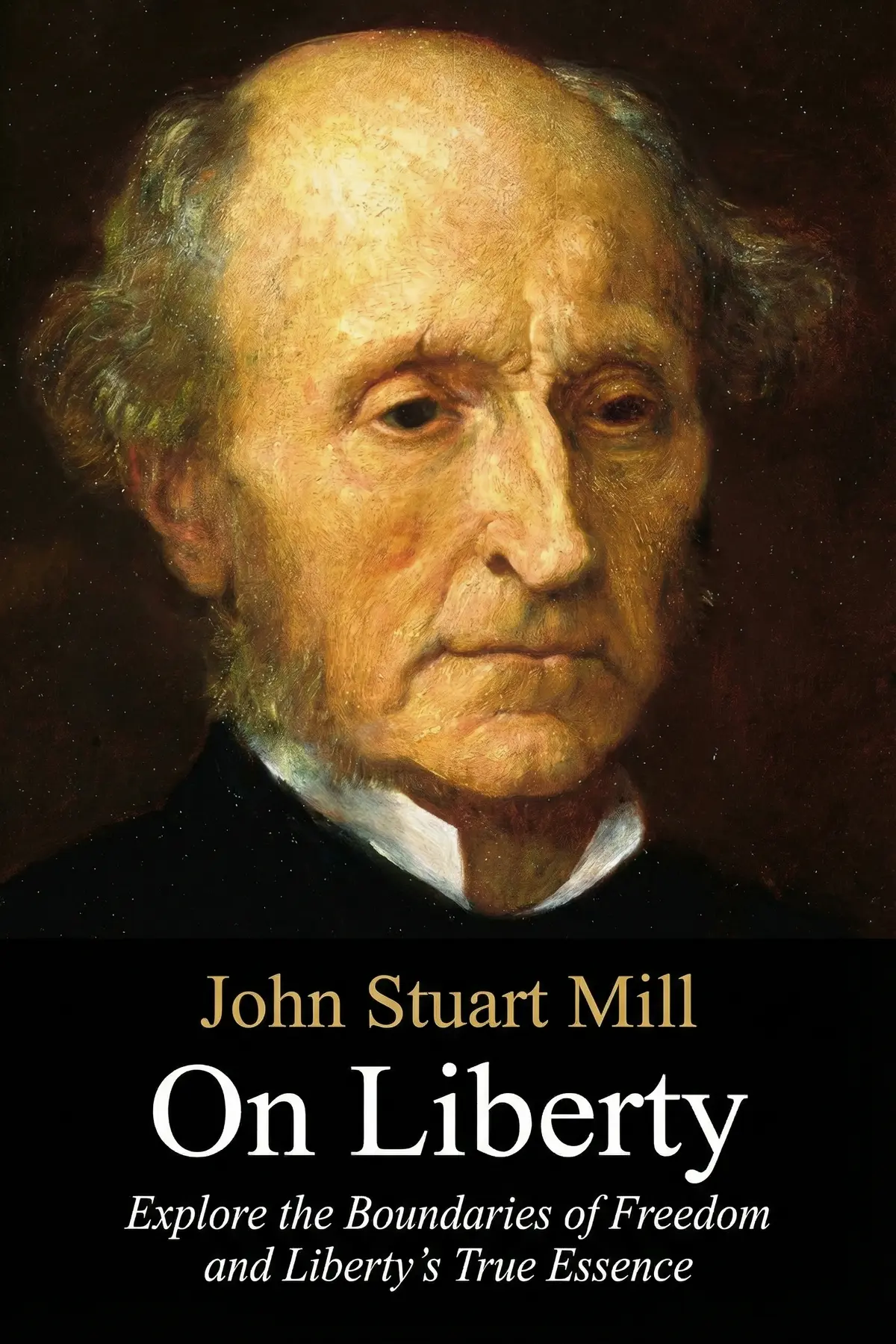
On Liberty
John Stuart Mill
Discover John Stuart Mill’s definitive framework for modern ethics. This summary explores how the principle of maximizing collective happiness can guide personal choices, legal systems, and social justice in an increasingly complex world.
1 min 51 sec
Imagine you are standing near a railway switch. In the distance, a runaway trolley is speeding toward a group of five people who are stuck on the tracks. They have no way to escape. You have the power to flip a lever and send the trolley onto a different track, which would save those five lives. However, there is a catch: a single person is standing on that second track. If you act, that person will surely die, but the five others will live. If you do nothing, the one person is safe, but the five are lost. What is the ‘right’ thing to do? Is it a matter of simple math, or is there something deeper at play?
This classic thought experiment, known as the trolley problem, sets the stage for one of the most significant debates in the history of human thought. For centuries, people looked to ancient traditions, religious edicts, or rigid laws to determine what was right and wrong. But in the nineteenth century, a thinker named John Stuart Mill popularized a different way of looking at the world. He argued that morality shouldn’t be about following a dusty list of rules, but about looking at the actual results of our choices.
In his seminal work on ethics, Mill explores the concept of utilitarianism. This philosophy suggests that the best action is always the one that produces the most happiness and reduces the most suffering for the largest number of people. It sounds simple on the surface, but as we will see, it has profound implications for how we live, how we punish, and how we treat one another. Over the course of this exploration, we will move through Mill’s intellectual journey, his definitions of true satisfaction, and his vision for a just society. We will see how these nineteenth-century ideas still provide the blueprint for many of the most important ethical decisions we face today.
2 min 32 sec
Explore the rigorous and unusual upbringing of John Stuart Mill and learn how his early intellectual training shaped his revolutionary views on social progress and individual rights.
2 min 23 sec
Discover why Mill believed that not all pleasures are equal, and how he distinguished between basic physical satisfaction and deeper intellectual fulfillment.
2 min 41 sec
Examine why Mill rejected moral systems based on fear, rigid tradition, or the glorification of suffering, and how he proposed a more rational alternative.
2 min 34 sec
See how utilitarianism redefines justice by focusing on the tangible outcomes of laws and punishments rather than abstract notions of revenge.
2 min 33 sec
Explore the practical challenges of using utilitarian logic in real-life dilemmas and learn why Mill advocated for humility and flexibility in our ethical decisions.
1 min 20 sec
In the end, John Stuart Mill’s exploration of utilitarianism remains a cornerstone of how we think about right and wrong in the modern age. By shifting the focus away from abstract, rigid rules and toward the actual experiences of living beings, he provided a framework that is both rational and deeply empathetic. He reminded us that the true measure of any action, law, or social system is whether it actually makes people’s lives better.
We have seen that this isn’t just about chasing cheap thrills. It’s about pursuing a higher form of human flourishing that values the mind, the spirit, and the community. It’s about a justice system that seeks to heal and protect rather than just punish. And it’s about having the courage to make difficult choices by looking at the big picture, while remaining humble enough to learn from our mistakes.
The next time you find yourself facing a tough decision, try to look past your immediate impulses. Ask yourself: What will the ripple effects of my choice be? Who will be helped, and who might be hurt? By striving to contribute to the greatest good for the greatest number, you aren’t just following a philosophy—you are participating in the ongoing work of building a kinder, more thoughtful, and more joyful world for everyone.
This summary dives deep into one of the most influential works of moral philosophy ever written. It explains John Stuart Mill’s theory of utilitarianism, a system that moves away from rigid, traditional rules and toward a focus on the real-world consequences of our actions. You will learn how Mill defines happiness not just as simple pleasure, but as a state of long-term flourishing that prioritizes intellectual and emotional growth over basic physical gratification. The text also explores the broader implications of these ideas for society at large. It examines how a utilitarian approach can reform the justice system by focusing on proportionality and rehabilitation rather than just punishment. Furthermore, it addresses the challenges of making difficult moral choices in high-stakes environments, like medical emergencies or environmental crises. By the end, you’ll see how Mill’s pursuit of the greatest good for the greatest number offers a flexible, logical, and deeply human way to navigate the ethical puzzles of the modern age.
John Stuart Mill was a nineteenth-century British philosopher, economist, and public intellectual who significantly shaped modern political and social thought. Born in 1806, he was a child prodigy whose education was strictly managed by his father, James Mill, leading him to master classical languages and complex philosophy at an incredibly early age. Throughout his life, Mill became a passionate advocate for individual freedom, gender equality, and progressive social reforms. His prolific writing career produced several foundational texts, including A System of Logic in 1843, Principles of Political Economy in 1848, and the celebrated essay On Liberty in 1859, which remains a cornerstone of liberal thought.
John Stuart Mill
Listeners find this work intellectually stimulating, as it provides useful perspectives on moral foundations. Moreover, the prose style draws varied feedback, with some noting its clarity while others characterize it as verbose. Finally, listeners are pleased with the affordable price.
As someone who enjoys debating morality, the famous 'better to be Socrates dissatisfied than a pig satisfied' quote alone makes this worth the read. Mill builds a compelling case for why higher intellectual pleasures outweigh simple physical ones, challenging the reader to think about quality over quantity. To be fair, the language is dense, but the ethical insights are incredibly sharp once you peel back the layers of Victorian phrasing. I found myself looking at my own daily choices through a new lens of social utility. It’s a thought-provoking classic that remains essential for anyone interested in why we do what we do. The edition I bought was remarkably affordable for such a fundamental text.
Show moreJust finished this for the second time and I'm struck by how Mill anticipates almost every major objection to his theory. He handles the 'doctrine worthy only of swine' criticism with such elegance that it’s hard not to be won over. The way he links utility to the feeling of justice is a masterstroke of philosophical synthesis. Look, it’s an old book, so you have to expect some flowery language and long-winded sentences, but the payoff is immense. It provides a clear, secular basis for morality that doesn't rely on mystical assumptions or complex metaphysical gymnastics. Truly a foundational text that every person should grapple with at least once in their life.
Show moreIn my experience, few books manage to define an entire school of thought as effectively and concisely as this one does. Mill isn't just presenting a theory; he's constructing a roadmap for social and individual improvement based on the reduction of pain. The book is incredibly thought-provoking, especially when he discusses the internal sanctions of conscience as a motivating force for moral behavior. Even though the prose is a bit heavy-handed at times, the clarity of his vision for a happier society is truly inspiring. For the price of a cup of coffee, you get a front-row seat to one of the most important intellectual shifts in history. Definitely worth the effort for anyone serious about ethics.
Show moreThe chapter on the connection between justice and utility is probably the most interesting part of the entire book. Mill attempts to reconcile the subjective nature of happiness with the rigid requirements of social law, and he mostly succeeds. I appreciated how he distinguishes between different levels of pleasure, moving beyond Bentham’s simpler hedonic calculus. Not gonna lie, some sections are a slog, and you’ll find yourself re-reading the same paragraph three times just to find the verb. Despite the heavy lifting required, the core principles are undeniably influential and still dictate much of how our modern legal systems function. For a few dollars, it’s an absolute bargain for any library.
Show moreWow, I didn't expect a 19th-century ethics treatise to feel so relevant to modern political discourse. Mill’s exploration of collective agency and the 'greatest happiness principle' offers a fascinating framework for evaluating government actions. The text is surprisingly short, yet it packs enough intellectual punch to keep you pondering for weeks after finishing. My only real complaint is that the flow can be quite disjointed, moving from brilliant clarity to dense, confusing explanations without warning. Personally, I think 'On Liberty' is the more engaging read, but this is the essential groundwork you can't really skip. It’s a challenging but rewarding dive into the mechanics of moral decision-making.
Show moreFinally got around to reading this classic, and I must say the ethical principles Mill lays out are still remarkably provocative. He moves the conversation of ethics away from abstract rules and toward the tangible results of our actions on human suffering. I particularly liked the distinction between being a satisfied pig and a dissatisfied Socrates, even if I don't fully agree with his conclusion. The writing is certainly lucid in the middle sections, though it starts and ends with a lot of fluff that could have been edited down. It's a solid 4-star read because of its historical importance and the way it forces you to question your own moral compass.
Show moreEver wonder why some philosophers feel the need to use fifty words when five would suffice? Mill’s writing is the definition of word soup at times, alternating between lucid genius and frustrating verbosity. He addresses the critics of utilitarianism with some skill, particularly regarding the relationship between justice and utility. However, I found his dismissal of 'satisfied fools' to be somewhat elitist and disconnected from the reality of human joy. While the book provides a solid foundation for public policy and ethics, it lacks a certain warmth that makes philosophy resonate on a personal level. It is a necessary read for students, but perhaps not one you’d pick up for fun on a Sunday afternoon.
Show moreAfter hearing so much about Mill in my undergrad courses, I finally sat down to read the full text of his most famous work. It is a bit of a mixed bag; the logic is airtight in some places but relies heavily on circular reasoning in others. I struggled with his hierarchy of pleasures, as it seems to ignore the genuine, simple contentment found in the physical world. The truth is, his 'higher' pleasures often just sound like a preference for academic pursuits over everything else. While the book is a bargain and offers great insight into the history of ethical thought, the writing style is undeniably tedious. It’s a classic for a reason, but that doesn't make it a page-turner.
Show morePicked this up because I heard it was a pillar of Western ethics, but I struggled to stay awake past the second chapter. Mill is undeniably brilliant, yet his prose feels like wading through thick molasses on a very cold day. I tried the Librivox recording to help, but it just turned the book into a powerful narcotic for my insomnia. The arguments are wordy and repetitive, making simple truisms sound like groundbreaking revelations. Frankly, it’s hard to appreciate the 'greatest happiness' principle when the act of reading the text causes so much mental anguish. It was likely revolutionary in the 19th century, but now it feels dry and a bit dated. If you need it for a class, get it, otherwise, find a summary.
Show moreNot what I expected given its massive reputation in the world of political science and philosophy. While the central idea is easy enough to grasp, Mill spends an eternity defending it with increasingly opaque and boring arguments. To be fair, the price point is great, but your time is also valuable, and this book will take a lot of it. I found the sections on the 'sanctions' of the principle of utility to be particularly unconvincing and dry. It feels like a series of truisms wrapped in unnecessary complexity just to satisfy the academic standards of the 1860s. I’d suggest finding a good summary or a lecture online unless you have a high tolerance for Victorian wordiness.
Show more
Nigel Warburton
John Rawls
William B. Irvine
Friedrich Nietzsche
AUDIO SUMMARY AVAILABLE
Get the key ideas from Utilitarianism by John Stuart Mill, plus 5,000+ more titles in English and Thai.







