
A Higher Loyalty: Truth, Lies and Leadership
James Comey
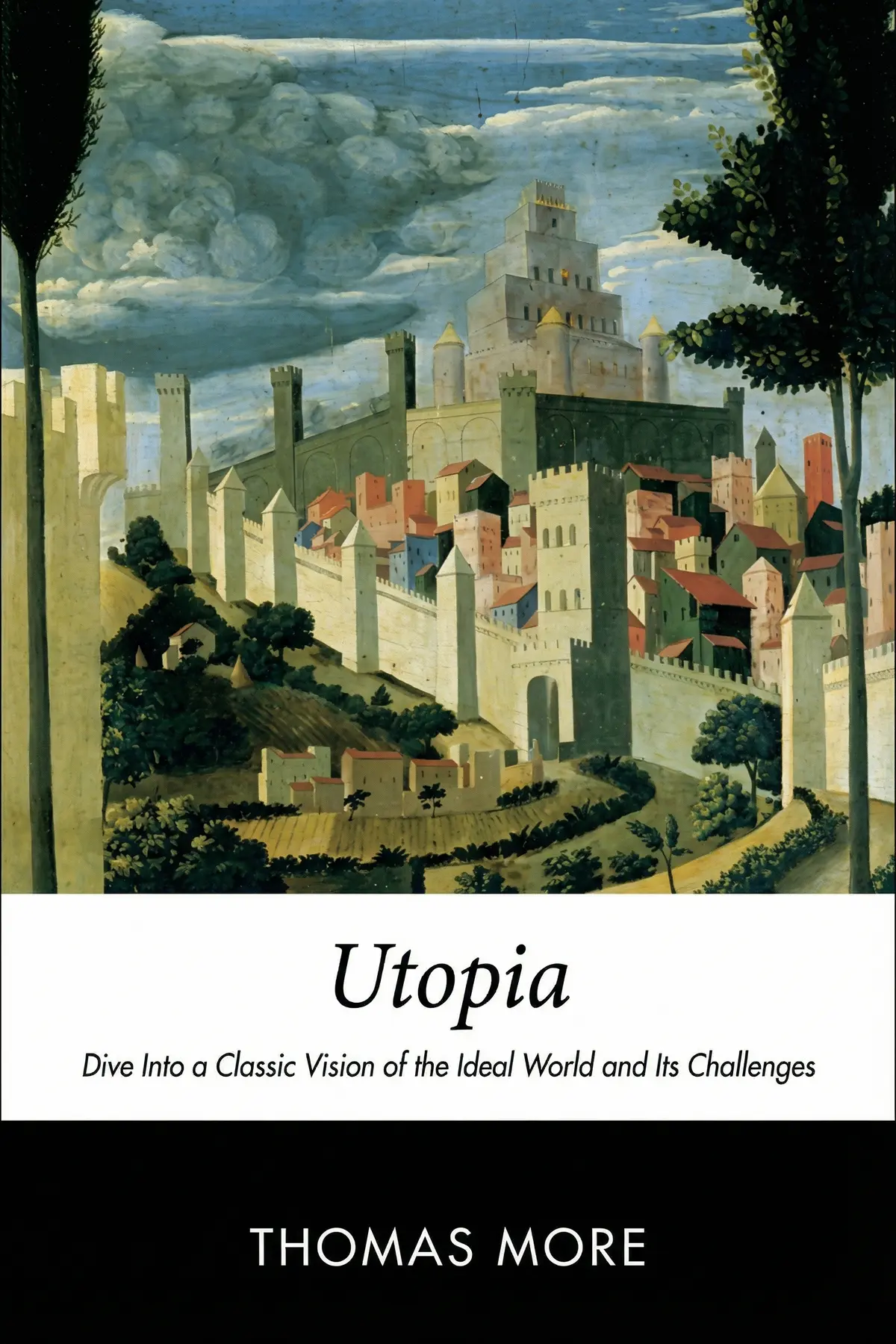
Explore Thomas More’s 1516 masterpiece, Utopia. This foundational text imagines a radical island society devoid of private property, offering a timeless critique of greed, governance, and the quest for a perfect civilization.
1 min 59 sec
Imagine, for a moment, stepping away from the bustling, often chaotic reality of the modern world and landing on the shores of a distant, perfectly ordered island. On this island, the anxieties that dominate our daily lives—the pursuit of wealth, the fear of poverty, and the constant friction of social inequality—simply do not exist. This isn’t the plot of a contemporary science fiction novel, but a vision sparked over five centuries ago. In 1516, a brilliant English lawyer and statesman named Thomas More sat down to pen a work that would not only define a genre but would echo through the halls of political philosophy for five hundred years.
That work is Utopia. It is a book that serves as a mirror, held up to the face of society to reveal its flaws, and as a map, charting a course toward a potentially better way of living. More wrote this during the height of the Renaissance, a period of explosive intellectual growth and geographical discovery. It was a time when the world was expanding, and for the first time, people were beginning to ask: if we are discovering new lands, could we also discover new ways of being human?
Through the character of a seasoned traveler, More presents us with a society that seems, on the surface, to be a paradise of reason and equity. But as we dive into this summary, we’ll see that Utopia is more than just a blueprint for a perfect world. It is a complex, ironic, and often challenging thought experiment. It asks us to consider what we would be willing to sacrifice for total security and equality, and whether a ‘perfect’ society is even possible in the hands of imperfect human beings. Over the next several sections, we will explore the radical foundations of this island nation, from its rejection of private property to its unique views on work, war, and the soul. We are about to embark on a journey to a place that, by its very name, tells us it exists nowhere—and yet, it has influenced almost everywhere.
2 min 12 sec
Discover how a fictional conversation between a statesman and a world traveler serves as a clever mask for radical political ideas.
2 min 08 sec
Explore the radical economic foundation of a world where the concept of ‘mine’ and ‘thine’ has been completely abolished.
2 min 08 sec
What would you do with your life if the workday was cut in half and everyone shared the burden of physical toil?
1 min 57 sec
Discover a political system built on elections and accountability rather than the luck of the draw in royal birth.
1 min 54 sec
Uncover a world where religious diversity is protected by law, provided it doesn’t cross the line into total nihilism.
2 min 03 sec
See how a society that values freedom and equality still finds a place for the grim institution of slavery.
1 min 56 sec
Learn why the Utopians view traditional battlefield glory as a foolish and unnecessary waste of human life.
1 min 59 sec
How a society that treats gold like garbage ended up changing the course of human history for five hundred years.
2 min 18 sec
As we reach the end of our journey through Thomas More’s visionary island, we are left with a landscape of ideas that is as challenging today as it was in 1516. We have seen a world where the abolition of private property ends the cycle of greed, where a six-hour workday opens the door to a life of the mind, and where religious tolerance and representative government offer a blueprint for social peace. Yet, we have also seen the shadows of this ideal: the use of slavery as punishment, the colonial expansion into ‘underutilized’ lands, and the pervasive lack of personal privacy.
Utopia is not a simple fairy tale of a perfect world. It is a profound critique of the human condition. More’s throughline is clear: our social ills—poverty, crime, and war—are not inevitable facts of nature, but the results of the systems we choose to build. If we value gold and status, we will create a world of inequality. If we value reason and the common good, we might just create something better.
The true power of this book lies in its name—the ‘no place’ that is also a ‘good place.’ It suggests that the ideal society is not a destination we will one day arrive at, but a North Star we can use to navigate. It invites us to be like Raphael Hythloday: to look at the world with a critical eye, to travel beyond the boundaries of our own assumptions, and to never stop asking ‘what if?’
What can we take away from this 500-year-old dream? Perhaps it is the courage to believe that change is possible. In a world that often feels fixed and unchangeable, Utopia reminds us that every system we live under was once just an idea in someone’s mind. By daring to imagine a society built on different principles, we take the first step toward building a more just and compassionate reality. As you move back into your own ‘someplace,’ carry with you the Utopian spirit of inquiry. Ask yourself which of our modern ‘necessities’ are truly essential, and which are just the golden chains we’ve chosen to wear. The ‘good place’ may not exist on any map, but as Thomas More showed us, it can always exist in our imagination—and from there, it can begin to shape the world.
Utopia is a profound exploration of an idealized island nation where social harmony is achieved through communal living and rational governance. Written in the early sixteenth century, Thomas More’s work serves as both a fictional travelogue and a sharp political commentary. It introduces readers to a world where money is obsolete, education is universal, and religious tolerance is the standard—concepts that were revolutionary in More’s time and remain provocative today. The book promises to challenge your assumptions about how a society should be structured. By contrasting the perceived failures of European monarchy and economics with the logical, albeit sometimes rigid, systems of the Utopians, More invites a deep reflection on human nature and justice. It is a journey into the origins of social dreaming, exploring the thin line between a 'good place' and 'no place.'
Thomas More (1478–1535) was a prominent English lawyer, statesman, and Renaissance humanist. He is most famous for his work Utopia, which significantly influenced political thought. More served as Lord Chancellor to King Henry VIII from 1529 to 1532. Throughout his life, he authored numerous texts on theology and history, including The History of King Richard III. Ultimately, More was executed for his refusal to acknowledge Henry VIII as the supreme head of the Church of England, an act of conviction that led to his later canonization by the Catholic Church.
Listeners find this work accessible and regard it as a significant literary milestone, with one listener observing how it casts an interesting shadow on 20th century communism. Additionally, the book provides important lessons for the modern era, and listeners appreciate its value for money. However, reactions to the length are varied, and one listener points out the lack of paragraph breaks.
Ever wonder where the term for an 'ideal' world actually originated? It turns out it comes from a Latin pun meaning 'no place,' which is the first hint that Thomas More was being much more satirical than most people realize. This book is a landmark literary achievement that balances deep humanism with a sharp critique of 16th-century European corruption. I loved the descriptions of the island’s geography and the way the Utopians value communal living over individual greed. It offers great lessons for today’s world, especially regarding how we distribute resources and treat the working class. Even though it was written during the Renaissance, the prose feels fresh and direct. It’s a short read that packs a massive intellectual punch. Every student of history should have this on their shelf.
Show moreThomas More’s masterpiece is a landmark literary achievement that manages to be both a satire of his own era and a blueprint for a future that never arrived. I was struck by how the Utopians abhor war and only fight to defend their borders or liberate others from tyranny. The writing is surprisingly easy to read, especially compared to other texts from the 1500s. It provides a unique window into the Renaissance mind and the search for a harmonious, moral society. For the price of a cup of coffee, you get a book that has shaped centuries of political discourse. Whether you see it as a communist manifesto or a Catholic satire, it is undeniably brilliant. I found myself highlighting passages that felt like they were written yesterday.
Show moreAfter hearing so much about it in school, I finally dove into the world of Amaurot and found it remarkably easy to read. This book casts an interesting shadow on 20th-century communism, showing that these ideas have been circulating for much longer than most people realize. To be fair, the Utopian system relies on a level of human perfection that probably isn't possible, but the ambition of the text is inspiring. It is a landmark literary achievement that challenges our assumptions about greed and governance. The value for money here is incredible, as you get a foundational piece of Western culture for almost nothing. Even with its flaws, More’s imagination is stunning. It’s a book that stays with you long after you finish the final page.
Show moreThe shadow cast by this 16th-century text over modern political movements is impossible to ignore. Thomas More’s vision of a society without private property certainly offers an interesting precursor to 20th-century communism, though it is far more theological in nature. I was pleasantly surprised by how easy it was to read despite the age of the translation. The book feels like a landmark literary achievement because it forces you to question what 'perfection' really costs a civilization. While some of the religious arguments feel a bit dated now, the core economic critiques of Tudor England remain shockingly relevant. It is a fantastic value for money if you want to understand the roots of Western political thought. You can definitely see why this has remained on university syllabi for hundreds of years.
Show morePicked this up on a whim because it was such a bargain, and I was genuinely surprised by how relevant it still feels. Thomas More managed to predict so many of our modern debates regarding wealth inequality and social welfare five hundred years ago. The descriptions of the capital city, Amaurot, or 'Aircastle,' were vivid enough to make the island feel almost real. I especially appreciated the focus on moral responsibility and the idea that a society is only as strong as its most vulnerable members. My only minor gripe is that the dialogue between Raphael Hythloday and More can get a bit long-winded in the first half. Once they actually start describing the island, however, the pace picks up significantly. It is a fascinating look into the mind of a Renaissance scholar.
Show moreLook, there is a fascinating tension between More’s progressive goals and the actual, stifling reality of his fictional island. On one hand, you have a six-hour workday and free healthcare, which sounds like a total dream even by modern standards. On the other hand, the existence of slavery for criminals and the rigid patriarchal structures made me feel very uncomfortable. It is a complete contradiction that oscillates between being incredibly liberal and fiercely conservative. The way the Utopians treat gold—using it for chamber pots to devalue it—was a clever touch, though. In my experience, the book works best as a mirror for our own societal failures rather than a legitimate blueprint for a better future. It’s worth reading, but don't expect a perfect society by today's definitions.
Show moreAs someone who appreciates historical philosophy, I found Raphael Hythloday’s account to be more of a dry lecture than a narrative. Personally, I expected more of a story, but instead, it is a very detailed list of laws and social customs. The lack of privacy in Utopia is what stood out to me the most; everyone is constantly watching everyone else to ensure they aren't being idle. It feels like a precursor to a surveillance state where autonomy is traded for basic security. While I can see how this influenced later socialist thought, it didn't feel like a place I would actually want to live. It's a landmark work, sure, but the 'tyranny of happiness' described here is actually quite terrifying if you think about it too long.
Show moreGotta say, the part about the Utopians using gold and silver for their toilets was the highlight of the entire book for me. It’s a hilarious way to show their disdain for material wealth, but the rest of the book is much more somber. The discussion in the first half about the injustice of the death penalty for thieves was incredibly ahead of its time. However, the second half where the island is described becomes a bit repetitive after a while. Every city is identical, every person wears the same clothes, and the sameness starts to feel a bit stifling. It’s an interesting historical curiosity that offers some great lessons for today, but it’s definitely not a page-turner. I’d recommend it for the history, not the plot.
Show moreFinally got around to reading this foundational text, but the formatting in my specific edition was a total nightmare. There were almost no paragraph breaks for pages at a time, which made the dense philosophical arguments incredibly difficult to track. Truth is, I found the famous 'naked marriage' ritual to be more weird than logical. Why would any sane society require teenagers to stand nude before their chaperones just to check for physical deformities? It felt less like an ideal world and more like a very awkward social experiment from 1516. To be fair, More was a product of his time, but his version of 'paradise' seems incredibly restrictive and boring. I appreciate its historical significance, but I wouldn't call it a fun or particularly enlightening read for a modern audience.
Show moreNot what I expected at all, especially given how much this reads like a precursor to a surveillance state. I found the whole concept of the Utopian society to be incredibly oppressive rather than idealistic. There is no private space, no freedom of movement without a passport, and your house is changed every ten years just so you don't get attached. It reminded me too much of Orwell’s 1984, which makes it more of a dystopia in my eyes. The lack of paragraph breaks in the text made the reading experience feel like a chore rather than an exploration. Frankly, I think More was mocking the idea of a perfect world rather than suggesting we actually build one. It’s an important book for history, but I didn't enjoy the actual content.
Show moreJames Comey
Anthony Pratkanis
Barack Obama
Masaji Ishikawa
John Rawls
Miles Taylor
AUDIO SUMMARY AVAILABLE
Get the key ideas from Utopia by Thomas More, plus 5,000+ more titles in English and Thai.







