
7 Powers: The Foundations of Business Strategy
Hamilton Helmer
A forward-thinking guide on surviving and thriving during the AI revolution, emphasizing that while machines will change how we work, they won't necessarily replace human value and creativity.
1 min 41 sec
Think about the device you likely have within arm’s reach right now. Whether it is a smartphone, a tablet, or a wearable watch, it is already quietly managing your existence. It counts your steps, it monitors your heart rate, it filters your messages, and it reminds you when you have been sitting still for too long. But as sophisticated as these tools feel today, we are standing on the edge of a much more profound shift. The digital tools of the near future aren’t just going to track our data; they are going to take that data and use it to perform our professional duties with a level of precision and speed that no human could ever match.
Naturally, this prospect creates a lot of noise and anxiety. We hear headlines about robots taking our seats at the table and algorithms making human intuition obsolete. It is easy to feel like we are being chased by an inevitable wave of obsolescence. However, if we look closer at the history of progress, a different story emerges. Every time humanity has invented a better tool, we haven’t stopped working; we have simply stopped doing the boring stuff.
The challenge isn’t the machine itself; it’s our readiness to adapt. In this summary, we are going to explore why data is the new fuel for the global economy, how to transform your business into a digital hybrid, and why the most repetitive parts of your job are the first things you should be happy to lose. We will look at the roadmap for getting ahead in a world where machines are increasingly doing everything, ensuring you aren’t just a spectator in the coming revolution, but a leader within it.
2 min 39 sec
Explore why our modern anxiety about artificial intelligence isn’t a new phenomenon, but rather the latest chapter in a long history of human worry over innovation.
2 min 37 sec
Learn why the automation of tasks doesn’t equate to the end of employment, and how new roles will likely outnumber those lost to machines.
2 min 36 sec
Go beneath the surface of modern apps to understand the ‘new machines’ that learn, adapt, and thrive on massive data streams.
2 min 30 sec
Discover the process of ‘instrumenting’ and why turning every object and process into a data source is the key to modern competitive advantage.
2 min 25 sec
Understand why traditional paper-based workflows are failing and how to transition toward a hybrid model that satisfies the modern consumer.
2 min 21 sec
Find out why the best place to begin your digital transformation is in the administrative heart of your company, where data is already king.
1 min 25 sec
The arrival of a new industrial revolution isn’t a threat to be feared, but a massive opportunity to be seized. At its center is a system of intelligence that turns the ‘new coal’—massive amounts of data—into a competitive engine. By embracing self-learning software and instrumenting every part of your operation, you can offload the drudgery of repetitive tasks and allow your human workforce to focus on what they do best: innovating, empathizing, and leading.
As you move forward, the most important thing to remember is that you cannot wait for the future to arrive; you have to build it. A powerful way to start is by looking for ways to ‘put your company out of business.’ Many employees live a split life: they use cutting-edge technology at home on Sunday night, only to walk into a workspace on Monday morning that feels like it’s stuck in 1995. You must bridge that gap.
Challenge your team to imagine five products or services that would make your current business obsolete. This exercise isn’t just a creative game; it is a way to identify the digital shifts that are already happening around you. By thinking like a disruptor today, you ensure that you are the one leading the charge tomorrow. The world where machines do everything is coming, and by preparing now, you ensure that ‘everything’ includes making your business more successful than ever before.
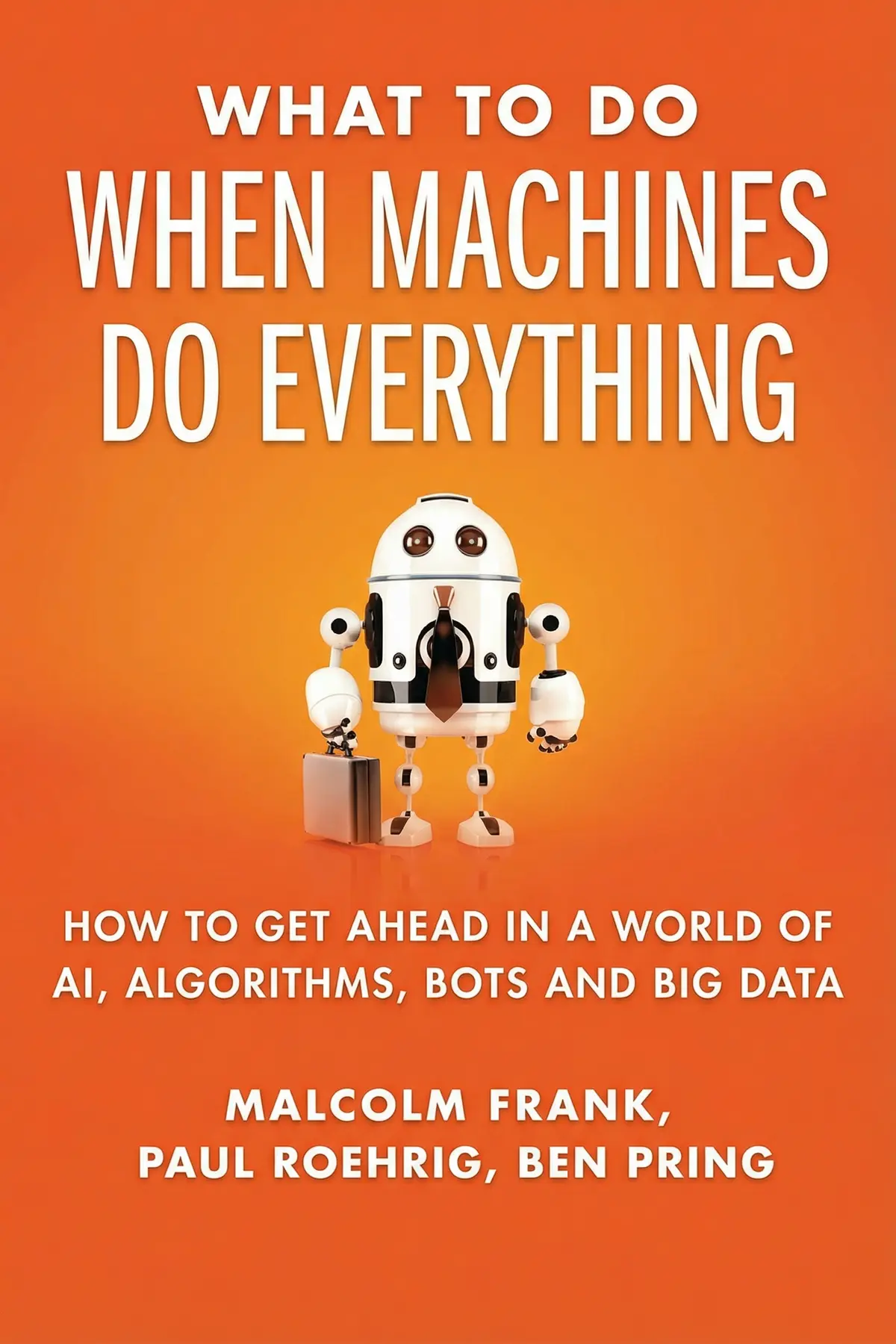
What To Do When Machines Do Everything addresses the growing fear of automation and provides a strategic roadmap for the era of artificial intelligence. It explores how systems of intelligence are reshaping industries and why data has become the world’s most valuable raw material. The authors promise that by understanding the shift from dumb to smart products and processes, business leaders can secure their place in a digital-first economy. Rather than a future of mass unemployment, the book outlines a transition where machines handle repetitive drudgery, allowing humans to focus on higher-value, more creative, and more impactful work.
Malcolm Frank, Paul Roehrig, and Ben Pring are executives at Cognizant, a global technology consultancy with more than 250,000 employees. They are recognized experts in how digital trends impact business and have also co-authored Code Halos.
Listeners find the material both revelatory and simple to digest, providing excellent observations on where AI might be headed. The information is also highly valuable for individuals in technology leadership, with one listener specifically pointing out the benefit of the provided framework. In addition, the text is praised for its all-encompassing scope and direct style. However, the work’s cheerful perspective draws varied responses from listeners.
Finally, a book that doesn’t treat the rise of AI like a scene from Terminator! The authors provide a beautifully optimistic and pragmatic overview of where technology stands today and where it’s headed. I loved the breakdown of how every major economic boom follows an S-curve, moving from initial bubble to eventual stability. It puts our current anxieties into a much-needed historical perspective. Not gonna lie, I was worried this would be too technical, but it’s actually very straightforward and easy to read. The examples of how machines can handle the mundane 'drudge work' so humans can focus on creativity are inspiring. We’ve been here before with the assembly line and the car, and we came out better on the other side. This is essential reading for anyone feeling anxious about their job security in the age of bots.
Show morePicked this up on a recommendation from my boss and I'm glad I did. It’s a comprehensive guide that finally demystifies what 'big data' actually means for a regular business. The presentation is straightforward, making complex topics like machine learning accessible to non-techies. I particularly enjoyed the section on the Luddites; it’s a great reminder that fear of new technology is as old as time. The book argues that AI will eventually create more jobs than it destroys, which is a perspective we don't hear often enough in the media. It’s eye-opening to think about how much 'invisible' data we generate and how that can be turned into a competitive advantage. If you're in a leadership role and feel like you're falling behind the curve, this book offers a very actionable framework to get back on track.
Show moreJust finished this and it’s a total breath of fresh air. Instead of the usual binary of 'AI will save us' or 'AI will kill us,' the authors take a very pragmatic stance. They show that while certain tasks will definitely be automated, the uniquely human elements of work—creativity, empathy, and complex problem-solving—will become more valuable than ever. The book is well-illustrated with case studies that show these theories in practice. I found the actionable steps for individuals particularly helpful. It’s not just about what companies should do, but what *you* should do to stay relevant. The writing style is engaging and the data they use to back up their historical claims is quite impressive. It’s a rare tech book that manages to be both informative and genuinely encouraging. Highly recommended for anyone trying to make sense of the digital economy.
Show moreAs someone who manages a small dev team, I found this to be a surprisingly practical guide for navigating the current tech landscape. The authors steer clear of the usual doom-and-gloom scenarios and instead offer what they call the AHEAD model, which focuses on data collection and refining business processes. It’s refreshing to see a focus on how humans can actually leverage these tools rather than just fearing them. To be fair, some of the analogies to the Industrial Revolution feel a bit stretched, and the writing can get a bit dry in the middle chapters. However, the strategic roadmap they lay out for organizational digital transformation is genuinely useful. It’s not a technical manual by any means, but for leadership roles, it’s a solid primer on why the 'fourth industrial revolution' is more about evolution than total replacement.
Show moreThe authors really nailed the historical S-curve pattern here. It’s easy to get caught up in the hype of the moment, but seeing how the steam engine and the assembly line followed the exact same path of innovation, bubble, and crash is incredibly grounding. I found the 'AHEAD' model—Automate, Halo, Enhance, Abundance, Discovery—to be a very helpful way to categorize different digital strategies. It isn't just about cutting costs; it's about finding new value. Truth is, most companies are still stuck in the paper-based mindset, and this book provides a clear kick in the pants to move toward a more data-driven approach. My only real complaint is that it occasionally feels like a sales pitch for the authors' consulting firm. If you can look past the corporate gloss, there’s some really high-quality strategic guidance in here.
Show moreLooking past the heavy corporate jargon, there’s a lot of meat here. The authors do a fantastic job of explaining why we are currently in a 'stagnation' period where the technology has arrived but the economic benefits haven't quite spread to everyone yet. It’s a balanced view that acknowledges the fear of job loss while remaining fundamentally hopeful. The chapter on the 'Halo' of data surrounding every physical product was a lightbulb moment for me. It completely changed how I think about my company's inventory and customer interactions. Personally, I think the section on self-diagnosing cars was a bit too 'sci-fi' for a business book, but it did a good job of illustrating the potential of the Internet of Things. Overall, a very informative read that helped me visualize a future where machines and humans work in tandem.
Show moreWhile the strategic insights are solid, I struggled with the tone of this book at times. The authors are clearly experts in their field, but the focus is so overwhelmingly business-centric that it ignores the very real social disruptions automation causes. They dismiss a lot of valid concerns as 'hogwash' or simple growing pains. In my experience, the transition for workers isn't nearly as smooth as their charts suggest. On the plus side, the AHEAD framework is a decent tool for visualizing how to integrate data analytics into a legacy business model. The chapter on 'Enlightening' processes was particularly thought-provoking. However, the book was written in 2017, and some of the predictions already feel a bit dated or overly simplistic given how fast LLMs have moved lately. It’s a good primer, just take the optimism with a grain of salt.
Show moreEver wonder how quickly a tech book can age? Reading this now is a strange experience because while the core principles hold up, the specific examples feel like they’re from a different era of AI. The book focuses heavily on 'bots' and 'algorithms' in a way that feels a bit pre-Generative AI. Still, the underlying message that we need to adapt our skills is timeless. The authors do a great job explaining why the middle of the S-curve is so painful for the workforce. I appreciated the section on how automated cars might change our daily lives, even if their vision of a car self-driving to a repair shop feels like it’s still decades away. It’s a decent introductory text, though it lacks the 'technical grit' that some readers might be looking for. Good for a flight read, but don't expect it to change your life.
Show moreThis felt like a collection of LinkedIn articles that someone decided to stretch into a full-length book. While the central premise—that we shouldn't fear AI—is comforting, the execution is incredibly repetitive and light on actual substance. Look, I understand the need for historical context, but comparing the current AI boom to the steam engine or the power loom over and over again doesn't count as 'unique insight.' It’s mostly corporate-speak designed to sell consulting services. Frankly, the most interesting part of the book is its ridiculously long title, which promises far more than the content actually delivers. If you’ve spent more than five minutes reading tech news in the last three years, you probably already know everything this book has to say. Not exactly the eye-opening experience I was hoping for after seeing it on so many 'must-read' lists.
Show moreI found this incredibly frustrating to get through. The authors seem to live in a world where free markets solve everything and 'ingenuity' magically fixes mass unemployment. Their ultraliberal approach completely ignores the human cost of these technologies. It’s a corporate manifesto disguised as a guide to the future. They spend so much time talking about how machines will make our lives easier, but they don't address the police-state dystopia that could arise from the very data collection they champion. The writing is repetitive, the arguments are far-fetched, and the tone is smug. If you want a book that actually explores the ethics of AI or the technical reality of how these systems work, look elsewhere. This is just a manual for how CEOs can replace their staff with algorithms while feeling good about it. Truly disappointing and lacks any real social conscience.
Show moreHamilton Helmer
Margaret Heffernan
AUDIO SUMMARY AVAILABLE
Get the key ideas from What To Do When Machines Do Everything by Malcolm Frank, plus 5,000+ more titles in English and Thai.







