
24 min 44 sec
Why Nations Fail: The Origins of Power, Prosperity, and Poverty
Why Nations Fail explores the deep-seated causes of global inequality, arguing that a country's success or poverty is determined not by geography or culture, but by the nature of its political and economic institutions.
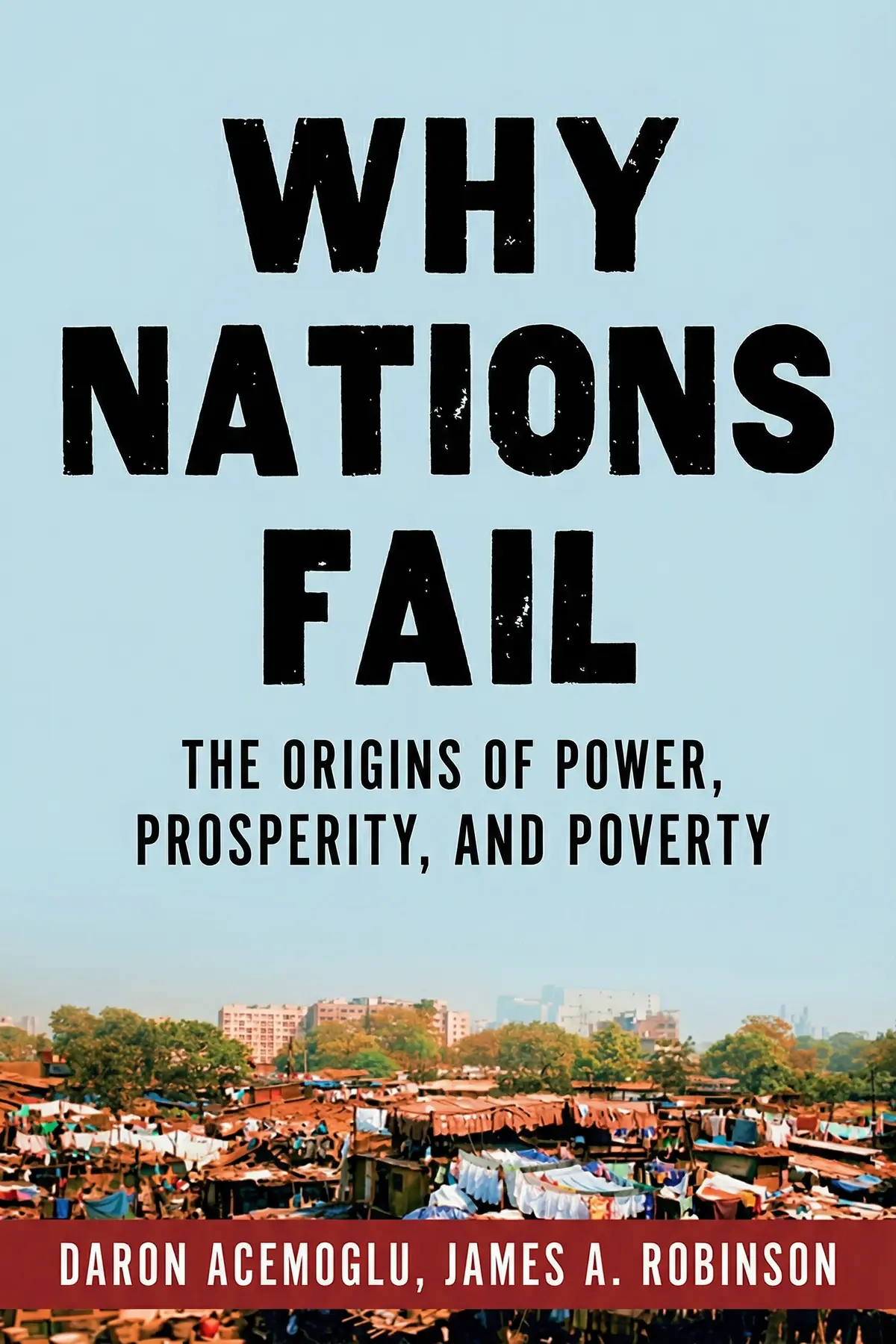
Table of Content
1. Introduction
2 min 00 sec
Imagine standing at a border where a single fence separates two worlds. On one side, people enjoy high-quality healthcare, modern schools, and the safety of a stable legal system. On the other side, just a few feet away, families struggle with rampant crime, poor infrastructure, and an income that is barely a third of their neighbors’. This isn’t a hypothetical scenario; it’s the daily reality in places like Nogales, which straddles the line between Arizona and Mexico.
When we see such stark disparities, we naturally ask: Why? Why do some nations rise to incredible heights of prosperity while others seem stuck in a cycle of poverty and dysfunction? For centuries, thinkers have tried to blame the weather, the soil, the local culture, or even the simple ignorance of leaders. But as we will explore in this summary of Why Nations Fail, those explanations often crumble under scrutiny.
The real secret to a nation’s fate lies in its institutions—the invisible rules and structures that govern how politics and the economy function. Over the next few sections, we’ll see how these institutions are built, why they persist, and how small moments in history can determine whether a country flourishes or fails. We will look at the difference between systems that invite everyone to participate and those that are designed to benefit only a select few.
Through stories spanning from the era of the Black Death to the rise of the industrial age and the struggles of modern-day developing nations, we’ll uncover a pattern. It’s a journey that takes us through the mechanics of power and the reasons why the road to wealth is often blocked by those at the top. By the end, you’ll have a new framework for understanding the news, the global economy, and the potential for any nation to change its destiny. Let’s begin by dismantling some of the most common myths about why countries end up where they do.
2. Dismantling Traditional Explanations for Global Inequality
2 min 27 sec
Is it the climate, the culture, or just a lack of knowledge that makes a nation poor? Discover why these popular theories fail to explain the real world.
3. The Divide Between Inclusive and Extractive Institutions
2 min 39 sec
The rules of the game determine who wins. Explore the fundamental difference between systems that share power and those that steal it.
4. Critical Junctures and the Path of Institutional Drift
2 min 16 sec
How small differences in history can lead to massive gaps in wealth. Learn how events like the Black Death changed the world forever.
5. Why the Industrial Revolution Started in England
2 min 09 sec
England wasn’t just lucky; it was prepared. See how a political revolution in 1688 paved the way for the greatest economic boom in history.
6. The Fear of Creative Destruction
1 min 59 sec
Progress isn’t always welcome. Discover why powerful elites throughout history have actively blocked new technologies and ideas.
7. The Self-Fulfilling Nature of Extractive Systems
2 min 21 sec
Extraction doesn’t just happen; it persists. Learn why the ‘Iron Law of Oligarchy’ makes it so hard for nations to change their ways.
8. How Inclusive Institutions Protect Themselves
2 min 14 sec
Stability isn’t about having a strong leader; it’s about having a strong system. Explore how virtuous cycles keep prosperity alive.
9. The Illusion of Growth Under Extraction
2 min 18 sec
Can a dictatorship actually be good for the economy? The case of the Soviet Union reveals why top-down growth is a dead end.
10. Breaking the Vicious Cycle
2 min 13 sec
History is not destiny. Discover how nations like Brazil have managed to pivot from extraction to inclusion through grassroots power.
11. Conclusion
2 min 08 sec
As we wrap up our journey through Why Nations Fail, the central message is clear: the wealth and poverty of nations are not accidents of nature. They are the predictable results of the choices societies make about how to govern themselves. Prosperity is built on the foundation of inclusive institutions—systems that protect property, encourage innovation, and spread power among many different voices. In contrast, failure is the inevitable result of extractive institutions that concentrate wealth and power in the hands of a few, stifling the creativity and energy of the rest of the population.
We’ve seen that these systems are incredibly durable. They create cycles that can last for centuries. But we’ve also seen that they are not permanent. Whether it was the peasants of Western Europe after the Black Death, the merchants of England in 1688, or the workers of Brazil in the 1980s, history is full of moments where the cycle was broken. These changes often happen during critical junctures—moments of crisis or opportunity that allow for a new path to be taken.
What does this mean for us today? It means we should look at the world’s problems with a more critical eye. When we see a nation struggling, we shouldn’t just look at its GDP or its resources; we should look at its rules. Who has the power? Are the courts fair? Can a regular person start a business without paying a bribe? The answers to these questions are the true indicators of a nation’s future.
For those of us living in inclusive societies, the lesson is one of vigilance. Inclusive institutions are not a natural state of being; they are the result of constant effort and struggle. They must be defended against the ever-present temptation of elites to concentrate power. And for the rest of the world, the message is one of hope. No matter how long a nation has been trapped in poverty, the possibility for institutional reform is always there. The engine of prosperity isn’t found in the soil or the sun—it’s found in the hearts and minds of people who are given the freedom to build their own future.
About this book
What is this book about?
Why do some countries experience immense wealth while others remain trapped in cycles of poverty? This exploration seeks to answer that fundamental question by looking back through centuries of human history. The authors move beyond traditional explanations like climate, religion, or the lack of expert knowledge. Instead, they propose a compelling framework centered on the concept of inclusive versus extractive institutions. The book promises to show that prosperity is the result of political and economic systems that share power and incentivize innovation. Conversely, failure is the outcome of systems designed to funnel wealth toward a small elite. By analyzing everything from the Roman Empire to modern-day North Korea and Botswana, the narrative reveals how small historical shifts can set nations on wildly different paths. It is a comprehensive look at the mechanisms of power and the possibility of institutional reform.
Book Information
About the Author
Daron Acemoglu
Daron Acemoglu is a highly distinguished economist and a professor at the Massachusetts Institute of Technology. He is widely recognized for his contributions to the field and was awarded the John Bates Clark Medal, an honor often seen as a precursor to the Nobel Prize. James A. Robinson is a prominent political scientist and economist serving as a professor at Harvard University. An expert in foreign aid and institutional development, he has conducted extensive research on the political landscapes of Latin America and Africa.
Ratings & Reviews
Ratings at a glance
What people think
Listeners find this work both thought-provoking and accessible, commending its thoroughly researched foundation in historical evidence. Furthermore, the prose is straightforward and thorough, with one listener mentioning that the text stays away from mathematical or technical explanations. Listeners also value the emphasis on economic and political frameworks, with one review emphasizing how inclusive systems lead to prosperity. The authors build a persuasive case using a variety of case studies, creating an essential resource for anyone curious about global history and economics.
Top reviews
Ana
Finally got around to reading this doorstopper and it didn't disappoint. The authors move away from simplistic geographic or cultural explanations, focusing instead on how political power is distributed. They use historical "critical junctures"—like the Black Death or the Atlantic trade—to show how small institutional differences can lead to massive divergence over centuries. I loved the Botswana example; it’s refreshing to see a success story that defies the typical "resource curse" narrative found in other economic texts. To be fair, the prose can feel a bit repetitive as they hammer home the "inclusive vs. extractive" point, but the depth of research is staggering. It makes complex global inequality feel understandable without relying on dense mathematical models or jargon. This is easily a must-read for any history buff.
Show moreSarocha
Wow, I didn't expect a book about macroeconomics to be this engrossing or easy to digest. Acemoglu and Robinson avoid the trap of technical jargon, opting instead for a narrative-driven approach that spans thousands of years of human history. The concept of "institutional drift" was a revelation for me, explaining how tiny differences in how a society responds to a crisis can lead to vastly different futures. Personally, I found the chapter on the Industrial Revolution particularly insightful because it highlights why some monarchs actively blocked new technologies like the steam engine to protect their own interests. It’s a sobering look at how human greed can literally hold back progress for centuries. If you enjoy authors like Jared Diamond or Steven Levitt, you’ll find this right up your alley, though it challenges many of their core assumptions.
Show moreLillian
Daron Acemoglu and James Robinson have crafted a masterpiece that feels both timely and timeless. They argue that the difference between the US and Mexico or the two Koreas isn't due to weather or work ethic, but the rules governing society. The way they trace the "iron law of oligarchy" through various revolutions is both chilling and illuminating. I loved how the book emphasizes that prosperity isn't guaranteed; it requires constant vigilance to keep institutions inclusive. Not gonna lie, I was worried it would be too academic, but it reads like a series of interconnected historical mysteries. It’s easily one of the most important books I’ve read in the last decade. It should be required reading for anyone interested in why the world is the way it is.
Show morePia
This book provides a masterclass in why some countries prosper while others remain trapped in poverty. Acemoglu and Robinson argue convincingly that inclusive institutions, which protect property rights and encourage "creative destruction," are the engine of sustainable growth. I was fascinated by the deep dive into the Glorious Revolution and how it set England on a different path than its European neighbors. Frankly, the writing is incredibly clear and accessible for such a heavy topic. My only gripe is that the authors tend to dismiss factors like climate and geography a bit too readily, which felt slightly one-dimensional at times. However, the sheer volume of historical evidence they provide—from the Maya to the Roman Empire—is hard to ignore. It’s a compelling, well-reasoned argument that changed how I look at global politics.
Show moreUbolwan
As someone who usually avoids non-fiction, I found "Why Nations Fail" surprisingly accessible and fast-paced. The authors do a great job of showing that the poverty of nations isn't an accident but a choice made by those in power. I particularly enjoyed the section on "creative destruction" and how new technologies often threaten the status quo of established elites. To be honest, I felt the book could have been about 100 pages shorter without losing its impact because the main thesis is stated early and repeated often. Still, the historical anecdotes about the Dutch East India Company and the massacre at the Banda Islands were eye-opening and deeply researched. It’s a dense read, but the lack of math makes it much more approachable for a general audience. A solid pick for anyone curious about the roots of inequality.
Show moreVera
The logic of inclusive vs extractive institutions is a powerful lens through which to view the world. I picked this up because I wanted to understand the disparity between North and South Korea, and the authors explain it perfectly through the incentives created by their respective regimes. Truth is, the book is incredibly ambitious, attempting to summarize the rise and fall of civilizations through a single political theory. While the prose is clear and the examples are vivid, the tone can be a bit repetitive toward the end. I also wish they had engaged more with the environmental costs of the "sustainable growth" they champion. Regardless, the historical breadth—from the Roman Empire's collapse to the modern growth of China—makes it an essential contribution to the field of political science.
Show moreDream
After hearing so much hype about this book in my economics class, I finally dove in. It’s essentially a long-form argument against the idea that geography or culture determines a nation's destiny. The authors' focus on how political centralization is necessary for inclusive economic growth was particularly interesting to me. Look, it’s a well-researched piece of scholarship that reads more like a history book than a dry economic treatise. I appreciated that they didn't rely on complex formulas to prove their points. My only criticism is that the "virtuous circle" concept feels a bit like wishful thinking at times, ignoring how even inclusive systems can be corrupted over time. It’s a thought-provoking read that will definitely spark debate, even if you don't agree with every conclusion.
Show moreDiego
This book’s focus on political and economic institutions offers a compelling alternative to the geographic theories of Jared Diamond. The authors show that when a small elite controls the resources, they have no incentive to innovate, leading to stagnation and eventual failure. I found the analysis of the Maya civilization’s collapse particularly interesting, even if it was a bit speculative. Gotta say, the writing is clear and detailed, avoiding the technical jargon that usually makes economic books such a chore to read. While it repeats itself quite a bit, the sheer variety of examples—from the Ottoman Empire to modern Sierra Leone—keeps you turning the pages. It’s a fascinating, well-supported argument that highlights why the struggle for pluralism is so vital for global prosperity.
Show moreGabriel
Ever wonder why some nations thrive despite having zero natural resources? This book attempts to answer that by looking at institutional frameworks rather than the usual suspects like location or religion. The core idea is solid: elites who extract wealth for themselves inevitably stifle innovation because they fear losing their grip on power. Not gonna lie, the first 200 pages were electric, especially the comparison between the colonization of North versus South America. But by the halfway point, the "extractive" and "inclusive" labels start feeling like a hammer looking for nails. Every single historical event is forced into this binary, which feels a bit reductive for a 500-page tome. It’s a brilliant magazine article expanded into a somewhat bloated book, though still worth the time for the unique case studies.
Show moreSook
Picked this up on a recommendation, but I have mixed feelings. On one hand, the historical data is fascinating and the writing style is very approachable for a layperson. On the other hand, the authors seem to ignore any facts that don't fit their specific "institutional" mold. For example, their dismissal of the role of tropical diseases in African development felt a bit too convenient for their theory. To be fair, the stories they tell are captivating—I particularly liked the bit about the Tudor and Stuart kings in England—but the repetition of the core thesis becomes exhausting after the fourth or fifth chapter. It’s a good book with a great premise, but it lacks the nuance I was hoping for in such a highly-regarded work of political science.
Show moreFeatured in

Readers also enjoyed

23 Things They Don’t Tell You About Capitalism
Ha-Joon Chang

A Little History of Economics
Niall Kishtainy
A Promised Land
Barack Obama


A River in Darkness: One Man’s Escape from North Korea
Masaji Ishikawa
A Splendid Exchange: How Trade Shaped the World
William J. Bernstein
A Theory of Justice
John Rawls
AUDIO SUMMARY AVAILABLE
Listen to Why Nations Fail in 15 minutes
Get the key ideas from Why Nations Fail by Daron Acemoglu, plus 5,000+ more titles in English and Thai.
- 5,000+ titles
- Listen as much as you want
- 7-day free trial
- Cancel anytime







