Fooled by Randomness: The Hidden Role of Chance in Life and the Markets
Nassim Nicholas Taleb
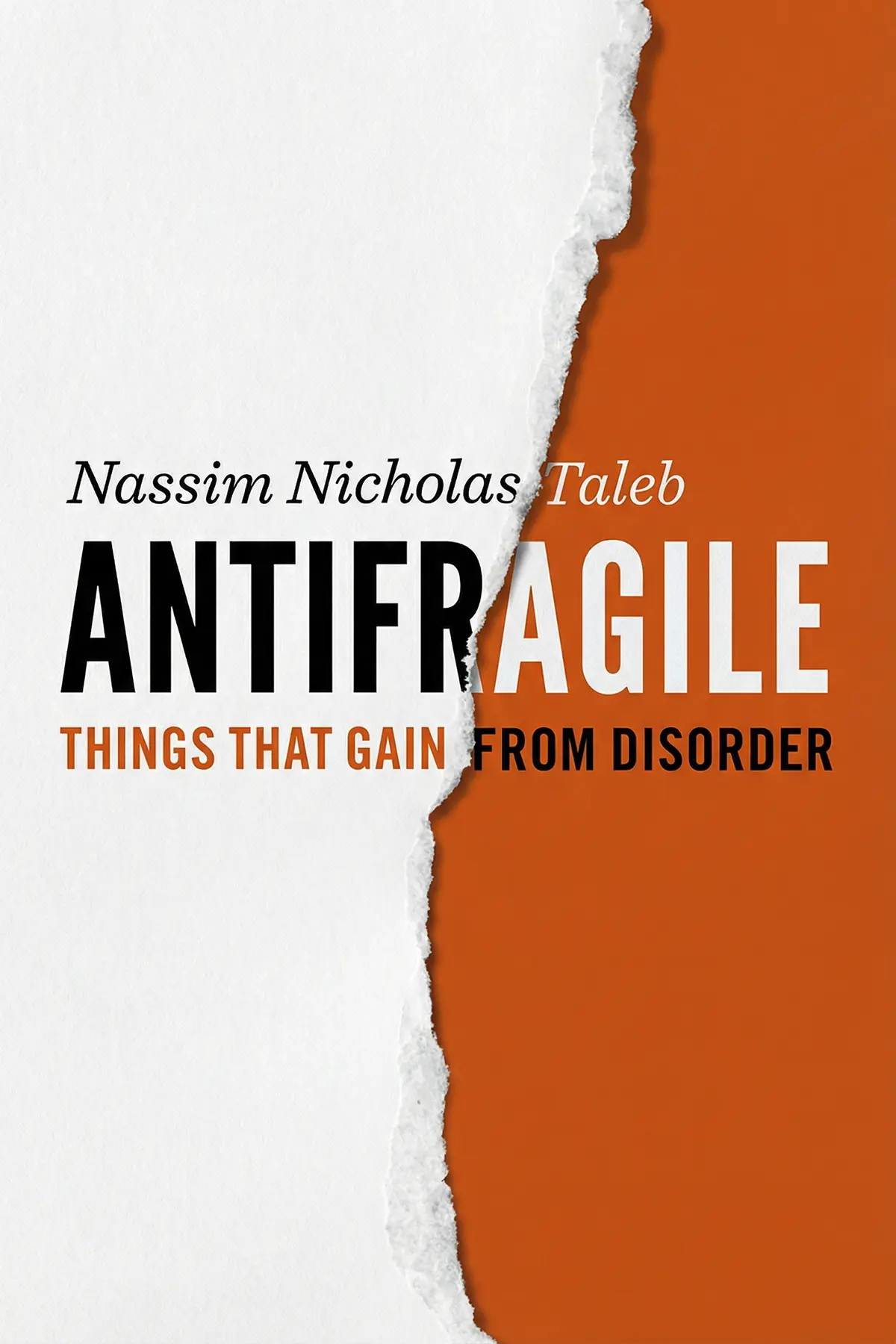
Explore the revolutionary concept of systems that don't just survive chaos, but actually grow stronger because of it, offering a new framework for navigating an unpredictable and volatile modern world.
2 min 03 sec
Imagine you are sending a gift through the mail. If that gift is a delicate vase, you would wrap it in layers of padding and stick a bright red label on the box that says ‘Handle with Care.’ This is because the vase is fragile; it is harmed by shocks, drops, and the rough-and-tumble reality of a delivery truck. If you were to think about the opposite of that vase, your mind might jump to a block of steel. A block of steel is robust; it can be dropped or shaken and remain exactly as it was. But notice that the steel doesn’t get better from being dropped. It simply resists change.
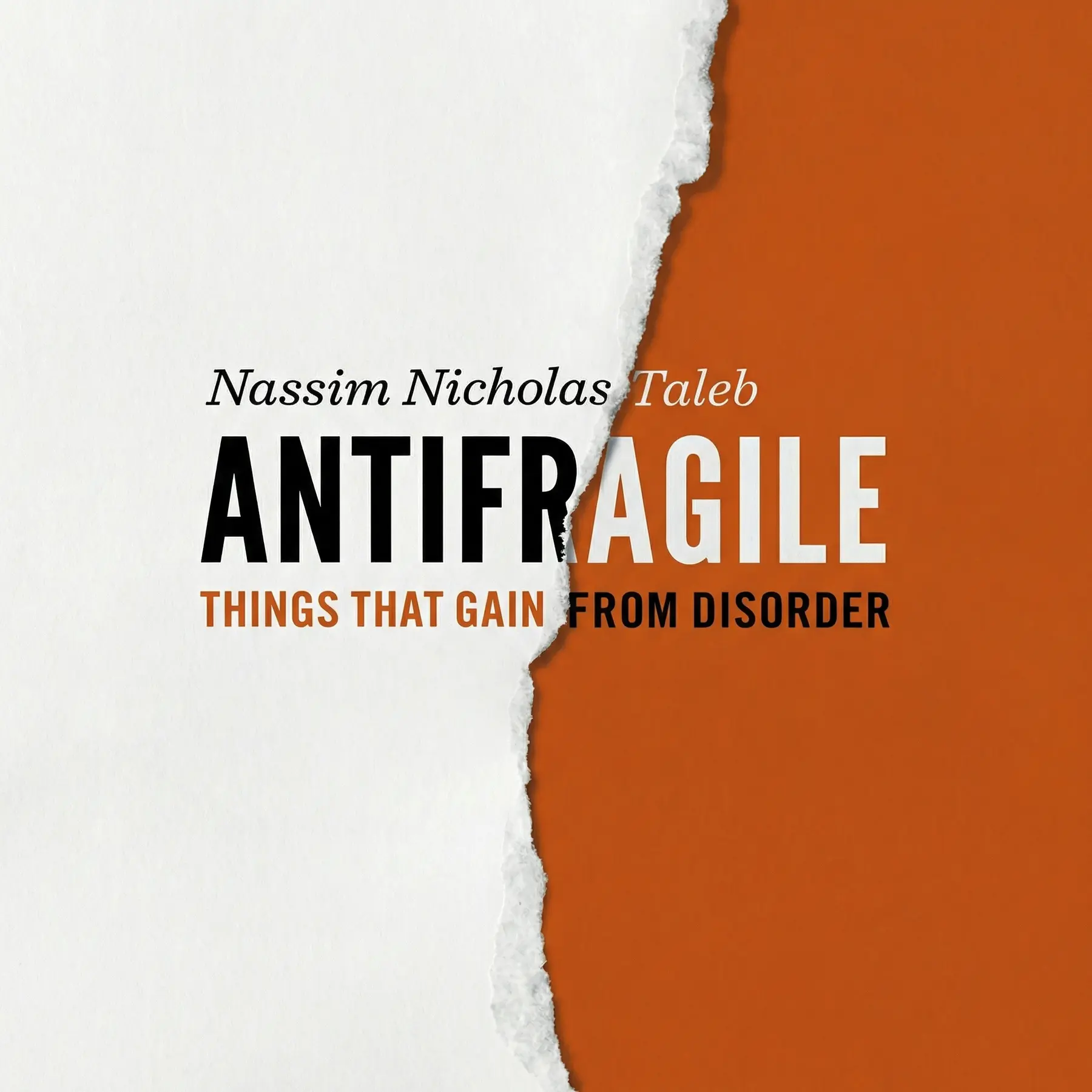
In this exploration of Nassim Nicholas Taleb’s work, we are looking for a third category: something that doesn’t just resist shock, but actually requires it to improve. This is the essence of being antifragile. It’s a concept so foreign to our modern way of thinking that most languages don’t even have a word for it. We understand what it means to break, and we understand what it means to be durable, but we often miss the category of things that gain from disorder.
Think of the ancient myth of the Hydra. When one of its heads was severed, two more grew back in its place. The monster didn’t just survive the injury; it became more dangerous because of it. This is the throughline of our discussion today. We live in a world that is increasingly obsessed with stability, predictability, and safety. However, by trying to smooth out every bump in the road, we might actually be making ourselves and our systems more vulnerable. Over the next several sections, we will break down how antifragility works in nature, in the economy, and in our personal lives. We will see why small failures are necessary for large-scale success and how you can position yourself to benefit from the very things that make others tremble. By the end, you’ll see that volatility isn’t something to be feared, but a vital source of energy for those who know how to harness it.
2 min 19 sec
Most people assume the opposite of fragility is strength or robustness, but there is a hidden category of things that actually require stress to survive.
2 min 11 sec
For a large system to grow stronger, it often requires the smaller parts within it to be vulnerable and even fail.
2 min 02 sec
When our bodies or systems face a shock, they don’t just repair the damage; they build extra capacity to handle even bigger shocks in the future.
2 min 00 sec
Trying to eliminate all volatility from a system is the fastest way to make it vulnerable to a massive, catastrophic collapse.
1 min 54 sec
You don’t need to be an expert at forecasting the future if you focus on creating options that allow you to benefit from any outcome.
2 min 08 sec
To protect yourself from ruin while staying open to massive success, you must avoid the ‘middle’ and focus on the extremes.
1 min 57 sec
In a crisis, being big is often a disadvantage because it leads to ‘squeezes’ where you are forced to act at any cost.
1 min 48 sec
Systems fall apart when the people making the decisions don’t have to suffer the consequences of being wrong.
1 min 58 sec
Trying to fix small problems often leads to much bigger ones because we overestimate our ability to control complex systems.
2 min 13 sec
We are consistently blind to the limits of our knowledge, relying on the past to predict a future that it cannot possibly contain.
1 min 49 sec
As we wrap up our journey through the world of the antifragile, it’s worth reflecting on the central throughline: we cannot eliminate the unknown, so we must learn to love it. We have seen that the most resilient and vibrant systems—from the muscles in our bodies to the vast reaches of evolution—actually require stress, volatility, and disorder to thrive. When we try to build a world that is perfectly smooth and perfectly safe, we are not creating a utopia; we are creating a fragile glass house that will eventually shatter.
The takeaway for your life is clear. Stop trying to be a turkey, collecting data on the past and hoping that tomorrow will look exactly like yesterday. Instead, embrace the barbell. Protect your downside by eliminating the risks that could truly ruin you, but stay wide open to the ‘positive black swans’—the unexpected opportunities that can only be found through tinkering, experimenting, and taking small, manageable risks.
Remember the importance of skin in the game. Don’t trust the experts who don’t have to live with the consequences of their mistakes, and don’t be that person yourself. Be a person whose actions and beliefs are tied to reality. Seek out ‘options’ rather than ‘plans.’ A plan is a rigid script that breaks when the world changes; an option is a tool that gives you the power to pivot when the world changes.
Ultimately, being antifragile is a mindset of courage. It is the realization that while the wind will blow out a candle, it will fan a fire. Your goal is not to hide from the wind, but to become the fire. By welcoming the small shocks of life and using them as fuel for your own growth, you can navigate an uncertain future not with fear, but with the quiet confidence of someone who knows they are built to gain from the disorder.
What if the opposite of fragile isn't robust, but something entirely different? In this summary, we delve into the concept of systems that thrive under pressure. While we usually think of volatility as a threat, this exploration reveals that many natural and economic structures require stress and disorder to improve and evolve. From the way our muscles grow after a workout to the way the global economy iterates through failure, we see a pattern of gain from disorder. The promise here is a fundamental shift in how you view risk and uncertainty. Instead of trying to predict the future or eliminate all variables, you will learn how to build a life and a career that benefits from the unexpected. By understanding the mechanics of overcompensation, the strategy of the barbell, and the importance of having skin in the game, you can move from being a victim of fate to a beneficiary of the unknown.
Nassim Nicholas Taleb is a renowned academic and the author of influential bestsellers including The Black Swan and Fooled by Randomness. He has dedicated his professional life to investigating the origins and consequences of uncertainty, probability, and risk. Currently, he serves as a Distinguished Professor of Risk Engineering at the Polytechnic Institute of New York University.
Nassim Nicholas Taleb
Nassim Nicholas Taleb
Nassim Nicholas Taleb
Listeners find the work stimulating and informative, hailing it as a philosophical discourse that stands out for its wealth of concepts. Furthermore, they view it as worth finishing, with one listener highlighting that it is jam-packed with ideas. Still, the prose style draws varied responses, as some enjoy it while others characterize it as terrible. There is also disagreement regarding its accessibility, with some finding it simple to follow whereas others deem it a difficult read.
Finally got around to finishing Antifragile, and my brain feels like it’s been through a high-intensity workout. Taleb is basically the philosopher of the 21st century, arguing that we shouldn't just be 'robust'—we need to be systems that actually get stronger from chaos. He uses examples like evolution and the immune system to show how stress is necessary for growth. I’ll admit, the guy is arrogant as hell and clearly doesn't care what a copy editor thinks, but the 'skin in the game' concept alone is worth the price of admission. It’s a dense read, jam-packed with ideas that make you question why we over-plan everything. Sometimes he gets lost in his own 'FU money' rants, but the core message is too important to ignore. If you want to understand how the world actually works beyond the neat models of academia, read this.
Show morePick this up if you're tired of the usual self-help or business drivel that promises 'certainty' in an uncertain world. Taleb’s focus on 'skin in the game' as an ethical imperative is probably the most profound thing I’ve read this year. He points out how modern systems fail because the people making decisions don't suffer when they're wrong. The book is a fractal—you can open it to almost any page and find a provocative thought about why nature is smarter than a committee of PhDs. It’s a difficult read, sure, and he’s definitely not interested in making friends with the 'fragilistas.' But the insights into how we transfer risk to others are chillingly accurate. A total fount of ideas for anyone willing to put in the effort.
Show moreEverything changed for me after I started looking at my life through the lens of optionality. Taleb teaches you that you don't need to know exactly what the future holds as long as you have options that pay off when things get wild. It’s a liberating perspective. The book is definitely jam-packed with ideas, from how we eat (the Paleo-style rejection of 'modern' food) to how we exercise and invest. I love his respect for the 'ancients' and his disdain for the 'modernity' that tries to smooth out all the bumps in life. Yes, he is arrogant. Yes, the book is 200 pages too long. But the content is so rich that I found myself highlighting almost every other paragraph. A true masterpiece of modern philosophy.
Show moreTo be fair, Taleb is an acquired taste, but once you 'get' his rhythm, this book is indispensable. He isn't just writing about finance; he’s writing about a way of being in the world that respects complexity. The idea that we make things fragile by trying to stabilize them is something you see everywhere once you know to look for it. Whether he’s talking about forest fires or the economy, the logic holds up. I appreciated the 'Fat Tony' anecdotes for adding some levity to the heavy philosophical lifting. It’s an educational treatise that carries the day because it refuses to play by the rules of standard non-fiction. It’s unfiltered, raw, and full of the kind of wisdom you only get from someone who has actually had skin in the game.
Show moreTaleb is the kind of author you want to buy a drink for and punch in the face at the same time. He is brilliantly contrarian, particularly when he’s tearing into the 'fragilistas' of the economic and academic world. I loved the section on iatrogenics—the idea that our interventions often cause more harm than good because we can't resist 'doing something.' The truth is, the book is quite long and could have been trimmed significantly if he didn't repeat himself so much. However, his defense of 'Fat Tony' style street smarts over 'Socrates' style over-rationalization is refreshing. It’s not an easy read by any stretch, but it’s deeply educational if you can stomach his ego. You’ll never look at a 'fragile' system the same way again.
Show moreAs a math person, I found Taleb’s use of Jensen’s inequality and convexity to be a fascinating way to look at risk management. He argues that we should focus on optionality rather than prediction, because predictions are usually wrong. The 'Barbell Strategy' he suggests—playing it very safe on one side and taking high-upside risks on the other—is something I’ve already started applying to my own portfolio. Frankly, the writing style is hit or miss; he’s dismissive of almost everyone who isn't a Roman philosopher or a street trader. But beneath the abrasive tone, there’s a wealth of subtractive knowledge here. It’s a book about how to survive a world that is fundamentally unpredictable. Just be prepared to skip the parts where he rants about his personal enemies.
Show moreThe chapter on the 'Soviet-Harvard' delusion had me laughing out loud even while I was nodding in agreement. Taleb is a master of the 'via negativa'—the idea that we improve things by removing what’s bad rather than adding more 'solutions.' His examples of 'Fat Tony' outsmarting the ivory tower types are great fun, even if they're a bit exaggerated. It’s a huge, sprawling mess of a book, but I’d rather read something messy and original than something polished and vapid. I do think he overcomplicates some of the math to make himself look smarter, which is ironic for someone who hates 'over-rationalization.' Still, the philosophy of embracing volatility is a game-changer for anyone in business or leadership.
Show moreNot what I expected from a business book, mostly because it’s actually a deep dive into epistemology and risk. Taleb’s core argument about the 'Black Swan'—those rare, unpredictable events—continues here with a focus on how to survive them. I especially liked the distinction between being a 'tourist' and a 'flâneur' in life. One seeks a scheduled experience, while the other gains from the unexpected. My only real gripe is the tone; he treats anyone who disagrees with him like they’re an idiot. It’s a bit much at times. However, his points about how we 'lecture birds on how to fly' (thinking theory precedes practice) are incredibly sharp. It’s a challenging, annoying, and ultimately rewarding book that stays with you.
Show moreIs it brilliant or just a long rant? I’m still not entirely sure. The central premise—that we should build systems that thrive on disorder—is 100% worth considering. But Taleb is so dismissive of science and 'lecturing birds' that he often undermines his own points. He acknowledges that evolution is antifragile but ignores that it also results in massive extinctions, which seems like a pretty big 'fragile' detail to gloss over. The book is undeniably thought-provoking, yet it’s so repetitive that I found myself skimming the later chapters. To be fair, his critique of the banking system and the way it privatizes gains while socializing losses is spot on. I just wish he had a better editor to help him stay on track instead of wandering off into diatribes about his gym routine.
Show moreThis could have been 100 pages of brilliance, but instead, it’s 500 pages of unfiltered ego and repetitive math that feels like blowing smoke. Taleb clearly has 'FU money,' and it shows because it feels like no editor was allowed within ten miles of this manuscript. He spends so much time mocking 'Soviet-Harvard' types and 'soccer moms' that the actual logic of antifragility gets buried under layers of petty grievances. I was really looking forward to the technical appendix, but the equations include undefined variables and seem designed to intimidate rather than explain. It's frustrating because the core idea—that some things benefit from volatility—is genuinely interesting. But the delivery is so disorganized and pompous that I struggled to reach the end.
Show more
Andrew Ross Sorkin
Nigel Warburton
John Rawls
Ha-Joon Chang
Niall Kishtainy
William J. Bernstein
AUDIO SUMMARY AVAILABLE
Get the key ideas from Antifragile by Nassim Nicholas Taleb, plus 5,000+ more titles in English and Thai.