
19 min 23 sec
Common Sense on Mutual Funds: New Imperatives for the Intelligent Investor
A foundational guide to sensible investing, emphasizing low-cost index funds, long-term discipline, and the critical importance of minimizing fees to maximize wealth in an industry often driven by marketing over stewardship.
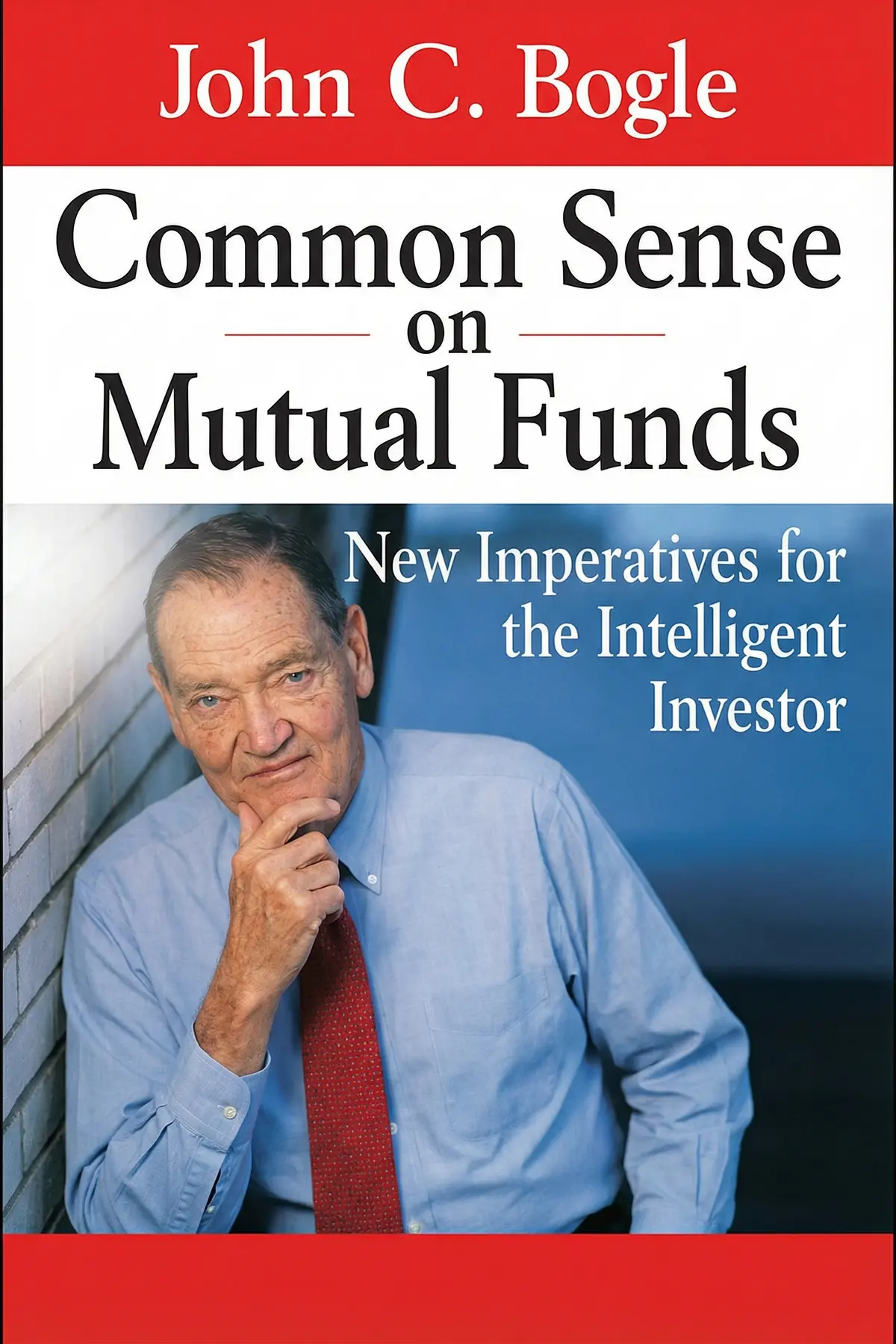
Table of Content
1. Introduction
1 min 44 sec
The world of finance often feels like a sprawling, chaotic labyrinth designed to confuse even the most diligent person. Everywhere you turn, there’s a new ‘hot’ stock tip, a complicated financial product, or a charismatic fund manager claiming they’ve found a way to beat the system. But what if the secret to building wealth isn’t about finding the exit to the maze, but about refusing to enter it in the first place? This is the central premise of John C. Bogle’s philosophy. He argues that the most effective way to invest isn’t through complex strategies or high-priced expertise, but through the simple application of common sense.
At its heart, successful investing is a battle against two major enemies: cost and emotion. The financial industry thrives by convincing you that more is better—more trading, more professional management, and more expensive advice. Yet, as Bogle demonstrates, the reality is exactly the opposite. In the long run, the more you pay the financial industry, the less you keep for yourself. The throughline of this summary is clear: by embracing simplicity, minimizing costs, and maintaining a long-term perspective, you can stop being a source of profit for Wall Street and start being a successful builder of your own financial future.
In the pages that follow, we will pull back the curtain on the mutual fund industry. We’ll explore why most professional stock pickers fail to keep up with the market, why your best friend in the investment world is a low-cost index fund, and how the simple passage of time is the most powerful tool in your arsenal. We are going to look at how to structure a portfolio that can withstand the inevitable storms of the market and why, in a world of high-speed trading and constant noise, the most revolutionary thing you can do is simply stay the course.
2. The Power of Time and Patience
1 min 59 sec
Discover why the best investment strategy is often the one that requires the least amount of activity, and how staying the course beats market timing.
3. The Arithmetic of Investment Costs
2 min 02 sec
Learn how small management fees and hidden trading costs can quietly strip away a massive portion of your potential retirement savings over the decades.
4. The Failure of Active Management
2 min 09 sec
Understand why professional fund managers consistently struggle to beat the market and why a simple index fund is usually the superior choice.
5. The Importance of Asset Allocation
1 min 59 sec
Explore how the balance between stocks and bonds determines your investment success far more than the specific funds you choose.
6. The Shift from Stewardship to Salesmanship
1 min 57 sec
Examine the changing landscape of the mutual fund industry and how marketing has overshadowed the original goal of serving investors.
7. Tax Efficiency and the Hidden Drain
2 min 04 sec
Uncover the impact of taxes on your investment returns and why high-turnover funds are often a tax disaster for the unwary.
8. The Pitfalls of Size and Complexity
2 min 04 sec
See why bigger isn’t always better in the world of mutual funds and how complexity often serves the industry rather than the individual.
9. The Human Element: Character and Integrity
1 min 59 sec
Reflect on the ethical dimensions of finance and why choosing a firm with a focus on trust and partnership is essential for long-term success.
10. Conclusion
1 min 26 sec
As we reach the end of our journey through the principles of common-sense investing, the path forward becomes remarkably clear. We’ve seen how the financial industry often acts as a giant distraction, pulling our attention toward the noise of the short term and the lure of expensive expertise. But we have also discovered the enduring power of the fundamentals: minimizing costs, maximizing time, and maintaining a disciplined asset allocation.
The most important lesson to take away is that you are the primary architect of your financial destiny. You don’t need a PhD in finance or a secret connection on Wall Street to be a successful investor. What you need is the courage to be simple in a world that praises complexity. By choosing low-cost index funds, you aren’t settling for average; you are mathematically guaranteeing yourself a better outcome than the vast majority of people who are paying high fees for the illusion of outperformance.
But remember, the best plan in the world is useless if you don’t have the temperament to stick with it. There will be times when the market is booming and you feel like you’re missing out on the latest fad, and there will be times when the market is crashing and every headline tells you to run for the exits. This is when common sense becomes your superpower. In those moments, remind yourself of the throughline: the market rewards those who stay the course. Trust the arithmetic, trust the power of compounding, and trust in your own ability to remain patient. Your future self will thank you for the quiet, common-sense decisions you make today.
About this book
What is this book about?
This summary explores the timeless investment principles established by John C. Bogle, the visionary founder of Vanguard. It deconstructs the mutual fund industry, revealing how high fees, excessive trading, and aggressive marketing tactics often erode the wealth of individual investors. By contrasting the pitfalls of active management with the steady efficiency of passive indexing, it provides a roadmap for building a secure financial future. Listeners will discover the 'arithmetic of investing,' which proves that lower costs lead to higher returns over time. The summary also covers essential strategies for asset allocation, the importance of tax efficiency, and the necessity of staying the course during market volatility. It ultimately promises a common-sense approach to wealth accumulation that prioritizes the interests of the individual investor over the profits of financial institutions.
Book Information
About the Author
John C. Bogle
John C. Bogle was the founder of the Vanguard Group and a transformative figure in the financial world. He is widely credited with creating the first index fund for individual investors, a move that revolutionized how people save for retirement. An advocate for low-cost, long-term strategies, Bogle spent his career championing the rights of the average investor. He authored several best-selling books, including The Little Book of Common Sense Investing and Stay the Course, all of which reflect his commitment to simplicity and financial discipline.
Ratings & Reviews
Ratings at a glance
What people think
Listeners describe the material as exceptionally clear and simple to grasp, though one individual remarks that it feels similar to a college textbook. They also value its utility as a manual for investing, with one listener labeling it the finest financial title available on mutual funds. Finally, the caliber of the content earns praise, with one listener emphasizing the use of historical data going back several hundred years.
Top reviews
Dylan
John Bogle’s masterpiece is less of a typical finance book and more of a historical manifesto for the common investor. He uses historical data going back several hundred years to prove that the "arithmetic of investing" is undefeated. While some chapters read like a dense college text, the core message is incredibly easy to understand: keep your costs low and stop trying to outsmart the market. The book is an essential investment guide that exposes how the financial industry prioritizes their own profits over your retirement. It’s a dense read, but if you want to understand the economics of mutual funds, there is simply no better source available.
Show moreUbolwan
Why did I wait so long to read this foundational text? Bogle is practically a saint in the investing world, and his passion for the individual shareholder shines through every page. He doesn't just give advice; he provides a meticulous breakdown of why index funds are superior to active management. The truth is, most managers are just charging you high fees to underperform. I loved the section on the "four dimensions of investing"—risk, return, cost, and time. It’s a long book, and occasionally repetitive, but the wisdom inside is worth every second of your time.
Show moreWanida
The 10th-anniversary edition is a bit of a mixed bag because of the formatting, but the content is gold. I really enjoyed Bogle’s updates where he reflects on his previous predictions—he’s remarkably humble when he’s wrong and rightfully vindicated when he’s right. But the way these updates are spliced into the original text can be confusing, especially if you’re listening to the audiobook version. That being said, the core logic remains impeccable. He rips into the "marketing machine" of Wall Street that treats investors like customers rather than owners. If you can push through the dense, academic-style prose, you’ll come away with a much clearer understanding of how to build a portfolio.
Show moreWyatt
Look, if you want a get-rich-quick scheme, go somewhere else. This is a book about discipline, patience, and the cold, hard math of compounding. Bogle explains that the "winner’s game" is simply avoiding the "loser’s game" of high costs and frequent trading. The historical data he presents is staggering and makes a very compelling case for why index funds are the only logical choice for 99% of people. Some parts feel like a college textbook, but that’s actually a plus—it means he’s backing up his claims with substance instead of just shouting vague platitudes at the reader.
Show moreAnna
To be fair, this is one of the most exhaustive looks at the mutual fund industry ever penned. Bogle focuses heavily on the cost structure of funds, illustrating how seemingly small fees can cannibalize a huge portion of your lifetime returns. I appreciated the specific rules for selecting funds, like ignoring "stars" and avoiding large asset sizes that inhibit performance. However, be prepared for some heavy jargon. If you aren't already familiar with expense ratios or turnover, you might find yourself reaching for a dictionary early on. Despite the occasionally dry tone, the information quality is top-tier. It serves as a sobering reminder that we are often our own worst enemies when we try to time the market.
Show moreWatcharaporn
Ever wonder why your portfolio isn't growing as fast as the S&P 500? This book gives you the answer in painful detail. Bogle argues that most of us should just buy the whole market and hold it forever. He suggests a simple rule of thumb: keep your bond percentage equal to your age to mitigate risk as you get older. I found this to be one of the most practical pieces of advice in the entire guide. The book is definitely long and repetitive, but that repetition helps drive home the point that simplicity wins. It’s a highly readable investment guide for anyone willing to put in the effort to study the data.
Show moreAmy
Picked this up after hearing Bogle called the "conscience" of Wall Street. It’s fascinating to read his take on leadership and the creation of Vanguard. He emphasizes that investing is an act of faith in corporate America, which was a surprisingly emotional take for such a data-heavy book. He really exposes how the mutual fund industry has shifted from a service to a profit-gathering machine. While the 10-year updates add a lot of length, they provide a great perspective on how the market evolved through the early 2000s. It’s a bit overwhelming at times, but the "rules" he provides in the later chapters are worth the price of admission alone. Truly a must-read for serious investors.
Show moreElan
As someone who appreciates data-driven arguments, Bogle’s use of centuries of market history is staggering. He doesn't just say costs matter; he proves that over time, they are the single biggest determinant of your success. I loved his breakdown of how "reversion to the mean" eventually kills most star fund managers. It’s a sobering look at an industry that thrives on hype. The book can be a bit dense and the tone is occasionally preachy, but the logic is airtight. If you're willing to ignore the "carpet-bombing" of financial advertising and follow Bogle’s lead, your bank account will thank you in twenty years. A definitive guide for any intelligent investor.
Show moreYam
Personally, I found the organization of the book a little frustrating. The author introduces complex concepts and jargon early on, only to explain them chapters later. It made for a very bumpy reading experience. To be fair, the underlying message about avoiding "hot" funds and focusing on long-term returns is essential, but the delivery is quite dry. I struggled with the sections that focused heavily on the business side of mutual fund management, which felt less relevant to a casual investor like me. It’s a valuable book, but it desperately needs a better editor to streamline the arguments and make them more accessible to beginners.
Show moreTong
It’s hard to ignore how dry the prose gets after the first few chapters. I really wanted to love this because Bogle is a legend, but the writing style felt like a slog through deep mud. He uses a lot of stretched metaphors that didn't quite land for me, and the organization felt disjointed. For a "common sense" book, it assumes you already have a high-level understanding of causal relationships in finance. I spent more time trying to figure out why A leads to B than actually learning. It’s definitely outdated in some respects, though the fundamental argument for low-cost indexing is still very solid.
Show moreReaders also enjoyed
AUDIO SUMMARY AVAILABLE
Listen to Common Sense on Mutual Funds in 15 minutes
Get the key ideas from Common Sense on Mutual Funds by John C. Bogle, plus 5,000+ more titles in English and Thai.
- 5,000+ titles
- Listen as much as you want
- 7-day free trial
- Cancel anytime







