
A Liberated Mind: How to Pivot Toward What Matters
Steven C. Hayes
A deep dive into Daniel C. Dennett’s revolutionary theory that consciousness is not a unified experience, but a complex series of parallel brain processes and narrative illusions shaped by language.
1 min 31 sec
Every morning, you wake up and a world appears. You feel like the star of a movie, sitting in a private theater behind your eyes, watching the sights and sounds of the day unfold. You feel like a singular ‘you’—a witness who perceives, thinks, and makes choices. But what if this feeling of being a central observer is actually the biggest mystery of all? What if there is no theater, no movie, and no tiny person sitting in the captain’s chair of your mind?
This is the provocative starting point for our exploration of Daniel C. Dennett’s landmark work. For centuries, the nature of consciousness has been treated as a spiritual or unsolvable puzzle, something that sits outside the realm of hard science. We’ve often assumed that there must be a specific place in the brain where it all ‘comes together’ to form a conscious experience. However, as we look closer at the mechanics of the mind, that central hub begins to vanish.
In this summary, we are going to look at how the brain actually functions as a massive, parallel processing system. We’ll see how the mind constructs a coherent story out of a chaotic rush of information, and why language might be the secret ingredient that gives us our sense of self. By the end, you’ll see consciousness not as a ghostly substance, but as a dynamic, ever-changing process. It’s a journey that requires us to flip our deepest intuitions upside down and rethink what it really means to say ‘I am.’
2 min 16 sec
Discover why the intuitive idea of a central ‘command center’ in your brain is actually a philosophical trap that prevents us from understanding how the mind works.
2 min 13 sec
What if your conscious experience isn’t a single stream of events, but a series of competing versions of reality that are constantly being edited?
2 min 15 sec
Explore why the ‘mysterious’ gap between physical brain cells and subjective feelings might actually be a trick of perspective rather than a scientific impossibility.
2 min 12 sec
Consider how the development of words and internal speech transformed the human brain from a reactive biological tool into a conscious, reflecting narrator.
2 min 01 sec
Learn about heterophenomenology, a method that allows scientists to study your private thoughts and feelings with the same rigor used to study chemistry or physics.
2 min 39 sec
What if the ‘I’ you think you are isn’t a physical thing, but a convenient story your brain tells to keep all your experiences organized?
1 min 44 sec
As we wrap up our journey through the ideas of Daniel C. Dennett, we are left with a vision of the mind that is both humbling and awe-inspiring. We have moved from the comforting, intuitive image of the Cartesian Theater—the little person watching a movie in our heads—to a much more complex and dynamic reality. We’ve seen that consciousness isn’t a single stream or a central command post. Instead, it’s a ‘multiple drafts’ process where parallel systems in the brain compete to create a coherent narrative of our existence.
We’ve explored how language acts as a powerful software upgrade, allowing us to build the ‘Joycean machine’ of self-reflection. We’ve learned that the ‘hard problem’ of subjective experience might be more of a masterfully crafted illusion than an impossible mystery, and that our very sense of self is a ‘center of narrative gravity’—a useful and necessary fiction that helps us navigate a complicated world.
So, what is the takeaway? The throughline of this exploration is that consciousness is not something we ‘have’ as an extra ingredient; it is something that our brains ‘do.’ It is an emergent property of thousands of small, unconscious processes working together. This doesn’t make our experiences any less beautiful or our choices any less meaningful. Instead, it invites us to see ourselves as part of the natural, biological world—a world where matter has evolved the incredible ability to tell its own story. The next time you feel that sense of being a singular ‘I,’ remember the busy newsroom in your head, the ancient history of language, and the brilliant narrative that your brain is spinning at every moment.
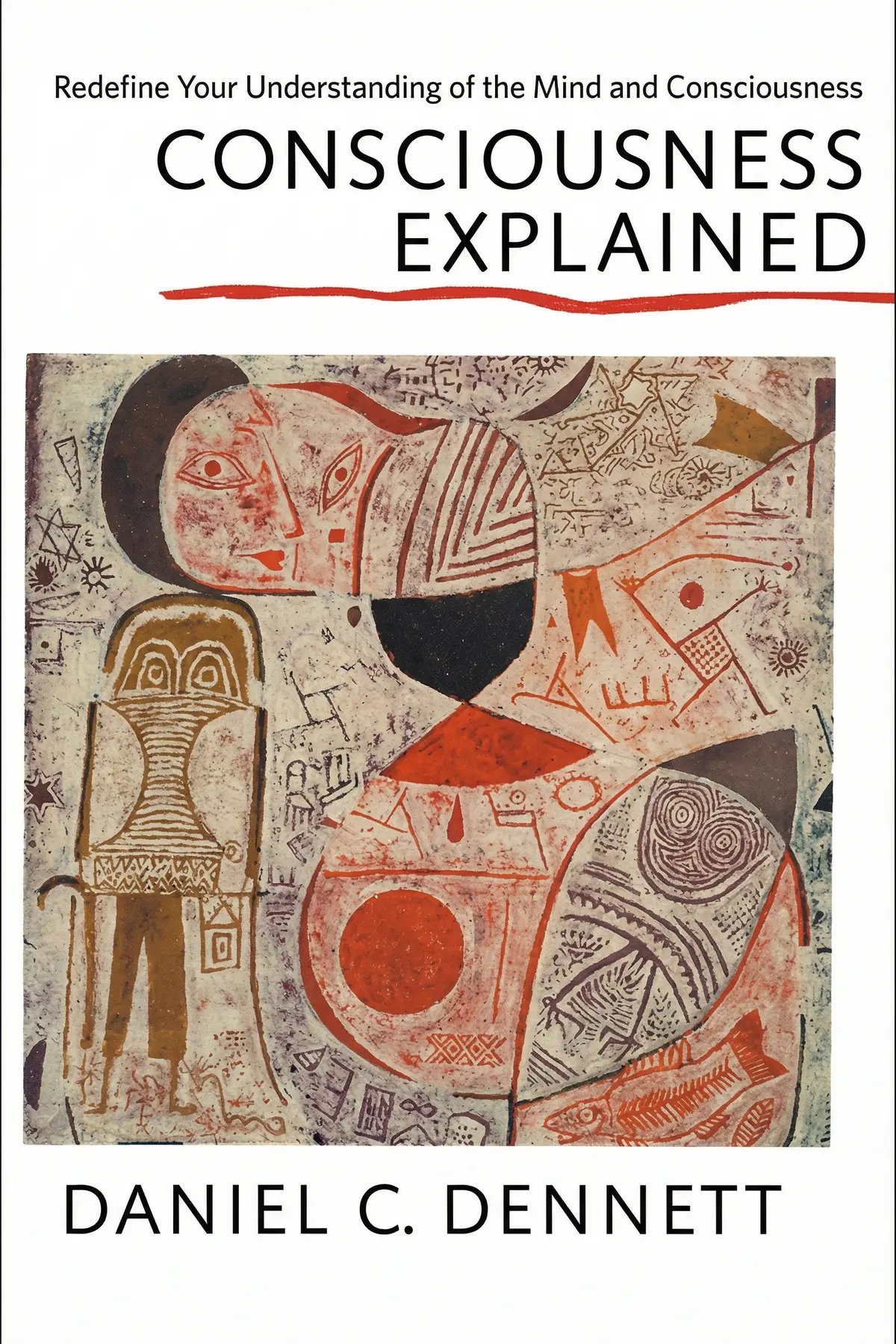
Have you ever wondered what is actually happening inside your head when you think, feel, or experience the world? For a long time, we have relied on the intuition that there is a central 'me' sitting inside our brains, watching a mental movie of life. This book challenges that entire foundation. Daniel C. Dennett argues that the feeling of a unified, singular consciousness is actually a clever trick our brains play on us. By weaving together insights from philosophy, neuroscience, and psychology, this work dismantles the idea of a central command center in the mind. Instead, it introduces a model where the brain constantly creates multiple drafts of reality, competing for attention until one becomes the story we tell ourselves. This summary explores how language functions as a software upgrade for the mind, how we can study subjective experience scientifically, and why the 'self' is more like a useful fiction than a physical reality. It promises to shift your perspective on what it means to be human and how we perceive the nature of existence.
Daniel C. Dennett is an American philosopher and cognitive scientist, known for his influential work on consciousness, free will, and evolutionary biology. He has held the position of University Professor and Austin B. Fletcher Professor of Philosophy at Tufts University, and authored numerous highly acclaimed books including Darwin's Dangerous Idea, Breaking the Spell, and From Bacteria to Bach and Back. Dennett's contributions to philosophy and cognitive science have earned him several honors, including the Erasmus Prize and the American Humanist Association’s Humanist of the Year award.
Listeners consider the work highly stimulating and thoughtfully crafted, noting that the intriguing concepts justify the energy required to get through it. Opinions on the prose are varied; while some listeners commend the writer’s style, others struggle to track the arguments. Although the text clarifies major aspects of consciousness effectively, some listeners feel the subject remains impossible to explain, and one review notes that the explanations are 5 times too long.
Dennett’s 'Multiple Drafts' model is a total paradigm shift that dismantles the cozy 'Cartesian Theater' we all imagine in our heads. To be fair, he doesn't just explain consciousness; he fundamentally redraws the map of what it means to be a thinking thing. I found the sections on how we 'story' ourselves into existence to be particularly well-considered and deeply moving in a strange, mechanical way. While the prose can get dense, the payoff for sticking with his thought experiments is immense. He treats the mind not as a mysterious glow, but as a series of parallel processes that eventually coalesce into a narrative. This is easily one of the most provocative books I’ve encountered in years. It forces you to look at your own interior monologue as a byproduct rather than the driver.
Show moreEver wonder how a 1991 philosophy book would hold up in the age of ChatGPT? Reading this now is a trippy experience because Dennett’s descriptions of 'stupid machines' acting like a mind feel incredibly prescient. His argument that we are just biological information processors is bolstered by how modern AI generates 'reasoning' steps without having a soul. I love how he tackles the idea of the 'center of narrative gravity' as a pragmatic fiction. To be honest, I think this book is more relevant today than when it was first published. It’s a dense read, sure, but the intellectual sparks it flies are worth every minute of your time.
Show morePicked this up expecting a dry textbook and instead found a radical demolition of everything I thought I knew about my own mind. Dennett’s 'heterophenomenology' is a brave attempt to study the mind from the outside in, and it’s surprisingly convincing. The way he describes the brain as a 'parallel, multitrack' system rather than a single theater of action changed how I perceive my own thoughts. Not gonna lie, some of the scientific data is dated, but the underlying logic remains a powerhouse. It’s a thick, demanding read that requires your full attention. If you want to understand the modern materialist view of the soul, this is the definitive starting point.
Show moreIs it possible to explain consciousness by simply pretending it isn't there? That’s the feeling you get halfway through this massive volume, which many critics have cheekily renamed 'Consciousness Explained Away.' Dennett is a master of the analytical school, using sharp logic to slice through our fuzzy intuitions about qualia and the self. Frankly, some of his metaphors feel like hand-waving, especially when he tries to bridge the gap between neural activity and actual feeling. Yet, even when I disagreed with his reductive approach, I couldn't stop thinking about the 'user illusion' he describes. The book is definitely a few hundred pages too long, but the core ideas remain essential for anyone interested in the hard problem.
Show moreAfter hearing a friend rave about the 'human as novelist' concept, I finally dived into this classic. The idea that our consciousness is just a narrative we spin to make sense of brain data is fascinating and strangely plausible. Personally, I found the writing style a bit pompous at times, as if Dennett is daring you to be 'blinkered' enough to disagree with him. The book succeeds in breaking down the mechanics of perception, even if it leaves the actual 'feeling' of experience a bit hollow. Some chapters felt repetitive, and I think the work could have been far more concise without losing its intellectual punch. Still, it’s a brilliant exercise in rethinking the first-person perspective from the ground up.
Show moreGotta say, Dennett has a way of making you feel like a rank dogmatist if you dare to believe in the 'soul' or qualia. He is a fierce advocate for a purely physicalist world, and he defends his territory with impressive rhetorical flair. I found his discussion on 'figments' and how the brain fills in gaps to be the strongest part of the text. Truth is, the middle section drags significantly, and he could have made his point in half the page count. However, the concept of the self as an 'epiphenomenal construct' is so well-argued that it’s hard to ignore. It’s a polarizing book that will either enlighten you or make you very, very angry.
Show moreNot what I expected from a philosophy tome, as Dennett’s prose is surprisingly lively and filled with rhetorical pyrotechnics. He doesn't just present theories; he stages a full-scale assault on our intuitive 'common sense' about the mind. I particularly enjoyed the chapter on the reality of selves, where he uses the metaphor of a 'center of gravity' to explain the 'I.' To be fair, he does lean heavily on computational metaphors that might not satisfy those looking for a more 'human' explanation. But as a piece of rigorous scientific philosophy, it is absolutely top-tier. It's a fascinating journey, even if you end up disagreeing with his eliminativist conclusions in the end.
Show moreLook, there is no denying that the man is a genius, but this book is easily five times longer than it needs to be. I spent weeks wading through his various 'drafts' of the same argument before I felt like I actually grasped the central thesis. While his takedown of the Cartesian Theater is logically sound, the writing can be incredibly difficult to follow if you aren't already steeped in cognitive science. I often felt like the 'explanation' was just a series of increasingly complex computational metaphors. It’s a well-considered work, but the sheer verbosity makes it a chore for the casual reader. If you have the patience for 500 pages of rhetorical pyrotechnics, go for it. Otherwise, a summary might suffice.
Show moreThe title is famously misleading; 'Consciousness Explained Away' would have been a far more honest branding choice for this work. Dennett essentially argues that our internal life is an illusion created by parallel neural processes, which feels like a bit of a cheat. In my experience, the analytical approach often ignores the 'lived experience' that continental philosophers like Derrida or Sartre prioritize. There’s a certain smugness in the way he dismisses the 'hard problem' as a mere linguistic confusion. While the biological details are fascinating, the philosophical conclusions left me feeling like the most important part of being human was missing. It’s a brilliant book, but one that seems to miss the forest for the trees.
Show moreFinally got around to finishing this, and frankly, I feel cheated by the promise of the title. Dennett spends hundreds of pages setting up a massive explanation, only to resort to hand-waving and 'golem' metaphors at the most crucial moments. He never actually explains how subjective experience emerges; he just tells us that it’s a 'user illusion' and we should stop worrying about it. The writing is incredibly repetitive and five times too long for the actual content provided. I found his dismissal of the phenomenology of lived experience to be arrogant and ultimately unconvincing. It felt more like a clever exercise in linguistic trickery than a genuine scientific breakthrough.
Show moreSteven C. Hayes

Deborah Gruenfeld
Anthony Pratkanis

William B. Irvine
AUDIO SUMMARY AVAILABLE
Get the key ideas from Consciousness Explained by Daniel C. Dennett, plus 5,000+ more titles in English and Thai.







