
16 min 45 sec
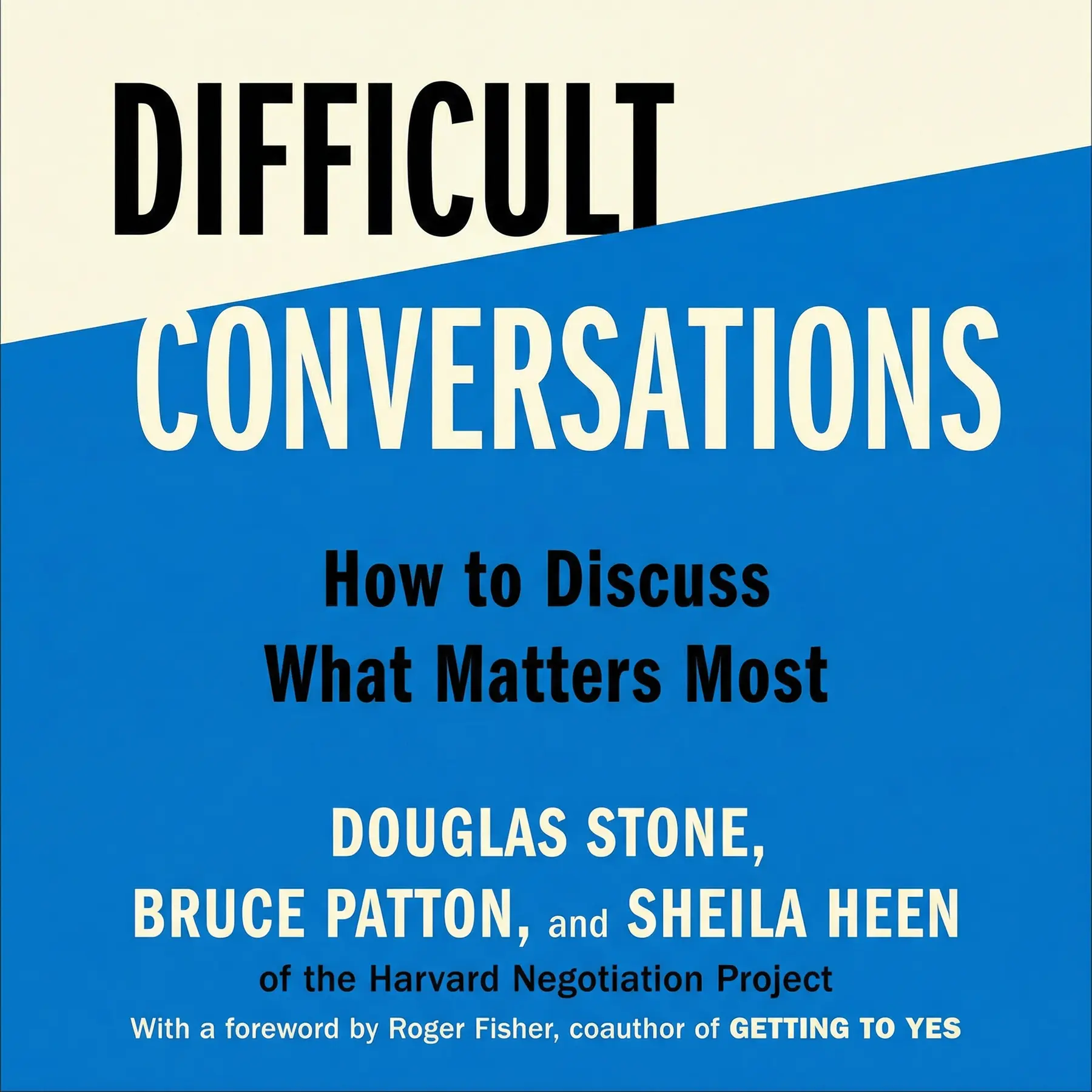
Difficult Conversations: How to Discuss What Matters Most
Difficult Conversations provides a practical framework for navigating high-stakes disagreements. By understanding the underlying layers of emotion and identity, readers learn to transform confrontational clashes into productive learning opportunities and stronger relationships.
Table of Content
1. Introduction
1 min 41 sec
We have all been there. That heavy feeling in your chest when you know you need to bring up a sensitive topic with a colleague, a spouse, or a friend. Perhaps it’s a neighbor whose habits are disruptive, or a coworker who consistently misses deadlines. Your mind starts racing. If you speak up, will you make things worse? Will they get angry? If you stay silent, will you just keep feeling resentful? This hesitation is the universal experience of facing a difficult conversation.
At its core, a difficult conversation is anything we find it hard to talk about. These moments are uncomfortable because the stakes feel high and the outcome is uncertain. We feel vulnerable because we don’t know how the other person will react, and we fear that the relationship might be permanently damaged. However, avoiding these talks usually doesn’t make the problem go away; it just allows the tension to simmer under the surface.
In this BookBits summary of Difficult Conversations, we are going to explore a framework developed through years of research at the Harvard Negotiation Project. We will move beyond the superficial level of what is being said and look at the underlying structures that make these interactions so volatile. The goal isn’t to provide a script that magically solves every problem, but to offer a shift in perspective.
We will learn how to move from a mindset of ‘delivering a message’ to one of ‘learning and discovery.’ We will see why our typical approach of proving ourselves ‘right’ usually fails, and how we can address the emotional and identity-based hurdles that trip us up. By the end of this session, you will have a new set of tools to step into those tough moments with more clarity and less fear, turning potentially explosive arguments into constructive dialogues.
2. The Cost of Silence and the Value of Engagement
1 min 53 sec
Discover why we reflexively avoid tough topics and why choosing to speak up, despite the risk, is essential for long-term peace.
3. Decoding the Three Conversations
2 min 26 sec
Every challenging interaction actually happens on three different levels simultaneously; missing any one of them can derail the entire talk.
4. Moving Beyond Blame to Contribution
2 min 02 sec
Learn how the ‘blame frame’ traps us in the past and how a ‘contribution’ mindset can lead to future-focused solutions.
5. Exploring Your Emotional Footprint
2 min 37 sec
Uncover the hidden rules that dictate how you handle feelings and learn how to share emotions in a way that builds connection.
6. Stabilizing Your Identity Conversation
2 min 19 sec
Learn to move away from ‘all-or-nothing’ thinking and build a more complex, resilient sense of self that can withstand criticism.
7. The Strategy of the Third Story
2 min 00 sec
Avoid the common mistake of starting from your own perspective and learn to frame the issue as a neutral observer would.
8. Conclusion
1 min 47 sec
Navigating difficult conversations is a skill that requires both self-awareness and practice. We have seen that these moments are not just about the facts of a situation, but are deeply intertwined with our emotions and our sense of identity. By understanding the three layers of every tough talk—the ‘What Happened?’, Feelings, and Identity Conversations—we can begin to see the hidden patterns that lead to conflict. Moving away from a focus on blame and toward an understanding of contribution allows us to look forward rather than getting stuck in the past.
The throughline of this entire approach is the shift from a ‘delivery’ mindset to a ‘learning’ mindset. Instead of entering a conversation to prove you are right, you enter it to understand why you and the other person see things so differently. This requires the courage to be honest about your own feelings and the resilience to handle the complexities of your own identity. Using tools like the ‘Third Story’ provides a neutral gateway into these discussions, ensuring that they start on a foundation of mutual respect rather than accusation.
As an actionable takeaway, start by paying closer attention to your ‘inner voice.’ This is the running commentary in your head that reacts to everything the other person says. Often, we try to ignore this voice so we can focus on being polite, but that internal monologue contains the clues to your real feelings and identity triggers. Instead of suppressing it, listen to it. By becoming a better listener to yourself, you will become a more attentive and effective listener to others. The next time you face a difficult conversation, remember that it is an opportunity for growth and a deeper connection. With these tools, you can transform the dread of a tough talk into the confidence of a meaningful dialogue.
About this book
What is this book about?
Have you ever walked away from a discussion feeling misunderstood or regretted staying silent when something was bothering you? Difficult Conversations explores why these moments are so challenging and how we can approach them with more confidence. The book breaks down every tough talk into three distinct layers: the facts of the situation, the emotions involved, and the impact on our self-image. Rather than viewing these exchanges as battles to be won, the authors provide a roadmap for shifting into a learning mindset. You will discover how to move past blame, investigate the hidden intentions of others, and express your own feelings without causing defensiveness. By introducing the concept of the Third Story, the book offers a neutral starting point for resolution. Whether it is a workplace conflict or a personal dispute, the promise of this guide is to help you handle the most uncomfortable topics in a way that preserves dignity and leads to better outcomes for everyone involved.
Book Information
About the Author
Douglas Stone
Douglas Stone is a lecturer at Harvard Law School and a seasoned expert in the fields of negotiation and communication. He is also a co-founder of the Triad Consulting Group. Bruce Patton serves as the co-founder of the Harvard Negotiation Project and is a founder of the law firm Vantage Partners. Sheila Heen is a teacher at Harvard Law School, a co-founder of Triad Consulting Group, and has served as a mediator for the Singapore Supreme Court.
Ratings & Reviews
Ratings at a glance
What people think
Listeners find the book highly accessible and value its actionable guidance, with one individual noting its usefulness across all types of relationships. The material earns praise for its informative content and relevance to tough dialogues within the home. Listeners view the work as powerful and transformative, with one person mentioning it works for both babies and adults. Opinions on the financial value vary, though some highlight the excellent pricing.
Top reviews
Fatima
Finally got around to reading this classic after years of it sitting on my shelf, and I’m genuinely kicking myself for waiting so long. This book provides a masterclass in human interaction that goes far beyond simple 'tips and tricks' for the office. By breaking down interactions into the 'Three Conversations'—What Happened, Feelings, and Identity—the authors give you a roadmap for understanding why things go off the rails. I’ve already started applying the concept of 'contribution' instead of 'blame' in my marriage, and the results were almost immediate. It’s rare to find a book that offers such profound psychological insights while remaining entirely accessible to the average reader. While it isn't a magic wand that makes conflict disappear, it gives you the tools to handle the heat without getting burned. Every chapter felt like a lightbulb moment for my personal relationships.
Show moreEleanor
The chapter on identity was a total revelation that changed how I view every argument I've ever had. We often think we are fighting about the facts of a situation, but the truth is usually that we feel our character is being attacked. Stone, Patton, and Heen explain this beautifully, showing how our internal narratives prevent us from actually hearing the other person. I loved the emphasis on moving from a 'delivery stance' to a 'learning stance.' Instead of trying to win the argument, the goal becomes understanding the other person’s perspective. This shift in mindset has helped me stay calm during high-stakes meetings where I used to get defensive and shut down. The book is packed with concrete examples that make the theory feel very real. It’s easily one of the most practical books on psychology I’ve ever owned.
Show moreKom
Ever wonder why a simple talk with your spouse turns into a nuclear explosion for no apparent reason? This book finally explains the 'why' behind those communication meltdowns and offers a way out of the cycle. I found the section on 'Impact vs. Intent' to be particularly helpful because it’s a trap I fall into almost every single day. We judge ourselves by our intentions, but we judge others by their impact on us, which leads to massive misunderstandings. This book is life-changing because it teaches you to pause and ask what you might be missing. It’s worked for everything from resolving issues with my coworkers to handling a toddler's temper tantrum. The value for money here is incredible considering how many relationships this can potentially save. It should be required reading for every human being on the planet.
Show moreSienna
Wow, this is a masterpiece on how to navigate the complexities of human ego and emotion. I was skeptical at first, thinking it would be another dry self-help book, but I was hooked within the first twenty pages. The authors have a way of describing those 'hot-headed' reactions we all have in a way that is both empathetic and challenging. They don't let you off the hook for your own behavior, but they explain why you act that way so you can finally change it. I especially liked the 'Third Story' concept, which encourages you to view the conflict from the perspective of a neutral observer. It’s a brilliant way to detach from your own narrative and see the bigger picture. This book has helped me find peace in situations that used to keep me up at night. Five stars for being both practical and profound.
Show moreMoo
As someone who struggles with communication due to ADHD, I found the breakdown of the internal 'Identity Conversation' incredibly illuminating. It’s one thing to know a talk is going poorly, but it’s another to understand that your sense of self is being threatened in the moment. However, I’ve got to say that actually implementing these strategies during a real-time conflict is a total nightmare. The authors make everything sound like a simple practice, but widening that gap between a stimulus and your knee-jerk reaction takes immense effort. You really need a patient partner who is willing to reflect and fail with you several times before this becomes second nature. It provides a solid foundation, but don't expect it to be a magic trick that fixes your life overnight. I still recommend it as a necessary first step for the communication-challenged.
Show moreCaleb
Picked this up on a recommendation for work, but I ended up using the 'contribution not blame' model with my siblings first. It’s a powerful shift to stop asking 'Who is at fault?' and start asking 'How did we both get to this point?' This approach helps de-escalate the tension and allows for a much more productive discussion. My only minor gripe is that some of the workplace examples feel a little dated or geared toward a very specific type of corporate culture. That said, the underlying principles are universal and can be adapted to almost any situation if you're willing to put in the work. The writing is clear and the authors are obviously experts in their field. It’s a great price for the amount of actionable advice you get. I’ll definitely be keeping my copy for future reference when things get heated again.
Show moreSirirat
Look, the advice here is practical and the authors clearly know their stuff, but be prepared for a slow read. There is a lot of information to process, and it isn't the kind of book you can just breeze through in a single afternoon. I found myself having to stop and reflect after almost every chapter to see how it applied to my own life. The section on 'reframing' was especially useful for turning a hostile comment into a productive question. It’s helped me stay professional in a job where I often feel undervalued and ignored. While I agree with other reviewers that some examples feel a bit simplistic, the core framework is undeniably effective. It’s an essential tool for anyone who wants to improve their emotional intelligence. Just don't expect it to make difficult conversations 'easy'—they are still hard, just more manageable.
Show moreEarn
Not what I expected from a book that often gets lumped in with dry business texts. While it certainly helps in professional settings, the true value for me was in my personal life and family dynamics. The authors do a great job of explaining how we often focus on blame instead of looking at our own contribution to a conflict. By shifting to a 'learning stance,' I’ve been able to navigate some really tricky conversations that used to result in weeks of silence. It isn't perfect, and some sections feel a bit repetitive, but the core framework is something I’ll be coming back to. I appreciate that they address the emotional aspect rather than just giving you a script to follow. It makes the advice feel much more authentic and less like a corporate negotiation tactic.
Show morePensuda
To be fair, the core message is solid, but the execution felt incredibly clinical and needlessly complicated at times. The authors attempt to put order to the messy reality of human emotions by creating these rigid structures for how a conversation should go. In my experience, real-life arguments don't follow a script, and trying to remember the 'three conversations' while someone is yelling at you is almost impossible. There were moments where the advice felt a bit like a mediator’s training manual rather than something for everyday people. While I appreciated the sections on avoiding blame, I found myself getting lost in the repetitive explanations. It’s not a bad book by any means, but I think it could have been half the length and twice as effective. If you have the patience to dig through the academic tone, there is definitely some value to be found here.
Show moreAmelia
This book is nothing more than a thinly veiled attempt to push corporate-minded 'management speak' onto workers who are already being exploited. Frankly, the examples provided, like the one involving Henry and Rosario, are absolutely asinine and detached from the reality of most wage earners. The authors suggest that if a boss demands you work your weekend, your only 'skillful' choices are to stay and be miserable or leave and risk starving. It frames the loss of a job as a fair consequence for setting a basic boundary, which is an incredibly insidious way to handle personnel problems. I felt like I was reading a manual on how to be a better cog in the machine rather than a guide to honest connection. If your supervisor asks you to read this voluntarily, be very wary of their true intentions. It’s patronizing pop-psychology at its absolute worst.
Show more
Readers also enjoyed
AUDIO SUMMARY AVAILABLE
Listen to Difficult Conversations in 15 minutes
Get the key ideas from Difficult Conversations by Douglas Stone, plus 5,000+ more titles in English and Thai.
- 5,000+ titles
- Listen as much as you want
- 7-day free trial
- Cancel anytime







