

19 min 10 sec
Don’t Buy It: The Trouble with Talking Nonsense About the Economy
Don’t Buy It explores how the language we use to describe the economy dictates our political reality, offering a guide to using metaphors that promote fairness and structural change.
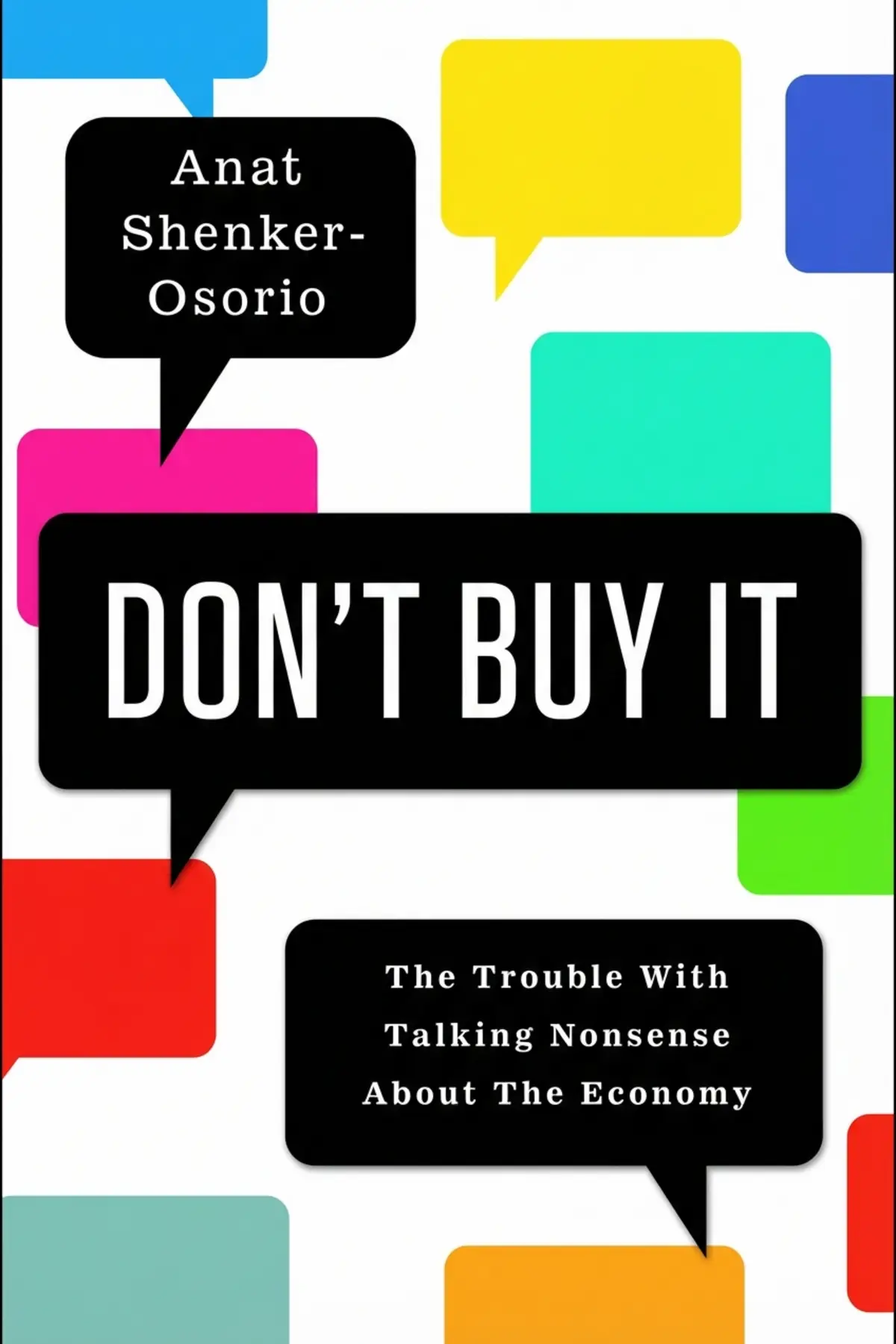
Table of Content
1. Introduction
1 min 34 sec
Think back to the global financial meltdown of 2008. It was a moment of absolute upheaval that seemed to signal the end of an era. Banks that were thought to be untouchable crumbled, entire nations faced the threat of bankruptcy, and millions of families saw their life savings and jobs vanish overnight. In the heat of that moment, it felt inevitable that the world would pivot toward a more stable and fair economic model. Yet, as the dust settled, the same old policies that had led to the brink of disaster remained firmly in place.
Why did such a massive shock fail to produce a lasting shift in how we manage our economy? The answer isn’t just found in backroom political deals or corporate lobbying; it’s found in the very words we use to talk about money, markets, and labor. In this summary of Anat Shenker-Osorio’s work, we are going to explore the hidden mechanics of political communication. We’ll see how the right-wing narrative managed to win the battle of ideas by using specific metaphors that made the crisis seem natural and government intervention seem dangerous.
More importantly, we’re going to look at the path forward. You’ll discover why describing the economy as a living creature is a trap, and why seeing it as a vehicle we drive can change everything. We will look at how the passive voice protects the powerful and how vertical metaphors like “top” and “bottom” reinforce the status quo. By the end, you’ll have a new perspective on how to speak about the world around you in a way that truly inspires progress and equity. This isn’t just a lesson in linguistics; it’s a blueprint for changing the conversation about our shared future.
2. The Deep Roots of Inequality
2 min 02 sec
Explore why the 2008 financial collapse was merely the tipping point of a crisis that had been brewing for decades within the American wage structure.
3. The Failure to Shift the Narrative
1 min 45 sec
Discover how the public’s sudden interest in economic news failed to translate into progressive policy changes despite a clear mandate for reform.
4. The Power of the Metaphor
1 min 54 sec
Learn how the human brain uses non-literal language to process complex systems and why these figures of speech are never truly neutral.
5. The Economy as a Living Organism
1 min 50 sec
Examine how conservative language frames the economy as a fragile patient, subtly discouraging government intervention as a form of interference.
6. A New Frame: The Economy as a Vehicle
1 min 45 sec
See how a simple shift in imagery—from a living thing to a man-made tool—can empower the public to demand better economic management.
7. The Hidden Traps in Common Words
1 min 50 sec
Uncover why terms like ‘crisis’ and ‘reform’ might actually be working against the goals of those who seek fundamental economic change.
8. How Passive Language Erases Accountability
1 min 44 sec
Learn how the way we structure our sentences can accidentally hide the villains in economic stories and blame the victims of financial crashes.
9. Vertical Metaphors and the Myth of Merit
1 min 53 sec
Explore why thinking about society in terms of ‘top’ and ‘bottom’ reinforces inequality and how to describe social structures more fairly.
10. The Grammar of a Better World
1 min 41 sec
Discover how a mindful approach to language can help citizens cut through political spin and demand an economy that works for everyone.
11. Conclusion
1 min 12 sec
The central takeaway of this exploration is that language is far more than just a way to convey information; it is a tool that shapes our reality. For years, the political right has used specific, carefully crafted metaphors to make an unequal economic system seem natural and unchangeable. Meanwhile, those seeking progress have often fallen into linguistic traps that undermine their own goals.
To move forward, we must become conscious of the frameworks we use. We need to stop seeing the economy as a fragile organism and start seeing it as a vehicle that we must steer toward fairness. We must replace passive sentences with active ones that assign responsibility. And we must exchange hierarchical metaphors for those that highlight structural obstacles.
The next time you hear a politician or a news anchor talking about the economy, listen for the hidden metaphors. Ask yourself if they are treating the market like a force of nature or a man-made system. By developing this critical awareness, you can avoid being misled by false narratives and start advocating for a world where the rules of the road are written for everyone’s benefit. Real change begins with the words we use to imagine it.
About this book
What is this book about?
Have you ever wondered why major economic disasters rarely lead to significant policy changes? This book argues that the answer lies in our vocabulary. Anat Shenker-Osorio examines the hidden power of metaphors, showing how the words used by politicians and the media shape our understanding of wealth, work, and government intervention. By analyzing the aftermath of the 2008 financial crisis, the author reveals how conservative framing successfully turned a systemic failure into a story about natural cycles and personal morality. The promise of this book is to provide progressives and concerned citizens with a new linguistic toolkit. You will learn how to move away from passive, limiting language and instead use powerful imagery that highlights human agency and the need for structural reform.
Book Information
About the Author
Anat Shenker-Osorio
Anat Shenker-Osorio is a strategic communications expert, researcher, and political pundit who focuses on social issues and public affairs in the United States. She has lent her expertise to several prominent organizations, including the Ford Foundation, the Roosevelt Institute, the Congressional Progressive Caucus, and the Ms. Foundation.
Ratings & Reviews
Ratings at a glance
What people think
Listeners describe the book as extremely accessible and stimulating, while one review emphasizes that it offers useful strategies for both activists and the general public. There is also praise for the sections on the economy, with one listener noting the superb analysis of economic messaging. Additionally, listeners value the humor, as one calls it wickedly funny and another review points out the persuasive and clear language. On the other hand, the prose style has prompted a variety of responses from listeners.
Top reviews
Montri
This book is a masterclass for anyone who feels like they’re shouting into the void about the economy. Anat Shenker-Osorio manages to take a dry subject and infuse it with a wickedly funny tone that keeps you engaged. To be fair, I expected a dense academic text, but instead, I found a practical toolkit for activists. Her breakdown of how we subconsciously view the market is eye-opening. We need to stop talking about 'gaps' and start identifying 'barriers' that are intentionally built. It is a thought-provoking read that equips citizens with the language needed to actually win arguments. If you want to understand how metaphors shape our political reality, look no further. The insights on active voice alone changed how I write my emails.
Show moreBee
Finally got around to reading this, and it has completely altered how I communicate with my more conservative relatives. Anat is a total badass with a sharp wit that makes even the most complex economic theories digestible. I found myself laughing out loud at her critiques of how we allow the opposition to frame every debate. The idea that we should use direct address—using 'you' to engage the audience—is such a simple but effective tool. Honestly, this should be required reading for anyone in communications or community organizing. It’s rare to find a book that is both intellectually stimulating and practically useful. I’ll be revisiting these frameworks for years to come. It's mind-altering and incredibly empowering.
Show moreNing
Not what I expected at all, but in the best way possible! I thought this would be a boring list of talking points, but it’s actually a deeply psychological look at how we process information. The humor throughout is dry and refreshing, making the deep dives into cognitive frames much more enjoyable. Truth is, most of us are using the wrong words to describe the things we care about. By moving away from passive descriptions, we can finally name the actors responsible for economic hardship. This book provides a fantastic framework for examining our own speech. It’s a must-read for anyone tired of seeing the same old arguments fail time and again. It makes sense of the political mess we are in.
Show moreWorawit
Look, if you want to understand why the public responds to certain policies while ignoring others, you need this book. Shenker-Osorio’s breakdown of how we talk about the 'natural' economy versus a 'man-made' system is revolutionary. I particularly loved the section on student loan repayment based on earnings; it framed the issue as a way to follow one's passion rather than just a debt problem. The writing is punchy and direct, which I appreciated. Not gonna lie, it made me look at every news headline differently. This is an essential read for activists who are tired of losing the argument before it even starts. The advice on using 'you' to engage the audience is incredibly effective.
Show moreOrawan
Picked this up after hearing Anat on a podcast and was fascinated by her take on cognitive linguistics. The way she deconstructs the 'economy as a body' metaphor is brilliant. Instead of viewing the market as something natural that just 'gets sick,' she argues we should treat it like a vehicle we built and can steer. It’s a subtle shift, but it changes everything about how we assign responsibility. To be clear, the writing style can feel a bit lecturing at times, which might turn some readers off. Still, the breakdown of economic messaging is excellent and provides a clear roadmap for progressives. It’s a convincing argument for why words matter just as much as policy. Definitely worth a read for the analysis.
Show moreRungrat
After hearing the author discuss the power of framing, I wanted to see if the book lived up to the hype. It mostly does, especially regarding how we perceive financial inequality. The section on active voice and identifying who is actually doing the harm is worth the price of admission alone. Personally, I think the author makes a very clear and convincing case for why Democrats often lose the messaging war. She isn't just complaining; she offers a specific guide for 'talking about our fellow Americans' in a way that builds solidarity. It isn’t a traditional economics book, but it’s a vital study on the pathology of language. A very readable and necessary perspective for anyone interested in political communication.
Show moreSienna
Wow, Anat really knows how to dissect a phrase until you see the hidden machinery underneath. The chapter on the 'vehicle' metaphor was particularly striking to me. She explains how shifting from a 'gap' to a 'barrier' shifts the focus to human agency and the need for deconstruction. Got to say, some of the prose is a bit dense with academic jargon, which slows down the pace significantly. But once you get into the section on framing policies like student loans or housing, the value becomes obvious. It’s a thought-provoking look at how we’ve been manipulated by 'wooden language' for decades. Definitely a tool for those who want to change the narrative. The specific policy recommendations at the end were a highlight.
Show moreMason
Ever wonder why political books always feel like they’re 150 pages too long? There is a brilliant 20-page pamphlet buried inside this nearly 200-page book. Frankly, the advice about using the active voice—like saying 'someone evicted this family' instead of 'this family lost their home'—is game-changing. However, you have to wade through a lot of repetition and 'point-scoring' against conservatives to get to the meat of the strategy. Truth is, her 'Words to Win By' podcast covers much of this ground with way more efficiency. It's a solid message, but the padding makes it a bit of a slog to finish. I’d recommend skipping straight to page 140 for the most useful tips if you are short on time.
Show moreNam
The chapter on manufactured inequality was the highlight for me, specifically the part about CEO pay ratios. It’s one of the few places where the book gets into the 'meat' of actual policy rather than just spin. However, I have to agree with other reviewers that the book feels stretched. In my experience, a lot of these communication experts fall in love with their own deconstructions. While the analysis of Republican 'spin' is spot on, the author’s plea for Democrats to become better manipulators feels a bit cynical. I wanted more economics and less 'messaging' advice. It's an interesting read, but I’m not sure it’s the revolution in thought the author thinks it is. Good for a browse, but maybe not a deep study.
Show moreRatthapong
As someone who considers themselves quite progressive, I found the tone of this book incredibly frustrating. Anat spends an exhausting amount of time lambasting others rather than simply presenting her own solutions. The writing feels insufferable because the actual recommendations are buried under pages of petty grievances. To be honest, I got more out of a five-minute summary than the actual text. It’s a shame because the core message about metaphors like 'barriers' versus 'gaps' is genuinely important. If you can stomach the constant lecturing and point-scoring, there are nuggets of wisdom, but most people will likely lose patience long before the good stuff starts. I expected a guide, not a 200-page lecture on why everyone else is wrong.
Show moreReaders also enjoyed
A Promised Land
Barack Obama

A River in Darkness: One Man’s Escape from North Korea
Masaji Ishikawa
A Theory of Justice
John Rawls
A Warning
Miles Taylor
Abolish Rent: How Tenants Can End the Housing Crisis
Tracy Rosenthal
AUDIO SUMMARY AVAILABLE
Listen to Don’t Buy It in 15 minutes
Get the key ideas from Don’t Buy It by Anat Shenker-Osorio, plus 5,000+ more titles in English and Thai.
- 5,000+ titles
- Listen as much as you want
- 7-day free trial
- Cancel anytime







