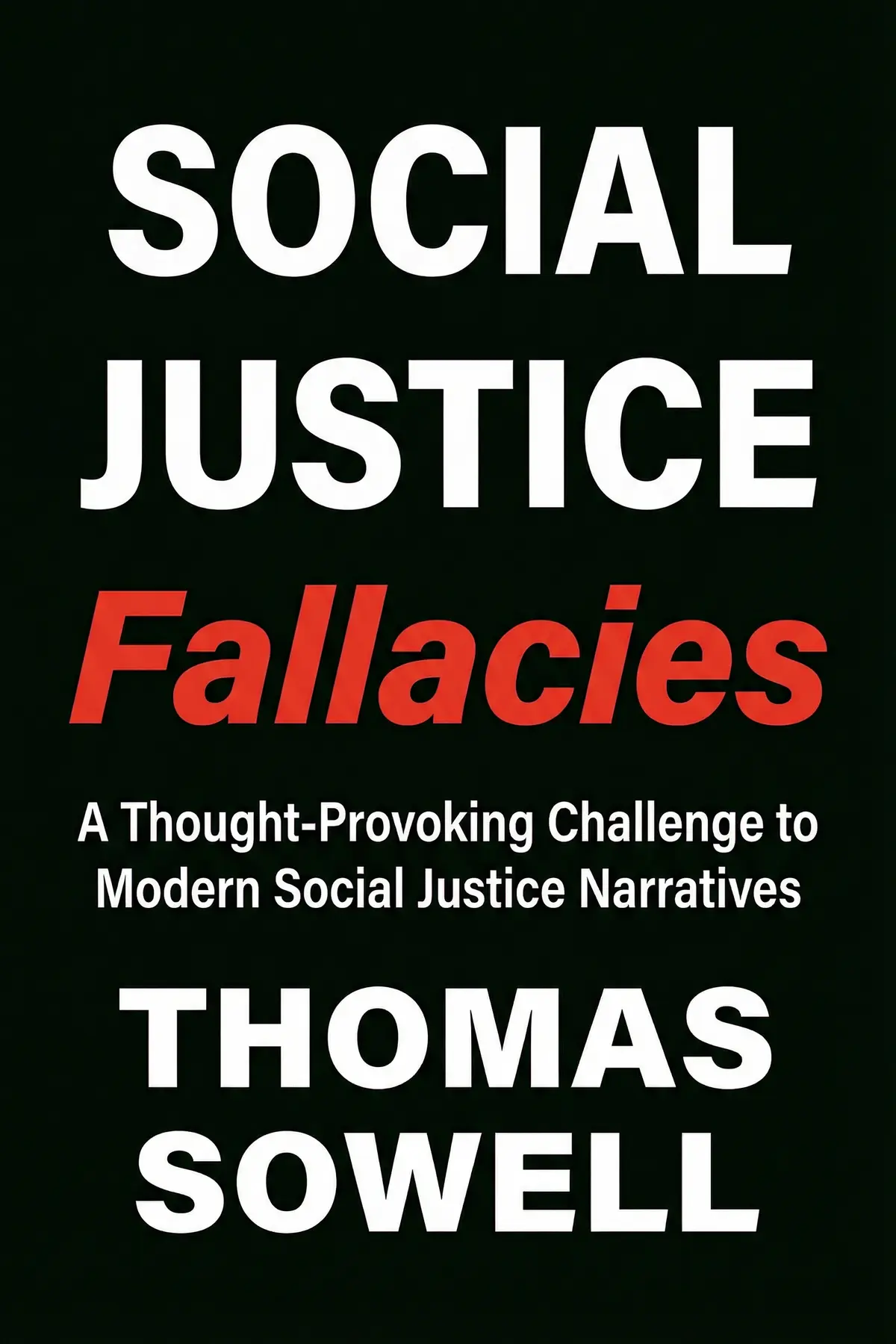
Social Justice Fallacies
Thomas Sowell
A rigorous examination of the most common myths in economics, revealing how popular misconceptions about housing, trade, and inequality often lead to policies that produce the exact opposite of their intended results.
1 min 49 sec
We live in an era defined by massive social and economic challenges. From the decay of our inner cities to the widening gap between the wealthy and the poor, the problems we face are undeniably complex. Yet, as Thomas Sowell argues, the difficulty of solving these issues is compounded when we base our solutions on foundational misunderstandings of reality. If we get the basic facts of economics wrong, even the most compassionate policies can lead to disastrous outcomes. This exploration of his work is designed to pull back the curtain on the popular myths that dominate our headlines and political speeches.
The core throughline here is a transition from emotional thinking to logical analysis. It is easy to feel outraged by inequality or housing shortages, but Sowell suggests that this outrage often fuels fallacies—logical errors that sound plausible but fail to hold up under scrutiny. These errors aren’t just academic; they have real-world consequences, affecting everything from the price of your rent to the stability of the global economy.
In the following sections, we will walk through the specific cognitive traps that lead us astray. You’ll see why the idea that one person’s gain is another’s loss is a primary driver of failed policy. We’ll look at how we misinterpret history by assuming that because one event followed another, it must have been caused by it. We will also dive into the dangers of open-ended demands that can never be satisfied and the way statistics are often manipulated to tell a story that isn’t true. By the end of this journey, the goal is for you to develop a sharper eye for these fallacies, allowing you to think more clearly about the world and the many challenges we all share.
2 min 33 sec
Discover why the popular belief that one person’s wealth must come at another’s expense leads to destructive policies in housing and international trade.
2 min 45 sec
Learn how the mistaken assumption that sequence implies causality has led to health crises and a misunderstanding of the Great Depression.
2 min 31 sec
Explore why ‘improving’ things like healthcare or the environment can become a bottomless pit for resources when no limits are established.
2 min 34 sec
Understand why helping a specific group or neighborhood often fails to benefit the economy as a whole, and may actually do harm.
2 min 22 sec
Discover how the lack of market discipline in universities allows for the accumulation of useless research and substandard qualifications.
2 min 33 sec
Uncover how the way we measure income can distort the reality of the wealth gap and fuel the fires of social resentment.
2 min 42 sec
Examine why geography and historical shifts, rather than just exploitation, are the primary reasons for the wealth disparities between nations.
1 min 43 sec
As we wrap up this look at Economic Facts and Fallacies, the most important takeaway is the need for intellectual humility and logical rigor. It is very easy to fall for ideas that sound morally righteous or emotionally satisfying, but as we have seen, these ideas often crumble when they are held up to the light of actual facts. Whether it is the well-meaning disaster of rent control or the statistical sleight of hand used to describe income inequality, the common thread is a failure to look at the long-term consequences and the broader context.
Thomas Sowell’s work challenges us to be better consumers of information. The next time you see a headline about a ‘crisis’ or a politician promising a ‘fix’ for a complex social problem, remember the fallacies we’ve discussed. Ask yourself: Is this a zero-sum view of the world? Are they confusing correlation with causation? Is this an open-ended demand that ignores trade-offs? Are they focusing on one small part of the economy while ignoring the cost to the whole?
The ultimate goal of spotting these fallacies is not just to win arguments, but to support policies that actually work. When we clear away the myths, we can finally focus on the real-world incentives and geographic realities that drive prosperity. True progress isn’t made by following our emotions toward ‘feel-good’ policies; it is made by following the facts toward ‘do-good’ results. By keeping your logical guard up and demanding context for every statistic, you can help move the conversation away from fallacies and toward the truth.
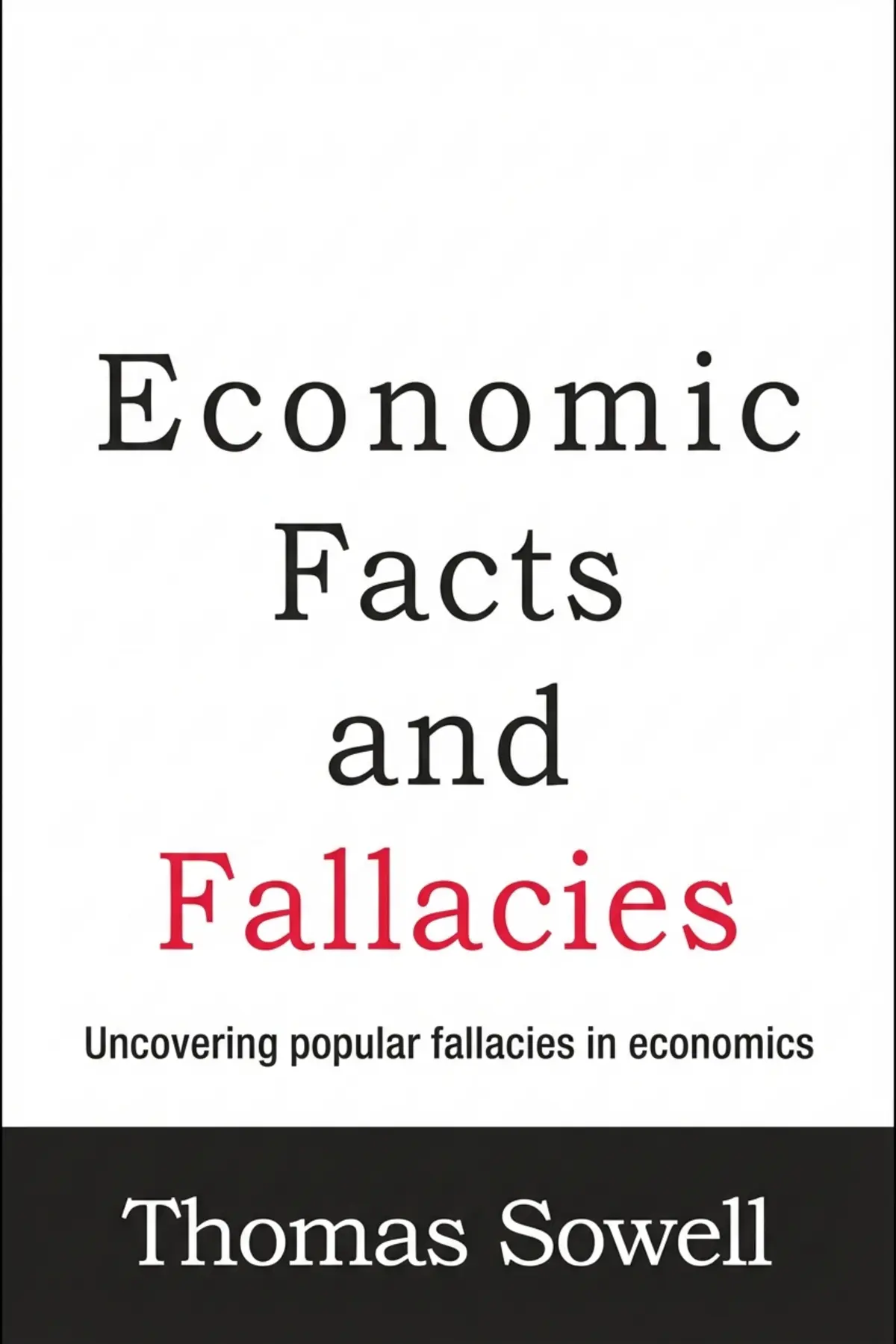
Economic Facts and Fallacies takes a sharp, logical look at the beliefs that underpin many of our modern social and political debates. Thomas Sowell argues that many of the most popular ideas regarding economics are rooted in misunderstandings of how markets and human incentives actually function. By dissecting fallacies such as the zero-sum view of trade and the post hoc errors of historical analysis, Sowell reveals why well-intentioned government interventions can lead to urban decay, increased poverty, and market stagnation. The book promises to strip away the emotional rhetoric and moral posturing that often clouds economic discussion. It covers a wide range of topics, including rent control, urban sprawl, the lack of accountability in academia, and the true nature of income inequality. Through clear reasoning and historical examples, it provides a framework for evaluating policies based on their actual results rather than their stated goals, offering readers a clearer lens through which to view the complex economic forces shaping our world today.
Thomas Sowell is a conservative economist, social theorist, and senior fellow at Stanford University’s Hoover Institution. Sowell has taught economics at Cornell, Amherst, and the University of California at Los Angeles, and the history of ideas at Brandeis University. In 2002, he was awarded the National Humanities Medal.
Thomas Sowell
Listeners find this economics book highly accessible and skillfully written, with one person calling it the finest on the subject. Furthermore, the work delivers thoroughly researched evidence and in-depth analysis, serving as a significant resource for the public. They value the author's talent for simplifying complicated themes and offering an unbiased perspective, with one listener noting how the book supports its conclusions with historical and factual references.
Thomas Sowell has a rare talent for stripping away the emotional baggage often attached to public policy. This book is a masterclass in using hard data to challenge popular narratives that sound good in theory but fail in the real world. I particularly liked how he tackled the urban planning fallacies by comparing cities like Houston and San Francisco. It really highlights how government intervention can drive up costs while claiming to help the poor. While some of the prose is a bit dense, the clarity of his logic is undeniable. It is a must-read for anyone who wants to understand why certain "obvious" solutions never seem to work. The book serves as a vital resource for citizens who are tired of being misled by political rhetoric.
Show moreAs someone who has always been confused by the "stagnant wages" headlines, this book was a breath of fresh air. Sowell explains how shifting from individual income to household income data can create a completely false picture of the American economy. The truth is that household sizes have changed, and failing to account for that is a major statistical fallacy that politicians use constantly. The way he breaks down these complex subjects into understandable chunks is impressive. I did find the chapter on the Third World a bit repetitive toward the end, but the core message remains powerful. This is the kind of detailed analysis we need more of in today's polarized climate.
Show moreThe chapter on academia alone is worth the price of admission. Sowell deconstructs the myth that an Ivy League degree is a prerequisite for success, showing that most top CEOs actually come from state schools or less "prestigious" institutions. It really changed my perspective on the whole college accreditation racket and how it is designed to protect the status quo rather than improve education. The writing is straightforward and avoids the jargon that usually makes economics books so inaccessible to the average person. My only gripe is that some of the data feels slightly dated, though the underlying principles still feel very relevant today. He supports his conclusions with solid historical references throughout the entire book.
Show moreFinally got around to reading this, and the section on the male-female pay gap was particularly fascinating. Sowell does not just look at the raw numbers; he looks at the choices and life circumstances that lead to those numbers, like career continuity and dangerous occupations. It is a much more nuanced take than the 70-cents-on-the-dollar talking points we usually hear in the news. Some might find his delivery a bit too blunt or even insulting at times, but he is more interested in facts than feelings. The book is well-written and serves as a great introduction to thinking like an economist. I would have liked to see a bit more discussion on modern tech industries, but the general principles still apply.
Show moreAfter hearing so much about Thomas Sowell, I decided to start with this one, and I was not disappointed. It is an incredibly well-researched book that provides a needed reality check on many of the economic myths we take for granted. From the way he explains foreign aid to his breakdown of racial economic disparities, the author never shies away from controversial topics. He manages to stay objective by relying on empirical evidence rather than anecdotes. It is the finest book on the subject I have read in a long time, providing a clear framework for analyzing public policy. Even if you consider yourself a liberal, you should read this just to see the best version of the opposing argument.
Show moreEver wonder why housing is so expensive in certain parts of the country while remaining affordable elsewhere? Sowell answers this by looking at facts rather than slogans, specifically highlighting how "smart growth" policies often achieve the opposite of their intended goals. The comparison between the unregulated growth in Texas and the restrictive zoning in California was incredibly eye-opening for me. I’ll admit that the tone can be quite dry, almost like a textbook at times, which might bore a casual reader. However, the depth of research and the historical context provided make the effort well worth it in the end. It is a refreshing take on economics that focuses on results rather than good intentions.
Show moreFew authors can take a subject as potentially boring as urban zoning and make it feel like a high-stakes detective story. Sowell investigates why "affordable housing" programs usually result in higher prices, and the logic is hard to fault once you see the numbers. Personally, I think every voter should be required to read the section on income inequality before they head to the polls. He provides an objective viewpoint that is sorely missing from our current national discourse. While he definitely has a specific point of view, he backs it up with so much research that you have to take his arguments seriously. It is an essential read for any informed citizen.
Show moreFrankly, the logic here is almost impossible to ignore, even if it challenges some of your deeply held beliefs. Sowell specializes in exposing the unintended consequences of "compassionate" legislation, like how minimum wage laws can actually hurt the very people they are supposed to help. He uses a wealth of historical data to show that these fallacies are not new; they just keep getting rebranded by every new generation of politicians. The book is easy to read but requires you to keep an open mind throughout. I appreciated the lack of emotional fluff—it is just straight-forward analysis from start to finish. A few sections felt a bit like he was tilting at windmills, but overall, it is a brilliant piece of work.
Show moreNot what I expected, as I thought this would be a more technical economics text. Instead, it’s a collection of arguments against common social beliefs that the author views as misguided. Look, he makes some incredibly strong points about rent control and how it actually decreases the supply of affordable housing over time. But at times, he seems to hand-wave away the genuine motivations behind certain regulations, assuming everything is just a grab for power. It is a bit one-sided, though I can't deny the statistics he brings to the table are compelling. If you want a counter-argument to the typical mainstream media narrative, this is a solid choice, even if you do not agree with every single conclusion.
Show morePicked this up hoping for an objective analysis of economic trends, but I found it to be more of a political manifesto disguised as data. To be fair, Sowell does point out some genuine flaws in how statistics are reported, but he often jumps to conclusions that happen to perfectly align with his own libertarian leanings. His dismissal of environmental concerns in urban development felt particularly shortsighted to me. Just because land is "undeveloped" in the desert doesn't mean we shouldn't care about green spaces in our cities. It felt like he was cherry-picking specific examples, like the Houston versus San Francisco comparison, while ignoring the myriad of other factors that make those cities different. Not for me.
Show more
Andrew Ross Sorkin
Ha-Joon Chang
Niall Kishtainy
William J. Bernstein
AUDIO SUMMARY AVAILABLE
Get the key ideas from Economic Facts and Fallacies by Thomas Sowell, plus 5,000+ more titles in English and Thai.