
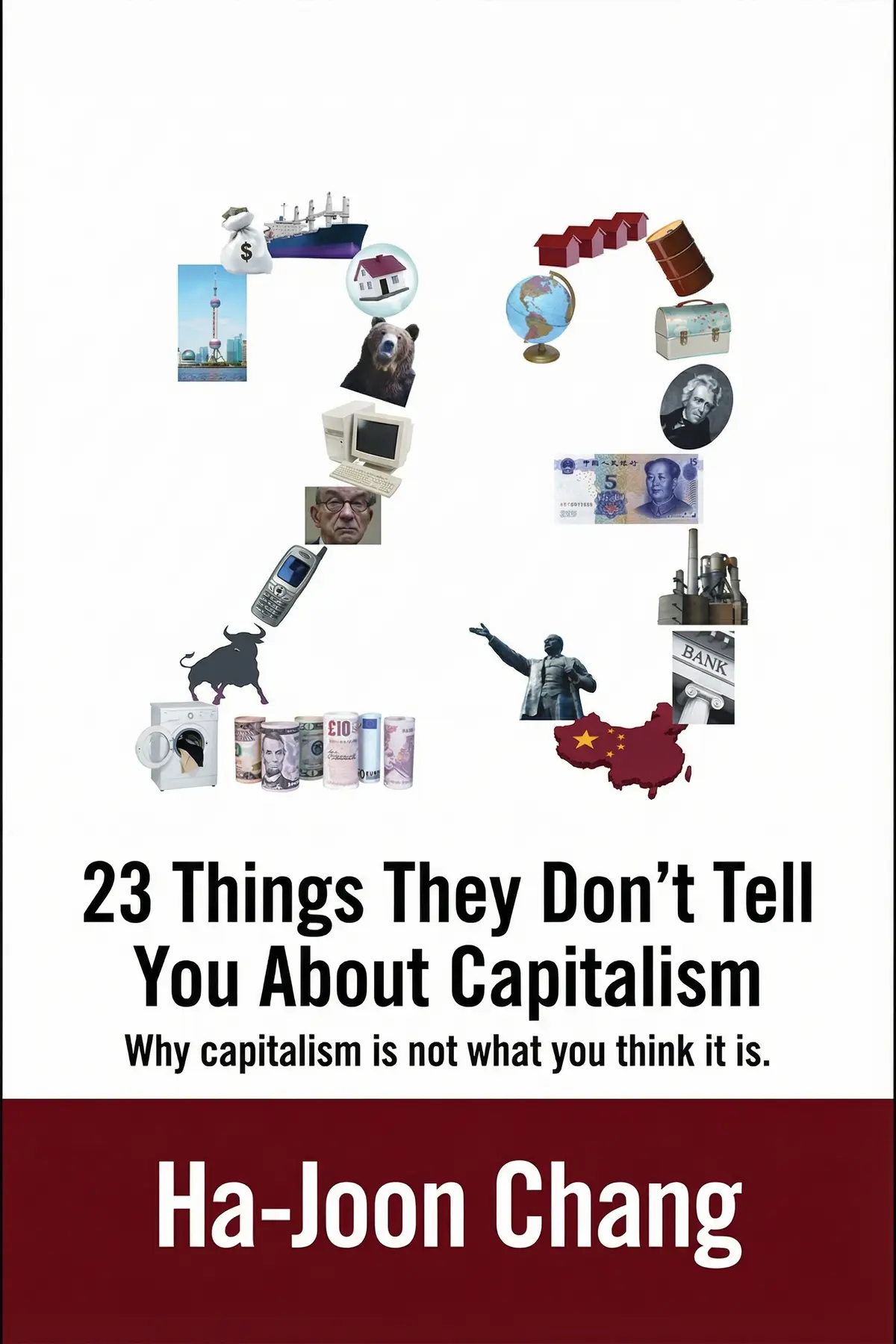
23 Things They Don’t Tell You About Capitalism
Ha-Joon Chang
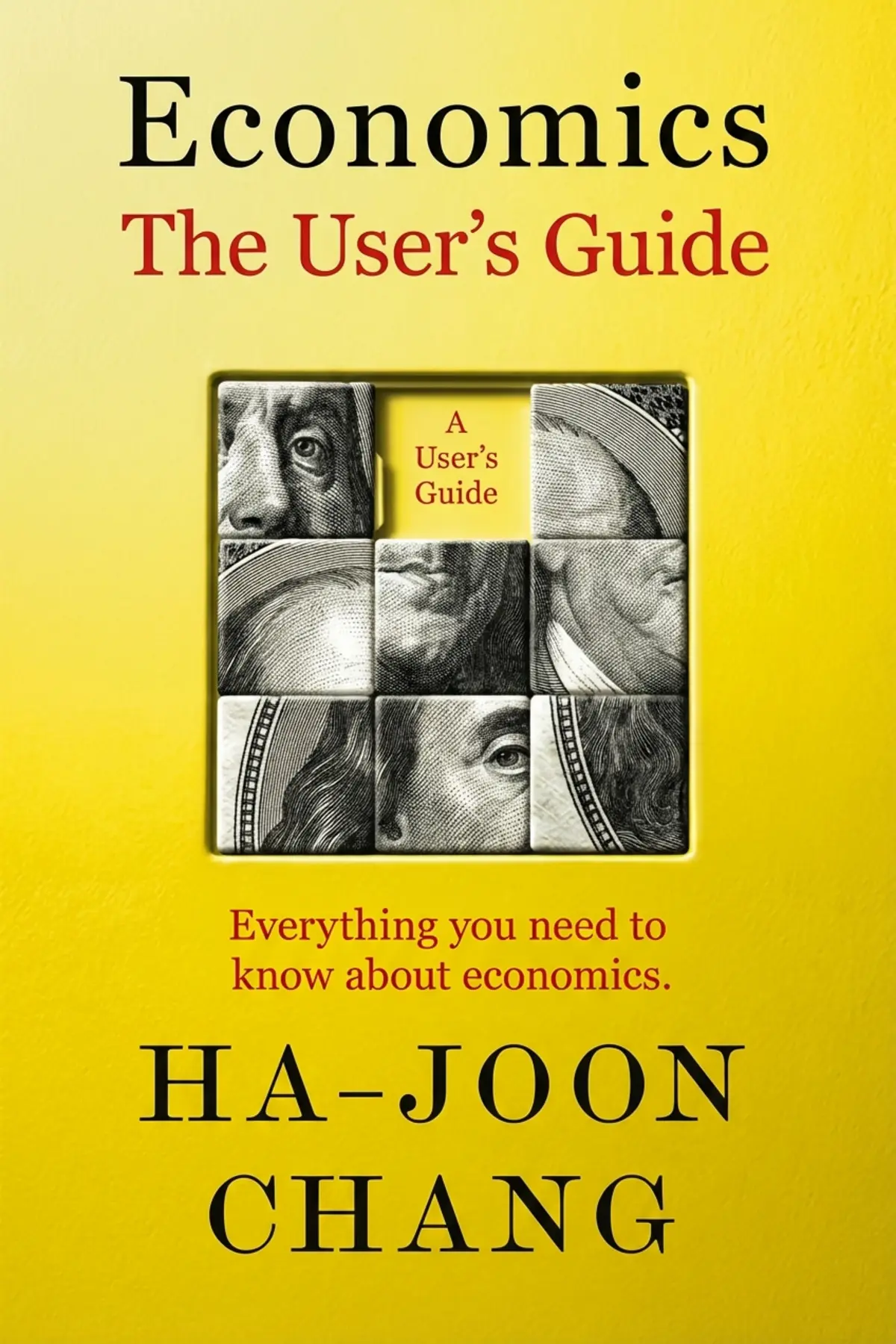
Economics: The User’s Guide offers an accessible roadmap to economic theories and history. Ha-Joon Chang breaks down complex systems to show how policy choices shape our daily lives, work, and global future.
2 min 03 sec
Have you ever felt like the world of economics is a closed-door club, reserved only for those with advanced degrees and a love for complex spreadsheets? Many of us found economics classes to be a chore, filled with dry numbers and abstract models that felt miles away from our actual lives. But the truth is, economics is the very air we breathe. It is the silent architect behind the clothes you choose to buy, the device you are using to listen to this summary, and the security of your retirement.
In this guide, we are going to peel back the curtain. We will explore how economics is much more than a collection of boring statistics—it is a deeply personal and critical force that shapes every transaction we make. By looking at where economic ideas came from and how they have evolved over centuries, we can begin to see the world with much clearer eyes. We will trace the path from medieval village markets to the sprawling multinational corporations that dominate the globe today.
Our journey will take us through the history of capitalism, the different schools of thought that argue over how to fix a broken economy, and the specific tools governments use to keep things running. We will look at why some countries thrive while others struggle, and what terms like GDP or inflation actually mean for your paycheck. Along the way, we will encounter some surprising examples—like the logic behind why a professional wrestler might lose on purpose, or why a plane made of solid gold is a terrible investment, no matter how much it cost to build.
By the end of this summary, you won’t just know more about money; you’ll have a framework for understanding how society itself is sculpted. This isn’t about memorizing formulas; it’s about gaining the knowledge to look at a news headline or a political promise and understand exactly what is at stake for your life and your community. Let’s dive in and see how the world really works.
2 min 26 sec
Think economics is just about money and markets? Discover how this field explores human choices from the sumo ring to the local grocery store.
2 min 04 sec
Trace the journey from local blacksmiths to global giants and learn how the division of labor changed everything.
2 min 25 sec
Rich nations often preach free trade today, but their history tells a different story of how they actually gained their wealth.
2 min 22 sec
Understand the logic of the most influential economic school today and why it prioritizes individual choice above all else.
1 min 57 sec
When the market fails to provide jobs, Keynesian economics suggests the government should step in and spend.
1 min 57 sec
Learn the difference between GDP and GDI, and why a dollar doesn’t buy the same amount of milk in every country.
1 min 55 sec
A skyrocketing GDP can be misleading. Discover why real economic health requires more than just a sudden influx of cash.
1 min 56 sec
Inequality isn’t just a social issue—it’s an economic hurdle that can stifle growth and discourage investment.
2 min 05 sec
How do taxes, spending, and interest rates shape the market? Learn the mechanics of fiscal and monetary policy.
1 min 59 sec
Discover the difference between your local bank and the giants of Wall Street, and how ‘clever’ financial products led to global chaos.
2 min 06 sec
Work defines our lives, but the nature of employment is constantly shifting. Explore the three main reasons why people find themselves jobless.
1 min 56 sec
Inside the corporate boardroom, a struggle for control often plays out between those who own the company and those who manage it.
2 min 10 sec
From call centers to trade deficits, discover how international trade connects every corner of the planet.
1 min 56 sec
As we have seen, economics is far too important to be left solely to the economists. It is the language of our social contracts, the history of our development, and the blueprint for our future. We have traveled from the early insights of Adam Smith and the power of specialized labor to the modern complexities of investment banking and global trade. We have seen how different schools of thought offer different remedies for the same problems, from the Neoclassical focus on individual choice to the Keynesian emphasis on government action during times of fear.
The most important takeaway is that economics is not a set of absolute, unchangeable laws like gravity. It is a series of choices made by people and governments. Whether we prioritize growth over equality, or protectionism over free trade, these decisions have real-world consequences for our health, our happiness, and the planet we inhabit. By understanding the tools used to measure the economy—like GDP, PPP, and the Gini coefficient—you are no longer just a passive observer of the news. You are an informed participant who can ask better questions about how resources are allocated.
Ultimately, this knowledge gives you the power to engage with the world more effectively. When you hear about a new policy or a financial crisis, you can now look beneath the surface to see the underlying theories at play. You can understand why your job might be at risk from automation, or why a change in interest rates affects your mortgage. Economics is, in the end, a user’s guide to society. Use this guide to advocate for the kind of world you want to live in—one that is not just bigger and wealthier, but fairer and more resilient for everyone. The more we all understand these systems, the better we can shape them to serve the common good.
Economics: The User’s Guide is a comprehensive primer designed to demystify the dismal science for the average person. Rather than focusing on abstract equations, it explores the history of capitalism, the competing schools of economic thought, and the practical metrics used to measure a nation's success. It challenges the idea that economics is a set of fixed laws, presenting it instead as a collection of diverse tools that can be used to build a better society. The book promises to equip listeners with the knowledge needed to engage in political and economic debates. It covers everything from the Industrial Revolution and the Great Depression to the mechanics of modern banking and international trade. By understanding how money, labor, and policy interact, you gain the power to see through political rhetoric and understand the real-world consequences of economic decisions on the environment and social equality.
Ha-Joon Chang is a distinguished economist and the author of the international bestseller 23 Things They Don’t Tell You About Capitalism. He is a regular contributor to The Guardian, providing insightful commentary on global economic issues. Chang has shared his expertise as an advisor to various national and international banks and currently serves as a teacher of economics at Cambridge University.
Ha-Joon Chang
Listeners find this economics guide unexpectedly accessible and articulate, offering an excellent primer on the topic by contrasting various economic frameworks. The material is thoroughly documented and clarifies complex ideas for non-experts, making it essential for anyone curious about the discipline. They value the witty tone and moral perspective, while one listener points out that it addresses significant matters in an unbiased way.
Finally, an economics text that doesn't feel like a lecture from a dusty podium. Ha-Joon Chang manages to demystify complex systems by breaking them down into what he calls 'economic cocktails,' urging readers to mix different schools of thought rather than sticking to just one. The way he presents the nine schools—from the Austrians to the Marxists—is incredibly refreshing because he doesn't treat one as the absolute truth. Truth is, most of us are taught that the Neoclassical way is the only way, but this book exposes the flaws in that thinking. It’s well-researched and surprisingly funny in places. I particularly enjoyed the breakdown of how the 2008 financial crisis proved that the 'experts' didn't have all the answers. If you want to understand the real-world forces shaping your life without getting bogged down in impenetrable jargon, this is the guide you need.
Show moreChang’s approach is a breath of fresh air because he actually acknowledges that economics is inseparable from social values and power relations. Most textbooks try to act like they are teaching physics, but this 'User’s Guide' reminds us that every economic choice is a political one. The breakdown of the 'Golden Age' of capitalism was particularly eye-opening for me. It’s fascinating to see how he uses his background in developmental economics to challenge the standard free-trade narrative. Not gonna lie, I was worried this would be a dry read, but his humor and ethical focus kept me engaged throughout. He explains things like the 'anarchy of the market' and 'regulatory capture' in ways that actually make sense for the real world. This book doesn't tell you what to think, but it gives you the tools to actually question the experts.
Show moreEconomics is too important to be left to the professional economists, and this book proves it. The truth is, most of the jargon we hear is just a smokescreen to hide political agendas that favor the rich. Chang pulls back the curtain with an ethical approach that is rare in this field. I loved his point that we shouldn't use only a hammer to see every problem as a nail. Instead, he gives us a whole toolbox. The chapter on the history of capitalism was a revelation, especially the parts about how South Korea developed. It’s well-written, punchy, and doesn't shy away from the 'messy' parts of human behavior. You don't even have to read it cover-to-cover to get something out of it. It’s a must-read for anyone who wants to be an active citizen in a democracy.
Show moreLook, I’m not a math person, but this book made me feel like I could actually hold my own in a conversation about trade policy. Chang avoids the complex formulas that usually make people's eyes glaze over and instead focuses on the logic and the history. His humor really shines through, especially when he’s mocking the hyper-rationality of 'Economic Man.' It’s a deeply human book that asks us to consider how we want our society to actually function. I appreciated the 'real world numbers' at the end of the chapters which helped ground the theories in reality. Even if you think you hate economics, give this a try. It’s surprisingly easy to read and will definitely change the way you look at your paycheck and your taxes. An essential primer for the 21st century.
Show moreThe chapter on the history of capitalism alone is worth the price of admission. It’s a concise yet thorough journey from the industrial revolution to the post-2008 world. Chang does a fantastic job of showing how the boundaries of 'the market' are actually determined by politics—like how we no longer allow the sale of human beings or child labor. This perspective makes it clear that we can choose to organize our economy differently if we want to. Frankly, it’s refreshing to read an economist who doesn't claim to have a crystal ball. He admits that the world is complicated and that every theory has its limitations. It’s well-researched, ethical, and incredibly relevant to the current global situation. If you’ve ever felt like the economy was a rigged game, this book will help you understand exactly how the rules were written.
Show moreEver wonder why economists never seem to agree on anything? This book explains why by treating economics as a political argument rather than a hard science. Chang’s central question—'cui bono?' or 'who benefits?'—should be at the heart of every policy discussion. I loved the section comparing the 'one-dollar-one-vote' rule of markets with the 'one-person-one-vote' principle of democracy. It’s a sobering look at how depoliticizing the economy often just hands more power to the wealthy. Frankly, the writing style is very approachable, making use of layman's terms without being patronizing. There are moments where his own bias toward state intervention is obvious, but he’s honest about it. It’s a much-needed antidote to the idea that there is no alternative to the current status quo. Highly recommended for anyone who feels intimidated by the financial news.
Show morePicked this up after a recommendation, and I'm glad I did, even if I don't buy into every single argument presented. The strongest part of the book is definitely the appendix where he summarizes the different schools of thought; I keep referring back to it! It’s quite useful to see how the Institutionalists or the Schumpeterians differ from the mainstream Neoclassical view. Personally, I found his discussion on how corporations actually work—outside the market, in hierarchical social relations—to be the most insightful part of the text. My only real gripe is that he misses some big topics like the environmental impact of infinite growth and the complexities of the military-industrial complex. Still, as a tool for developing a more critical eye toward the nightly news, it’s immensely valuable. It’s a solid 4 stars for making a difficult subject feel manageable.
Show moreAs someone who spent years in a business major, I found Chang’s breakdown of the different 'schools' of thought more enlightening than my actual 101 courses. He actually explains the assumptions behind the theories, which is something most professors gloss over. For example, his explanation of why 'perfect knowledge' in markets is a fantasy was brilliant. To be fair, he does have a clear preference for a larger state and more regulation, which might annoy some readers. However, his argument that we should read as extensively as possible from different viewpoints is one I can get behind. The book is dense with information but never feels heavy. It’s a great refresher for the basics, though I wish he had spent a bit more time on the ecological contradictions of the capitalist system. Definitely worth the time for a thoughtful reader.
Show moreWhile the first half of this guide is a masterclass in clarity, the second half unfortunately drags quite a bit. Chang starts strong with a brilliant history of capitalism and an accessible introduction to various economic schools, but then the momentum stalls. In the latter sections, he has a tendency to oversimplify nuanced concepts, often relying on pop-culture references that felt a bit forced to me. To be fair, his explanation of the Keynesian school was excellent, yet I found the chapters on 'doing' economics to be repetitive. He spends a lot of time on numbers that feel a bit dated now. It’s a decent primer for a total beginner, but if you already have a firm grasp of current affairs, you might find yourself skimming through the second part. It’s a good bridge to more serious critiques, but don't expect it to be the final word on the subject.
Show moreThe problem with this book is it feels more like a political manifesto disguised as an objective 'user's guide.' Chang claims to be presenting a variety of views, yet he consistently paints market-based solutions in a negative light while championing heavy-handed regulation. For instance, his claim that only Chile benefited from neo-liberal policies in the late 20th century is a massive oversimplification that ignores huge swaths of data from other regions. Look, he is a talented writer, and I appreciate his attempt to make the subject accessible, but the bias is just too thick to ignore. He treats the history of capitalism as a series of failures that only the state can fix. If you’re looking for a balanced introduction to the field, you might want to look elsewhere. It reads more like a collection of opinions with some economic terms mixed in for flavor.
Show more
Niall Kishtainy
William J. Bernstein
Yanis Varoufakis
Andrew Ross Sorkin
AUDIO SUMMARY AVAILABLE
Get the key ideas from Economics: The User’s Guide by Ha-Joon Chang, plus 5,000+ more titles in English and Thai.







