
15 min 10 sec
Fashionable Nonsense: Postmodern Intellectuals’ Abuse of Science
Physicists Alan Sokal and Jean Bricmont expose how postmodern intellectuals misuse scientific jargon and reject objective truth, arguing that this trend undermines critical thought and stalls genuine social progress.
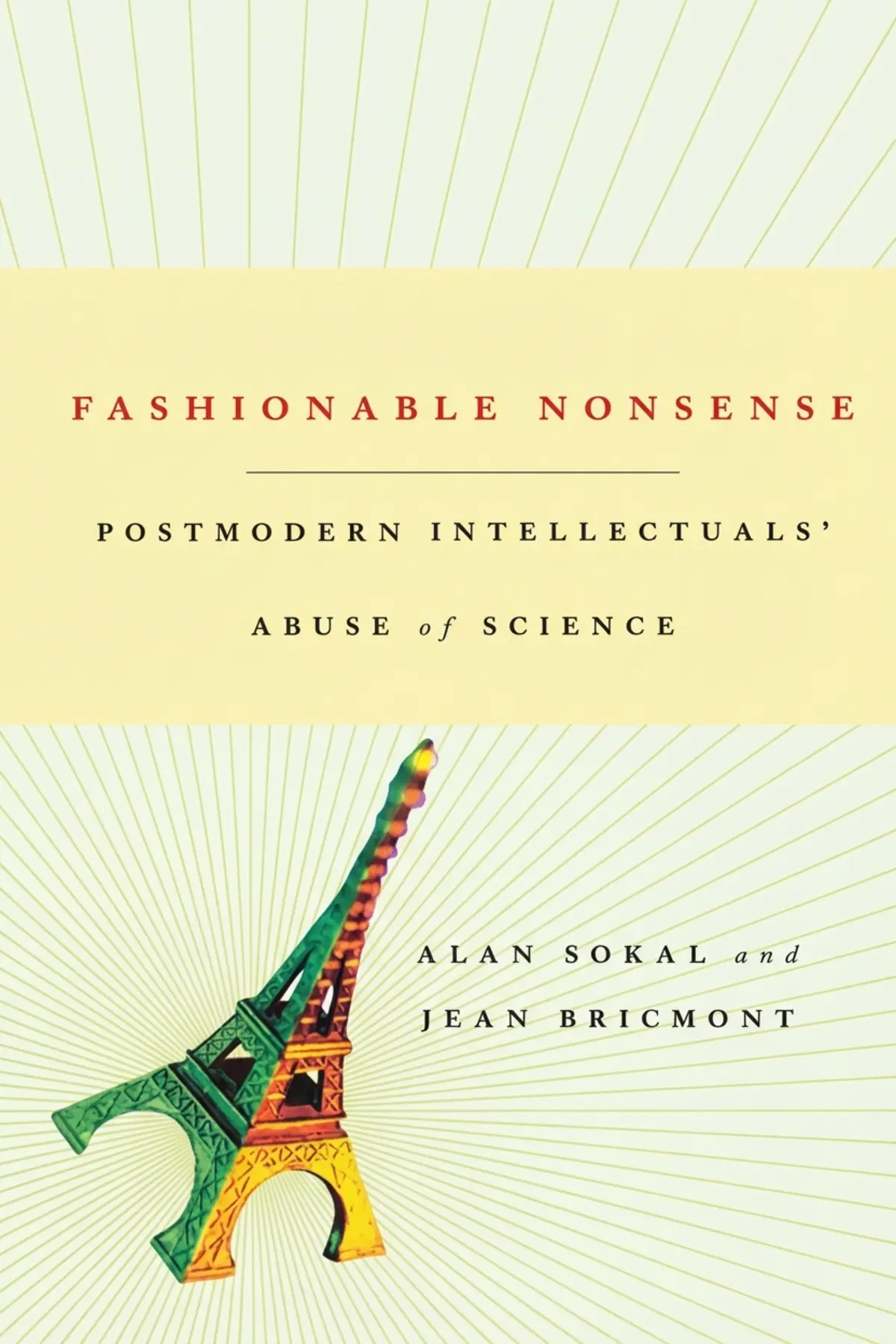
Table of Content
1. Introduction
1 min 37 sec
Imagine picking up a respected academic journal and reading a dense, scholarly article about the intersection of physics and philosophy. It uses impressive terms like ‘quantum gravity’ and ‘hermeneutics,’ and it quotes the most famous thinkers of the day. Now, imagine finding out a few days later that the entire article was a prank—a deliberate collection of gibberish designed to see if the editors could tell the difference between profound insight and total nonsense. This is exactly what happened in the mid-1990s, and it sparked a firestorm that reached far beyond the ivory tower.
At the center of this storm were Alan Sokal and Jean Bricmont, two physicists who became increasingly concerned with how science was being treated in the humanities. They noticed a growing trend called postmodernism, an intellectual movement that challenges the very idea of objective truth. While postmodernism has made contributions to art and literary criticism, Sokal and Bricmont argue that it has taken a dangerous turn by treating scientific facts as nothing more than social opinions.
In this summary, we will explore the ‘Sokal Hoax’ and what it revealed about the state of modern academia. We’ll look at how prominent philosophers have misused mathematical concepts to sound more authoritative and why the rejection of evidence-based thinking isn’t just an academic problem—it’s a threat to our ability to solve real-world issues. Through this lens, we’ll see how the throughline of the book is a call for a return to clarity, honesty, and the pursuit of truth based on evidence rather than fashionable jargon.
2. The Denial of Objective Reality
2 min 25 sec
What if scientific facts were considered no more valid than ancient legends? Explore how postmodernism shifts the focus from what is true to what is merely a social construct.
3. The Anatomy of an Intellectual Hoax
2 min 17 sec
Discover the ‘Trojan Horse’ article that exposed the vulnerabilities of academic gatekeepers and proved that even experts can be fooled by high-sounding nonsense.
4. The Misuse of Science as Metaphor
2 min 38 sec
What happens when philosophers borrow terms from advanced math without understanding them? Learn how some of the most famous thinkers used physics to hide a lack of clarity.
5. The Backlash Against Scientism
2 min 20 sec
Explore the historical reasons why social scientists turned away from evidence-based thinking and how the fear of ‘dogma’ led to a different kind of intellectual trap.
6. Why Objective Truth Still Matters
2 min 23 sec
What happens to a society that can no longer agree on the facts? Discover the real-world consequences of relativism in law, medicine, and social progress.
7. Conclusion
1 min 30 sec
As we wrap up our look at Fashionable Nonsense, the central message is clear: clarity of thought and the defense of objective truth are not just academic preferences; they are the foundations of a healthy society. Alan Sokal and Jean Bricmont have shown us that when intellectuals hide behind incomprehensible jargon, they are often masking a lack of substance. More importantly, when they attack the very idea of evidence, they weaken our collective ability to distinguish fact from fiction.
The Sokal Hoax was a wake-up call that still resonates today. It reminds us to be skeptical of ‘experts’ who use scientific language in ways that don’t make sense, and to value the hard work of the scientific method, which seeks to find truths that are true for everyone, everywhere. Postmodernism may have started as a way to expand our perspectives, but when it entered the realm of science, it lost its way.
The throughline of this book is an invitation to be more rigorous in how we think and how we talk to one another. It encourages us to reject the ‘fashionable’ trend of being intentionally vague and to embrace the often difficult but necessary task of seeking evidence. In an era where ‘alternative facts’ can dominate the conversation, the lessons of Sokal and Bricmont are more relevant than ever. By insisting on rational thought and objective reality, we protect the tools we need to solve the world’s most pressing problems and ensure that our progress is based on something more solid than just words.
About this book
What is this book about?
Fashionable Nonsense serves as a rigorous critique of how various postmodern thinkers have appropriated and misused scientific concepts to lend an air of unearned authority to their work. The book originated from a famous intellectual experiment where a physics professor successfully published a completely nonsensical paper in a respected cultural studies journal. This event pulled back the curtain on a segment of academia that the authors argue has replaced clarity with jargon and substituted objective evidence with extreme relativism. The authors, Alan Sokal and Jean Bricmont, provide a detailed look at various examples where complex ideas from quantum mechanics, chaos theory, and advanced mathematics are used as mere metaphors or, even more concerningly, as literal but nonsensical justifications for philosophical claims. The core promise of this book is to offer a spirited defense of the scientific method and a warning about the decline of clear-headed critical thinking. It argues that when we abandon the idea of an objective reality that can be studied and understood, we lose the very tools needed for social and intellectual progress. By the end, listeners will see why maintaining a distinction between fact and fiction is vital for the health of our intellectual and social systems.
Book Information
About the Author
Alan Sokal
Alan Sokal is a professor of physics at New York University. He is also the author of the book Beyond the Hoax. His co-author, Jean Bricmont, is a professor of theoretical physics at the Université de Louvain in Belgium. In addition to his work in physics, Bricmont co-authored the book Humanitarian Imperialism with Diana Johnstone.
Ratings & Reviews
Ratings at a glance
What people think
Listeners find the work to be well-crafted, amusing, and intellectually stimulating, with one listener emphasizing its successful critique of postmodern relativism. Additionally, they praise the book’s storytelling and momentum, and one listener remarks on its brilliant skewering of "left-wing cant." Conversely, the ease of reading draws varied responses; while some consider it highly fascinating, others describe the work as incomprehensible.
Top reviews
Nam
This book is a surgical strike against the intellectual laziness that plagued late 20th-century humanities. Sokal and Bricmont don't just complain about postmodernism; they systematically dismantle the way thinkers like Lacan and Kristeva used scientific terminology they clearly didn't understand. It is incredibly satisfying to see someone finally point out that the emperor has no clothes when it comes to these dense, supposedly 'profound' texts. The authors maintain a tone of controlled exasperation that makes for a surprisingly engaging and often humorous read. While the math sections can be dense, the general argument against epistemic relativism is accessible to any rational reader. Frankly, it serves as a necessary defense of objective truth in an era where 'social construction' is used as a shield for poor logic. Every student of the social sciences should be required to grapple with these arguments before diving into continental philosophy.
Show moreJeeranan
As someone who identifies with the political left, I found Sokal’s critique of postmodern 'fashionable nonsense' to be incredibly refreshing and necessary. He argues that by abandoning rationality and evidence, the left loses its most powerful tool for social change. The book is a brutal takedown of the 'sharlatans' who use obscure language to hide a lack of actual content. Seeing the specific examples of how E=mc^2 was labeled a 'sexist equation' makes you realize how far some academics have drifted from reality. The writing is sharp, witty, and surprisingly fast-paced for a book about the philosophy of science. It serves as a vital reminder that obscure language is not a synonym for deep thought. Truth is, we need more scientists willing to step into the humanities to keep the discourse grounded in facts.
Show moreSupachai
After hearing about the Sokal Hoax for years, seeing the actual analysis of how these intellectuals abuse topology and quantum physics was eye-opening. The book is a masterclass in intellectual honesty, showing exactly where the line is crossed between metaphor and misinformation. Sokal and Bricmont are fair but firm, giving these authors enough rope to hang themselves with their own incomprehensible prose. The way they handle Jacques Lacan is particularly devastating, exposing his 'mathematical' models as little more than smoke and mirrors. I found the book to be thought-provoking and surprisingly easy to follow, provided you skip some of the more intense equations. It's a brilliant skewering of the way some academics try to 'look' smart rather than actually saying anything of value. Personally, I found it to be one of the most refreshing books on philosophy I've ever read.
Show moreAroha
Ever wonder how many famous philosophers are actually just throwing around scientific buzzwords to sound profound? Sokal and Bricmont provide a hilarious yet devastating answer by quoting long passages of absolute gibberish from icons like Deleuze and Guattari. The book brilliantly skewers the 'left-wing cant' that replaces empirical evidence with opaque, poetic metaphors masquerading as physics. I found the chapter on Luce Irigaray’s feminist critique of fluid mechanics particularly eye-opening because of how blatantly the scientific concepts were distorted. To be fair, some of the technical explanations of topology and calculus might go over the head of a layperson. However, the sheer absurdity of the quoted passages makes the point clear enough even if you aren't a physicist. It is a thought-provoking narrative that challenges the way we grant authority to academic superstars.
Show moreDavid
Wow, the chapters on Jean Baudrillard and his bizarre misuse of non-Euclidean geometry are worth the price of admission alone. Sokal and Bricmont do an excellent job of showing that these aren't just minor metaphors; they are foundational errors that render the original arguments meaningless. The tone is often funny, treating the philosophers with a sort of polite bafflement that highlights the absurdity of their writing. I especially liked the section on 'epistemic relativism' because it explains why this academic trend is actually dangerous for society. My only complaint is that the book can feel a bit like 'preaching to the choir' at times. If you already suspect that postmodernism is mostly hot air, you'll love this, but it might not convince a die-hard Derrida fan. Still, it’s a brilliant skewering of pretension that remains very relevant today.
Show morePick
Finally got around to reading this classic of the 'Science Wars,' and its relevance hasn't faded a bit since the late nineties. The authors provide a much-needed reality check for the academic world, showing how 'deliberately obscure language' is used to dupe snobbish readers into seeing depth where none exists. I found the narrative quality surprisingly high, with Sokal and Bricmont leading the reader through complex ideas with clarity and wit. They aren't just attacking the left; they are defending the very idea that an external world exists and can be understood through reason. It's a sobering look at how easily intellectual standards can slip when people value style over substance. Some of the quotations are so dense they are almost incomprehensible, which only proves the authors' point. This is a must-read for anyone who values clear thinking over academic posturing.
Show moreCamila
Not what I expected, but in a good way—it’s much more than just a follow-up to a famous prank. The authors use the hoax as a jumping-off point to discuss the wider crisis of truth in the social sciences. They address the 'science wars' with a level of detail that shows they aren't just out for blood; they genuinely care about the integrity of academic discourse. The readability is generally good, though the chapters on specific French authors can get a bit repetitive if you read them all at once. I appreciated the effort to explain the actual science behind the concepts being abused, like relativity and chaos theory. It’s a humorous, well-written, and ultimately important book that challenges the reader to think more critically about the 'fashionable' ideas we consume. Just be prepared for some very dense blocks of text from the philosophers themselves!
Show moreGoy
Picked this up expecting a lighthearted romp through academic satire, but I found myself bogged down in the technical math. While the Sokal Hoax itself is a brilliant piece of performance art, the book version feels a bit like a repetitive list of grievances. The authors quote pages of French philosophy and then spend several more pages explaining why the math is wrong, which becomes dry after a while. I appreciate the critique of postmodern relativism, but the readability is a bit of a mixed bag for someone without a STEM background. It's definitely an important document for the 'science wars,' but it isn't exactly a page-turner for a casual Sunday afternoon. Some of the 'intermezzos' are great, though, especially the ones discussing the misuse of Kuhn and Popper. If you want a deep dive into why Lacan's use of topology is nonsense, this is for you, but others might find it a bit tedious.
Show moreUdom
In my experience, this book is best read in small doses because the sheer volume of academic nonsense being debunked can be overwhelming. Sokal and Bricmont are excellent guides, but the structure of the book—alternating between long quotes and scientific corrections—gets predictable. They do a great job of explaining the 'Strong Programme' and why its brand of relativism is flawed, which was the most interesting part for me. However, I sometimes wondered if these philosophers are still as influential as they were when the book was first published. Is it a critique that still needs to be made today, or is it a relic of a specific academic era? To be fair, the 'Sokal Hoax' appendix is still a highlight and makes for a very funny ending. It’s a solid 3-star read that offers some great laughs at the expense of pretentious thinkers.
Show moreLuckana
The core problem with Sokal and Bricmont's approach is that they often sound like humorless pedants correcting love letters with a red pen. While they are undoubtedly correct about the scientific errors, they seem to miss the metaphorical or poetic intent behind many of these philosophical texts. Applying strict mathematical rigor to psychoanalysis or social theory feels like a category mistake that ignores the nuanced ways language functions in the humanities. The book is repetitive, structured as a long series of 'he said this, but the math is actually that' segments. For a book about 'nonsense,' it’s surprisingly dry and difficult to finish. I found the tone to be dismissive and at times even arrogant, which dampened my interest in their otherwise valid points. It feels more like a victory lap for the Sokal Hoax than a truly constructive bridge between the 'two cultures' of science and art.
Show moreReaders also enjoyed
Alien Earths: The New Science of Planet Hunting in the Cosmos
Lisa Kaltenegger
A Guide to the Good Life: The Ancient Art of Stoic Joy
William B. Irvine
A Life Decoded: My Genome: My Life
J. Craig Venter
AUDIO SUMMARY AVAILABLE
Listen to Fashionable Nonsense in 15 minutes
Get the key ideas from Fashionable Nonsense by Alan Sokal, plus 5,000+ more titles in English and Thai.
- 5,000+ titles
- Listen as much as you want
- 7-day free trial
- Cancel anytime







