
21 min 58 sec
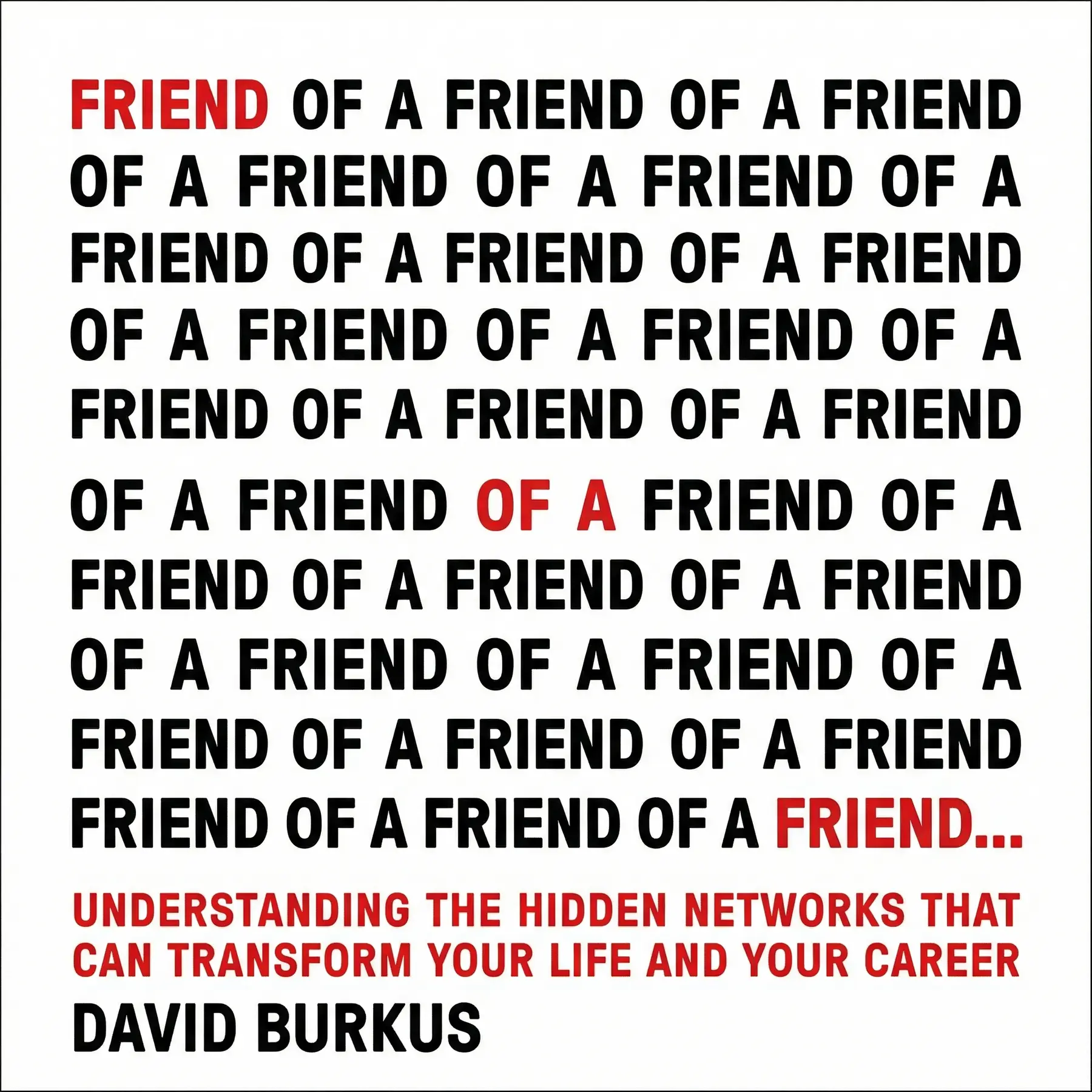
Friend of a Friend: Understanding the Hidden Networks That Can Transform Your Life and Your Career
By David Burkus
David Burkus reveals the science behind human connections. This summary explains how navigating hidden social patterns, leveraging weak ties, and embracing diversity can unlock new opportunities for career growth and personal innovation.
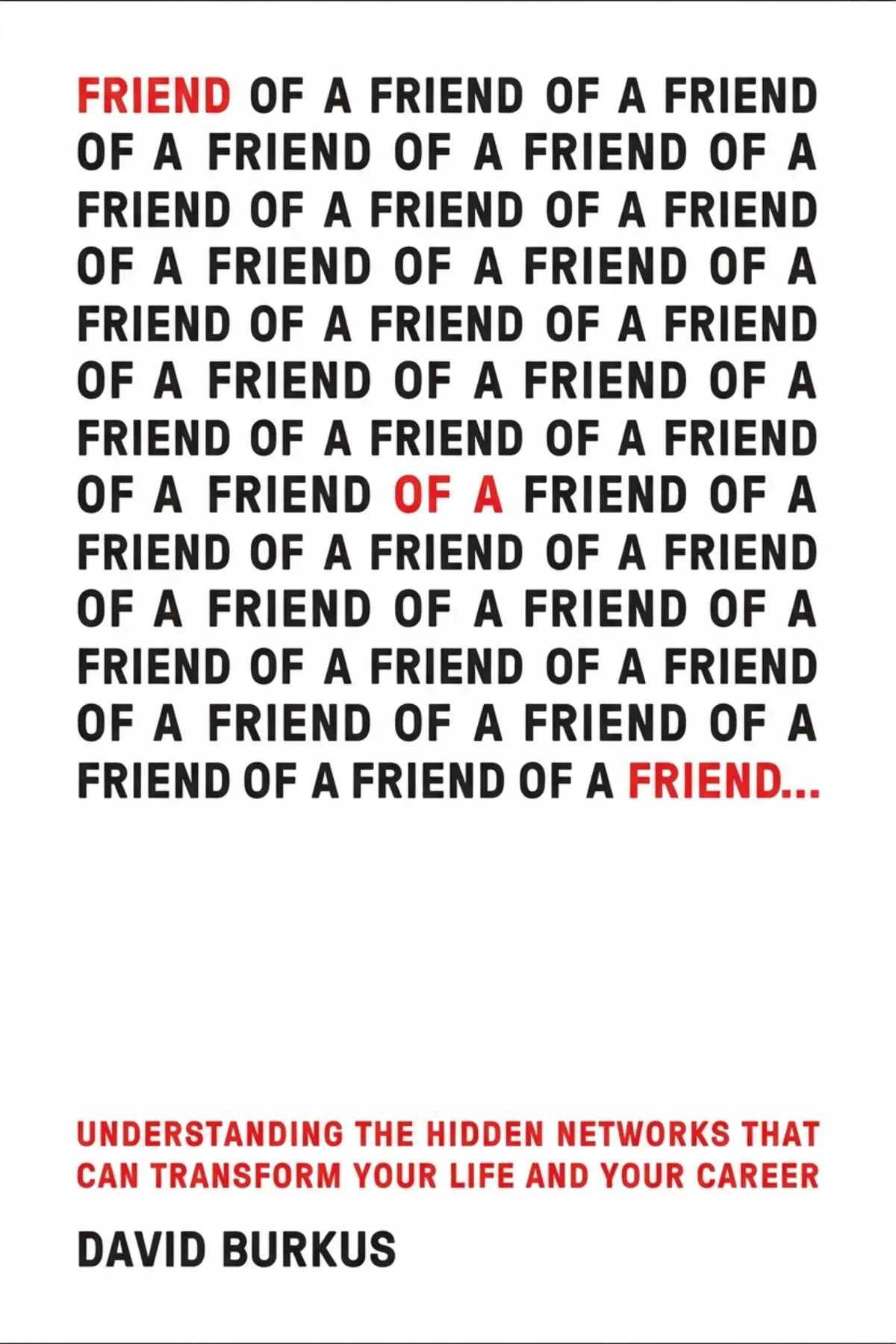
Table of Content
1. Introduction
1 min 39 sec
We often look at the giants of industry, the innovators, and the high-achievers with a sense of awe, assuming they possess some secret, innate talent that the rest of us simply weren’t born with. We tell ourselves that their success is a product of high IQ or an ironclad work ethic. While those traits certainly help, they aren’t the whole story. In fact, they might not even be the most important part of the story. There is an old cliché that says it is not about what you know, but who you know. As it turns out, modern sociology and network science suggest that this old saying is more accurate than we ever imagined, though perhaps not in the way we usually think.
In Friend of a Friend, author David Burkus invites us to look past our immediate circle of friends and colleagues to see the vast, interconnected web that actually determines our professional fate. We usually think of networking as a verb—something we go out and ‘do’ at events. But Burkus argues that a network is actually a noun—a living, breathing map of human connection that we are already a part of. The secret to success isn’t just making more contacts; it’s about understanding the hidden patterns and forces that govern how these connections work.
Over the course of this summary, we are going to explore why your most distant acquaintances are often your most powerful assets. We’ll look at how innovation is rarely the work of a lone genius and is instead the result of the right people being in the right place at the right time. We will also debunk the myth of the traditional networking mixer and discover why shared activities are the true glue of meaningful professional bonds. By the end, you’ll see your social world in a completely different light, equipped with the tools to leverage the hidden power of the ‘friend of a friend.’
2. The Power of Distant Acquaintances
2 min 31 sec
Discover why your inner circle might actually be holding your career back and how casual contacts provide the vital bridges to new opportunities.
3. Bridging Structural Gaps for Innovation
2 min 31 sec
See how acting as a link between separate social worlds can turn you into a powerhouse of creativity and career advancement.
4. The Shift Toward Collaborative Invention
2 min 21 sec
Learn why the era of the lone genius is over and why reshuffling your team is the secret to sustained creative success.
5. The Snowball Effect of Social Connection
2 min 25 sec
Understand the ‘Matthew Effect’ and how building a network gets easier once you reach a certain threshold of visibility.
6. The Strategy of Super-Connectors
2 min 22 sec
Learn how a few key individuals dominate the social landscape and how you can emulate their growth by targeting the right ‘hubs.’
7. Breaking the Cycle of Sameness
2 min 18 sec
Understand why our brains naturally avoid diversity and how to intentionally seek out different perspectives to keep your network healthy.
8. Why Activities Trump Traditional Networking
2 min 11 sec
Stop wasting time at awkward mixers and learn why ‘doing’ something together is the fastest way to build lasting professional trust.
9. The Symbiosis of Friendship and Business
2 min 05 sec
Discover how personal bonds provide the emotional fuel for professional success and why the best deals often start with a game of cards.
10. Conclusion
1 min 35 sec
As we have seen, the landscape of your professional life is not a random collection of people you’ve happened to meet. It is a complex, structured system governed by the same laws that dictate how electricity flows or how diseases spread. Understanding these laws is the key to transforming your career from one of chance encounters to one of strategic growth. By looking toward your weak ties, you open doors to information you didn’t even know you were missing. By bridging structural holes, you become a catalyst for the kind of innovation that companies value most. And by moving away from the superficiality of traditional networking in favor of shared activities, you build the kind of deep trust that stands the test of time.
The throughline here is clear: success is a team effort, and your network is the team. But it’s not just about the size of the team; it’s about the quality and the diversity of its connections. You don’t need to be an extroverted social butterfly to succeed in this world. You just need to be a thoughtful architect of your own social map.
So, where do you start? The most actionable advice is to look at your existing circle and identify the gaps. Who are the people you haven’t spoken to in a while? Reach out to one ‘weak tie’ this week, not with a request, but with genuine curiosity about what they are working on. Join a group where you are the outsider. Stop looking for people who confirm what you already know and start looking for the friends of friends who can show you what you’ve yet to discover. Your next big opportunity is already out there, hidden in the layers of the network you already belong to. All you have to do is reach out and find the bridge.
About this book
What is this book about?
Many of us view networking as an uncomfortable necessity—a series of forced conversations at stale cocktail mixers. However, Friend of a Friend argues that this traditional view misses the point entirely. David Burkus suggests that your potential for success isn't just about the people you know personally, but the vast, hidden structure of the network those people inhabit. By understanding the science of social mapping, you can learn to navigate the invisible forces that dictate how ideas spread and how opportunities arise. This summary provides a deep dive into the sociological principles that govern our professional lives. You will discover why your casual acquaintances are often more valuable than your best friends when it comes to finding a new job, and how bridging the gaps between different social groups can spark massive innovation. From the strategy behind best-selling books to the unexpected social habits of the world's wealthiest individuals, this guide offers a blueprint for building a more diverse, resilient, and influential network without the need for traditional, awkward networking events.
Book Information
About the Author
David Burkus
David Burkus is a popular speaker and author, as well as an associate professor of business studies. He writes regularly for the Harvard Business Review and has given several TED talks on business and management, which have been viewed by millions of people.
Ratings & Reviews
Ratings at a glance
What people think
Listeners find the book’s research to be captivating and deeply investigated, with one listener pointing out the extensive bibliography for those interested in further study. Furthermore, they value how the text validates networking approaches while offering actionable tips, including one listener who mentioned it provided immediate benefits to their life and career. Additionally, listeners characterize the work as very compelling, enjoyable, and worth the investment, featuring top-notch stories throughout. They also prize the eye-opening material, with one review emphasizing how the book assists in reviving dormant connections.
Top reviews
Jan
Finally got around to reading this, and it completely reframed how I view my professional circle. For years, I felt guilty about not attending enough happy hours or 'mixer' events, but Burkus uses actual research to show why those are often a waste of time. The concept of 'dormant ties' was a total revelation for me, prompting me to reach out to a few former colleagues I hadn't spoken to in nearly five years. Truth is, those old connections have already opened more doors for me in two weeks than a hundred business cards ever did. I loved the deep dive into how the NFL’s CIO landed her role through unconventional paths rather than just climbing a linear ladder. The book is well-researched with a thorough bibliography that makes you feel like you're learning something substantial rather than just fluff. If you want to understand the hidden architecture of your industry, this is the manual you need.
Show morePetch
Wow. This is hands down the best book on relationship networks I’ve ever read. Most authors in this space give you cheesy scripts for LinkedIn, but Burkus actually digs into the sociology of why certain connections thrive. He manages to make complex ideas like 'brokerage' and 'structural holes' accessible to a general audience without dumbing them down too much. The way he ties in the history of the most-cited papers in social science with modern success stories is masterful. I especially loved the section on how to rekindle dormant connections; it’s such an untapped resource that most people completely ignore out of awkwardness. Frankly, the book validated so many things I intuitively felt about networking but couldn't put into words. It's an evocative and essential read for anyone who wants to maximize their influence through genuine community building rather than just transactional interactions.
Show moreWachira
Ever wonder why the loudest person at the networking event isn't necessarily the most successful? Burkus breaks down the science of networks in a way that feels incredibly validating for those of us who hate traditional self-promotion. I found the sections on 'multiplex relationships' particularly useful because they explain how mixing your personal and professional lives can actually lead to more robust connections. Some of the storytelling gets a bit repetitive after a while, and I found myself skimming the parts that focused heavily on private industry clusters. However, the core message about being a 'broker' between different social groups is powerful enough to carry the book. Not gonna lie, I was skeptical at first, but the practical advice on performing a 'network audit' gave me a clear picture of where my connections were lacking. It's a smart, readable guide for anyone who wants to build influence without feeling like a mercenary.
Show moreFah
The chapter on 'shared activities' changed my entire strategy for community involvement. Burkus argues that we build better bonds when we are working toward a common goal, like a non-profit board, rather than just standing around with cocktails. This makes so much sense when you look back at your best professional relationships and realize they started in the trenches of a project. I appreciated how he cited Mark Granovetter’s work on weak ties, giving the book a level of academic credibility that many business books lack. One minor gripe is that the focus is heavily skewed toward people who are already established in their careers. Pre-career students might find some of the advice a bit difficult to implement without a pre-existing base of contacts to pull from. Still, the insights into the 'majority illusion' and how information travels through clusters were eye-opening. It's an excellent resource for anyone looking to diversify their perspective.
Show moreManop
After hearing about this book on several podcasts, I decided to see if the hype was real. David Burkus does a fantastic job of debunking the 'self-serving' element of networking that makes so many people feel dirty or opportunistic. Instead, he focuses on being a bridge between different clusters of people, which feels much more authentic and helpful. The stories about Adam Rifkin and Scott Harrison illustrate these points beautifully without feeling like typical corporate case studies. I did find a few chapters to be a bit uneven, particularly when the anecdotes didn't quite mesh with the psychological studies being cited. Despite that, the overall framework for tending to your community is one of the most useful I've encountered in years. It’s a great read if you want to understand how the 'small world effect' actually impacts your daily career opportunities. Definitely worth the price for the networking audit exercise alone.
Show moreTee
As someone who is currently navigating a major career transition, the advice in this book was incredibly timely. Burkus explains why your closest friends are actually the least likely to help you find a new job—they know everyone you already know! It was the discussion on 'weak ties' acting as bridges to new information that finally convinced me to start reaching out beyond my immediate circle. I found the tone to be very encouraging, though some of the examples felt a bit out of reach for someone not working in Hollywood or the NFL. Look, it’s not a perfect book, and some of the science-to-practice sections felt a little bit like homework. However, the core insights are so strong that they far outweigh any minor pacing issues. It helped me understand that my network isn't just a list of names, but a living community that needs to be tended to.
Show moreNong
Direct and insightful. Burkus manages to take the 'ick' factor out of networking by showing how it’s actually just about understanding human systems. I really liked the focus on 'shared activities' as a way to drop the prescribed roles we often feel forced into during professional meetups. The research is solid, and the bibliography is a goldmine for anyone who wants to dive deeper into the academic side of things. There were a few moments where the book felt a little padded to reach its page count, but the quality of the writing kept me moving through those sections. If you’re tired of the same old 'how to win friends' advice, this provides a much more modern and data-driven perspective. It’s a practical handbook for anyone who wants to be more intentional about who they know and how they connect others.
Show moreDuang
This book attempts to bridge the gap between academic sociology and the frantic world of professional networking. While the focus on weak ties and structural holes is genuinely enlightening, I found the pacing a bit erratic throughout the middle sections. David Burkus relies heavily on anecdotes, like the story of Brian Grazer, which are entertaining but sometimes feel like they are stretching a single data point too far. To be fair, the 'From Science to Practice' summaries at the end of each chapter provide a much-needed anchor for readers who want actionable steps. It is a solid read if you are interested in network science, but be prepared for some chapters that feel a little light on new information. I appreciated the shift away from 'working the room,' as that traditional approach always felt disingenuous to me. Ultimately, it’s a decent handbook that probably could have been a very long essay instead of a full book.
Show moreLuke
Picked this up hoping for a step-by-step guide, but it’s more of a philosophical shift supported by social science. The good news is that it’s extremely readable and moves quickly, but the bad news is that it sometimes feels a bit superficial. To be fair, the research on how our networks can limit our thinking if they are too similar to us was a much-needed wake-up call. I realized my own circle had become an echo chamber, and Burkus provides some decent tips on how to break out of that. I wish there was more focus on the 'how-to' rather than just the 'why,' as the anecdotes can start to feel a bit redundant by the end. It's a 3.5-star book for me, rounded down because I found myself skimming large sections of the industry-heavy examples. Useful, but not necessarily a life-changer.
Show moreSing
Not what I expected given all the hype surrounding the research. While the initial premise regarding the 'strength of weak ties' is fascinating, the book quickly devolves into a series of loosely related anecdotes about already-famous people. It’s hard to relate to a Hollywood producer’s networking strategy when you’re just trying to find a mid-level marketing job in a flyover state. Personally, I found most of the chapters to be far too long for the actual 'nugget' of science they were trying to convey. If you have already read any basic sociology papers on social networks, you likely won't find much new ground covered here. The writing is polished, but the substance feels spread thin across 200+ pages. I’m giving it two stars because the 'From Science to Practice' sections are okay, but I honestly struggled to stay engaged past the halfway mark.
Show more
Readers also enjoyed
60 Seconds & You’re Hired!
Robin Ryan
Be the Unicorn: 12 Data-Driven Habits That Separate the Best Leaders from the
William Vanderbloemen
AUDIO SUMMARY AVAILABLE
Listen to Friend of a Friend in 15 minutes
Get the key ideas from Friend of a Friend by David Burkus, plus 5,000+ more titles in English and Thai.
- 5,000+ titles
- Listen as much as you want
- 7-day free trial
- Cancel anytime







