
12 min 46 sec
Grow the Pie: How Great Companies Deliver Both Purpose and Profit
By Alex Edmans
Discover how businesses can achieve enduring success by shifting from a narrow focus on profit to a broader commitment to societal purpose, ultimately benefiting shareholders, employees, and the global community alike.
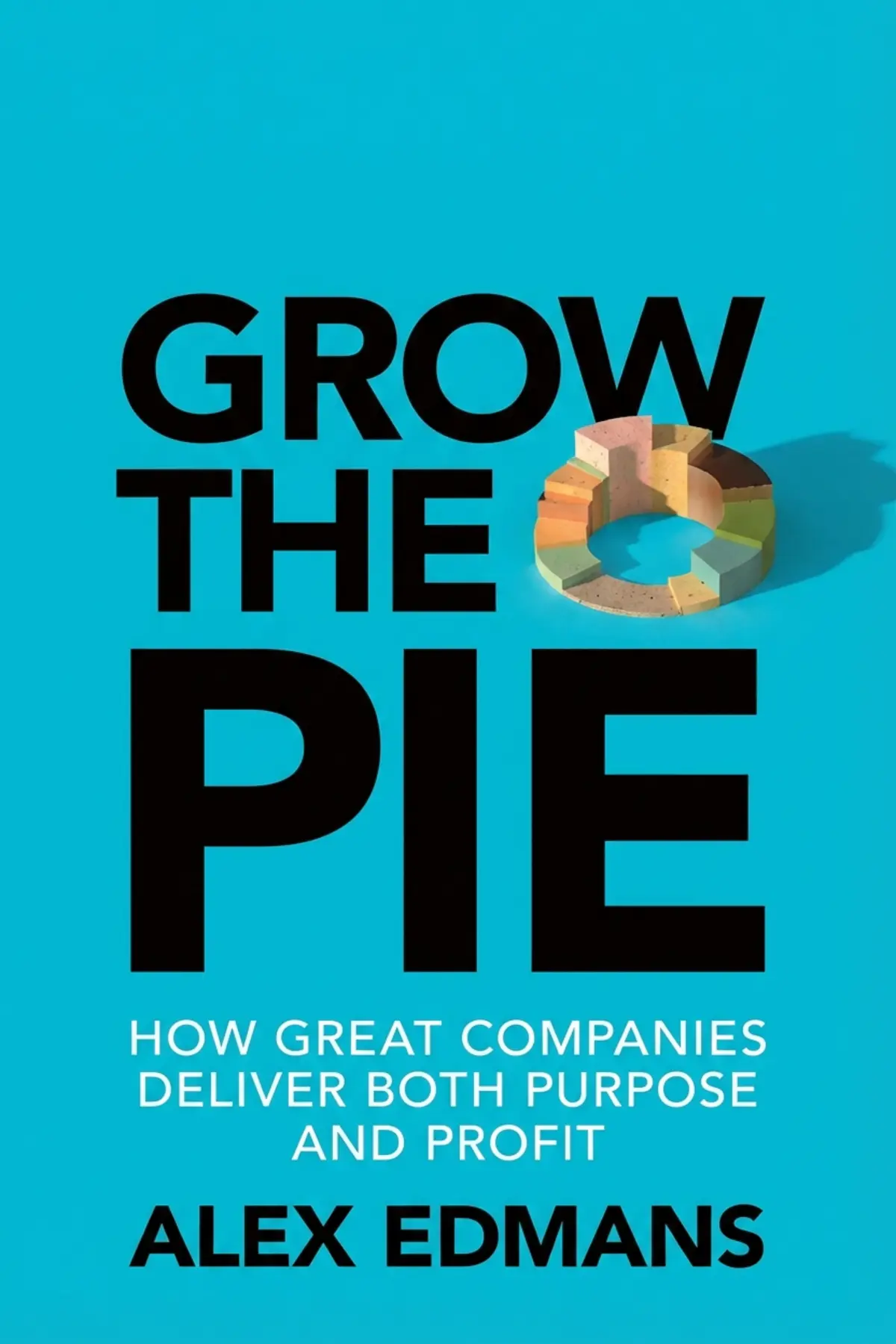
Table of Content
1. Introduction
1 min 38 sec
In the modern era, we often find ourselves caught in a heated debate about the true purpose of a business. On one side, there is the traditional view that a company’s sole responsibility is to generate as much profit as possible for its owners. On the other side, there is a growing demand for companies to serve society, even if it means sacrificing their bottom line. This tension creates a sense that business is a zero-sum game—a situation where if the company wins, society loses, and if society wins, the company’s financial health must suffer.
But what if this entire premise is wrong? What if the relationship between profit and purpose isn’t a tug-of-war, but a partnership? This is the core question we are going to explore. We are moving toward a new paradigm called the ‘pie-growing mentality.’ In this framework, we stop looking at value as a fixed resource to be divided and start looking at it as something that can be expanded through innovation, investment, and integrity.
Over the course of this summary, we will break down the mechanics of how this shift happens in the real world. We will look at how companies can rethink executive pay to encourage long-term thinking, why certain financial maneuvers like share buybacks aren’t always the villains they are made out to be, and how a clear sense of mission can actually lead to higher stock returns. We will also see that this isn’t just a task for CEOs and boardrooms; it is a movement that requires the active participation of every one of us—as employees, as customers, and as investors. By the end, you’ll see how a business can thrive not by taking a bigger slice of the pie, but by making the entire pie bigger for everyone involved.
2. The Shift from Pie-Splitting to Pie-Growing
2 min 14 sec
Explore the fundamental difference between companies that exploit resources for quick gains and those that create lasting value for the entire community.
3. Rethinking Executive Incentives for the Long Term
1 min 50 sec
Understand why the way we pay leaders matters more than the amount, and how the right structures can align corporate and social goals.
4. The Nuance of Share Buybacks and Capital Allocation
1 min 46 sec
Debunk common myths about share buybacks and see how they can actually serve as a tool for more efficient and responsible growth.
5. Defining Purpose as a Strategy for Excellence
1 min 51 sec
Learn how a clear, focused mission drives innovation and why a company’s core business is its greatest contribution to society.
6. The Power of the Individual in the Economic Ecosystem
2 min 00 sec
Discover how your daily choices as a consumer, employee, and investor provide the fuel for a more responsible business world.
7. Conclusion
1 min 27 sec
As we wrap up this exploration of the pie-growing mentality, it is important to remember that this isn’t just a hopeful theory; it is a practical and proven framework for the future of capitalism. The traditional tension between doing well and doing good is a relic of an era that viewed value as a limited resource. By shifting our focus from the division of value to the creation of value, we unlock a massive amount of human potential and innovation. We have seen that when companies lean into their purpose, they don’t just help the world—they become more resilient, more attractive to talent, and more profitable over the long term.
The throughline of everything we’ve discussed is the power of the long-term perspective. Whether we are talking about executive pay, share buybacks, or corporate mission, the goal is always to move away from the ‘quick win’ and toward sustainable growth. This requires a level of courage from business leaders to resist the pressure of the next quarter, but it also requires a level of commitment from us as individuals.
Your takeaway should be one of empowerment. You don’t have to wait for a law to change or a new CEO to be hired to start moving toward a pie-growing economy. You can start today by being more intentional about where you work, where you spend your money, and how you view the role of business in your community. When we stop fighting over the size of the slices and start working together to make the entire pie bigger, everyone wins. That is the promise of a purpose-driven world, and it is a goal that is well within our reach.
About this book
What is this book about?
Grow the Pie challenges the traditional notion that corporate success and social well-being are in constant conflict. Instead of viewing the value a company creates as a fixed pie where one side’s gain is another’s loss, this exploration introduces the pie-growing mentality. This approach suggests that by prioritizing a higher purpose and investing in stakeholders—such as employees, customers, and the environment—businesses actually create more value for everyone, including shareholders. The narrative provides a comprehensive framework for rethinking modern capitalism. It examines the nuances of executive compensation, the reality behind controversial share buybacks, and the power of purpose-driven innovation. By moving beyond short-termism and superficial corporate social responsibility, the book offers a roadmap for leaders and citizens to foster an economy that is both prosperous and equitable. The promise is a sustainable future where profit is the natural byproduct of a company’s positive impact on the world.
Book Information
About the Author
Alex Edmans
Alex Edmans is a Professor of Finance at London Business School and a renowned authority on responsible business practices. A former Fulbright Scholar with a PhD from MIT, he has shared his expertise at the World Economic Forum and provided testimony to the UK Parliament. Edmans is also a sought-after speaker, known for his impactful TED talks on trust and corporate responsibility. His literary contributions include co-authoring the influential textbook Principles of Corporate Finance and writing May Contain Lies, a deep dive into how statistics and narratives can influence our perceptions.
Ratings & Reviews
Ratings at a glance
What people think
Listeners find this read highly pleasant and well-substantiated by data. They are grateful for its point of view, with one listener mentioning how it provides a different lens through which to see capitalism.
Top reviews
Palm
Ever wonder if capitalism can actually be a force for good without losing its competitive edge? Edmans tackles this head-on with his 'Pieconomics' framework, arguing that we shouldn't just fight over how to slice the existing wealth. Instead, he demonstrates how companies like Merck, through their work on river blindness, actually created more total value for everyone by being purpose-driven. It’s refreshing because it isn't just another 'feel good' corporate social responsibility manual. The book is grounded in rigorous data, proving that long-term social impact leads to long-term financial success. I loved the nuance regarding share buybacks, which are often unfairly demonized in the media. This is essential reading for anyone who wants to see business evolve beyond short-termism. It genuinely changed how I view the relationship between a CEO's incentives and societal well-being.
Show moreSiriporn
Wow. It is rare to find a business book that is both intellectually rigorous and deeply inspiring. Alex Edmans has managed to write a manifesto for a new kind of capitalism that doesn't require us to choose between profit and purpose. The contrast between Martin Shkreli’s predatory 'pie-splitting' tactics and Roy Vagelos’s 'pie-growing' vision at Merck is a powerful narrative device. It makes the abstract concepts of stakeholder theory feel immediate and practical. Truth is, many people think being 'purposeful' means being soft, but Edmans proves that it requires more innovation and better management, not less. I specifically appreciated the deep dive into how citizens and investors can use their voice to hold corporations accountable. It’s a refreshing take that empowers the reader rather than just lecturing them. Highly recommended for any leader looking to build something that lasts.
Show moreYuki
Finally a book that treats business with the respect it deserves while also demanding better from it. Edmans understands that profitable companies are the ones best positioned to solve global problems like climate change or poverty. This isn't a book about charity; it's a book about how being a 'good' business is actually just good business. The case studies, from Vodafone to Merck, are meticulously chosen to prove his point that stakeholder well-being is the foundation of sustainable success. I found the section on 'citizens as investors' particularly empowering. It reminds us that we all have a role to play in shaping the economy through our choices. The writing is sharp, and the logic is airtight. It’s a rare 5-star read for me in the business category. This should be required reading in every boardroom across the country.
Show moreOksana
This book provides a much-needed bridge between the 'shareholder primacy' crowd and the 'social justice' activists in the business world. Edmans avoids the usual fluff found in management books, opting instead for a data-heavy approach that challenges common dogmas on both sides of the aisle. I found the section on executive compensation particularly illuminating, especially the case of Reckitt Benckiser. While many criticize high pay, Edmans shows that if it's structured as long-term restricted shares, it can align a leader's interests with the company's health. My only gripe is that it can get a bit repetitive in the middle chapters. Sometimes the 'pie' metaphor feels a little stretched thin. However, the insights on how M-Pesa transformed the Kenyan economy while still being a profitable venture for Vodafone are simply brilliant. It’s a solid 4 stars for its intellectual honesty.
Show moreSara
As a business student, I was initially assigned this for a course on sustainable finance, but I ended up finishing it for my own interest. Before reading this, I thought 'purpose' was just a marketing buzzword used to cover up corporate greed. Edmans completely flipped that perspective for me by showing that purpose is actually a tool for excellence and innovation. The way he explains share buybacks was a real eye-opener. Instead of seeing them as a way to starve workers, he explains how they can reallocate capital to where it’s most needed. The writing style is clear, though some of the examples felt a bit dated. Still, the core message of Pieconomics is incredibly persuasive. It gave me a new framework for how I want to approach my future career in finance. Definitely worth the time if you care about the future of our economy.
Show moreLucas
Picked this up after hearing Alex Edmans on a podcast and I’m glad I did. He has a way of cutting through the noise of the usual anti-business rhetoric without becoming an apologist for bad corporate behavior. The distinction he makes between creating value and just moving it around is crucial for understanding modern markets. I found the chapter on how Unilever used handwashing campaigns to drive both health outcomes and sales to be a perfect illustration of his theory. It shows that social value isn't an 'add-on' but can be the core driver of growth. One minor criticism is that he sometimes glosses over the difficulty of measuring social impact, which is a huge hurdle in the real world. Despite that, the book is a great guide for anyone interested in making the system work better for everyone involved.
Show moreAkira
After hearing so much about the 'stakeholder vs. shareholder' debate, it was great to find a book that offers a practical way forward. Edmans avoids the trap of being too idealistic by anchoring his 'Pieconomics' theory in hard evidence. I especially liked how he addressed the controversies surrounding CEOs like Bart Becht, showing that even with high pay, a leader can create massive value for both shareholders and the environment. It’s a nuanced take that you don't often see in the headlines. Personally, I would have liked more focus on small and medium-sized enterprises, as most of the examples are global giants. But the principles are clearly applicable across the board. The book is well-structured and provides a clear roadmap for how to integrate social responsibility into a company’s DNA. A very strong four-star effort.
Show moreRung
A thoughtful dive into the 'why' behind successful companies. Edmans makes a very compelling case that purpose and profit aren't mutually exclusive, but rather two sides of the same coin. I was particularly impressed by his defense of share buybacks, which he argues can actually increase long-term stock returns when used correctly. This kind of evidence-based approach is what sets 'Grow the Pie' apart from other business books. It’s not just an opinion piece; it’s a rigorous analysis of what actually works. To be honest, I think some of the sections on integrated reporting were a bit too technical for me, but I can see why they are included for professional investors. Overall, the book is a masterclass in how to think about value creation in the 21st century. It's a timely and essential contribution to the conversation.
Show moreOmar
The core premise of 'Grow the Pie' is fantastic and easy to get behind. Who wouldn't want a world where businesses thrive by helping society? However, the book struggles to maintain its momentum after the first few chapters. Once you understand the difference between pie-growing and pie-splitting, the rest of the book feels like it's repeating the same point with different anecdotes. I appreciated the nuance on things like CEO pay and share buybacks, but I think the book could have been about a hundred pages shorter. It’s not that the information is bad—it’s actually very well-researched—but the tone can be a bit dry at times. It’s a good book for a reference shelf, but it’s not exactly a page-turner. If you're looking for a quick summary of the purpose-profit debate, you might find this a bit too detailed.
Show moreSamuel
To be fair, the central idea that we should grow the overall value of a company rather than just fighting over its distribution is excellent. But the execution left me cold. The book is incredibly dense and at times feels more like a textbook for an MBA course than a book for the general public. I honestly found the second half to be quite a slog, especially when it got into the weeds of integrated reporting and corporate governance structures. It felt like the author was trying to pack too many academic arguments into one volume. For a layperson, the technical language might be a barrier. If you aren't already familiar with finance and economic theory, you might find yourself googling terms every five minutes. It’s a shame because the message is important, but the delivery is just a bit too academic for me to recommend to a casual reader.
Show moreReaders also enjoyed
A Splendid Exchange: How Trade Shaped the World
William J. Bernstein
7 Powers: The Foundations of Business Strategy
Hamilton Helmer

A Bigger Prize: How We Can Do Better Than the Competition
Margaret Heffernan

Adults in The Room: My Battle With Europe’s Deep Establishment
Yanis Varoufakis
AUDIO SUMMARY AVAILABLE
Listen to Grow the Pie in 15 minutes
Get the key ideas from Grow the Pie by Alex Edmans, plus 5,000+ more titles in English and Thai.
- 5,000+ titles
- Listen as much as you want
- 7-day free trial
- Cancel anytime







