

10 min 11 sec
Hard Facts, Dangerous Half-Truths, and Total Nonsense: Profiting from Evidence-based Management
Hard Facts, Dangerous Half-Truths, and Total Nonsense explores how leaders can achieve better results by abandoning outdated myths and intuition in favor of evidence-based management and data-driven decision-making processes.
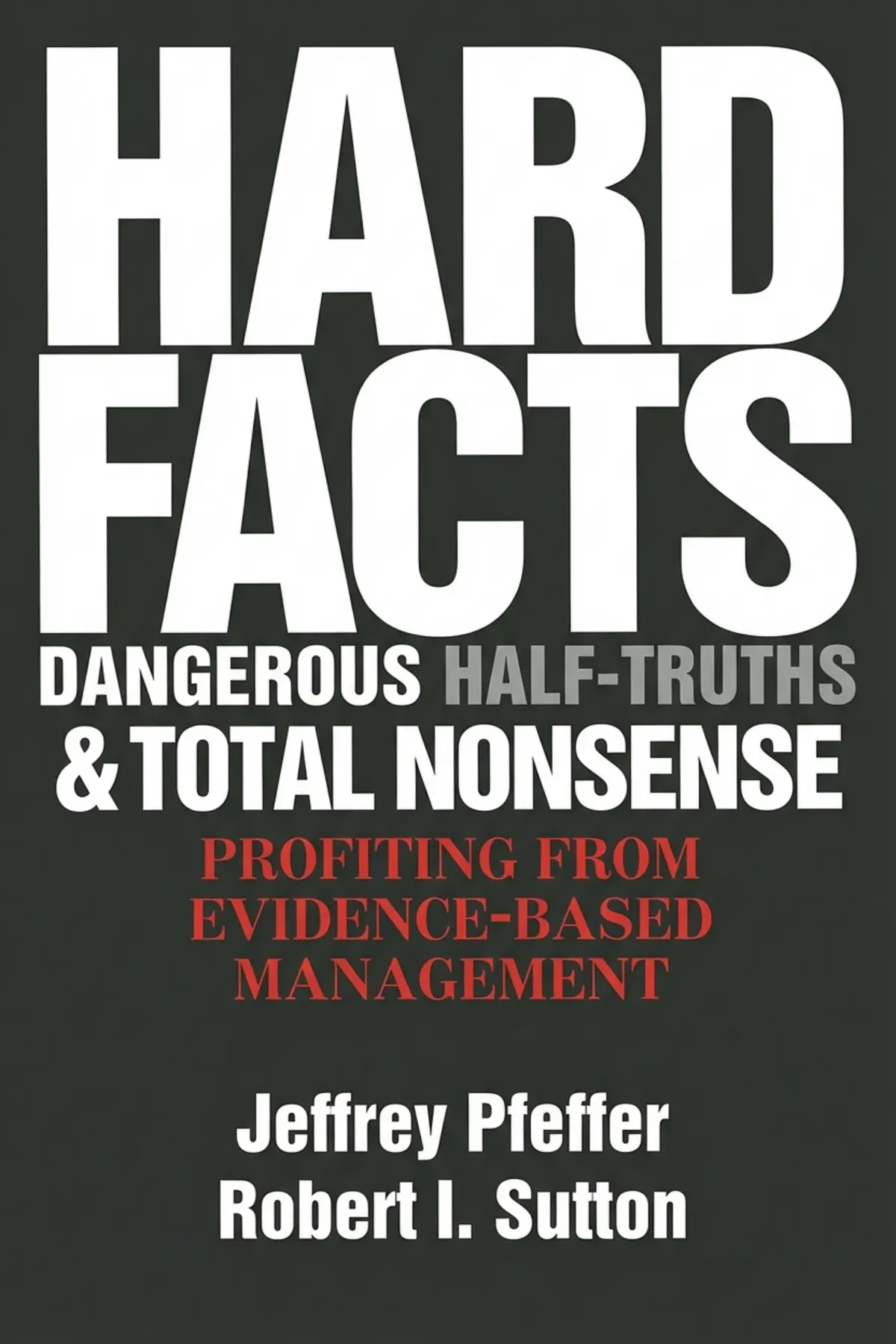
Table of Content
1. Introduction
1 min 08 sec
In the high-stakes environment of modern business, every choice a leader makes can have massive consequences. Yet, if you look closely at how many organizations actually function, you will find a surprising amount of guesswork. Instead of relying on what actually works, many executives fall back on what they’ve always done, what they think they know, or what they see their competitors doing. This reliance on tradition and imitation is a gamble that often leads to stagnation or even failure.
This is where the concept of evidence-based management, or EBM, changes the game. Think of it as the application of scientific logic to the world of business leadership. It is about moving away from gut feelings and moving toward a culture that prizes facts, data, and proven results. In this summary, we will explore the core philosophy presented by Jeffrey Pfeffer and Robert I. Sutton in their work, Hard Facts, Dangerous Half-Truths, and Total Nonsense. We will examine why common management practices often fail us and how you can implement a more rigorous, evidence-based approach to lead your company toward sustained success.
2. The Hidden Risks of Management Folklore
1 min 15 sec
Discover why relying on common industry assumptions and imitation is a dangerous strategy that often leads to organizational failure rather than success.
3. Challenging Assumptions with Data
1 min 27 sec
See how even the most successful companies can be wrong about what drives performance until they look at the hard evidence.
4. Neutralizing Bias for Fairer Decisions
1 min 19 sec
Explore how shifting to an objective, evidence-based system can reveal and eliminate deep-seated professional biases that hinder talent acquisition.
5. The Pitfalls of Surface-Level Imitation
1 min 19 sec
Learn why copying the tactics of industry leaders like Toyota often fails if you don’t understand the underlying philosophy and culture.
6. Adopting an Unfinished Prototype Mindset
1 min 18 sec
Discover the power of treating your organization as an ongoing experiment that requires constant refinement and objective feedback.
7. The Art of Persuasion and Strategic Resistance
1 min 23 sec
Understand how to champion data-driven decisions and how to cautiously handle misguided initiatives from above.
8. Conclusion
1 min 02 sec
The transition to evidence-based management is not about memorizing a new set of rules, but about adopting a new way of seeing the world. It is a commitment to replacing speculation with hard facts and trade-worn myths with proven principles. As we’ve seen, the benefits of this approach are clear: it helps avoid the traps of imitation, neutralizes costly biases, and keeps organizations in a state of constant, data-driven evolution.
While it might feel safer to follow the crowd or rely on your ‘gut,’ the evidence shows that this is often a path to mediocrity. By embracing the principles of EBM—treating your company as a prototype, seeking outsider perspectives, and marketing your data through powerful stories—you position yourself to make superior decisions. The next time you face a critical business choice, don’t just ask what you feel or what others are doing. Ask what the evidence says. In the long run, the facts are your most reliable allies, and following them is the surest way to lead your company toward a prosperous and stable future.
About this book
What is this book about?
Many organizations operate on a foundation of shaky assumptions, imitation of competitors, and unproven management theories. Hard Facts, Dangerous Half-Truths, and Total Nonsense exposes these common pitfalls and introduces a more reliable alternative: evidence-based management. This approach encourages leaders to treat their companies as continuous experiments where decisions are grounded in hard data rather than gut feelings or tradition. The book provides a roadmap for transforming organizational culture by questioning long-held beliefs. It covers why even successful companies often fail when they mimic others without understanding the underlying principles, and how bias can distort professional judgment. By adopting the principles outlined in this work, managers can learn to identify the difference between effective strategies and total nonsense, ultimately leading to more predictable performance and reduced organizational risk.
Book Information
About the Author
Jeffrey Pfeffer
Jeffrey Pfeffer is a highly regarded professor at the Stanford Graduate School of Business. He is a prominent voice in organizational behavior and has authored influential titles such as 7 Rules of Power, Leadership BS, and The Human Equation. Robert I. Sutton is a professor at the Stanford University School of Engineering and an accomplished researcher. He is well-known for his insightful books including The No Asshole Rule, Weird Ideas That Work, and Good Boss, Bad Boss.

Ratings & Reviews
Ratings at a glance
What people think
Listeners find the book to be thoroughly investigated and simple to digest, with one listener mentioning how it applies a rigorous scientific lens to long-held convictions. Furthermore, the quality of the writing receives positive marks, and listeners feel it is well worth the cost. One listener also points out the high volume of examples and case studies provided throughout the text.
Top reviews
Viroj
As someone who has struggled with the 'corporate way' for years, this book felt like a breath of fresh air. Pfeffer and Sutton provide a masterclass in deleting the nonsense that clogs up modern offices, replacing it with actual facts. I loved the concept of treating your organization as an 'unfinished prototype' because it allows for growth without the fear of immediate perfection. The authors aren't afraid to take a hard scientific look at deeply ingrained beliefs that many of us just accept as truth. From the Toyota success stories to the breakdown of total quality management, the evidence is overwhelming. To be fair, some sections on data-driven decisions require a bit of focus to digest, but the payoff is worth it. It’s easily the most useful book about applying evidence I’ve encountered. If you want to lead with clarity and move beyond common myths, you need this on your shelf.
Show moreRatchada
Ever wonder why so many mergers fail despite the hype from top-tier consultants? Pfeffer and Sutton dive deep into this, using empirical evidence to show why these massive deals often lead to disaster. This book is a must-read for anyone serious about leading with evidence rather than just following the latest trends. I was impressed by the section on Toyota’s philosophy of employee relations, which proves that success isn’t just about manufacturing speed. It’s about the culture you build. The authors explain how to make data-driven decisions appealing by enlisting respected leaders to weave compelling narratives. Frankly, it’s refreshing to see someone call out the 'dangerous half-truths' that dominate boardrooms. The writing is sharp, the evidence is solid, and the call to action is clear. This is perhaps the very best book on the market for dismantling business myths. I can't recommend it enough for those who value reality over rhetoric.
Show moreOak
This book is a wake-up call for leaders who are tired of making decisions based on 'gut feelings' or the latest airport bookstore trends. Pfeffer and Sutton have delivered a powerful argument for Evidence-Based Management that every CEO should read. I was fascinated by the deep dive into why mergers often fail and how companies can avoid these perilous traps. The concept of treating your organization as an unfinished prototype is brilliant and something I plan to implement immediately. The authors' ability to take a hard scientific look at deeply ingrained beliefs is what sets this apart from typical business fluff. They bring statistics and figures to life, making them resonate on a personal level. Not gonna lie, it changed how I look at my team's performance metrics. If you want to steer your company toward real success based on proven principles, this is the book. It’s authentic, well-researched, and incredibly timely.
Show morePhichai
Finally got around to reading this after hearing so much about Evidence-Based Management (EBM) in my MBA circles. The authors do a fantastic job of debunking several common myths in the business world, particularly the obsession with financial incentives. They argue convincingly that pay-for-performance often does more harm than good, which is a tough pill for some executives to swallow. I found the case studies regarding Google’s leadership cultivation to be particularly enlightening, showing how even tech giants can improve by aligning with hard data. The writing quality is top-notch and the book is well worth the price for the case studies alone. However, the section on 'half-truths' can feel a bit repetitive at times. They praise an idea, debunk it, and then suggest it's okay in moderation, which gets slightly confusing. Still, it’s a solid resource for anyone wanting to base their decisions on proven principles rather than speculation.
Show moreUdom
The core philosophy here—Evidence-Based Management—is a total game changer for the modern workplace. It seems so obvious that we should use facts, yet so much of what we call management is just unthinking habit. I was particularly struck by how the authors handle the 'unfinished prototype' mindset. It encourages a culture of continuous organizational learning rather than rigid, stagnant hierarchies. The book is well researched and surprisingly easy to read for something so data-heavy. My only minor gripe is that some of the narratives used to make the statistics 'resonate' felt a bit long-winded. Look, if you’re tired of the mountains of bullshit in the marketplace of business ideas, this is your antidote. It motivates you to question the seemingly unquestionable practices we see every day in recruiting and performance management. A very strong four stars for practical utility and clear-eyed honesty.
Show moreSin
Picked this up to see how giants like Toyota or Google actually handle their operations, and I wasn't disappointed. The authors provide a critical examination of popular management practices that most of us take for granted. I particularly liked the discussion on how to make statistics and figures resonate on a personal level for management. It’s not just about the numbers; it’s about the narrative you build around them. The book challenges the myth that financial incentives are the primary motivators for employees, which is something I've observed in my own career. In my experience, the 'unfinished prototype' approach is the only way to stay agile in a shifting market. The book is well worth the price for the abundance of case studies provided. It’s a thoughtful, data-driven approach that will make you rethink your entire leadership style. A few sections felt a bit academic, but the overall message is vital.
Show moreSomsri
Gotta say, I appreciated the nuanced approach to balancing competing priorities in this volume. It’s not just about 'data is good, myths are bad.' The authors recognize that there are no one-size-fits-all solutions in management. They encourage a more thoughtful approach that considers the specific context of each organization, which is rare in business publishing. I found the notes on Google’s leadership efforts particularly interesting—seeing how they could have been even more effective with EBM is eye-opening. The writing is high quality and the case studies are plentiful. To be fair, it can be a bit daunting to think about implementing all these changes at once. But as the book suggests, slowing the spread of bad decisions is a great place to start. It’s a solid, four-star effort that provides a much-needed reality check for the industry. Well worth the time for any serious manager.
Show moreHugo
While the research is incredibly solid, the structure of the book left me wanting more. The authors focus heavily on 'dangerous half-truths,' but the way they present them is often frustrating. They end up praising a management style, then debunking it, then suggesting it’s useful if not taken to the extreme. Isn't that effectively the definition of a half-truth? It makes for a confusing reading experience where you're never quite sure what the final takeaway is supposed to be. To be fair, the section on slowing the spread of bad decisions was a highlight for me. It’s a practical piece of advice that you can implement immediately. The writing is clear, and the authors are clearly well-credentialed, but the book feels like it’s circling the same few points for 200 pages. It's an interesting read with some good things to apply, but it could have been much tighter.
Show moreDarawan
Look, the advice isn't necessarily revolutionary if you have a science background, but it’s rare to see it applied to business. The book's major accomplishment is that it convinces you to question practices like standard performance management and recruiting. We often plunge ahead despite the evidence, and Pfeffer and Sutton are right to point that out. However, I found the tone a bit repetitive after the first hundred pages. The 'half-truth' framework is clever at first, but it starts to feel like a linguistic trick to cover all their bases. Truth is, management is messy, and while evidence is great, the book sometimes oversimplifies how hard it is to implement these changes. It’s a good read for the 'bullshit deletion' aspect, but don't expect a step-by-step manual. It’s more of a philosophical shift than a practical toolkit. It’s fine, just not the life-changing experience some reviews promised.
Show morePannipa
The irony in these pages is almost unbearable and honestly ruined the experience for me. In the chapter about the difference between correlation and causation, the authors explain ad nauseum how people confuse the two. Then, they immediately turn around and lay out a cost argument about social promotion in schools based entirely on correlation. It is incredibly frustrating to see such an analytical book fall into the very traps it warns against. I felt like I was wasting precious hours of my life reading through sections that felt more like a lecture than a guide. Not gonna lie, I was tempted to DNF this one halfway through. While there are some decent ideas about organizational learning, they are totally obscured by the contradictory tone. I wanted hard facts, but what I got was a lot of circular reasoning and tedious examples that didn't always hold up to scrutiny.
Show moreReaders also enjoyed
A Year with Peter Drucker: 52 Weeks of Coaching for Leadership Effectiveness
Joseph A. Maciariello


Acting with Power: Why We Are More Powerful Than We Believe
Deborah Gruenfeld
All In: How Great Leaders Build Unstoppable Teams
Mike Michalowicz

7 Powers: The Foundations of Business Strategy
Hamilton Helmer

A Bigger Prize: How We Can Do Better Than the Competition
Margaret Heffernan
AUDIO SUMMARY AVAILABLE
Listen to Hard Facts, Dangerous Half-Truths, and Total Nonsense in 15 minutes
Get the key ideas from Hard Facts, Dangerous Half-Truths, and Total Nonsense by Jeffrey Pfeffer, plus 5,000+ more titles in English and Thai.
- 5,000+ titles
- Listen as much as you want
- 7-day free trial
- Cancel anytime







