
17 min 54 sec
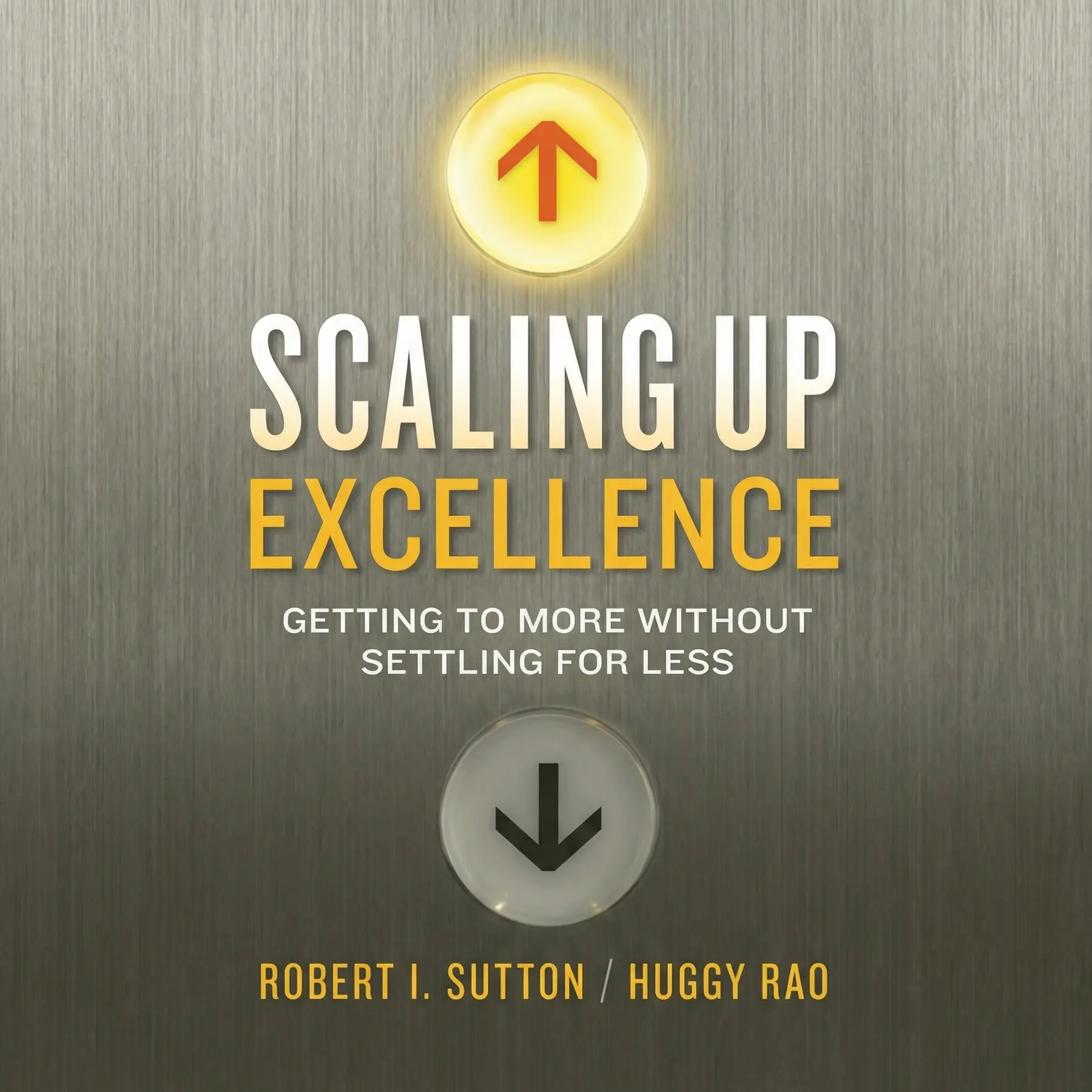
Scaling Up Excellence: Getting to More Without Settling for Less
Scaling Up Excellence offers a roadmap for expanding organizational success. It explores the psychological and structural challenges of spreading best practices without losing the quality that made those practices great in the first place.
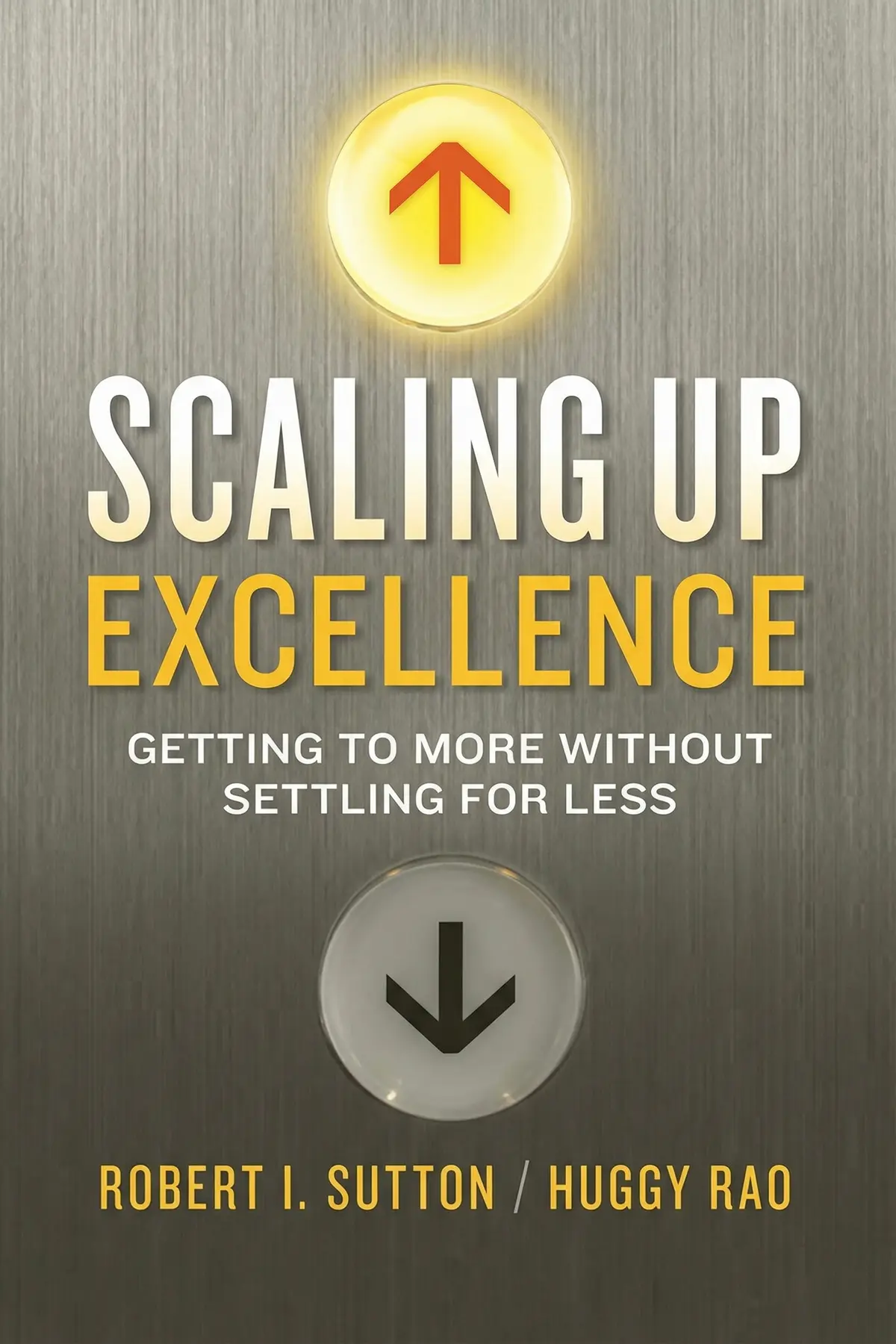
Table of Content
1. Introduction
1 min 29 sec
Have you ever wondered why certain teams seem to have a magic touch while others in the same company struggle to keep up? Maybe you have seen a single branch of a retail chain that consistently outperforms the rest, or a specific department in a university that wins all the awards while its neighbors remain stagnant. We often look at these pockets of brilliance and ask: Why can’t we just bottle that success and pour it everywhere else?
This is the core challenge addressed in Scaling Up Excellence. Authors Robert I. Sutton and Huggy Rao invite us to look at scaling not just as a financial or logistical goal, but as a deeply human and psychological puzzle. They suggest that the real work of growth isn’t just about adding more zeros to a spreadsheet; it’s about the “problem of more” and the “problem of better.”
In our journey through this summary, we are going to explore what it really takes to move greatness from one person or team to a thousand. We will look at why some organizations choose a rigid, centralized approach while others allow for local flavor. We will uncover why spreading excellence is more like a grueling ground war than a quick aerial strike, and why the most dangerous thing to a growing company isn’t a lack of resources, but the infectious spread of bad habits.
By the end of this session, you will have a new perspective on how to lead an organization through the growing pains of success. Whether you are leading a tiny startup or a massive multinational, the principles of excellence remain the same. It’s about building a culture where doing the right thing becomes the easiest thing for everyone to do, no matter how large the group becomes.
2. Defining the Problem of More and Better
1 min 37 sec
Discover why scaling is much more than just increasing your size, and how true excellence requires a focus on improving performance as you grow.
3. Adopting the Ground War Mentality
1 min 45 sec
Explore why the path to excellence is a marathon of persistence rather than a quick sprint of easy victories.
4. Standardization Versus Local Variation
1 min 51 sec
Learn to navigate the tension between the “Catholic” approach of strict rules and the “Buddhist” approach of flexible mindsets.
5. The Interplay of Beliefs and Behaviors
1 min 33 sec
Find out whether you should focus on changing what people think or what they do to drive lasting organizational change.
6. Combating the Disease of Complexity
1 min 40 sec
Learn why adding more layers and rules can turn a growing company into a “big dumb organization” and how to fight back.
7. Building Accountability Through Shared Identity
1 min 35 sec
See how creating a sense of belonging and responsibility is the secret to maintaining high standards as you expand your team.
8. The Power of Diverse Human Connections
1 min 39 sec
Understand why spreading best practices requires a network of relationships across every department and level of the company.
9. Eradicating Toxic Behavior Early
1 min 32 sec
Discover why one “bad apple” can destroy the efforts of a hundred excellent workers, and how to stop the spread of negativity.
10. The Strategic Value of the Premortem
1 min 38 sec
Learn a simple time-travel technique to identify potential roadblocks before they derail your scaling efforts.
11. Conclusion
1 min 35 sec
Scaling up is one of the most difficult feats in the world of business and leadership. It’s not just about getting bigger; it’s about making sure that as you grow, your organization stays as vibrant, effective, and excellent as it was in its early days. Throughout this summary, we’ve seen that excellence isn’t something you can just mandate from the top down. It requires a “ground war” mentality—a commitment to the slow, steady work of building culture and character in every single person you bring on board.
As you move forward with your own scaling challenges, remember the key takeaways. Be clear about where you stand on the spectrum of standardization versus flexibility. Be vigilant about complexity, and don’t be afraid to subtract rules that no longer serve you. Most importantly, protect your culture from the infectious spread of bad behavior.
For a bit of immediate action, try the “premortem” technique with your team this week. Pick a project you are working on and spend an hour imagining its total failure. It might feel uncomfortable at first, but the insights you gain will be the best insurance policy you can buy. Also, consider the “Freaky Friday” tool: if two departments are clashing, have them swap roles for a day. There is no better way to build the connections necessary for excellence than by walking in someone else’s shoes.
Scaling is a journey with no final destination. It is a constant process of spreading the best parts of ourselves and our work to others. If you approach it with persistence, accountability, and a little bit of humor, you won’t just build a bigger organization—you’ll build a better one.
About this book
What is this book about?
Scaling Up Excellence tackles one of the most persistent hurdles in the business world: how to take a pocket of brilliance and make it the standard for an entire organization. Many leaders mistake growth for scaling, but the authors argue that true scaling is the "problem of more and better." It is not enough to simply increase headcount or open new locations; the challenge lies in ensuring that excellence remains intact as complexity increases. This summary explores the strategic trade-offs between standardization and local flexibility, the necessity of a long-term mindset, and the importance of accountability. By looking at examples from tech giants to elementary schools, the book provides a framework for leaders to spread exemplary behavior while ruthlessly cutting out the toxic habits that can derail progress. It is a guide for anyone who wants to ensure their organization’s expansion results in a more effective, higher-performing culture rather than just a larger, more bureaucratic one.
Book Information
About the Author
Robert I. Sutton
Robert I. Sutton is a professor of management science and engineering at Stanford University. He is widely recognized for his work on organizational culture and leadership, having authored best-selling books such as Good Boss, Bad Boss and The No Asshole Rule. Huggy Rao is a professor of organizational behavior at Stanford University. His academic work focuses on collective action and innovation, and he is the author of Market Rebels: How Activists Make or Break Radical Innovation. Together, they bring decades of research and consulting experience to the challenge of organizational scaling.
Ratings & Reviews
Ratings at a glance
What people think
Listeners find the book offers superb illustrations and extensive practical lessons, featuring thoroughly investigated material that covers a wide range of pertinent subjects. Furthermore, the text is accessible and stimulates deep thinking, providing discerning perspectives on intricate problems alongside captivating narratives. Listeners also value the high standard of writing and structure, with one listener highlighting the book’s influence on smaller companies.
Top reviews
Orm
Finally got around to reading this after seeing it on Adam Grant’s recommendation list, and it absolutely lived up to the hype. The distinction between 'plumbing' and 'poetry' is a game-changer for anyone trying to grow a business without losing its soul. I loved the story about the Taj Hotel employees; it really illustrated what it means to have a mindset where 'I own the place and the place owns me.' The book is packed with well-researched content that feels both practical and deeply inspiring. It’s rare to find a business book that balances high-level strategy with the gritty details of implementation so effectively. Truly energized by these insights!
Show moreSomboon
Wow. This is easily one of the most thought-provoking business books I’ve picked up in years. The 'scaling premortem' exercise alone is worth the price of admission; our team tried it last week and it surfaced risks we hadn’t even considered. I love the mantra 'argue like you’re right and listen like you’re wrong.' It perfectly captures the culture of excellence the authors are trying to promote. Every chapter offers a wealth of real-world learnings that are applicable to both giant corporations and tiny startups. If you want to build a sustainable organization, you need to read this.
Show moreLiam
Picked this up expecting a dry management manual, but I was pleasantly surprised by how engaging and human it is. The authors really get that scaling isn't just about numbers; it's about shifting mindsets across an entire organization. Truth is, I’ve already started applying the 'addition and subtraction' rule to our weekly meetings to cut out the unnecessary overhead. The case studies are diverse and provide a lot of perspective-changing moments. It’s easily one of the best books I’ve read this year for understanding the complex issues of growth. Highly recommended for anyone in a leadership position.
Show moreNan
As someone who manages a small but rapidly growing team, I found the section on adding and subtracting structure incredibly relevant. Sutton and Rao argue that you shouldn't just scale for the sake of footprint, and that really resonated with me. To be fair, some of the analogies—like the Buddhism vs. Catholicism comparison—felt a bit forced and oversimplified. However, the core lessons on accountability and moving from System 1 to System 2 thinking are gold. The book is easy to read despite being dense with information. It’s a solid resource for anyone navigating the 'big dumb company' disease.
Show moreGin
Ever wonder why some great ideas never take off while others spread like wildfire? This book dives deep into the 'people stuff' that usually scales the worst. I particularly enjoyed the section on how bad behavior spreads faster than good behavior and why it’s vital to 'fear the clusterfug.' The writing is engaging and the stories are memorable, though I agree with other reviewers that it can be a bit wordy in places. In my experience, the advice on slowing down to scale faster is something every executive needs to hear. It’s a very well-researched and insightful read.
Show morePete
The chapter on accountability was the highlight for me. It’s not just about giving people tasks; it’s about fostering a sense of ownership where everyone feels responsible for the collective outcome. Sutton and Rao do a great job of linking short-term realities to long-term dreams. I did find some of the phrasing—like 'I own the place and the place owns me'—a little weird, but the underlying concept is powerful. The book provides a great lens for viewing organizational growth. It’s a bit long, but the wealth of examples makes the concepts stick much better than a dry textbook would.
Show morePenelope
Scaling excellence isn't just about footprint; it's about mindset. That’s the core takeaway here, and Sutton and Rao drive it home with some truly enlightening stories. I was fascinated by the Zynga example regarding promotions—the idea that you have to bring someone up with you to move up yourself is brilliant. Gotta say, the book is a little repetitive, but that might be intentional to make the 'mantras' stick. It addresses many relevant topics that other business books ignore. While it could have been 50 pages shorter, the quality of the research and the writing make it a must-read.
Show moreLandon
Look, the advice here is undeniably solid, but the delivery is a bit of a mess. I appreciated the case studies on Adobe and Salesforce, particularly the bit about letting employees choose their teams, but the overall organization felt disjointed. It's essentially a list of loosely connected ideas that are too long to fully digest in one sitting. Not gonna lie, I found myself skimming several sections that felt repetitive. Is it a good book? Yes. Is it a revolutionary one? Probably not if you've been in management for a while. It’s a decent collection of common sense backed by some interesting research.
Show moreRoydao
To say this drags would be an understatement. I struggled through the first few chapters because the authors spent way too much time praising their own research methods rather than getting to the point. Frankly, I was looking for actionable steps, but instead, I got a pile of anecdotes that felt more like name-dropping than actual guidance. While the concept of avoiding a 'clusterfug' is catchy, the writing style is just too wordy for a busy professional. It’s a laborious read that repeats the same three points over and over. I really wanted to like this, but it felt like a chore.
Show morePakinee
I found the organization of this book incredibly frustrating. Instead of a clear framework, Sutton and Rao provide an endless stream of anecdotes that feel more like name-dropping than integrated lessons. For example, the focus on 'plumbing' over 'poetry' is a great concept, but it gets buried under repetitive lists that are hard to remember. Personally, I was disappointed by the lack of concrete, step-by-step instructions. It’s all very high-level and theoretical. If you enjoy reading about 'interesting people' the authors know, you might like it, but I found very little practical value here.
Show moreReaders also enjoyed
7 Powers: The Foundations of Business Strategy
Hamilton Helmer

A Bigger Prize: How We Can Do Better Than the Competition
Margaret Heffernan
A Year with Peter Drucker: 52 Weeks of Coaching for Leadership Effectiveness
Joseph A. Maciariello
AUDIO SUMMARY AVAILABLE
Listen to Scaling Up Excellence in 15 minutes
Get the key ideas from Scaling Up Excellence by Robert I. Sutton, plus 5,000+ more titles in English and Thai.
- 5,000+ titles
- Listen as much as you want
- 7-day free trial
- Cancel anytime







