
20 min 01 sec
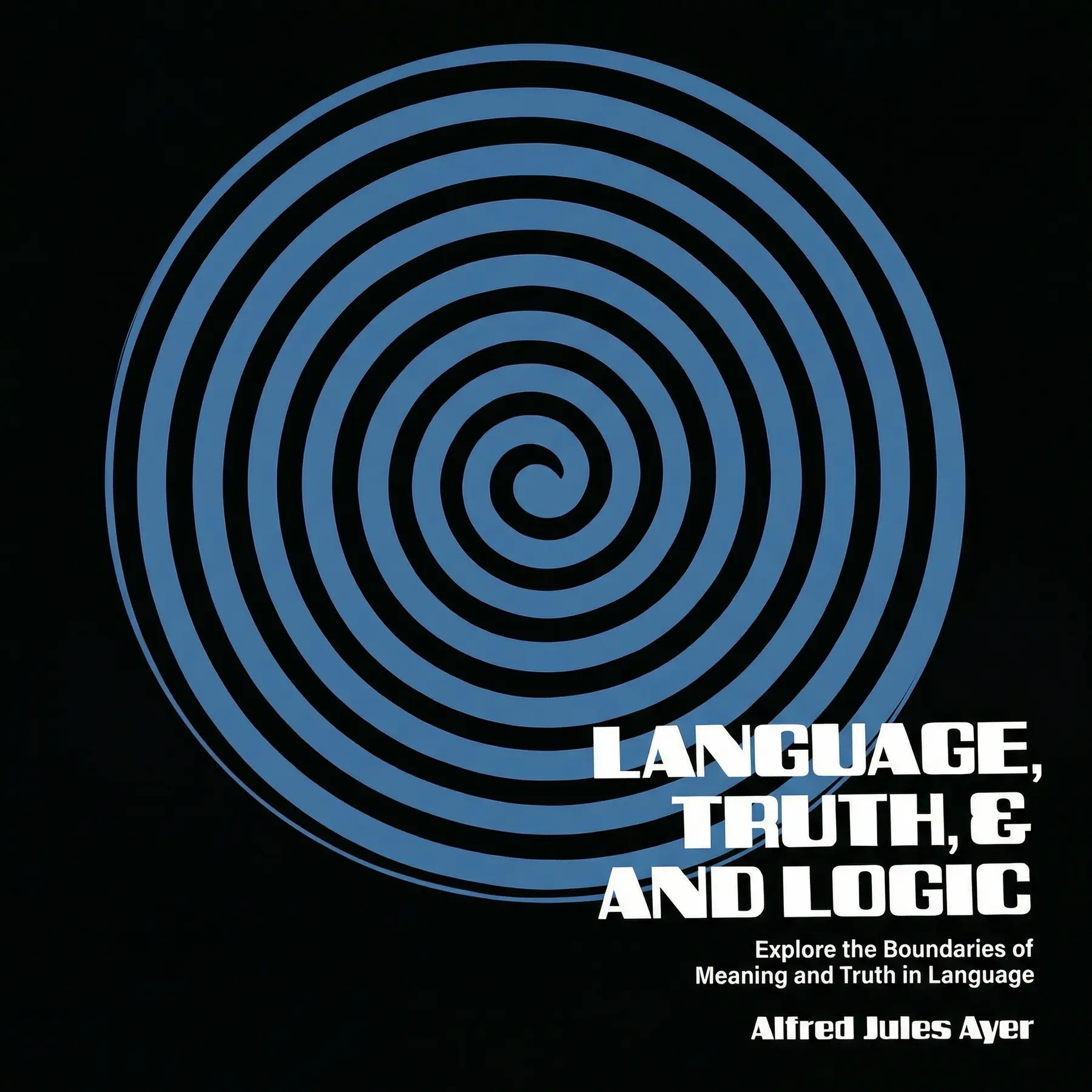
Language, Truth, and Logic
Alfred Jules Ayer’s landmark work introduces logical positivism, arguing that for any statement to be truly meaningful, it must be either logically self-evident or capable of being verified through empirical, scientific observation.
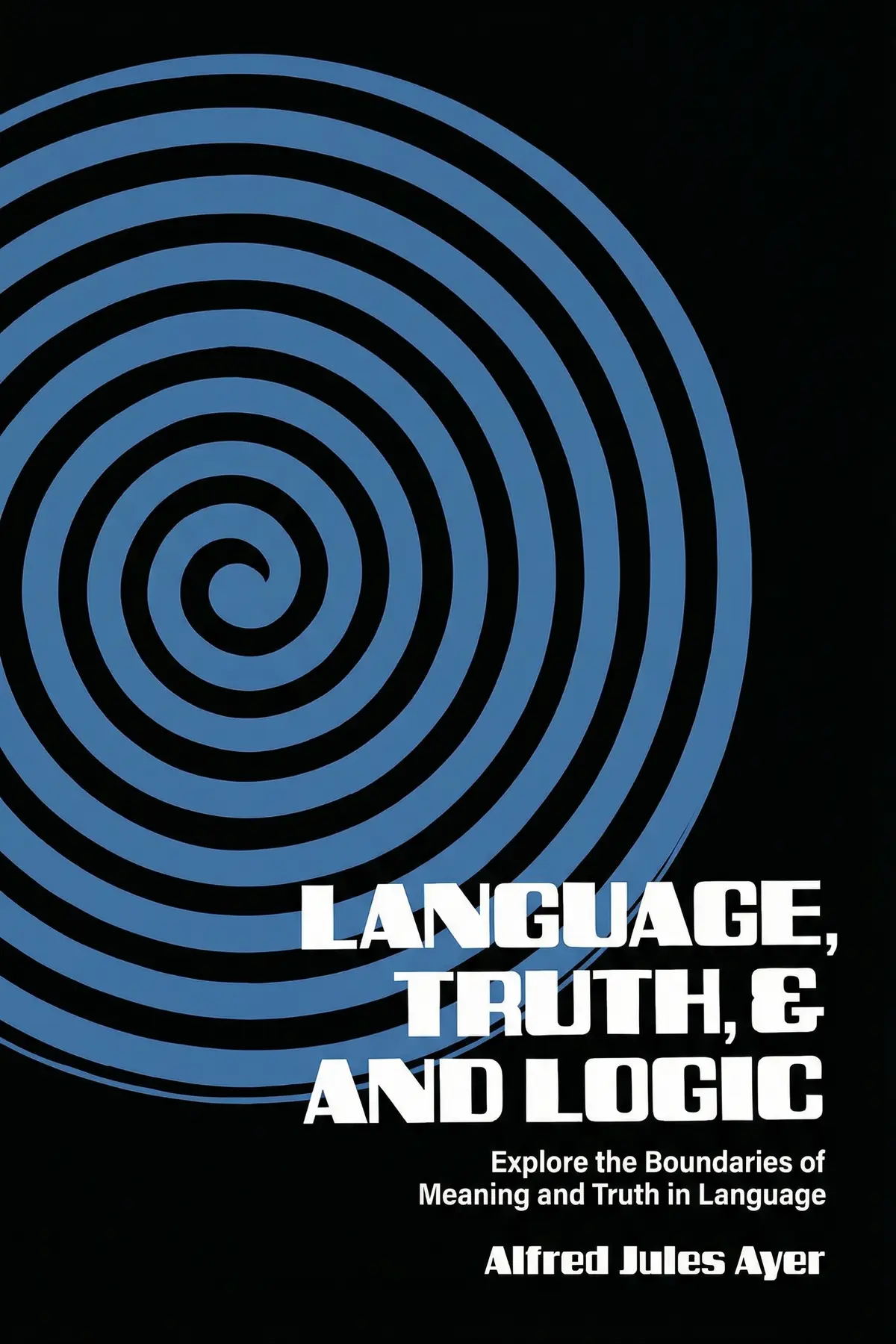
Table of Content
1. Introduction
2 min 02 sec
Imagine standing in a grand library filled with the greatest works of human thought. For centuries, these books have asked the ‘big questions.’ What is the nature of the soul? Does a transcendent reality exist beyond what we can see? What is the ultimate meaning of ‘the Good’? Now, imagine a young man walking into that library and suggesting that almost every one of those volumes is filled with nothing but sophisticated nonsense. This was the provocative stance taken by Alfred Jules Ayer when he published Language, Truth, and Logic in 1936.
At the time, Ayer was a young British philosopher heavily influenced by a radical group of thinkers in Austria known as the Vienna Circle. These scholars were witnessing a world transformed by the dizzying successes of science and technology. They looked at the progress made by physicists and biologists and then looked at the state of philosophy, which seemed to be going in circles, arguing about the same metaphysical abstractions it had debated since the time of Ancient Greece. They decided it was time for a revolution. They wanted to turn philosophy into a tool that was as precise and verifiable as a laboratory experiment.
The result was the school of thought known as logical positivism. This philosophy wasn’t just a new way of thinking; it was a way of filtering language itself. It proposed that if a sentence doesn’t actually say something we can test or define clearly, it doesn’t really say anything at all. In this exploration, we are going to look at how Ayer’s work challenged the foundations of religion, ethics, and traditional philosophy. We will see how he divided the things we say into neat categories of ‘meaningful’ and ‘meaningless,’ and how his ideas forced the world to rethink what it actually means to speak the truth. This journey isn’t just about dusty academic debates; it’s about the very tools we use to understand reality and communicate with one another in an age defined by evidence and logic.
2. The Scientific Turn in Philosophical Thought
2 min 08 sec
Discover why the rise of modern science forced philosophers to abandon ancient metaphysical mysteries in favor of a radical new focus on observable reality.
3. Categorizing the Meaning of Human Language
2 min 27 sec
Learn how the logical positivists used a strict linguistic filter to separate useful information from what they considered to be sophisticated nonsense.
4. The Strict and Flexible Versions of Verification
2 min 08 sec
Explore the verification principle and see how Ayer differentiated between things we can prove right now and things that are only potentially verifiable.
5. The Radical Reinterpretation of Ethics and Morality
2 min 19 sec
Prepare for a shock as we examine why logical positivism views our deepest moral convictions as nothing more than personal emotional outbursts.
6. Language That Acts and Expresses Without Stating Facts
2 min 19 sec
Go beyond simple facts and definitions to discover how certain types of speech actually change reality or reveal our inner states without being ‘true’ or ‘false.’
7. The Great Challenges to the Logic of Truth
2 min 21 sec
Witness the intellectual battles that followed Ayer’s work, as legendary thinkers like Wittgenstein and Popper began to poke holes in the positivist armor.
8. The Lasting Influence of the Analytic Revolution
2 min 29 sec
Discover why, despite its flaws, Ayer’s work continues to shape the way we demand clarity, evidence, and logical rigor in the modern world.
9. Conclusion
1 min 48 sec
In the end, A. J. Ayer’s Language, Truth, and Logic remains a bracing cold shower for the human intellect. It arrived at a time when philosophy was drifting into the clouds, and it pulled it back down to the hard, verifiable earth. By insisting that our words must have a clear connection to either the definitions we create or the world we observe, Ayer set a standard for intellectual honesty that continues to challenge us.
The throughline of this work is the belief that language is the frontier of truth. If we can’t speak clearly, we can’t think clearly. While his dismissal of ethics and metaphysics as ‘meaningless’ might feel extreme, it serves as a powerful reminder to distinguish between our subjective values and objective facts. It teaches us that while our emotions and social rituals are a vital part of being human, they belong to a different category of experience than the verifiable truths of the physical universe.
As you move forward from this summary, the actionable takeaway is to become a more conscious ‘filter’ of the information you consume and the words you use. When you encounter a bold claim—whether it’s in a political speech, a self-help book, or a scientific article—ask yourself: Is this an analytic truth that is true by definition? Is it a synthetic truth that can be verified with evidence? Or is it an emotive statement designed to trigger a feeling? By applying these categories, you can navigate the modern landscape of information with the same sharp, analytical mind that Ayer brought to the library of philosophy nearly a century ago. The conversation about truth and meaning may never be fully complete, but thanks to this work, we have a much better map of the territory.
About this book
What is this book about?
Language, Truth, and Logic serves as a radical manifesto for the movement known as logical positivism. In this work, Alfred Jules Ayer seeks to dismantle traditional metaphysics, theology, and even ethics by applying a strict test of meaning: the verification principle. He argues that most of the grand questions philosophers have historically wrestled with—such as the nature of the soul or the ultimate purpose of the universe—are not actually false, but rather literally meaningless because they cannot be tested by the senses. The book promises to clean up the messy world of human language by separating genuine knowledge from mere emotional expression. By distinguishing between analytic truths, which are true by definition, and synthetic truths, which describe the physical world, Ayer provides a framework for understanding how we can speak clearly and scientifically. It is an invitation to view philosophy not as a search for hidden spiritual truths, but as a rigorous tool for the analysis of language and the clarification of thought in a scientific age.
Book Information
About the Author
Alfred Jules Ayer
Alfred Jules Ayer (1910-1989) was a prominent British philosopher who played a central role in introducing the ideas of the Vienna Circle to the English-speaking world. A graduate of Oxford, he became a leading figure in analytic philosophy. Throughout his career, which included professorships at University College London and Oxford University, he authored several influential works, including The Foundations of Empirical Knowledge and The Problem of Knowledge. He is widely remembered for his sharp wit and his commitment to scientific empiricism.
Ratings & Reviews
Ratings at a glance
What people think
Listeners find the writing accessible and articulate, with one observer noting that it is a quick read for philosophy students. Furthermore, they value the intellectual substance, with one person describing it as a standard introduction to Logical Positivism. The book is also commended for its logical methodology, and one listener mentions its exemplary presentation of Anglo-American style philosophy.
Top reviews
Pisit
Ayer manages to condense a massive paradigm shift into a remarkably slim volume that feels both dangerous and refreshing. This book serves as the quintessential manifesto for Logical Positivism, presenting the Vienna Circle's doctrines with a sharp, Anglo-American clarity that is rarely seen in dense philosophical texts. Frankly, his 'elimination of metaphysics' acts like a conceptual flamethrower, burning away centuries of what he considers linguistic confusion and nonsense. While some might find his dismissal of ethics and theology as mere 'emotive grunts' to be overly reductive, the sheer boldness of his prose is infectious. He takes the complex ideas of Wittgenstein and Russell and makes them accessible to anyone willing to follow a rigorous logical path. It is a quick read for any philosophy student, yet it leaves you questioning the very foundations of how we use language to describe reality. Even if you disagree with his verification principle, you cannot deny the impact of his godlike style.
Show moreTun
Wow, talk about a philosophical flamethrower! Ayer doesn't just critique previous philosophers; he essentially tells them they’ve been speaking gibberish for two thousand years. I love the notion that something isn't necessarily false, but just plain meaningless if it can't be verified. It’s an aggressive, exciting approach to truth that clears the air of so much metaphysical smoke. The chapter on the 'elimination of metaphysics' is easily one of the most provocative things I’ve ever read in an academic context. He writes with a godlike confidence that makes you want to agree with him, even when your intuition is screaming that there must be more to ethics than just 'emotive squeaks.' If you want to understand the roots of modern analytical thought, this is the place to start. It’s concise, logical, and unapologetically brutal toward anything it deems irrational.
Show morePan
Ever wonder what happens when you apply the strict rules of science to every single thought you have? This book is the answer, and it is absolutely fascinating in its cold, clinical approach to the human experience. Ayer argues that the task of the philosopher is not to speculate about the universe, but to act as a scientist of language. He strips away the 'mythical mumbo-jumbo' of the past and leaves us with a lean, mean system of logic and observation. I especially loved the section on how we verify the existence of other people through hypothesized sense-experiences. It sounds abstract, but he makes it feel like the only rational way to view the world. This is a must-read for anyone who values clear thinking over poetic obfuscation. It’s a short book that packs a massive intellectual punch, and it changed the way I look at every sentence I speak.
Show moreNang
Picked this up for a seminar and was surprised by how readable the prose actually felt compared to the usual continental slog. Ayer has this way of making radical ideas seem like common sense, especially when he’s dismantling the 'mumbo-jumbo' of traditional metaphysics. Not gonna lie, seeing him describe ethical judgements as nothing more than expressions of feeling was a bit of a shock to the system. He essentially argues that when we say 'stealing is wrong,' we aren't stating a fact, but rather just saying 'boo' to stealing. It’s a bitchslap to traditional morality that feels incredibly modern and cynical. The book is short, punchy, and provides an exemplary presentation of how to do philosophy with a scalpel rather than a sledgehammer. My only gripe is that he occasionally treats his predecessors with a hauteur that feels a bit unearned given the cracks in his own logic.
Show moreMarco
There’s a certain youthful audacity here that makes the text pulse with energy, even when the logic feels a bit too tidy for the real world. Ayer was only in his mid-twenties when he wrote this, and that 'hauteur of youth' is evident in every dismissive sentence directed at the 'metaphysicians.' He provides a standard introduction to the logic of science that every aspiring philosopher should grapple with at least once. Personally, I found his distinction between analytic and synthetic propositions to be a helpful, if flawed, way to categorize our knowledge. The way he synthesizes the empiricism of Berkeley and Hume with modern symbolic logic is nothing short of brilliant. Even if Quine eventually undercut the foundations of this book, the clarity of Ayer’s vision remains a stern reminder of what philosophy can be when it stops over-complicating itself. It’s a foundational piece of the Anglo-American style that remains relevant for its sheer rhetorical force.
Show moreNim
Finally got around to this classic manifesto, and it’s easy to see why it caused such a stir in the 1930s Oxford scene. Ayer took the complex, often impenetrable ideas of the Vienna Circle and translated them into a punchy, English idiom that anyone could grasp. The way he handles the division between analytic and synthetic propositions is a masterclass in philosophical exposition. Gotta say, I appreciated his honesty later in life when he admitted that nearly all of this was wrong, but the journey through his logic is still immensely valuable. It teaches you how to look for the 'nonsense' in everyday arguments and demands a level of precision that most writers lack. It’s a brief, intense encounter with a mind that wanted to solve everything with a single rule. Even as a failed project, it’s a brilliant failure.
Show moreFah
Is it still worth reading a book whose central thesis was famously debunked by the author himself in his later years? To be fair, Ayer is an incredible stylist who presents the analytic tradition with more vigor than almost any of his contemporaries. The problem is that the verification principle—the idea that a statement is only meaningful if it’s a tautology or empirically verifiable—fails its own test. It isn't a mathematical certainty, nor can we prove it through a laboratory experiment, which leaves the whole system feeling like a house of cards. I found his treatment of the problem of induction particularly hand-wavy, almost as if he decided that if he couldn't solve it, it simply wasn't a real problem. Still, as a historical document, it’s an essential bridge between Hume’s empiricism and modern linguistic analysis. It’s a standard introduction to a movement that failed, but it failed in a fascinating, intellectually stimulating way.
Show moreBrooklyn
After hearing so much about the 'death of logical positivism,' I wanted to go straight to the source to see what the fuss was about. The truth is, Ayer is a fantastic writer, but his system is far too restrictive to be practically useful in our daily lives. He attempts to turn philosophy into a mere appendage of science, tasking the philosopher with nothing more than the clarification of definitions. While this linguistic turn was revolutionary at the time, it feels somewhat limiting today. Why should we stop asking 'why' just because a lab can't provide the answer? His dismissal of theology as literally senseless is a bold move, but it ignores the deep psychological and social functions of religious language. It’s a quick read for philosophy students, and certainly an intellectual milestone, but it feels more like a museum piece than a living philosophy. I respect the effort, but I’m not buying the doctrine.
Show moreDream
As someone who prefers the rigors of science to the vagueness of traditional metaphysics, I expected to love this book more than I did. To be fair, Ayer’s project of linguistic analysis is noble and his writing is exemplary in its clarity. However, the rigid adherence to the verification principle feels like a trap that eventually catches the author himself. If we can only talk about what we can observe or calculate, we lose so much of what makes philosophy worth doing in the first place. I found the sections on the 'logic of science' to be the most rewarding, as they provide a clear framework for how we should define our symbols. But the total dismissal of aesthetics and ethics as non-sciences felt like a massive oversight. It’s a standard introduction to the period, but it lacks the depth of the thinkers it tries to replace.
Show moreSupachai
The arrogance dripping from these pages is almost unbearable, even if you appreciate the historical importance of the Vienna Circle. Ayer seems to believe he has solved every philosophical problem once and for all by simply declaring that anything he doesn't like is 'meaningless.' Look, you can't just wave away the problem of induction or the entirety of ethics by calling them fictitious problems. It feels less like a rigorous inquiry and more like a dogmatic religious tract for people who hate religion. He leans heavily on the work of Russell and Wittgenstein, yet he seems to miss the mystical nuances that made the Tractatus so profound. To him, the world is just a collection of sense-data and tautologies, which leaves no room for the actual human experience of living. It is a well-written book, sure, but the underlying philosophy feels hollow and ultimately self-defeating.
Show moreReaders also enjoyed
A Guide to the Good Life: The Ancient Art of Stoic Joy
William B. Irvine
A Little History of Philosophy
Nigel Warburton
A Theory of Justice
John Rawls
Anarchy, State, and Utopia
Robert Nozick
Antifragile: Things That Gain from Disorder
Nassim Nicholas Taleb
Areopagitica: Philosophy)
John Milton
AUDIO SUMMARY AVAILABLE
Listen to Language, Truth, and Logic in 15 minutes
Get the key ideas from Language, Truth, and Logic by Alfred Jules Ayer, plus 5,000+ more titles in English and Thai.
- 5,000+ titles
- Listen as much as you want
- 7-day free trial
- Cancel anytime







