
A Short History of Nearly Everything
Bill Bryson
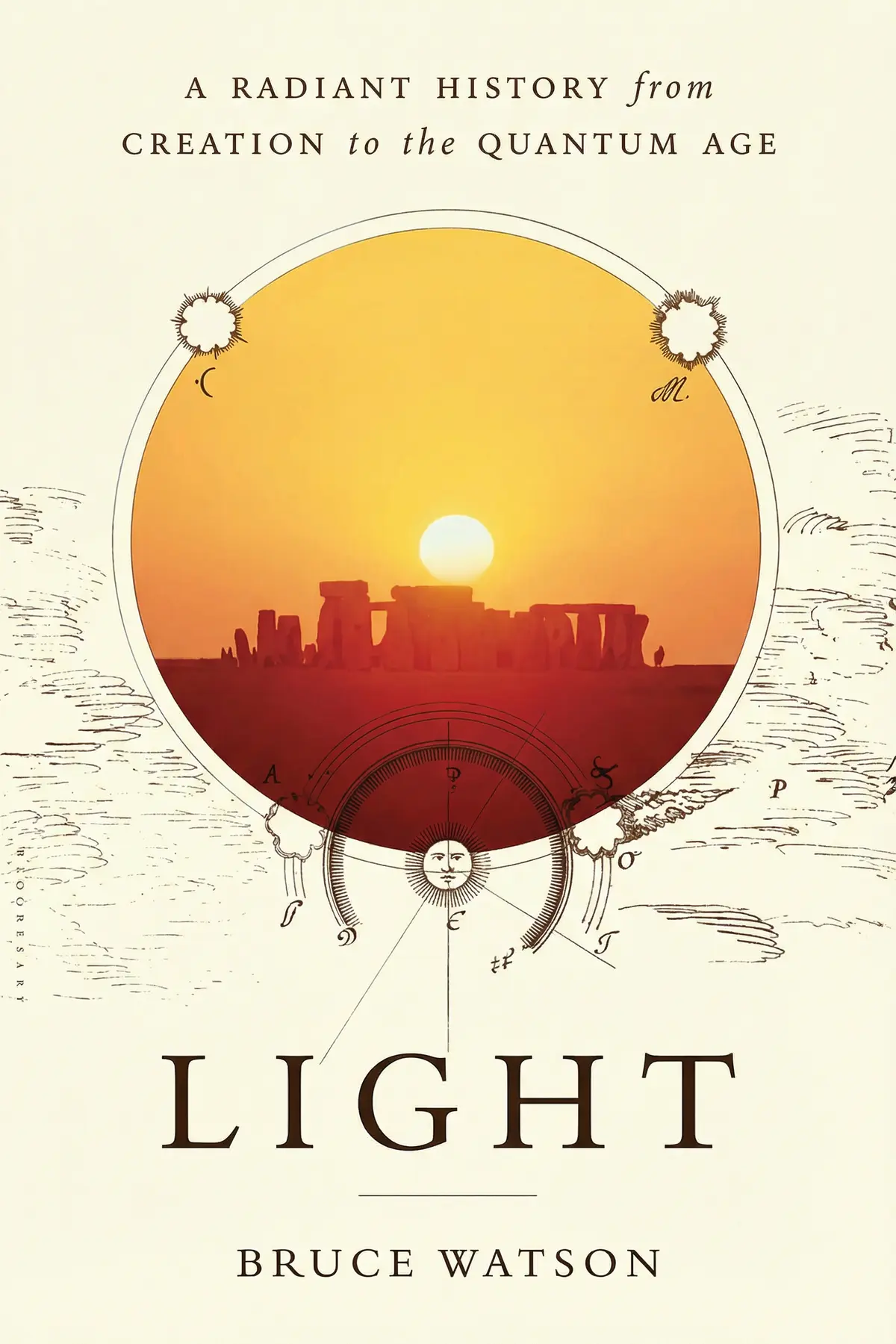
A sweeping historical journey through the science, art, and mythology of light. From ancient creation stories to Einstein’s relativity, explore how our quest to understand illumination transformed the human experience and redefined reality.
1 min 49 sec
Every morning, for as long as humans have walked the Earth, the sun has risen to peel back the curtain of night. For our earliest ancestors, this wasn’t just a daily atmospheric event; it was a miracle. Light has always been the ultimate threshold—the difference between the known and the unknown, between safety and peril. It is the very fabric of our reality, yet for thousands of years, we had no idea what it actually was. We used it, we worshipped it, and we feared its absence, but its true nature remained a mystery locked away from the human mind.
In this exploration, we are going to follow the throughline of light’s history. It’s a journey that begins with ancient people kneeling before the rising sun and ends with modern physicists peering into the deep structures of the cosmos. We will see how light transitioned from a god-like force in creation myths to a subject of intense scientific inquiry. Along the way, we’ll discover how it fueled the creative fires of the Renaissance and the scientific breakthroughs of the Enlightenment.
But this isn’t just a story of scientists in labs. It’s also a story of how light shaped our spirituality and our art. We will look at why light was once considered the literal breath of the divine and how that belief influenced the architecture of the world’s most beautiful buildings. We’ll examine the great debates that pitted geniuses against one another—was light a stream of tiny bullets or a rolling ocean wave?
As we move through these ideas, pay attention to the shift in human perspective. We went from being passive observers of light to masters of it, learning to generate it with the flip of a switch. This transformation didn’t just brighten our homes; it changed our relationship with time, space, and the very boundaries of human potential. Let’s begin our journey by looking back at how the first humans tried to make sense of the brilliance from above.
2 min 28 sec
Discover how ancient cultures from the Congo to Finland used fantastic imagery to explain the sun’s birth and why early Greek philosophers first struggled to define sight.
2 min 16 sec
Explore the profound connection between spiritual illumination in religion and the revolutionary use of shadow and perspective by Renaissance painters.
2 min 39 sec
Witness the moment light moved into the laboratory with Newton and Kepler, and see how their discoveries inspired poets and composers to turn colors into moods and melodies.
2 min 18 sec
Follow the groundbreaking experiment that proved light travels in waves and see how the discovery of electromagnetism finally ended the era of burning animal fat for light.
2 min 41 sec
See how a tiny packet of energy called a ‘quanta’ shattered 19th-century physics and how the constant speed of light revealed that time itself is not fixed.
1 min 33 sec
The story of light is the story of humanity’s gradual awakening. We began in a state of humble awe, crafting myths to explain the brilliant fire in the sky. We moved into a phase of spiritual devotion, using light to represent the divine in our holy books and our greatest cathedrals. Then, through the lens of the scientific revolution, we began to dismantle light, breaking it into colors and measuring its waves, until finally, we learned to create it for ourselves.
But as we’ve seen, light is never quite as simple as it seems. Just when we thought we had it pinned down as a wave, Einstein showed us it was also a particle. And in that discovery, he revealed a universe that was far more mysterious than we had ever imagined—a place where time itself is fluid and light is the only constant.
Today, light is so common that we often take it for granted. We flick a switch and expect the darkness to flee without a second thought. But perhaps the takeaway from this journey is to regain a bit of that ancient wonder. The next time you see a beam of sunlight catching dust motes in a room, or watch a rainbow form after a storm, remember that you are looking at the very thing that connects us to the dawn of creation and the furthest reaches of the future. Light isn’t just what helps us see; it is the fundamental language of reality. By understanding it, we don’t just see the world more clearly—we see our place within it.
Light is an expansive exploration of humanity’s most fundamental obsession. It traces the journey of illumination from its origins as a worshipped deity in ancient creation myths to its role as the centerpiece of modern physics. The narrative moves through the spiritual halls of medieval cathedrals and the studios of Renaissance masters, showing how light has been both a divine symbol and an artistic tool. Beyond art and faith, the book delves into the scientific revolution, chronicling the intense debates over whether light is a particle or a wave. It highlights the brilliant minds—from Newton and Maxwell to Einstein—who fought to decode the laws of the universe. By the end, you will understand how the transition from burning animal fats to harnessing electricity changed the world, and how the constancy of light eventually forced us to rethink the very nature of time itself.
Bruce Watson is a frequent contributor to Smithsonian magazine, where he writes about everything from eels to pi, artists and writers. His other books include Bread and Roses, Sacco and Vanzetti and Freedom Summer.
Listeners find the book accessible and straightforward, featuring thoroughly researched material that spans hundreds of years of thought regarding light. They admire the elegant writing style, with one listener observing that it reads like a thriller written by a poet. The work earns praise for its comprehensive scope, with one review characterizing the experience as a fascinating journey through the history of light. Listeners appreciate the book’s exploration of religion and mysticism, and one listener mentions it provides a foundational grasp of light for those without a scientific background.
Watson's prose is genuinely arresting, reading more like a lyrical thriller than a standard nonfiction text. He weaves together the mysticism of Stonehenge with the cold precision of Maxwell’s equations in a way that feels seamless. To be fair, some chapters linger a bit too long on the philosophical metaphors, but the historical scope is undeniably impressive. I found myself particularly drawn to the sections detailing how our ancestors perceived the divine in a simple sunrise. It’s an encyclopedic journey that somehow manages to remain accessible to those of us without a physics degree. This is a truly illuminating read that reminds us why light is the ultimate protagonist of the human story.
Show morePicked this up on a whim and was immediately struck by the sheer scale of Bruce Watson’s research. It is rare to find a book that treats stained glass windows and quantum mechanics with the same level of reverence and curiosity. In my experience, most science books tend to ignore the emotional impact of discovery, but Watson keeps the human element front and center. The chapter on how photography captured light through chemical reactions was a personal highlight that I won't soon forget. Even though some of the math-heavy sections went over my head, the overall narrative kept me hooked. This is a must-read for anyone who enjoys history with a side of physics and art.
Show moreThe way this book bridges the gap between the lab and the cathedral is nothing short of masterful. Watson’s writing is fluid and poetic, making the history of the telescope feel as dramatic as any work of fiction. Not everything landed perfectly—the discussion on light as a metaphor for love felt a bit repetitive after a while—but the core message remains strong. I loved learning about the shift from animal fat candles to incandescent bulbs and how that changed our social structures. It’s a broad, sweeping history that manages to feel intimate because of Watson’s focus on individual thinkers and artists. This is the kind of book you want to read slowly by the glow of a good lamp.
Show moreFinally got around to this after hearing it described as a 'masterclass' in cultural history, and it mostly lived up to the hype. The book explores everything from Renaissance painters to the invention of the lightbulb with incredible detail and a poet's touch. Personally, I think the transition from soot-heavy tallow candles to the clean glow of LEDs was the most fascinating part of the narrative. The author has a real talent for making complex optics feel like a grand adventure through time. My only real gripe is that the middle sections felt slightly repetitive when discussing religious symbolism. Still, it is a solid achievement in science writing that I would recommend to any curious reader.
Show moreThis feels like it was written for a high-end television special, with each chapter unfolding like a beautifully narrated episode. Watson does a fantastic job of tracing our relationship with the sun, from ancient rituals to the modern-day internet. Not gonna lie, I was surprised by how much I enjoyed the bits about Haydn’s music and its sonic representation of light. The book successfully argues that light isn't just a physical constant, but a cultural force that has shaped our religions and our architecture. Some of the transitions between centuries are a bit abrupt, which can be jarring if you aren't paying close attention. Regardless, it’s a thought-provoking piece of work for any history buff.
Show moreAs someone who usually finds science history a bit tedious, I was pleasantly surprised by how much I enjoyed Watson's storytelling. He treats the discovery of the speed of light like a detective story, keeping the reader engaged through every twist and turn. Gotta say, the link between the Renaissance and our understanding of optics was handled with a lot of nuance and skill. It isn't a perfect book—the lack of focus on solar energy and modern technology felt like a missed opportunity—but it's still very good. The writing style is what really carries it, as it feels both scholarly and incredibly warm. I would definitely recommend this to anyone looking for a fresh perspective on the natural world.
Show moreLook, I really wanted to love this given the subject matter, but it felt remarkably dry in several places. The writing is certainly elegant, but the pacing often slows to a crawl when the focus shifts heavily toward metaphorical interpretations. While the science of Einstein and Maxwell is touched upon, the book seems much more interested in how light felt to people than how it actually works. I appreciate the effort to bridge the humanities and the sciences, but for me, the balance was just a little off. It is a decent overview for a general audience, though it might not satisfy someone looking for a deep technical dive into the physics of photons.
Show moreTruth is, I was expecting a bit more hard science and a bit less philosophy when I started this. The book is heavily weighted toward how light is perceived through art and religion, which is fine, but it left me wanting more physics. To be fair, Watson explains the Maxwell Equations quite well for a layman, but those moments are few and far between. The prose is beautiful, almost too beautiful at times, occasionally obscuring the actual facts of the history he’s presenting. It’s a pleasant read for a rainy afternoon, but it didn't quite hit the 'phenomenal' mark for me. Good, but perhaps a little too focused on the metaphorical side of things for my personal taste.
Show moreEver wonder how we went from worshiping the sun to perfecting the LED? Watson takes us on that journey with a level of detail that is occasionally exhausting. From the winter solstice at Stonehenge to the quantum revolution, this book covers an immense amount of ground, but it often feels like it's trying to do too much. Personally, I found the exploration of how light influenced architectural glory in cathedrals interesting, yet the narrative gets bogged down in mysticism too frequently. It is an ambitious project that only partially succeeds in reconciling the ancient wonder of light with our modern understanding. A decent read, but not quite the 'phenomenal' experience I was promised by the cover blurb.
Show moreWhy would a book about light ignore the most fundamental biological process on Earth? I was stunned that Watson managed to write hundreds of pages without giving photosynthesis or the biological evolution of the eye more than a passing glance. Frankly, neglecting how life itself incorporates light feels like a massive oversight that undermines the 'comprehensive' nature of the work. The sections on art history and the development of artificial lighting are well-researched, but they can't fill the void left by the missing science. It felt like reading a biography of a chef that focuses only on the kitchen tools rather than the food. It’s a beautifully written book, but ultimately a frustratingly incomplete one.
Show moreBill Bryson
Philip Freeman
Jeff Hawkins

Michael Axworthy

Tom Standage
AUDIO SUMMARY AVAILABLE
Get the key ideas from Light by Bruce Watson, plus 5,000+ more titles in English and Thai.







