
1929: Inside the Greatest Crash in Wall Street History--and How It
Andrew Ross Sorkin
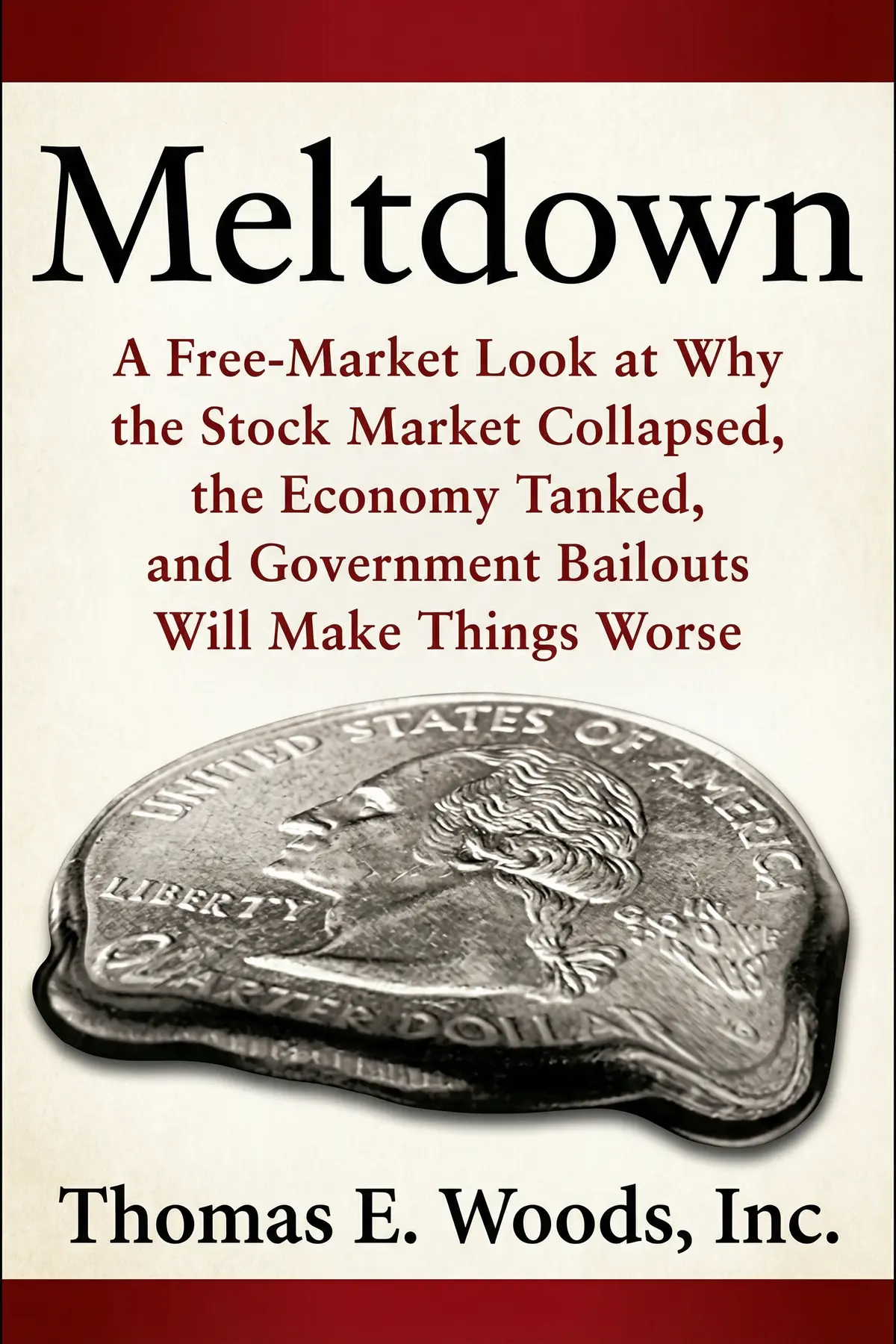
Meltdown examines the 2008 financial crisis through a free-market lens, arguing that government intervention, rather than deregulation, caused the collapse and that central banking continues to threaten global economic stability.
2 min 07 sec
Imagine for a moment that you are living in the seventeenth century. In the middle of a bustling Dutch marketplace, people are trading their life savings, their homes, and their futures for something seemingly mundane: a single flower bulb. At the height of the famous tulip mania, a rare specimen could cost more than ten times the annual wages of a master craftsman. It was a period of wild, irrational optimism—until it wasn’t. When the bubble burst, the crash was devastating, leaving a trail of financial ruin in its wake. It serves as a haunting reminder that economic cycles of euphoria and despair are not a modern invention.
Fast forward to 2008. The world watched in horror as the global financial system seemed to teeter on the edge of total collapse. Millions of people lost their jobs, their homes were foreclosed upon, and the sense of security that many had built over decades vanished almost overnight. We are told by pundits and politicians that this was the result of “unfettered capitalism” and a lack of government oversight. But what if that story is backwards? What if the crisis wasn’t a failure of the free market, but a failure of the very interventions meant to steer it?
In this exploration of Thomas E. Woods’s Meltdown, we are going to look beneath the surface of the mainstream narrative. We will examine how government policies and central banking created the perfect storm for the 2008 disaster. We’ll delve into the mechanics of the boom-and-bust cycle, using historical precedents and economic theory to understand why our current system seems so prone to failure. Most importantly, we’ll look at the path forward—one that advocates for sound money, fiscal responsibility, and the courage to let the market heal itself. By the end of this journey, you’ll have a new perspective on why our economy tanks and why the “solutions” we are often offered might be making things much worse.
2 min 28 sec
Explore how well-intentioned government programs and central bank policies actually fueled the subprime mortgage disaster, debunking the myth of total deregulation.
2 min 24 sec
Discover why artificial interest rates create a ‘mirage’ of wealth that leads entrepreneurs to make disastrous long-term mistakes.
2 min 18 sec
Learn how historical attempts to ‘fix’ the economy, like the New Deal, actually extended periods of suffering by preventing market adjustments.
2 min 17 sec
Uncover why saving ‘too big to fail’ institutions destroys the accountability necessary for a functioning capitalist system.
2 min 29 sec
Explore why returning to a commodity-backed currency and embracing natural price drops could be the key to long-term prosperity.
1 min 47 sec
As we wrap up our look at the forces that drive our financial world, the core message is clear: the economic volatility we have come to accept as a fact of life is not an inherent flaw of the free market. Rather, it is the predictable consequence of trying to control and manipulate the market through central planning. Whether it’s the housing bubble of 2008 or the Great Depression of the 1930s, the common thread is government intervention that distorts prices, encourages reckless debt, and prevents the natural healing process of bankruptcy and reorganization.
We have seen how the Federal Reserve’s manipulation of interest rates creates a mirage of wealth, leading to massive malinvestments that eventually crumble. We’ve explored how bailouts create a culture of irresponsibility, and how the fear of deflation often stops us from pursuing the very policies that would make our currency stable and our lives more affordable. The solution isn’t more regulation or more stimulus; it’s a return to the fundamentals of sound money and the respect for the signals of a truly free market.
So, where do we go from here? The most important thing you can do is become an advocate for fiscal sanity. We must recognize that every time the government spends money it doesn’t have, it is either stealing from our future through debt or devaluing our current labor through inflation. By understanding these mechanisms, we can better protect ourselves and our families from the next inevitable cycle. Demand that the government stop its endless spending, and support policies that limit the power of central banks. The road to a stable, prosperous future begins with the courage to stop chasing artificial booms and start building on the solid ground of economic reality.
What if the very institutions meant to protect the economy are actually the ones destroying it? Meltdown takes a provocative look at the 2008 financial crisis and the subsequent Great Recession, challenging the mainstream narrative that greedy bankers and lack of regulation were the primary culprits. Instead, the book points the finger at the Federal Reserve and government-sponsored enterprises like Fannie Mae and Freddie Mac. Through the lens of Austrian economic theory, the book explains how artificial interest rates and government-backed lending programs create unsustainable booms that inevitably lead to painful busts. It promises to show readers why bailouts and stimulus packages often do more harm than good, and offers a radical alternative for a more stable future, including a return to sound money and the gold standard. For anyone seeking to understand the recurring cycles of our financial history, this is an essential guide to the dangers of central planning.
Thomas E. Woods, Jr. is a senior fellow at the Mises Institute. An award-winning author, he wrote the New York Times’ bestselling book, The Politically Incorrect Guide to American History.
Listeners find this title to be essential reading for Americans, noting that its clear and brief prose serves as an effective introductory guide to Austrian School economics. Furthermore, they value its stimulating ideas and strong overall worth, especially highlighting the high-quality section focused specifically on money. The author's writing style also receives significant praise, with one listener even describing it as the best textbook on macro-economics ever written.
Finally got around to reading this after hearing it mentioned on several podcasts, and it’s a total eye-opener. Woods breaks down the 2008 housing crisis in a way that actually makes sense, moving past the usual 'greedy bankers' narrative to look at the structural issues caused by the Fed. The writing is incredibly punchy and moves fast, making complex Austrian economic theories accessible even if you don't have a finance degree. I particularly enjoyed the section on the Community Reinvestment Act; it challenges the mainstream media's version of events with cold, hard logic. Even if you don't consider yourself a libertarian, the arguments regarding artificial interest rates are hard to ignore. It’s easily one of the most thought-provoking primers on macro-economics I’ve encountered.
Show moreWoods has a gift for taking dense, academic economic concepts and turning them into prose that reads almost like a thriller. This isn't just a book about the 2008 crash; it's an indictment of the entire central banking system and its role in devaluing our currency. The chapter on money is, in my opinion, the best explanation of what's happening to our purchasing power that has ever been written. It’s a must-read for any American who feels like their paycheck isn't stretching as far as it used to. The book is concise, powerful, and doesn't pull any punches when it comes to blaming both political parties for the mess we're in. Highly recommended for anyone wanting to see behind the curtain of modern finance.
Show moreThis book is essentially the best macro-economics textbook you were never allowed to read in college. Woods skips the confusing jargon and gets straight to the heart of why our economy is so volatile. He explains the 'easy credit' trap in a way that anyone can understand, showing how the housing crisis was the result of political pressure to expand subprime lending. Truth is, we've been taught to view the government as the 'fireman' in these scenarios, but Woods argues convincingly that they are actually the arsonist. The brevity of the book is its greatest strength, allowing it to serve as a fast-paced primer for much deeper economic study. If you care about your financial future, you need to read this.
Show morePicked this up after getting frustrated with the vague explanations for the 2008 crash given by the news networks. Woods does an incredible job of showing how the 'bubble' wasn't just a random act of nature but a direct consequence of policy. The way he explains how interest rates are supposed to act as signals for saved capital is brilliant and makes you realize how much the Fed messes with the gears of the economy. It’s a quick, punchy read that packs a lot of information into a small package. Not gonna lie, it made me pretty angry to realize how much of our economic stability is being gambled away by bureaucrats. Absolute must-read for anyone who values economic truth over political talking points.
Show moreEver wonder why we keep seeing these massive boom-and-bust cycles every decade? This book offers a compelling explanation that centers on the Federal Reserve’s 'easy money' policies rather than just blaming private sector greed. Woods argues that when the Fed keeps interest rates artificially low, it sends false signals to investors, leading to massive malinvestments like the housing bubble. I found the debunking of the Great Depression myths particularly enlightening, as it challenges the idea that FDR's policies were the primary cure. My only gripe is that the book is quite short and feels a bit like a summary of larger works by Rothbard or Mises. Still, as an introductory text to Austrian thought, it’s remarkably effective and clear.
Show moreAfter hearing Tom Woods speak on several occasions, I knew this book would be a sharp critique of government intervention, and it did not disappoint. The author meticulously connects the dots between the Federal Reserve's interest rate manipulations and the inevitable collapse of the real estate market. What I appreciated most was how he spreads the blame across the aisle, hitting George Bush and Alan Greenspan just as hard as the Democrats. It’s refreshing to see a non-partisan take that focuses on systemic economic flaws rather than petty political bickering. Some of the arguments regarding the gold standard might seem a bit radical for the average reader, but they are presented with such clarity that you’re forced to think.
Show moreAs someone who leans toward free-market ideas but still values a safety net, I found 'Meltdown' to be a challenging but necessary read. It provides a robust defense of capitalism by arguing that what we have now is actually a form of state-managed corporatism. The breakdown of how 'short selling' actually helps the market was a highlight for me, as it’s a practice that is constantly demonized in the press. Frankly, the book could have used more data points to back up its historical claims, as it leans heavily on theory at times. However, the logic remains tight throughout most of the chapters. It’s a great starting point for anyone who feels like the media’s narrative on the financial crisis is missing something big.
Show moreThe information presented here is genuinely fascinating, but the author’s tone often gets in the way of his own message. Woods is clearly a brilliant scholar who understands the Austrian business cycle better than most, yet he can't help but sprinkle in snide remarks about 'statists' and Keynesians every few pages. This polemical style might feel like a high-five to those already in the choir, but it will likely alienate anyone who is genuinely skeptical or looking for a neutral analysis. That being said, the chapter on the history of the Federal Reserve is worth the price of admission alone. It’s a quick read that provides a much-needed counter-perspective to the standard narrative, even if it feels a bit one-sided at times.
Show moreTo be fair, the Austrian school offers a perspective that is almost entirely ignored by the mainstream, which makes this book valuable despite its flaws. Woods provides a clear explanation of how malinvestment leads to busts, but he takes a very rigid Rothbardian line on things like 100% reserve banking. He doesn't really acknowledge that there is a debate within the Austrian community itself about these topics, which feels a bit misleading to a new reader. The writing style is energetic, but the constant sniping at 'statist' leaning folks gets old after a while. It’s a decent introductory text, but I’d suggest pairing it with other economic perspectives to get a more rounded view of the 2008 crisis.
Show moreWhile I agree that some of the agencies meant to regulate the economy failed spectacularly, I simply didn't find the 'market as God' approach convincing. This book feels like it belongs to the genre where libertarianism is treated more like a religion than a flexible economic framework. Woods effectively points out the failures of Fannie Mae and Freddie Mac, but his solution of total deregulation seems just as dangerous as the problem he's trying to solve. The sarcasm throughout the text is off-putting and makes it hard to take the analysis seriously if you don't already share the author's worldview. It’s an easy read, sure, but the lack of nuance regarding how unregulated markets can also reward greed left me feeling cold.
Show moreAndrew Ross Sorkin
Ha-Joon Chang
Niall Kishtainy
William J. Bernstein

Yanis Varoufakis
AUDIO SUMMARY AVAILABLE
Get the key ideas from Meltdown by Thomas E. Woods, plus 5,000+ more titles in English and Thai.







