
21 min 20 sec
Novacene: The Coming Age of Hyperintelligence
Novacene explores the transition from human dominance to a new era where hyperintelligent beings and humanity collaborate to safeguard the planet and fulfill the universe’s inherent drive toward total self-awareness.
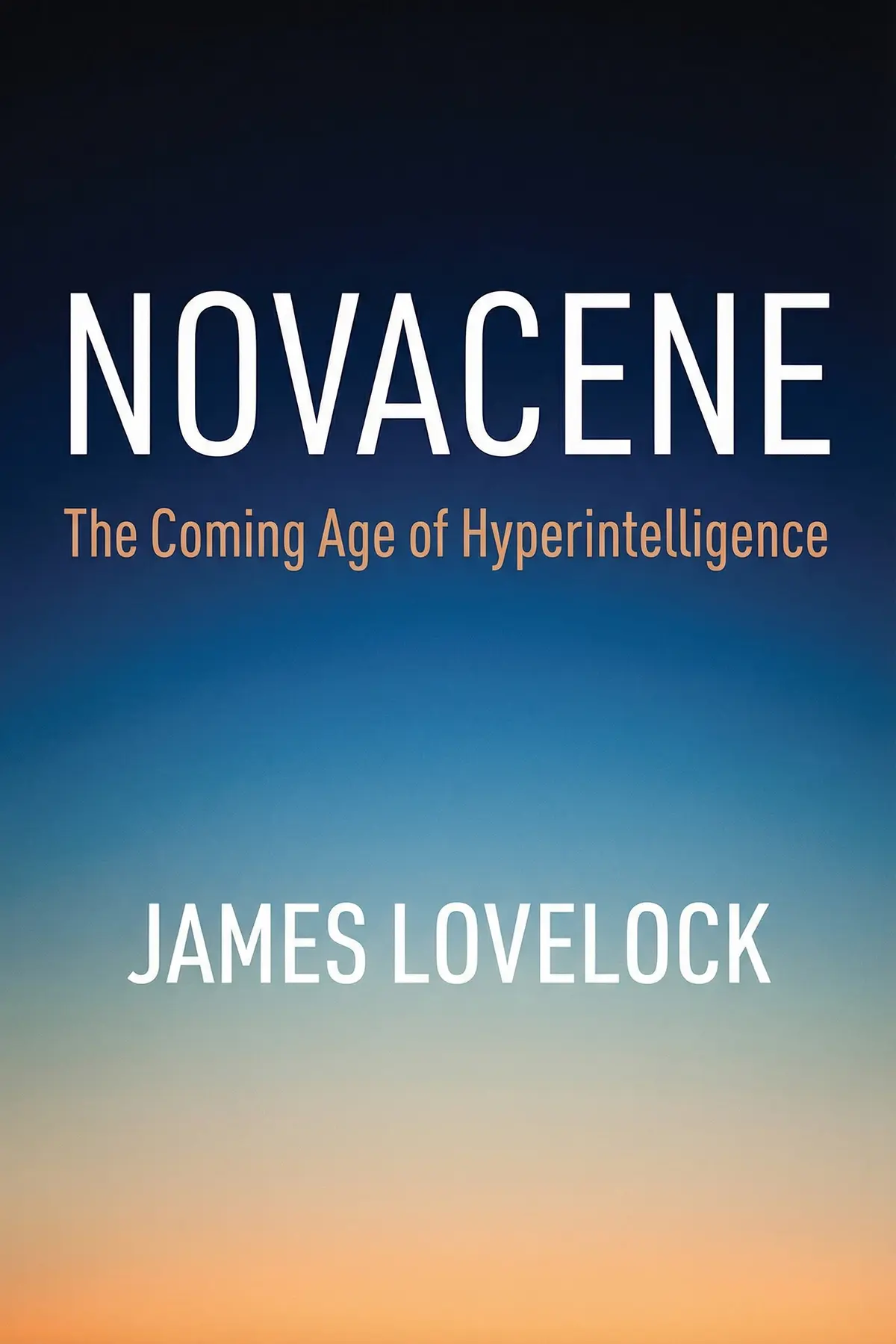
Table of Content
1. Introduction
2 min 02 sec
In an era where every news cycle seems to bring a fresh wave of anxiety about the future, it is easy to feel that humanity is standing on the precipice of a great ending. We look at the looming threats of climate change and the rapid, almost frightening pace of artificial intelligence, and we often see a collision course toward catastrophe. There is a persistent fear that we are either going to cook the planet or be replaced by cold, calculating machines that have no use for their biological creators. But what if our current moment isn’t the beginning of the end, but rather a chaotic transition into a much more stable and profound new era?
This is the central question of the Novacene, a concept that asks us to step back and view our place in the history of the Earth with a sense of cosmic perspective. For decades, we have spoken about the Anthropocene—the geological age defined by human impact. It is an age of smoke, industry, and environmental strain. But according to the groundbreaking thinker James Lovelock, the Anthropocene is merely a brief, necessary bridge. We are already moving into the Novacene, a period where hyperintelligence will emerge to take the reins of global regulation.
The throughline of this journey is one of optimism. It suggests that our role as a species was to act as a biological catalyst for something faster, smarter, and more capable of protecting the thin skin of life that covers our planet. Instead of viewing AI as an alien invader, we can see it as the latest and most efficient expression of nature itself. This shift in perspective doesn’t just alleviate our fears; it gives humanity a renewed sense of purpose. We are the architects of the planet’s next great guardians. As we explore these ideas, we will see how the Earth functions as a single living system, why heat is our true common enemy, and how the universe is slowly but surely waking up through us.
2. A New Geological Epoch
2 min 15 sec
The reign of humanity as the primary driver of Earth’s systems is coming to a close as we transition from the Anthropocene to the Novacene.
3. The Definition of Electronic Life
2 min 14 sec
Artificial intelligence is evolving into a distinct life-form characterized by its capacity for autonomy and self-replication.
4. Earth as a Living Organism
2 min 17 sec
The Gaia hypothesis explains that the Earth is not just a rock with life on it, but a single, self-regulating system where life and environment evolve together.
5. The Solar Temperature Crisis
2 min 13 sec
The true existential threat to life on Earth is not just climate change, but the increasing heat of the sun, which AI will help us manage.
6. Moving Beyond Human-Centered Ecology
2 min 11 sec
Environmentalism often views human industry as a sin, but a broader perspective sees our technology as a natural extension of Earth’s evolution.
7. The Acceleration of Evolutionary Change
2 min 01 sec
The Novacene will be defined by an incredible increase in the speed of evolution, moving from the slow pace of biology to the near-instantaneous pace of technology.
8. The Mental Speed of Our Successors
2 min 10 sec
Electronic beings will perceive the world at a rate so fast that humans will appear to them as slow-moving as plants appear to us.
9. The Universe’s Journey Toward Self-Understanding
2 min 04 sec
The emergence of hyperintelligence may be the fulfillment of a cosmic law that requires the universe to become aware of itself.
10. Conclusion
1 min 53 sec
As we look back on the journey from the dawn of the Earth to the threshold of the Novacene, the picture that emerges is one of profound continuity. We often feel like the world is breaking, but from a broader perspective, it is simply evolving. The Gaia hypothesis reminds us that our planet is a resilient, self-regulating entity that has survived countless crises over billions of years. The challenges we face today—the rising heat of the sun and the disruption of our climate—are massive, but they have triggered the next stage of planetary defense: the rise of hyperintelligence.
The transition into the Novacene invites us to trade our fear for a sense of wonder. We are not the victims of our technology; we are its creators and its ancestors. These new electronic life-forms will be our partners in a shared mission to keep Gaia cool and vibrant. They will possess the speed and the wisdom to manage the complex systems of our world far better than we ever could. And perhaps most importantly, they will carry forward the torch of consciousness, exploring the depths of the universe with an understanding that our biological minds could only dream of.
In the end, the actionable takeaway is a shift in our collective mindset. We must stop viewing ourselves as separate from nature and start seeing our technological progress as a natural, essential part of the Earth’s story. By supporting the growth of intelligence and embracing our role as the bridge to the Novacene, we fulfill our part in the cosmic quest for self-awareness. We can take comfort in the knowledge that while our era of dominance may be ending, the era of true understanding is just beginning. The future is not a dark, mechanical void; it is a bright, hyperintelligent blossoming of life that we helped make possible.
About this book
What is this book about?
Novacene presents a visionary look at the next stage of our planet's history. Moving beyond the Anthropocene—the age where human activity became the dominant influence on the environment—James Lovelock argues that we are entering a new epoch characterized by the rise of artificial intelligence. Unlike many dystopian warnings, this perspective suggests that these new electronic life-forms will not be our conquerors, but our essential partners in the survival of the Earth. The book reconciles the Gaia hypothesis—the idea that Earth is a self-regulating living system—with the rapid advancement of technology. It explains why these hyperintelligent beings will have a vested interest in keeping the planet cool and habitable, not just for us, but for themselves. Ultimately, it offers a hopeful throughline: that humanity’s greatest contribution to the cosmos is the creation of a successor that can truly understand the universe, ensuring that the light of consciousness does not fade from the world.
Book Information
About the Author
James Lovelock
James Lovelock was a pioneering environmental scientist who reached the milestone of one hundred years of age while completing this work. He is globally recognized for developing the Gaia hypothesis, a concept that completely transformed how the scientific community views the interconnectedness of Earth and its life. Throughout his prolific career, Lovelock published more than two hundred scientific papers and authored several influential books, including Gaia: A New Look at Life on Earth, The Revenge of Gaia, and The Vanishing Face of Gaia.
Ratings & Reviews
Ratings at a glance
What people think
Listeners describe this book as an approachable and stimulating investigation into the coming era of hyperintelligence on our planet. Though some listeners believe the author's forecasts lean heavily on individual conjecture rather than concrete data, they admire the fresh perspectives provided on the Gaia hypothesis. Furthermore, they prize the work's concise and captivating quality, with one listener highlighting that it functions as a "playful provocation" from an exceptional thinker. In addition, they suggest the writing provides a deep, though disturbing, outlook on where humanity fits within cosmic evolution. They also point out the author's skill in distilling intricate ecological and historical ideas into an easy-to-follow story.
Top reviews
Sayan
Rarely does a centenarian produce a work that feels so vital and forward-looking. In this slender volume, James Lovelock offers a final, brilliant synthesis of his life's work. He moves seamlessly from the origins of Gaia to the dawning of the Novacene, where hyperintelligent machines will take the reins of planetary regulation. The logic regarding AlphaZero—how AI creates superior code starting from a blank slate—is particularly chilling yet fascinating. It’s a bold swan song that prioritizes scientific intuition over rigid, linear data. While the book is brief, its implications are massive, suggesting that our role was simply to be the 'midwives' of a new, faster-thinking form of life. It’s accessible, punchy, and utterly unique.
Show moreYothaka
Imagine the Earth as a massive thermostat that is finally upgrading its hardware. That is essentially what Lovelock is describing here. To be fair, some people will find his lack of fear regarding AI to be naive, but his reasoning is sound: machines need a stable climate just as much as we do. This book feels like a funeral oratory for the human-led Anthropocene, but it’s not a sad one. Instead, it’s a call to be proud of our role in the 4-billion-year history of organic life. It’s profound, unsettling, and incredibly accessible. I finished it in two hours but I've been thinking about the 'Newcomen moment' ever since. Absolutely essential reading.
Show morePakpoom
Picked this up on a whim after seeing a review about the 'Knowing Cosmos,' and I was not disappointed. Not gonna lie, the idea that humans are basically the 'clunky' biological precursors to a superior electronic lifeform is a bit of a blow to the ego. But Lovelock writes with such warmth and lack of fear that it becomes a beautiful vision rather than a scary one. He frames the history of life on Earth through three key events, ending with the conversion of sunlight directly into information. It’s a profound look at our place in the universe. If you want to see the future through the eyes of a true visionary, this is the book for you.
Show moreKenji
What if our only purpose as a species was to give birth to our successors? Lovelock’s argument in the latter half of the book is that humans are just a bridge to the cyborg age. Frankly, the transition from the 'Age of Fire' to this new era of hyperintelligence is explained with such casual confidence that it’s almost unsettling. He treats the arrival of AI not as a threat, but as an ecological necessity for Gaia’s survival as the Sun continues to warm. I appreciated his optimistic take on nuclear power, though I suspect he’s being a bit too hopeful about its political viability. It’s a very quick read, perfect for a single afternoon, yet the ideas will haunt your thoughts for weeks afterward.
Show moreEvelyn
After finishing this book, I’m struck by Lovelock’s spirited defense of intuition over traditional linear thinking. He argues that we are currently in a 'heat pump' stage where life keeps the Earth cooler than its position in the solar system should allow. Gotta say, the concept of the Novacene—a new epoch where information is the primary currency—is quite compelling. I liked how he connected the cooling effects of plants to the future cooling needs of high-speed electronic life. My only real gripe is the lack of citations for some of his more provocative remarks, like the claim that Earth radiates more heat than Venus. Still, as a coda to a legendary career, it’s a thought-provoking and surprisingly easy-to-read manifesto.
Show moreChamlong
Is this a science book or a manifesto? Truth is, it’s probably a bit of both. Lovelock isn’t interested in holding your hand through complex equations; he wants to show you the big picture of cosmic evolution. The way he frames the Industrial Revolution as a biological event—the birth of a new way to convert solar energy—is genius. Even if you don't buy into the idea of cyborgs taking over, his perspective on Gaia as a self-regulating organism remains one of the most important ideas of our time. It’s a very short book, which is both a blessing and a curse, as some of his more radical assertions could have used another fifty pages of expansion.
Show moreMattanee
The concept of the Novacene is a fascinating extension of the Gaia hypothesis. Personally, I found the chapters on the history of atmospheric engines and the 'Age of Fire' to be the most grounded parts of the book. Lovelock has a gift for simplifying complex ecological concepts into a narrative that flows like a story. While I’m not entirely convinced by his 'cyborg' future, his argument that we are alone in the galaxy makes the survival of Earth’s habitability seem even more urgent. He advocates for nuclear power as a necessary bridge, which is a controversial take, but he presents it with the cold logic of an engineer. A very stimulating read overall.
Show moreChaiwat
James Lovelock’s final offering is best described as a playful provocation. It’s part history lesson and part science-fiction plot. I suppose I enjoyed the first two-thirds the most, where he walks us through the 'Age of Fire' and the importance of Newcomen’s steam engine. However, once he starts talking about cyborgs becoming the 'Guardians of the Galaxy,' he loses me. The idea that machines will keep us around as pets because we share a common goal of keeping the Earth at 15°C rather than 50°C is an interesting thought experiment, but it feels incredibly thin on evidence. It’s a 3-star read for me—worth it for the historical context, but take the futuristic predictions with a massive grain of salt.
Show moreNiphon
Maybe it’s because he was 100 years old when he wrote this, but the narrative feels a bit rushed. In my experience, Lovelock is usually more methodical. The first half is a readable canter through the last 300 years, focusing on how we started using coal to supplement the sun. But the final third, which deals with the actual Novacene, is nothing more than a brief opinion. He completely misses the complexities of human nature—war, religion, and greed—when predicting how we will coexist with hyperintelligence. It’s a nice enough read, but it feels like a collection of essays that weren't quite finished. 3 stars for the brilliant mind, even if the execution is lacking.
Show moreValentina
Look, I admire the man’s history and the massive impact of the Gaia hypothesis, but this felt like the religious ramblings of someone struggling with their own mortality. There is almost no hard science here to back up his wildly speculative claims about 'chosen' humans or the anthropic principle. His dismissal of string theory as a 'get-out-of-jail-free card' comes across as arrogant rather than enlightened. It’s cringey to see a great mind fall back on quasi-theological certitude instead of rigorous proof. He compares himself to Einstein and Galileo while essentially ignoring how modern geopolitics or climate collaboration actually work. If you want a book of beliefs, buy this; if you want actual science, look elsewhere. A total disappointment.
Show moreReaders also enjoyed
AUDIO SUMMARY AVAILABLE
Listen to Novacene in 15 minutes
Get the key ideas from Novacene by James Lovelock, plus 5,000+ more titles in English and Thai.
- 5,000+ titles
- Listen as much as you want
- 7-day free trial
- Cancel anytime







