
18 min 45 sec
Other People’s Money: The Real Business of Finance
By John Kay
John Kay explores how the modern financial sector moved away from its original purpose of serving the real economy, leading to systemic instability and the 2008 global financial crisis.
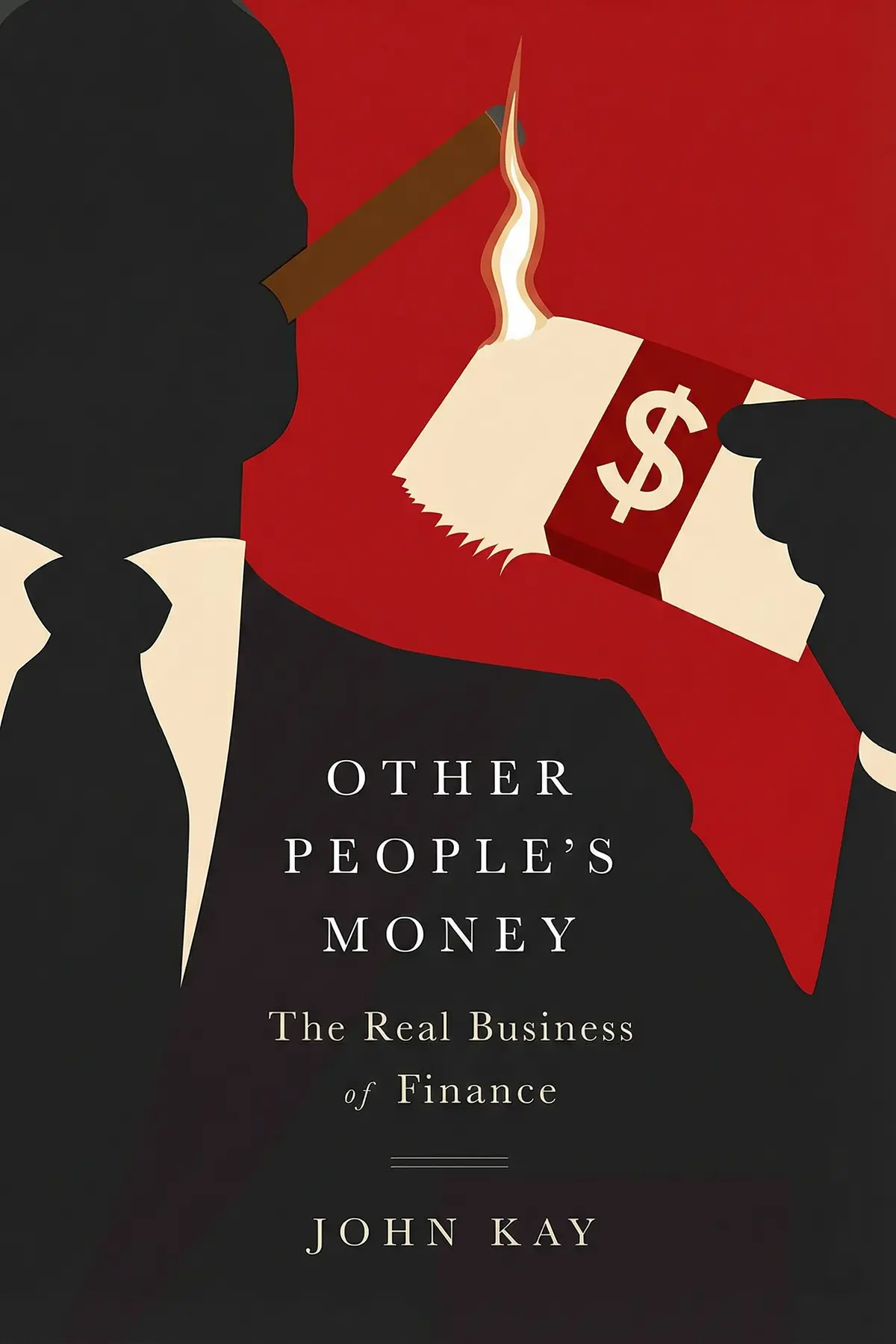
Table of Content
1. Introduction
1 min 48 sec
When we open a newspaper or scroll through a news feed, financial instability often feels like a permanent fixture of our modern world. We hear about market fluctuations, housing bubbles, and the looming threat of the next great recession. Yet, despite how often we discuss these events, the inner workings of the financial system remain a mystery to most people. We remember the devastating fallout of the 2008 collapse—the lost homes, the evaporated savings, and the taxpayer-funded bailouts—but the ‘why’ and the ‘how’ stay shrouded in dense jargon like ‘subprime mortgages’ and ‘credit default swaps.’
This lack of understanding isn’t a coincidence; in many ways, it is a feature of a system that has grown increasingly detached from the lives of ordinary people. At its core, finance was meant to be a service—a utility that helps a baker start a shop, a family buy a home, or a business protect itself against future risks. But somewhere along the line, the tail began to wag the dog. The financial sector stopped being a bridge to the real economy and became an economy unto itself, trading endlessly in its own shadow.
In this exploration of Other People’s Money, we are going to pull back the curtain on this complex world. We will look at where the system began, how it evolved into a high-stakes gambling arena, and why the current structure of banking rewards short-term recklessness over long-term stability. Most importantly, we will discuss how the system can be repaired to once again serve the interests of society rather than just the interests of those who manage the money. It’s time to move past the confusion and understand the real business of finance.
2. The Noble Origins of Financial Intermediation
2 min 43 sec
Understand how finance originally served as a bridge for human ambition and societal growth before becoming increasingly detached from its purpose.
3. The Shift Toward Financialization and Speculation
2 min 32 sec
Discover how the industry moved away from supporting real businesses to focus on complex trading and derivatives that create little social value.
4. The Erosion of Personal Responsibility in Banking
2 min 38 sec
Learn why modern banking structures encourage short-term gambles rather than long-term stability and client trust.
5. The Interconnected Web of the 2008 Crisis
2 min 33 sec
See how a lack of accountability and the rise of complex insurance products led to a global meltdown that everyone should have seen coming.
6. The Political Shield and the Burden of Complexity
2 min 28 sec
Explore the deep ties between financial institutions and government policy and why lobbying protects the status quo.
7. Designing a Path Toward Ethical Reform
2 min 31 sec
Examine why traditional regulation often fails and how we can foster a culture of internal integrity and purpose.
8. Conclusion
1 min 32 sec
In the end, the story of modern finance is a story of how a vital utility lost its way. We have built a system that is incredibly efficient at moving money around in circles, but increasingly inefficient at serving the actual needs of society. The 2008 crisis was not a one-off accident; it was a symptom of a deep-seated rot where ‘other people’s money’ became a playground for a small group of specialists who faced none of the risks they created.
However, this is not a permanent state of affairs. We have seen throughout history that finance can be a force for good. To get back to that place, we must demand a system that prioritizes transparency over complexity and long-term value over short-term speculation. We must advocate for the separation of essential banking services from high-risk trading and support a culture of genuine accountability.
The real business of finance shouldn’t be a mystery. It should be a clear, reliable service that helps us build businesses, own homes, and secure our futures. By understanding the flaws in the current system, we take the first step toward reclaiming it. It’s time to ensure that the financial world once again reflects our shared values and contributes to a stable, prosperous economy for everyone, not just for those behind the trading desk.
About this book
What is this book about?
Other People’s Money provides a penetrating analysis of the contemporary financial world, arguing that the industry has become a self-serving loop that prioritizes complex trading over genuine economic value. John Kay traces the history of finance from its helpful roots in supporting trade and property ownership to its current state of excessive 'financialization.' Through this exploration, readers will learn why the 2008 crisis was an inevitable result of shifting incentives and how the industry’s complexity acts as a barrier to true accountability. The book promises a roadmap for reform, suggesting that the path back to stability requires a return to ethical standards, simpler structures, and a refocusing on the needs of real-world clients rather than the interests of the banks themselves.
Book Information
About the Author
John Kay
John Kay is a distinguished economics professor and has held a fellowship at St. John’s College, University of Oxford, since 1970. He is a prominent voice in economic commentary, contributing regularly to the Financial Times. In addition to his academic work, Kay is the acclaimed author of books such as Obliquity and The Long and Short of It.
Ratings & Reviews
Ratings at a glance
What people think
Listeners find the book perceptive and useful for grasping the modern financial sector, with one listener observing that it offers a clear road map. Additionally, the prose is well-expressed, and listeners consider it a mandatory read. They appreciate its stimulating nature, as one listener points out how it keeps the focus on basic tasks. However, the accuracy receives mixed feedback, and views on the author’s outlook are split.
Top reviews
Joy
Wow, John Kay has managed to take a topic as dry as sawdust and turn it into a compelling narrative about the soul of our economy. He argues brilliantly that the finance sector has basically become an internal circular loop, trading with itself rather than serving the real people it's supposed to help. I loved the way he explained 'stewardship' versus 'search,' showing how we’ve lost that personal touch of the old-school bank manager. While some might find his British wit a bit dry, I thought it added a necessary levity to a pretty grim subject. The section on how the 'bezzle' works was a real eye-opener for me, making me realize just how much of our perceived wealth is actually smoke. Truth is, this should be required reading for anyone who thinks the current system is sustainable or fair. It's a sharp, necessary critique of how we've let math-whiz traders replace actual value creators.
Show morePatchara
This book is a fantastically angry and informative dissection of how the finance industry has essentially been perverted from its original mission. Kay explains with surgical precision how we’ve created a system where intermediaries get rich while the actual users of financial services bear all the costs. I was particularly struck by the idea that much of what happens in the City is fundamentally pointless for the real economy. It’s a wake-up call that challenges the notion that a bigger financial sector automatically leads to a more prosperous country for all its citizens. The way he describes the 'I'll be gone, you'll be gone' culture of short-term incentives is both hilarious and deeply depressing for the reader. Personally, I found the chapters on how we’ve substituted trust for complex contracts to be the most compelling part of the whole narrative. It’s an essential read for anyone frustrated by the lack of real change since the global financial crash.
Show morePita
I honestly never realized how much of our financial world is just people moving 'bits of paper' around until I read this. Kay has a gift for taking these massive, intimidating concepts and breaking them down into metaphors that actually make sense to a layman. The way he identifies the 'too interconnected to fail' problem is probably the most lucid explanation of systemic risk I have ever come across. He makes a powerful case for why we need to separate the shadow banking system from the mundane utility of commercial banking. It’s a thought-provoking piece that doesn't just complain about the problem but actually offers a vision for what a robust system should look like. Every page feels like a revelation about why things are so broken and why the fixes we’ve tried so far haven't worked. Simply put, this is a masterful synthesis of ideas that everyone should understand.
Show moreTun
Picked this up after hearing a podcast mention the concept of 'financialization,' and I wasn't disappointed by the depth Kay provides here. He offers what I’d call a clear road map of how we moved from a system that supports trade to one that simply feeds on it. The transition from trust-based relationships to these cold, algorithmic transactions is described with startling clarity. I particularly appreciated the focus on basic tasks like payments and risk pooling, which often get lost in the noise of high-frequency trading. To be fair, there are moments where the technical jargon gets a bit heavy, especially when he dives deep into the weeds of derivatives. However, the overarching message about the industry’s massive complexity being a feature for intermediaries rather than a bug is impossible to ignore. It’s a thought-provoking look at the gap between the finance world and the real world.
Show moreGabriel
Finally got around to this modern classic, and it’s arguably one of the most articulated dissections of the 2008 fallout I’ve seen. Kay’s grasp of the core principles is undeniable, particularly when he highlights how the end of Glass-Steagall essentially paved the way for our current mess. He doesn't hold back on his disdain for the way 'mark-to-market' accounting was used to conjure up fake profits. My only real gripe is that his perspective on modern technology feels slightly dated in certain chapters. Still, his argument that the banking sector is now 'too interconnected' rather than just 'too big' to fail is a vital distinction for policy makers. It really makes you question why we allow these institutions to run so much of the global economy with so little personal accountability. Look, it’s not a light beach read, but it’s definitely essential if you want to understand the plumbing of the global financial system.
Show moreFatou
After hearing several economists recommend this, I finally dove in and found Kay’s writing style to be exceptionally clear and well-articulated. He does a great job of explaining how the FSI has shifted from a financing organization to a pure trading organization over the last few decades. The book is remarkably thorough, covering everything from the Sherman Act to the modern-day nuances of collateralized debt obligations. I appreciated how he constantly brought the discussion back to the real-world impact on labor and social welfare. My only criticism is that the middle sections can become a bit of a slog if you aren’t already deeply interested in the history of banking regulation. Nevertheless, the insight he provides into the 'febezzle' is worth the price of admission alone. It’s a very reasonable and realistic take on why our current regulatory frameworks are doomed to keep failing without structural change.
Show moreArnav
Ever wonder why bankers make so much money when the rest of the economy seems to be struggling for air? Kay provides a brilliant answer to that question by looking at the asymmetry of information that exists between the industry and its clients. He argues that the complexity of modern finance isn't an accident; it’s a design choice that benefits the middlemen at the expense of everyone else. I found the chapter on the evolution of risk-shifting to be particularly enlightening, showing how we’ve moved away from holding loans to maturity. While I don't agree with every single one of his conclusions—some feel a bit too focused on the UK market—his general framework is incredibly useful. The book successfully keeps the focus on the basic tasks of finance and highlights how far we’ve strayed from our roots. It’s a solid, intellectual critique that avoids the typical populist shouting matches found in most mainstream financial media.
Show moreBunyarit
As someone who works in the City, I found this to be a bit of a mixed bag, despite its high praise in other circles. Kay is correct about the problem of too many regulations leading to even more complex loopholes, which is a vicious cycle we see every day. However, his analysis of specific events like the collapse of HBOS felt a bit overly simplistic and ignored the traditional lending failures of that era. The truth is, he is a great writer, but he sometimes prioritizes a good metaphor over the gritty, technical reality of how derivatives are managed. I found myself agreeing with the sentiment that the industry is bloated, yet rolling my eyes at some of his more extreme suggestions for reform. It’s an insightful book that definitely keeps the focus on the basics, but take some of his historical interpretations with a grain of salt. It’s a solid three-star read that offers good questions but questionable answers for the future.
Show moreElias
Gotta say, while I agree with Kay’s diagnosis of the industry's ills, the actual experience of reading this was quite a bit of a slog. The book is incredibly dense and repetitive in parts, which made it hard for me to stay engaged through the entire three hundred pages. To be fair, the information is valuable, especially his critiques of how shareholder value became the only metric that matters for modern businesses. But I felt like he could have made his point in about half the length without losing any of the actual substance or impact. It’s an important message, but the delivery is a bit dry for my taste, even with the occasional flashes of dry British humor. I’d recommend it to those who are already steeped in the industry, but others might find it a bit overkill for a casual weekend read. It’s informative, sure, but it definitely requires a lot of mental energy to get through.
Show moreSirinat
Not what I expected from someone with Kay's reputation, as this book feels like a Luddite’s manifesto written for an era that no longer exists. While his heart is clearly in the right place, his understanding of the mechanics of modern banking seems stuck somewhere around 1986. He spends so much time pining for the days of the local bank manager that he completely misses the nuances of why high-frequency trading emerged. Frankly, the dismissal of LIBOR as just bad cosmetics or trader chatter shows a fundamental misunderstanding of how those benchmarks actually functioned during the crisis. It’s a frustrating read because he gets the initial problem right but then veers off into these weirdly nostalgic conclusions that wouldn't work today. He wants to put the genie back in the bottle, but the bottle has already been shattered by technology and globalization. I found the whole thing unnecessarily pessimistic and out of touch with the current reality of global capital markets.
Show moreReaders also enjoyed
1929: Inside the Greatest Crash in Wall Street History--and How It
Andrew Ross Sorkin
23 Things They Don’t Tell You About Capitalism
Ha-Joon Chang
A Little History of Economics
Niall Kishtainy
A Splendid Exchange: How Trade Shaped the World
William J. Bernstein
AUDIO SUMMARY AVAILABLE
Listen to Other People’s Money in 15 minutes
Get the key ideas from Other People’s Money by John Kay, plus 5,000+ more titles in English and Thai.
- 5,000+ titles
- Listen as much as you want
- 7-day free trial
- Cancel anytime







