Helgoland: Making Sense of the Quantum Revolution
Carlo Rovelli
A poetic exploration of the fundamental laws governing our universe. This guide simplifies complex concepts like general relativity and quantum mechanics, revealing how the cosmos operates at both massive and microscopic scales.
1 min 41 sec
Imagine looking up at the night sky and realizing that everything you see—the stars, the planets, even the seemingly empty darkness between them—is governed by a set of rules that are as beautiful as a symphony but as strange as a dream. For most of history, humanity lived in a world where things felt solid, predictable, and simple. But over the last century, our understanding of reality has been completely upended. We have moved from a world of fixed objects to a world of curved space and dancing particles.
In this exploration of the foundations of physics, we are stepping into the mind of Carlo Rovelli, a scientist who sees the universe not just as a collection of data points, but as a poetic masterpiece. The throughline of our journey today is the tension and the triumph of two massive ideas: general relativity and quantum mechanics. One explains the grand scale of galaxies and gravity, while the other explains the tiny, jittery world of atoms.
But here is the catch: even though both theories work perfectly in their own domains, they don’t actually get along with each other. This creates a fascinating mystery at the heart of science. We’re going to look at how we got here, from the first inklings of a spherical Earth to the complex theories of “atoms of space” and the nature of time itself. We will see why a rock isn’t really an object, but a temporary event, and how the heat in your coffee cup is actually a clue to why time only moves in one direction. Most importantly, we’ll see how we, as thinking, feeling beings, are woven into the very fabric of these physical laws.
2 min 15 sec
Discover how a young Albert Einstein reimagined the very fabric of the universe, transforming our understanding of space from a flat stage into a dynamic, curving reality.
2 min 17 sec
Step into the microscopic realm where reality becomes grainy, and discover why the smallest building blocks of nature refuse to follow the rules of the everyday world.
2 min 10 sec
Trace the evolution of human perspective from a flat Earth at the center of everything to a tiny speck in a vast, expanding sea of galaxies.
2 min 04 sec
Explore the building blocks of matter and learn why a solid object is actually a temporary event rather than a permanent thing.
2 min 06 sec
Peek into the greatest challenge of modern physics: finding a single theory that can unite the smooth curves of gravity with the grainy reality of atoms.
1 min 59 sec
Uncover the strange relationship between heat and the passing of time, and see why the future is only different from the past because of probability.
1 min 55 sec
Reflect on how we, as conscious beings, are not just observers of these laws, but are made of the same stardust and governed by the same cosmic rules.
1 min 48 sec
As we come to the end of this journey through the landscape of modern physics, we find ourselves in a world that is far more vibrant and mysterious than the one we started in. We have seen how Einstein turned space into a curving, dynamic field, and how quantum mechanics showed us a reality that is grainy and probabilistic. We have explored the tension between the big and the small, and the possibility that space and time themselves are made of tiny, discrete loops.
The most important takeaway is that our understanding is always evolving. We have moved from a flat Earth to an expanding universe, but we still have many unanswered questions. The conflict between our two greatest theories suggests that there is a deeper truth still waiting to be discovered—a unified theory that could explain everything from the Big Bang to the flickering of an electron.
But even without that final answer, we can find immense beauty in what we already know. We are part of a universe that is made of events, not just objects—a world where time is driven by heat and chance, and where we are made of the same fundamental building blocks as the stars.
The actionable closing for all of us is to maintain that sense of wonder and curiosity. Physics isn’t just for scientists in labs; it is the story of our home. By looking at the world through the lens of these lessons, we can see the extraordinary in the ordinary. Whether you are looking at a rock, a swinging pendulum, or the night sky, remember that you are witnessing a grand cosmic performance, and you have a front-row seat. Keep asking questions, keep looking at the stars, and never stop seeking to understand the beautiful laws that govern our existence.
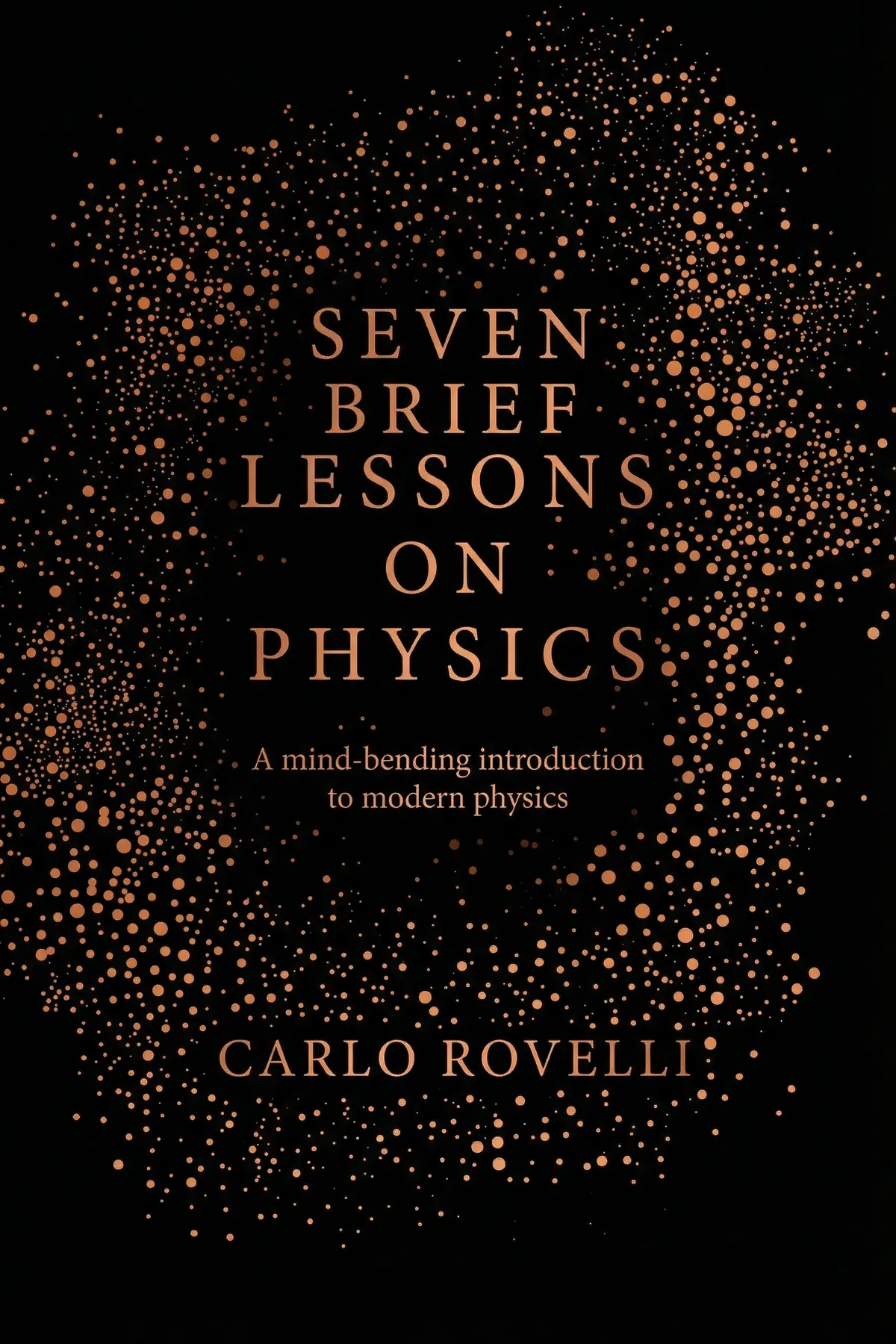
This summary provides a lucid journey through the most significant revolutions in modern physics. It traces the shift from a world governed by rigid Newtonian mechanics to the fluid, curved reality proposed by Albert Einstein and the strange, probabilistic landscape of quantum theory. Listeners will gain a deeper understanding of how the universe began, the nature of time and heat, and the elusive elementary particles that compose everything we see. Beyond the math and equations, the book promises to show how we, as humans, fit into this vast physical tapestry, bridging the gap between scientific theory and philosophical wonder.
Carlo Rovelli is a theoretical physicist celebrated for his contributions to the study of space and time. He currently leads the quantum gravity research group at the Centre de Physique Théorique in Marseille, France. Rovelli is the acclaimed author of The Order of Time and Reality is Not What It Seems.
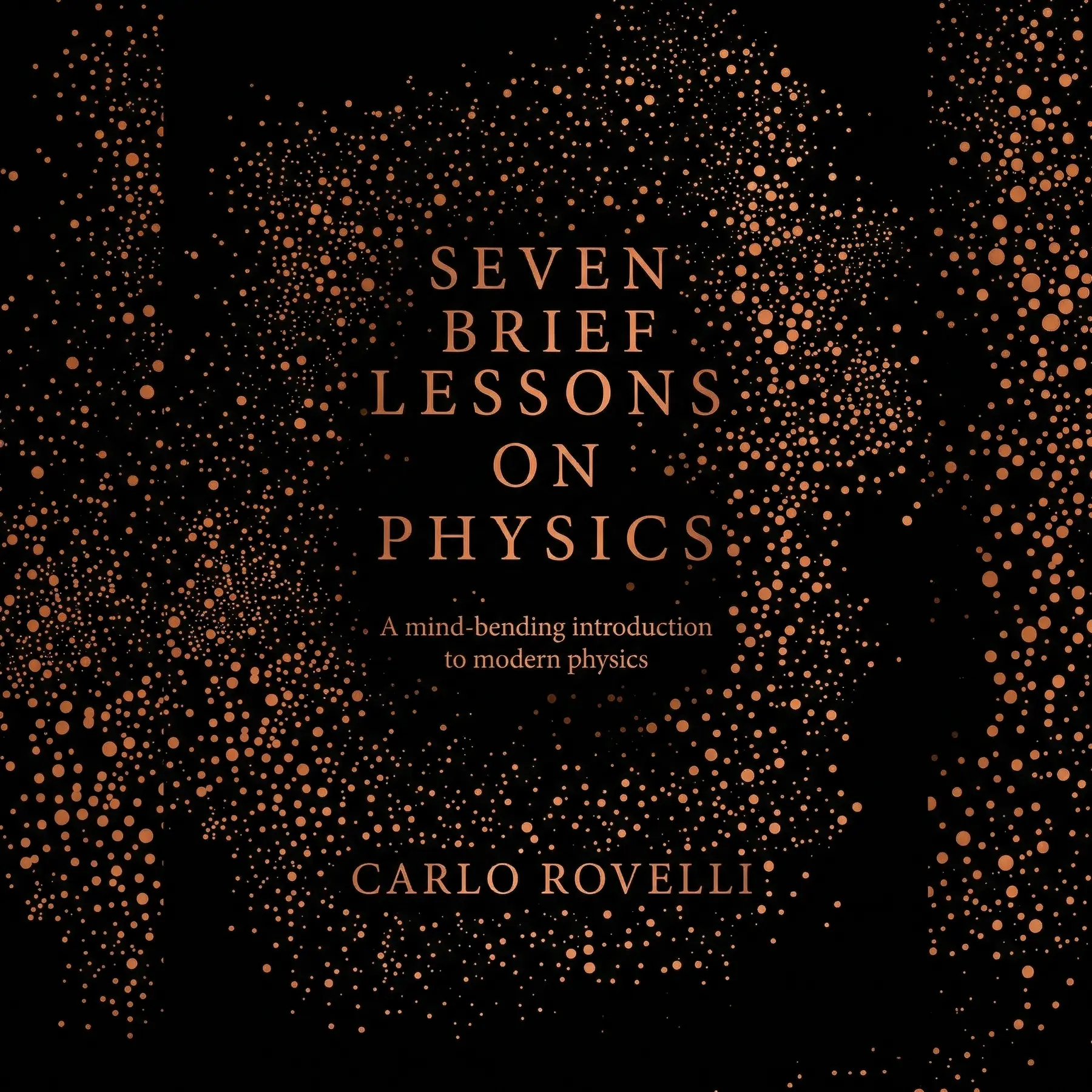
Listeners find this physics guide both educational and elegantly composed, as it clarifies intricate scientific principles using accessible terminology. They value the book's smooth narrative and stimulating themes that provide a deeper understanding, with one listener highlighting how it excites the relationship between mind and science. The work earns high marks for its perspective on physics, especially regarding quantum mechanics, and listeners view it as essential reading for anyone curious about the field. The total length draws varying opinions, with several listeners feeling that the book is too short.
Picked this up on a whim after seeing it on a gift guide, and I’m genuinely glad I did. As a total novice who usually finds quantum mechanics terrifying, I appreciated how Rovelli used down-to-earth metaphors to explain why heat only moves from hot to cold. The writing is incredibly gentle, almost like a friend whispering a secret about the universe into your ear while you stare at the stars. Personally, I think the 'loafing' anecdote about a young Albert Einstein was a highlight, as it humanizes these legendary figures. My only real gripe is the price point for such a thin book, but the quality of the insights almost makes up for the lack of page count.
Show moreThe chapter on the nature of humanity in a quantum universe is worth the price of admission alone. Rovelli doesn’t just teach you about atoms and orbits; he forces you to confront the ephemeral nature of our species. I loved the analogy of the elderly rabbi to explain how contradictory theories can both hold truth in their own way. It’s a very quick read, but the density of the ideas means you’ll probably want to re-read certain sections to let the brain-melting parts sink in. Not gonna lie, the price tag for something so slim is a bit steep, but the way it excites the link between human consciousness and the cosmos is rare.
Show moreAfter hearing so much buzz about this 'tiny masterpiece,' I finally understand why it’s so beloved by the artsy crowd. Rovelli writes with a visionary language that turns the gravitational field into a vibrant, bending sea. I particularly enjoyed the section on entropy and the heat of black holes; it’s the first time I’ve actually grasped why the future is different from the past. I found the book to be a deeply emotional experience rather than just an educational one. It reminds us that we are made of the same stardust as the galaxies we study. Even though it is incredibly short, every page feels intentional and polished. This is a wonderful reminder that curiosity is a fundamental part of our nature.
Show moreLook, if you want a textbook, go to a university library; if you want to fall in love with the cosmos, read this. Rovelli’s work is a triumph of accessible science communication that focuses on the vision behind the math. I was captivated by the descriptions of elementary particles as a cosmic alphabet telling the history of the world. To be fair, the brevity is a double-edged sword, as some might find the lack of depth disappointing. But for me, the gentle prose and the philosophical musings on our collective demise and our home in nature were exactly what I needed. It’s a compact book that leaves you with a clearer grasp of the universe's grand design. This is a true gem for any bookshelf.
Show moreWow, I didn't expect a physics book to read like a long-form poem. Rovelli manages to take the most complex, brain-melting concepts—like the idea that time doesn't really exist—and turns them into something deeply moving. I found myself lingering over sentences about the 'cosmic alphabet' of particles vibrating in the void. To be fair, if you’re looking for rigorous mathematical proofs, you’re going to be disappointed because this is about the vision of science rather than the technical grit. It’s a slim volume that you can breeze through in an hour, yet the philosophical implications of that final chapter stayed with me for days. This is absolutely breathtaking in its simplicity and scope.
Show moreEver wonder why time seems to move faster in the mountains than at sea level? Rovelli explains this and other paradoxes with a lyrical grace that I’ve rarely seen in popular science writing. The way he describes loop quantum gravity makes the universe feel like a living, breathing tapestry of events rather than a collection of static things. I will admit that some of the more abstract bits about the Standard Model still went a bit over my head, but I didn't mind the confusion. The book acts as a catalyst for curiosity, pushing you to look at the night sky with fresh eyes. It’s not meant to be a textbook; it’s an invitation to wonder about our origins.
Show moreAs someone who usually avoids science books because they make me feel stupid, Rovelli’s prose was a breath of fresh air. He has this incredible ability to distill the history of human thought—from Riemann's curvature to the swarming of quanta—into manageable, elegant chapters. The truth is, I’ve always found the idea of black holes and the big bang to be intimidating, but here they felt like parts of a grand story. I specifically liked how he didn't shy away from the gaps in our current knowledge, highlighting that science is an ongoing process of falling veils. My only criticism is that it’s almost too brief; I was just getting into the flow when it ended.
Show moreThis book feels more like a taster menu than a full meal. While Carlo Rovelli is clearly a master of his craft, these lessons are so condensed that they occasionally skirt the edge of being insubstantial. I enjoyed the elegant prose and the way he bridges the gap between hard science and human emotion, but I wanted more meat on the bones. It is perfectly suited for an arts graduate looking for a poetic overview, yet for someone seeking a deep dive into general relativity, it might feel like a series of postcards. The physical book is beautiful and would make a great gift, even if the content is a bit fleeting for the price.
Show moreTruth is, I finished this in about forty-five minutes and felt a bit cheated by the 'lessons' label. While the writing is undeniably well-written and poetic, it lacks the technical detail I was craving in a science book. It’s a postcard sketch of modern physics that hits the highlights like relativity and the nature of time without ever really showing the work. I appreciate the author’s passion and his focus on loop quantum gravity, which is a fresh perspective compared to the usual string theory focus. However, it’s almost too simple at times, making complex theories feel like magic tricks rather than science. It's a nice little volume, but definitely more of a gift book.
Show moreFrankly, I felt like the author spent more time waxing philosophical than actually explaining the mechanics of the universe. This is a very short collection of essays that have been simplified to the point where they lose their scientific utility. I understand that the goal was accessibility, but I finished the book feeling like I’d read a series of flowery blog posts rather than a scholarly introduction. For a work priced like a full-length hardcover, the lack of depth is frustrating. If you want to feel smart without actually doing the mental work of understanding physics, this is for you. It is a pretty object for a coffee table, but it offers very little else for the serious student.
Show more

Lisa Kaltenegger
J. Craig Venter
Carl Zimmer
Bill Bryson
AUDIO SUMMARY AVAILABLE
Get the key ideas from Seven Brief Lessons on Physics by Carlo Rovelli, plus 5,000+ more titles in English and Thai.