
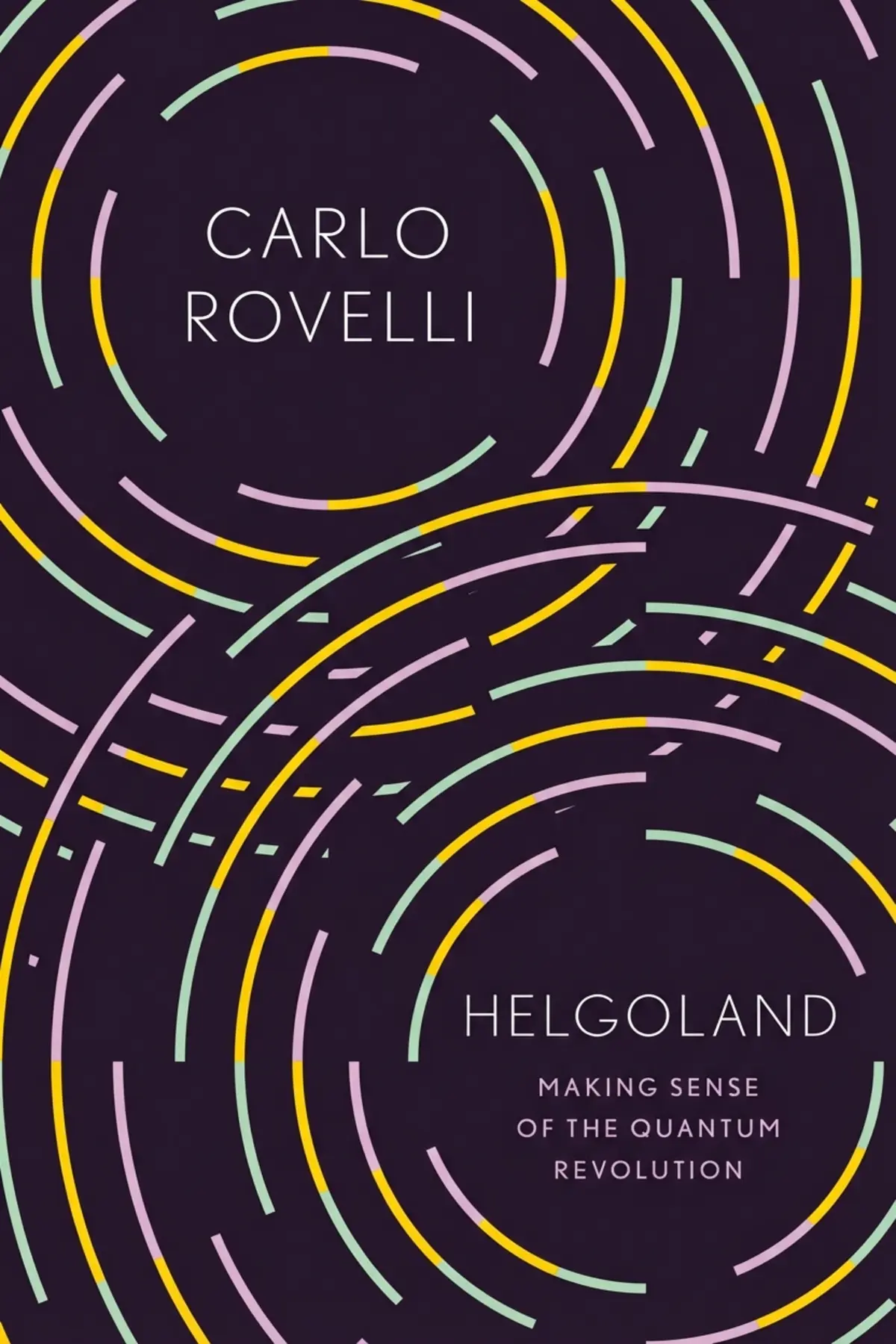
Helgoland: Making Sense of the Quantum Revolution
Carlo Rovelli
Explore the history of physics and the quest to reconcile general relativity with quantum mechanics. This summary details the evolution of our understanding of space, time, and the granular nature of reality.
1 min 42 sec
Every time we look at the night sky or wonder about the ground beneath our feet, we are participating in a tradition of inquiry that stretches back millennia. For much of human history, the mysteries of the weather, the stars, and the composition of matter were attributed to the whims of the divine. However, there was a shift—a moment when humanity began to ask not who was responsible for the world, but how the world functioned on its own terms. This shift marked the birth of physics, a journey that has led us from the simple observation of falling rain to the mind-bending complexities of quantum gravity.
In this exploration of our physical reality, we are going to trace the lineage of these ideas. We will see how ancient intuition about atoms evolved into the mathematical certainties of the Renaissance, and how those certainties were eventually shattered by the dual revolutions of the twentieth century: general relativity and quantum mechanics. The throughline of this story is a constant narrowing of the gap between what we perceive and what is actually there. We are moving toward a realization that the universe is far stranger, more interconnected, and more granular than our senses could ever suggest. As we move through these concepts, keep in mind that the goal of modern physics is to find a single, unified language that explains everything from the birth of galaxies to the invisible dance of subatomic particles. It is a journey toward the very edges of human knowledge, where the concept of time itself begins to dissolve and the fabric of space reveals its true, hidden texture.
3 min 00 sec
Travel back to ancient Greece to discover how early philosophers traded mythological explanations for the power of observation, reason, and the first theories of atomic matter.
2 min 31 sec
Discover how Isaac Newton unified the laws of the heavens and the earth, only for new discoveries in electromagnetism to set the stage for Einstein’s breakthroughs.
2 min 47 sec
Explore Einstein’s masterful realization that space and gravity are not separate entities, but rather a dynamic, curving fabric that defines the cosmos.
2 min 50 sec
Dive into the microscopic realm where the universe becomes granular, things only exist in relation to each other, and certainty is replaced by probability.
2 min 58 sec
Witness the attempt to unify the two pillars of physics and learn why the final answer might require us to abandon our concept of time altogether.
1 min 33 sec
The journey of physics is a story of human perspective expanding far beyond the limits of our biological senses. We started by looking at the rain and the stars and seeing gods; we moved to seeing clockwork and invisible forces; and today, we are beginning to see a universe that is a shimmering web of relations, grains of space, and probable events. The throughline of this entire history is a move away from the idea that we are the center of the universe, and toward a realization that our daily experience of reality—of solid objects, of empty space, and of a steady flow of time—is just a surface-level interpretation of a much more complex and beautiful structure.
As we look toward the future of science, the challenge of quantum gravity remains the great mountain to climb. Reconciling the smooth curves of the cosmos with the jittery grains of the subatomic world is more than just a mathematical puzzle; it is an attempt to finally understand the very substance of our existence. The takeaway is not just a collection of facts about atoms or galaxies, but a profound sense of wonder. We live in a world where space can bend and time can dissolve, reminding us that reality is truly not what it seems. The most important thing we can do is stay curious, continue to test our assumptions, and embrace the fact that there is always a deeper layer of the mystery waiting to be uncovered.
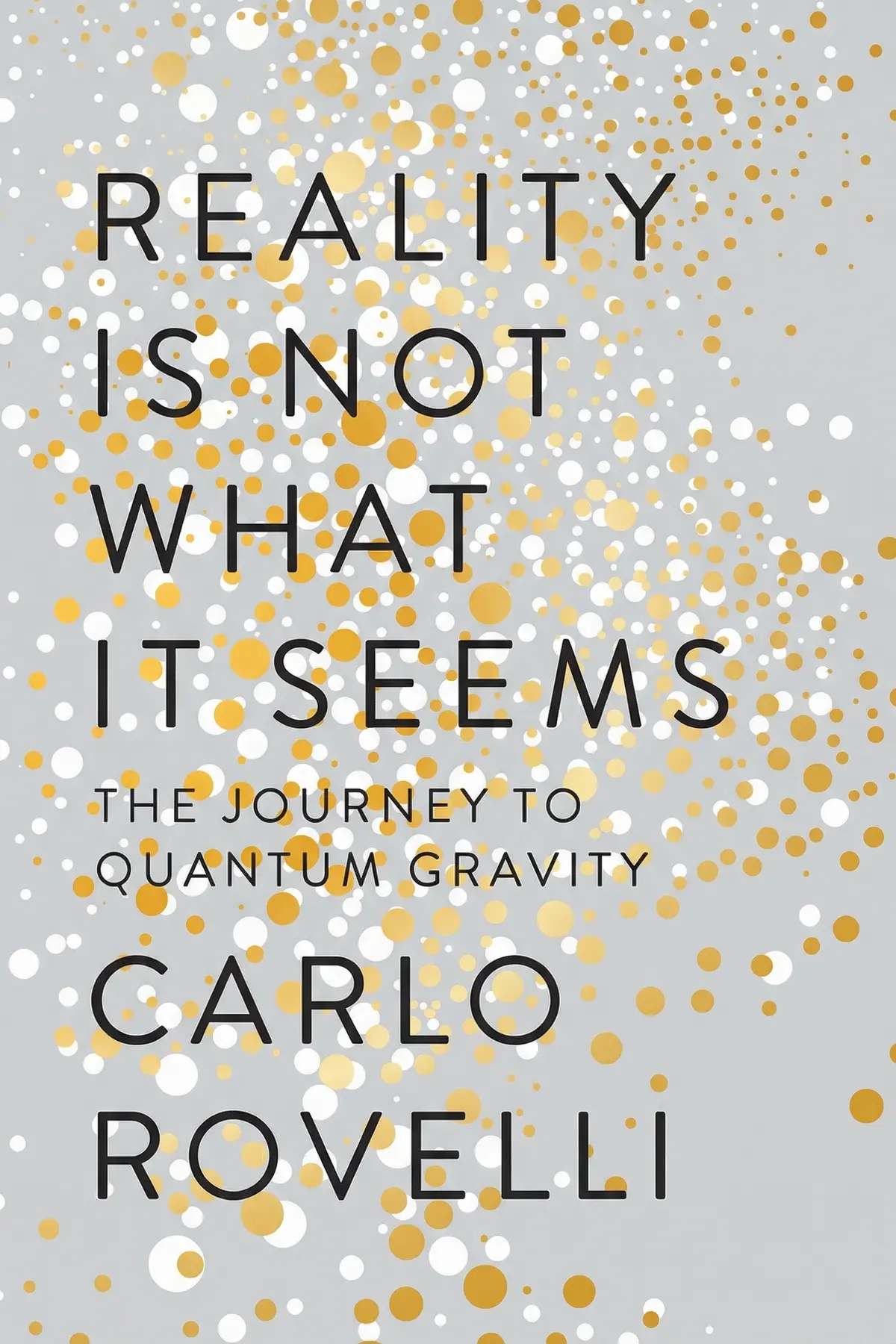
Reality Is Not What It Seems takes readers on a journey through the history of human thought, tracing the path from the first scientific inquiries in ancient Greece to the complex theories of modern theoretical physics. The book explores how our understanding of the universe has shifted from a world of spirits to one governed by mathematical laws, eventually leading to the groundbreaking work of Albert Einstein and the strange world of quantum mechanics. The core promise of the book is to explain the frontiers of modern science, specifically the field of loop quantum gravity. It aims to bridge the gap between the two massive pillars of 20th-century physics: general relativity, which explains the cosmos at a large scale, and quantum mechanics, which looks at the smallest particles. By merging these two seemingly incompatible ideas, the narrative reveals a universe where space is made of individual grains and time as we know it might not actually exist.
Carlo Rovelli is a theoretical physicist who has made significant contributions to the field of physics and our understanding of space and time. He currently directs the quantum gravity research group of the Centre de Physique Théorique in Marseille, France. His other books include Seven Brief Lessons on Physics and The Order of Time.
Carlo Rovelli
Carlo Rovelli
Carlo Rovelli
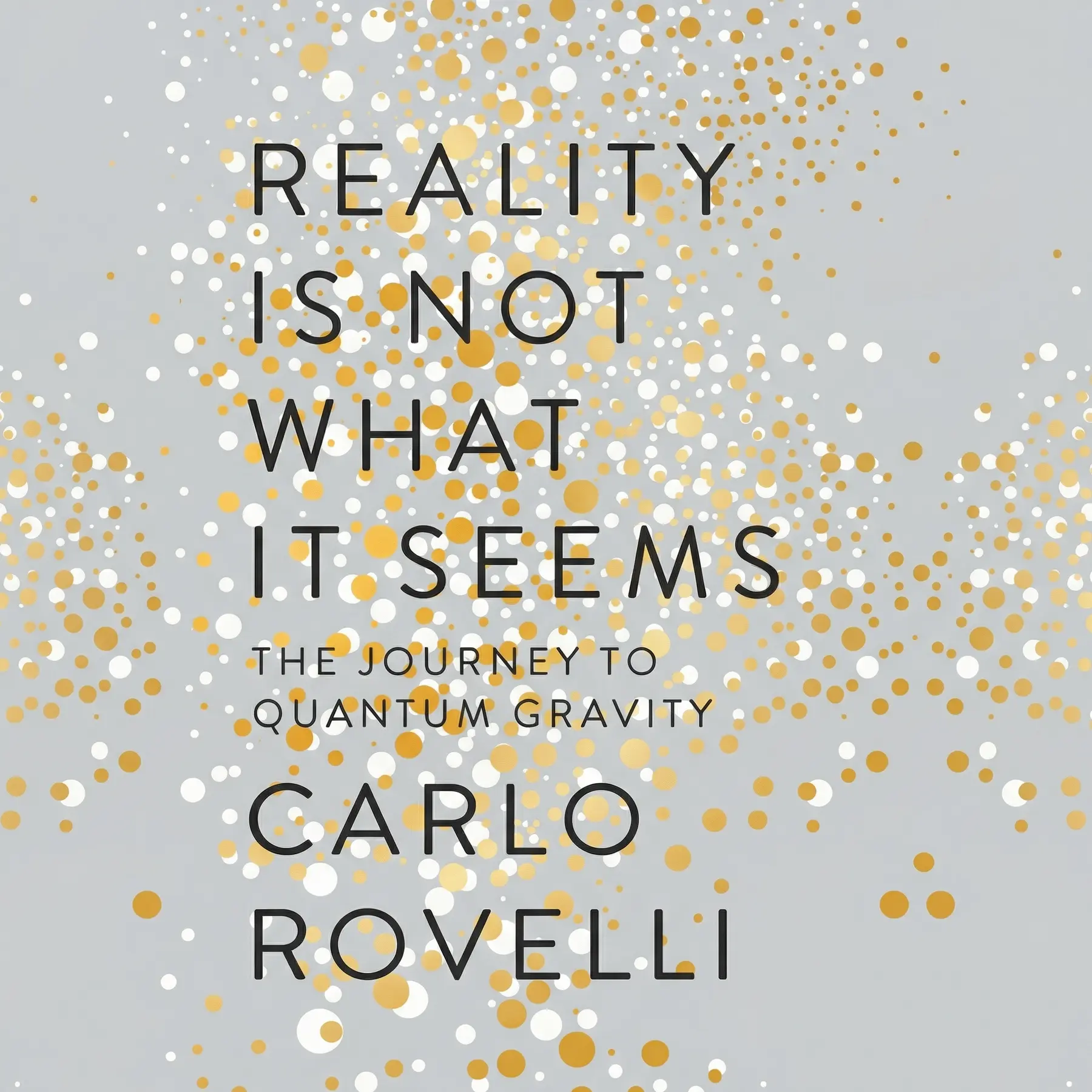
Listeners find the book remarkable for clarifying intricate scientific principles, especially general relativity and quantum mechanics, and they praise the accessible narrative style. Furthermore, the work provides an in-depth survey of the history of physics, establishing it as one of the field’s most readable volumes. Listeners call it a profound, mind-expanding journey that is simple to comprehend, while one listener points out that it is worth revisiting through several readings.
Wow. Rovelli writes about physics with the soul of a poet, transforming cold equations into a sweeping narrative about our place in the cosmos. He starts with the ancient Greeks, specifically Democritus and Anaximander, and builds a bridge to the strange world of Loop Quantum Gravity. The way he explains how space is actually 'granular'—not a continuous void but a fabric of tiny loops—is genuinely mind-bending. I loved the rejection of infinite singularities in favor of a 'Big Bounce' theory. My only minor gripe is that the text feels a bit too brief in places. You will likely finish a chapter and immediately wish he had stayed on that specific topic for twenty more pages. It is a masterpiece of science communication.
Show moreEver wonder what the world looks like if you zoom in past the atoms, past the quarks, down to the very fabric of existence? Rovelli suggests that space isn't a container we live in, but a dynamic, granular entity made of 'atoms of space' that interact relationally. The most staggering part for me was the idea that time isn't a fundamental part of the universe at all. It is just an emergent property of these quantum gravitational fields, which sounds like science fiction but is grounded in serious theoretical work. The writing is accessible and elegant, making complex topics like 'covariance' feel almost intuitive. Highly recommended for any curious mind looking for a fresh perspective on what is real.
Show moreThis book is like a guided tour through the evolution of human thought regarding the nature of reality. Rovelli doesn't just present cold facts; he presents a vision of a world where things only exist in relation to one another. I was particularly fascinated by the 'Big Bounce' theory, which offers a much more coherent explanation for the beginning of the universe than the standard Big Bang. The idea that everything—from the chair you are sitting on to the thoughts in your head—arises from one Covariant Quantum Field is breathtaking. It is a short book, but the density of ideas means you will be thinking about it for months after you finish.
Show moreIt will take me several days to emotionally recover from the sheer scale of the ideas presented here. Rovelli has a way of making you feel the weight of the universe's mystery while providing a clear path through the confusion. He explains that space is composed of discrete 'quanta,' setting a lower limit on how small things can be, which effectively solves the problem of infinite density in black holes. Seeing the progression from the ancient 'apeiron' to modern spin foams makes the current state of physics feel like a natural conclusion to a 2,500-year conversation. It is a beautiful, essential piece of science writing that I will definitely reread many times.
Show moreFinally got around to reading this after seeing it recommended next to Stephen Hawking’s work. While String Theory usually gets all the limelight, Rovelli makes a compelling case for Loop Quantum Gravity being the more 'rational' path forward for modern physics. He manages to reconcile General Relativity and Quantum Mechanics by treating spacetime itself as a quantum field composed of discrete 'spin foams.' Some of the later sections on the disappearance of time were a bit of a struggle to wrap my head around, frankly. You really have to be willing to let go of your physical intuition to follow his logic to the end. It is a great introduction, even if it leaves some technical questions unanswered for the reader.
Show moreAs a casual science buff, I found this to be one of the most readable overviews of modern physics I have encountered. Rovelli has a knack for selecting exactly the right historical anecdotes, from Faraday’s lines of force to Einstein’s realization that space and gravity are the same thing. The transition from classical physics to the 'spooky' world of quanta is handled with care and clarity. I did find the sections on 'spin networks' a little dense toward the end, and I had to reread several pages to grasp the geometry. Still, the concept of a finite universe without 'mathematical horrors' like infinite density is incredibly satisfying to contemplate. It makes the cosmos feel structured rather than chaotic.
Show moreAfter hearing so much hype, I was worried this would be another over-simplified 'physics for poets' book. While it is certainly poetic, Rovelli doesn't shy away from the radical implications of his field, specifically the concept of 'relationality.' He argues that properties like position or energy only exist during interactions, meaning the world is a series of events rather than a collection of static things. I appreciated the subtle critiques of scientism found in the margins, even if Rovelli himself sometimes leans into a reductionist perspective. It's a fascinating look at the 'sea foam' of reality. I just wish there was a bit more on the competing theories for context. Still, a solid four-star read.
Show moreThe chapter on loops and nodes was the highlight of the book for me. Rovelli manages to explain how 'spin networks' combine with time to create 'spin foams,' which are essentially the building blocks of everything we see. It is a lot to take in, especially the part about the non-existence of a universal 'future,' but the author’s enthusiasm for the subject is infectious. My only minor complaint is that he occasionally dismisses philosophy and religion a bit too quickly, which felt unnecessary given the topic. However, as a primer on the current state of Quantum Gravity, this is probably the most accessible text on the market right now. Excellent for beginners.
Show moreLook, I appreciate the beautiful prose, but there is a certain slipperiness to Rovelli’s arguments that occasionally bothered me. He spends a lot of time on the history of science—which is great—but when he gets to the actual Loop Quantum Gravity, things get vague quickly. He avoids the complex math, which is understandable for a popular science book, but he replaces it with metaphors that feel like they are masking gaps in the theory. I found the inclusion of Shannon’s information theory interesting, though it felt like a bit of a stretch to apply it so universally to all reality. It is an enjoyable read, but do not expect a rigorous defense of LQG over String Theory.
Show moreTo be fair, I might just not be the intended target audience for this particular book. I found the first half incredibly repetitive, as if the author assumed the reader had never heard of Democritus or Isaac Newton before. When we finally reached the actual topic of the book—Loop Quantum Gravity—the language became so abstract and metaphorical that I felt like I was reading a philosophy text rather than a physics one. Phrases like 'weaving the threads of space' are pretty, but they do not actually explain the mechanics of how these loops interact. It felt like I was being asked to accept the theory on faith because the writing was charming. Not for me.
Show more
J. Craig Venter

Carl Zimmer
Bill Bryson
Jeff Hawkins
AUDIO SUMMARY AVAILABLE
Get the key ideas from Reality Is Not What It Seems by Carlo Rovelli, plus 5,000+ more titles in English and Thai.







