
22 min 28 sec
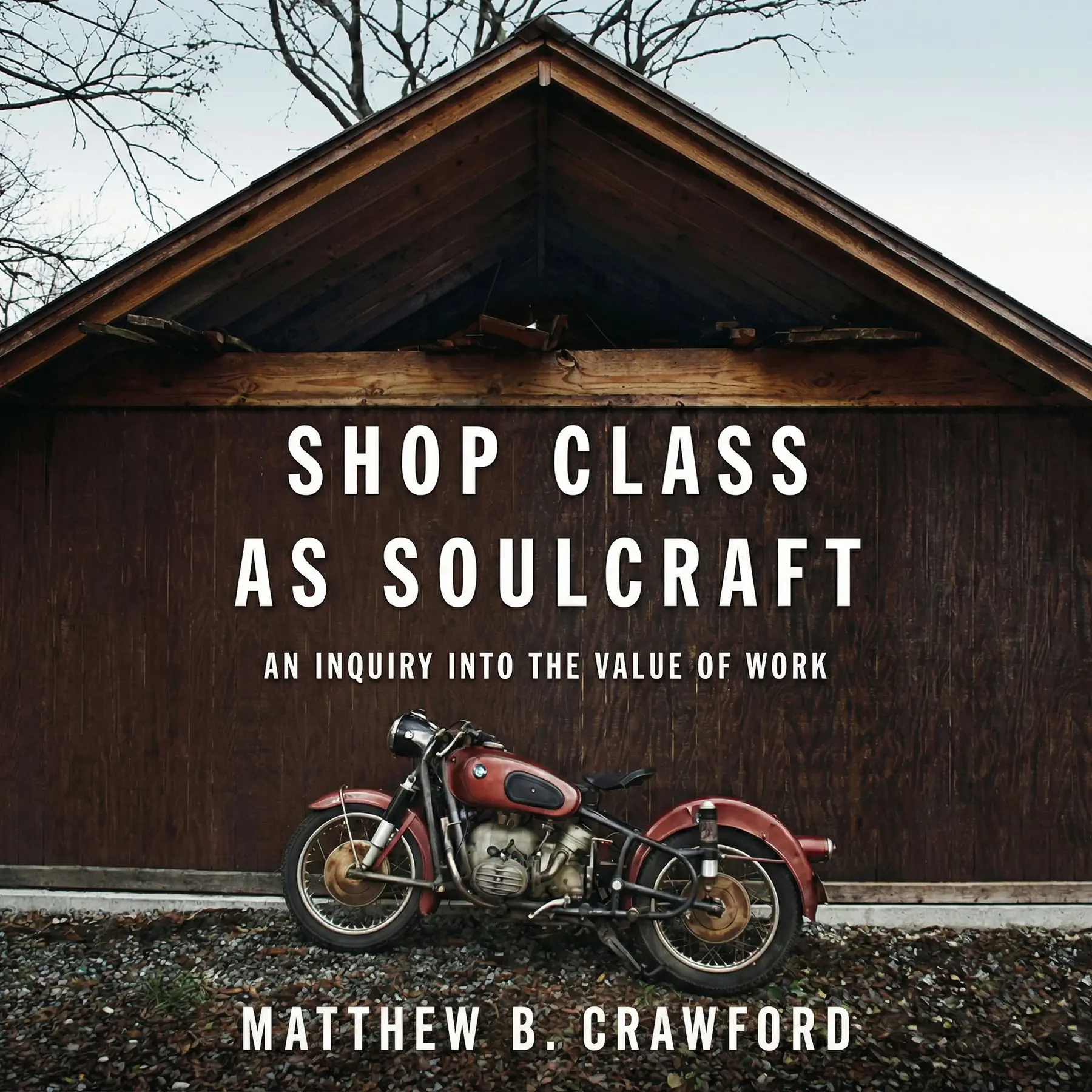
Shop Class as Soulcraft: An Inquiry Into the Value of Work
A deep philosophical investigation into why manual trades offer more intellectual satisfaction, economic stability, and personal agency than the abstract cubicle jobs that dominate the modern professional landscape.
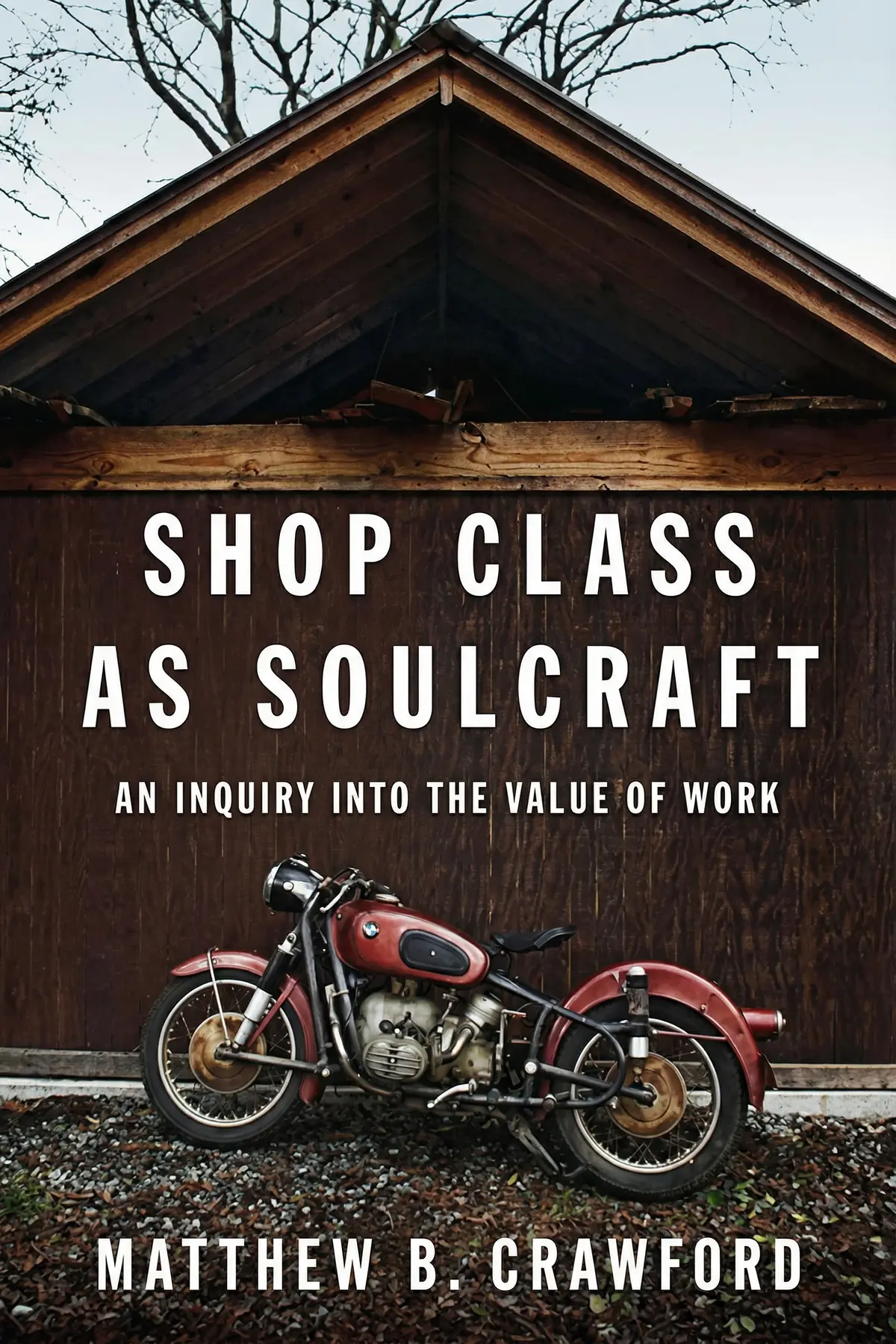
Table of Content
1. Introduction
1 min 48 sec
Imagine a typical modern career path. Most parents, when they look at their children, see a future filled with spreadsheets, management meetings, and digital interfaces. We are conditioned to believe that the pinnacle of success is a ‘knowledge work’ job—something clean, abstract, and performed in a climate-controlled office. The idea of a child becoming a mechanic or an electrician is often met with a subtle sense of disappointment, as if they are settling for something less. But what if our hierarchy of work is completely backward? What if the cubicle is actually a place of intellectual stagnation, while the workshop is where the mind truly comes alive?
This is the central question Matthew B. Crawford explores. He invites us to look at the world through the eyes of someone who fixes things, builds things, and understands how the physical world actually functions. In a world that is becoming increasingly automated and digital, we have lost touch with the ‘soulcraft’ that comes from manual labor. We’ve traded the satisfaction of fixing a real machine for the exhaustion of managing abstract data, often without realizing what we’ve lost in the process.
Throughout this summary, we are going to dive into a philosophical and practical defense of the trades. We will see why the modern office can feel so draining and why the skilled trades are actually becoming some of the most secure and intellectually demanding careers available today. This isn’t just a book about fixing bikes or plumbing; it’s an inquiry into how we can reclaim our autonomy and find genuine meaning in the work we do every day. By the end, you might find yourself looking at that local repair shop not as a fallback plan, but as a model for a well-lived, intellectually vibrant life.
2. The Decline of Practical Agency
2 min 01 sec
Our modern devices are designed to keep us from understanding them, turning us from capable fixers into passive consumers who depend on others for everything.
3. The Shifting Landscape of Career Stability
2 min 04 sec
A college degree is no longer the ironclad guarantee of success it once was, as the line between high-skilled and low-skilled work begins to blur.
4. The Fragmentation of Thought and Action
2 min 15 sec
The separation of planning from execution has degraded the quality of both manual and intellectual work, leading to a loss of true craftsmanship.
5. The Flaws of Modern Education
1 min 57 sec
Schools have shifted away from teaching practical mastery, focusing instead on awarding credentials that often fail to prepare students for real-world challenges.
6. The Alienation of the Abstract Office
2 min 04 sec
Knowledge work can be more exhausting than physical labor because it demands constant mental shifting without providing a clear sense of accomplishment.
7. Teamwork as a Social Constraint
2 min 14 sec
In many office settings, ‘teamwork’ is used as a tool for social control, whereas ‘crews’ in the trades are judged on objective physical results.
8. The Quest for Coherence and Meaning
2 min 02 sec
Finding work that aligns with our physical and psychological needs prevents the fragmentation of self that occurs when we work only for the weekend.
9. The Honest Feedback of the Material World
2 min 02 sec
Manual labor provides an objective standard of success that keeps the ego in check and fosters a genuine sense of pride.
10. The Intellectual Depth of the Trades
2 min 11 sec
Mastering a craft requires the same level of diagnostic reasoning and judgment as the most complex academic fields, offering true cognitive freedom.
11. Conclusion
1 min 50 sec
As we look back at the insights of Matthew B. Crawford, it becomes clear that the value of work isn’t just about the paycheck or the prestige of a title. It’s about the connection between our minds and the world we live in. We have spent decades devaluing the trades, pushing everyone toward an abstract ‘knowledge economy’ that has, for many, resulted in a loss of agency, a sense of alienation, and job insecurity. But the physical world remains, and it still requires people with the skill and the judgment to maintain it.
Crawford’s journey from the think tank to the motorcycle shop isn’t a rejection of the intellect; it’s a pursuit of it. He shows us that the workshop is a place of deep philosophical inquiry and rigorous problem-solving. It’s a place where you can find honest feedback, a clear sense of accomplishment, and a community of people who value you for what you can actually do. The trades offer a path to a life that is integrated, where thought and action are once again joined together.
If you find yourself feeling drained by the abstractions of the modern office, take heart. There is an alternative. You don’t necessarily have to quit your job tomorrow and become a mechanic, but you can start by reclaiming your practical agency. Learn a trade, even as a hobby. Fix something that’s broken. Build something with your own hands. By engaging with the physical world, you aren’t just ‘getting your hands dirty’—you are cultivating your soul. You are becoming a more autonomous, competent, and grounded human being. In the end, ‘soulcraft’ is the art of making yourself at home in the world by mastering the tools and machines that inhabit it. Whether you are a philosopher or a plumber, that is a goal well worth pursuing.
About this book
What is this book about?
In this exploration of the modern working world, Matthew B. Crawford challenges the cultural assumption that white-collar knowledge work is the ultimate path to success. He argues that our current economy has pushed many professionals into roles that are increasingly abstract, repetitive, and disconnected from the real world. By contrast, skilled manual labor—like motorcycle repair or carpentry—demands a high level of cognitive engagement, problem-solving, and diagnostic reasoning. The book promises to reshape how you view professional dignity. It explains why the traditional trades are often more resilient to globalization and automation than middle-management roles. Crawford uses his own transition from a high-level think tank to a motorcycle repair shop to illustrate how working with physical objects can heal the sense of alienation many feel in the modern office. Ultimately, it provides a blueprint for finding meaning through tangible achievement and mastering the material world.
Book Information
About the Author
Matthew B. Crawford
Matthew B. Crawford is a unique figure who bridges the gap between high-level academia and practical craftsmanship. He is a philosopher and a professional motorcycle mechanic. Crawford earned a Ph.D. in political philosophy, but after finding his work at a Washington D.C. think tank unsatisfying, he decided to change course entirely. He opened an independent motorcycle repair shop while continuing his academic pursuits as a research fellow at the University of Virginia’s Institute for Advanced Studies in Culture.
Ratings & Reviews
Ratings at a glance
What people think
Listeners view this title as essential reading for teachers and parents alike, commending its stimulating material that promotes functional reasoning and sparks dialogue. Additionally, its educational merits earn high marks; one listener mentions its special importance for K-12 instructors, whereas another points out its ability to motivate people to master a craft. Still, opinions are divided regarding the prose and substance—while some appreciate the quality of the writing, others argue it feels like a technical academic paper, and despite the excellent analysis, some feel the tone is too scholarly.
Top reviews
Emily
Picked this up after hearing a colleague rave about it, and it really should be mandatory reading for every K-12 principal in the country. We have spent decades telling kids that a four-year degree is the only path to a meaningful life, but Crawford argues—quite convincingly—that trade skills offer a level of cognitive engagement that a cubicle never could. The way he describes 'tacit knowledge' resonates with anyone who has ever tried to master a difficult craft. To be fair, he gets pretty deep into the philosophical weeds at times, citing Greek thinkers and Marxist theory, which might put off some readers looking for a light 'how-to' guide. But if you stick with it, the payoff is a profound rethinking of what it means to be productive. It’s a powerful defense of the dignity of manual work and an essential resource for parents trying to guide their children through a confusing job market.
Show moreWorawit
This book genuinely changed the way I look at my daily commute and my computer-based career. Crawford identifies the fundamental disconnect we feel when our 'output' is nothing more than a digital file or a slide deck. By contrasting this with the objective reality of a running engine, he exposes the psychological toll of the modern office. I've been inspired to finally start that woodworking project I’ve been putting off for years. Truth is, we are biological creatures meant to interact with a physical world, not just abstractions. While the prose can be thick—bordering on a technical paper in some chapters—the underlying message is a vital wake-up call for a society that has lost its way. It’s an essential manifesto for anyone feeling burnt out by the 'knowledge work' trap. Crawford isn't just a mechanic; he’s a modern-day philosopher for the working man.
Show moreAisha
Finally got around to reading this and I’m glad I did, even if it irritated me at times. Crawford makes an airtight case for why we need to stop devaluing vocational education. The book is at its best when he's describing the gritty reality of his repair shop and the satisfaction of solving a tangible problem. It makes you want to go out and build something immediately. My only gripe is that it feels remarkably dated in its social outlook. He treats 'manly' work as the only work that matters, which is a weirdly narrow view for such a supposedly deep thinker. Still, for parents wondering why their kids are miserable in school, this offers some much-needed perspective on the value of working with your hands. It's a thought-provoking, albeit imperfect, manifesto for the modern era.
Show moreKom
Ever wonder why 'intellectuals' feel the need to over-complicate things that are actually quite simple? That was my recurring thought while reading this, yet I couldn't put it down. Look, I’ve worked in the trades for twenty years, and while I appreciate Crawford standing up for us, his prose is undeniably dense. He writes like he's still trying to impress his Ph.D. advisors, which is ironic given his critique of academia. However, the analysis of how corporations suck the life out of employees is absolutely brilliant. To be fair, the solution he proposes—reclaiming agency through manual work—is the most practical advice I've read in years. It’s a solid read if you want to feel validated for liking tools, and it’s a 'soulcraft' manifesto that actually challenges your brain. Don't let the ten-dollar words scare you off; the core message is worth the heavy lifting.
Show morePooja
After hearing so much hype about Crawford's 'Shop Class as Soulcraft,' I went in with high expectations. The central thesis—that we have been steered toward 'knowledge' work at the expense of our own agency—is brilliant and timely. He perfectly captures that feeling of frustration when you can't fix your own appliances because they've been designed to be disposable. Personally, I found the chapters on the history of vocational education fascinating. It’s a great piece for educators to chew on. However, the book isn't exactly a 'light' read. It meanders, and Crawford's disdain for certain types of white-collar work feels a bit like he's settling old scores from his time in a think tank. Still, the practical thinking it encourages is worth the effort. It’s a solid 4-star read that will definitely spark some heated dinner table conversations.
Show moreWoravit
The chapter on 'The Separation of Thinking from Doing' is worth the price of the book alone. It explains so much about why our current education system is failing so many bright students who just want to make things. Crawford’s writing is definitely 'academic,' and there were times I had to reread paragraphs three times to grasp his point. Not gonna lie, it's a slog. But the insights into how we find meaning through objective failure—like a bike that simply won't start—are profound. It teaches you that reality doesn't care about your 'positive thinking' or 'team player' attitude; it only cares if the gears mesh. Despite the thick prose and the weirdly narrow focus on motorcycles, it’s an important book. It’s particularly valuable for parents who see their kids struggling in traditional academic environments and want to offer them a different path to dignity.
Show moreChanikarn
Honestly, I’m torn on this one. On one hand, Crawford is a gifted writer who captures the 'gestalt' of mechanical troubleshooting better than almost anyone. On the other, he is incredibly prone to ranting about his pet peeves. He uses his Ph.D. as a shield while attacking the very intellectualism he clearly belongs to, which feels a bit hypocritical. The book is ostensibly about the value of the trades, but it spends a massive amount of time on the author's personal biography and his specific obsession with vintage bikes. In my experience, the best parts of the book are the ones where he stops philosophizing and just talks about the work. When he gets into the weeds of Marxist theory, he loses the plot. It’s an interesting, provocative read, but it’s far more of an apology for his own career path than a universal guide to finding 'soulcraft' in labor.
Show moreRuangrat
As someone who grew up in a garage, the premise of Crawford’s book initially felt like a breath of fresh air. He hits the nail on the head regarding the 'hollow' feeling of modern office work, where we basically shuffle emails until we die. However, the execution is a bit of a mixed bag. For a book that praises manual labor, it is shockingly academic and dense, often reading more like a philosophical dissertation than a call to pick up a wrench. I also found it impossible to ignore the glaring lack of female representation. Every example of 'soulcraft' seems to involve grease-stained men in shops, while women are relegated to the background or ignored entirely. It’s a great intellectual exercise that will definitely prompt discussion among educators, but it feels like it’s written for a very specific, male-dominated niche. I wanted to love it, but the elitist tone and the hyper-fixation on motorcycles eventually wore me down.
Show moreMint
Not what I expected based on the catchy title and the cool cover. I was hoping for an inspiring look at the maker movement or a practical guide to reclaiming a sense of agency through handiwork, but what I got was a dense, often rambling polemic. Crawford is clearly brilliant, but his writing style is incredibly opaque; he uses ten-dollar words to describe five-cent problems. Frankly, it feels like he’s trying too hard to prove his intellectual bona fides while simultaneously bashing the 'knowledge economy.' The constant deep dives into motorcycle repair were alienating since I have zero interest in gearheads, and he never really bridges the gap to other types of labor. It’s a shame because the core message about the soul-crushing nature of modern corporate life is spot on, but the delivery is so bogged down in academic jargon that it loses its impact. Just read a summary online and you'll get the gist without the headache.
Show morePloy
Wow. I really wanted to like this, but it was just so incredibly exclusionary. Crawford writes as if women don’t exist in the world of manual labor, or if they do, they’re just baking with Betty Crocker. It’s a bizarre blind spot for a book about 'human' work. Beyond that, the book is just too academic for its own good. I expected a narrative about shop class and instead got a dense, rambling treatise on the moral virtues of a very specific type of masculinity. If you enjoy reading technical descriptions of motorcycle parts for pages on end, you might find some value here. Otherwise, the elitist tone and the hyper-fixation on one hobby make it a tough sell. It’s a great premise that unfortunately gets lost in its own self-importance.
Show moreReaders also enjoyed
60 Seconds & You’re Hired!
Robin Ryan


A Guide to the Good Life: The Ancient Art of Stoic Joy
William B. Irvine
A Little History of Philosophy
Nigel Warburton
AUDIO SUMMARY AVAILABLE
Listen to Shop Class as Soulcraft in 15 minutes
Get the key ideas from Shop Class as Soulcraft by Matthew B. Crawford, plus 5,000+ more titles in English and Thai.
- 5,000+ titles
- Listen as much as you want
- 7-day free trial
- Cancel anytime







