
Shop Class as Soulcraft: An Inquiry Into the Value of Work
Matthew B. Crawford
Explore how modern technology fragments our focus and how to reclaim your individuality by engaging with the physical world, mastering manual skills, and embracing the friction of real-life social interactions.
1 min 38 sec
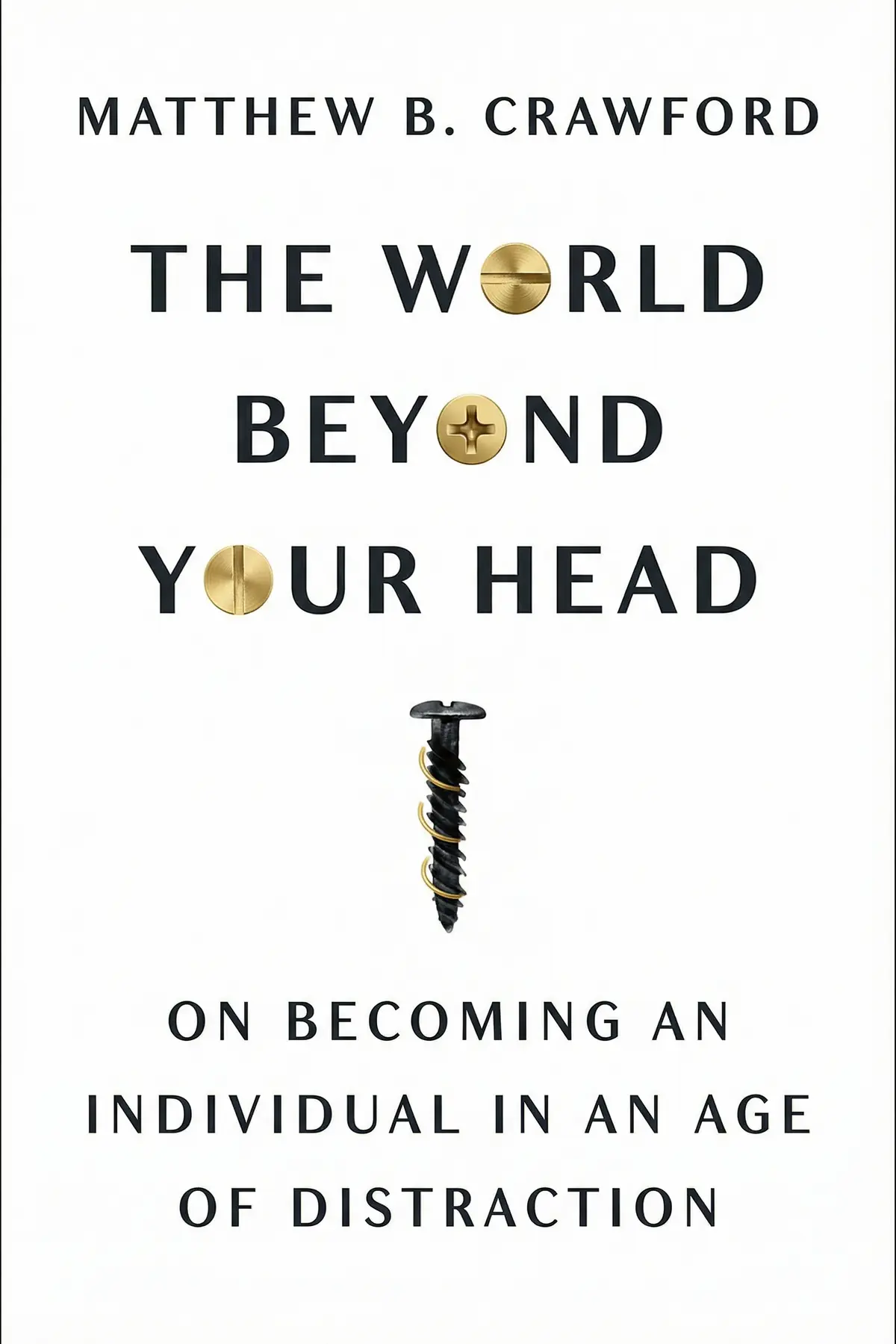
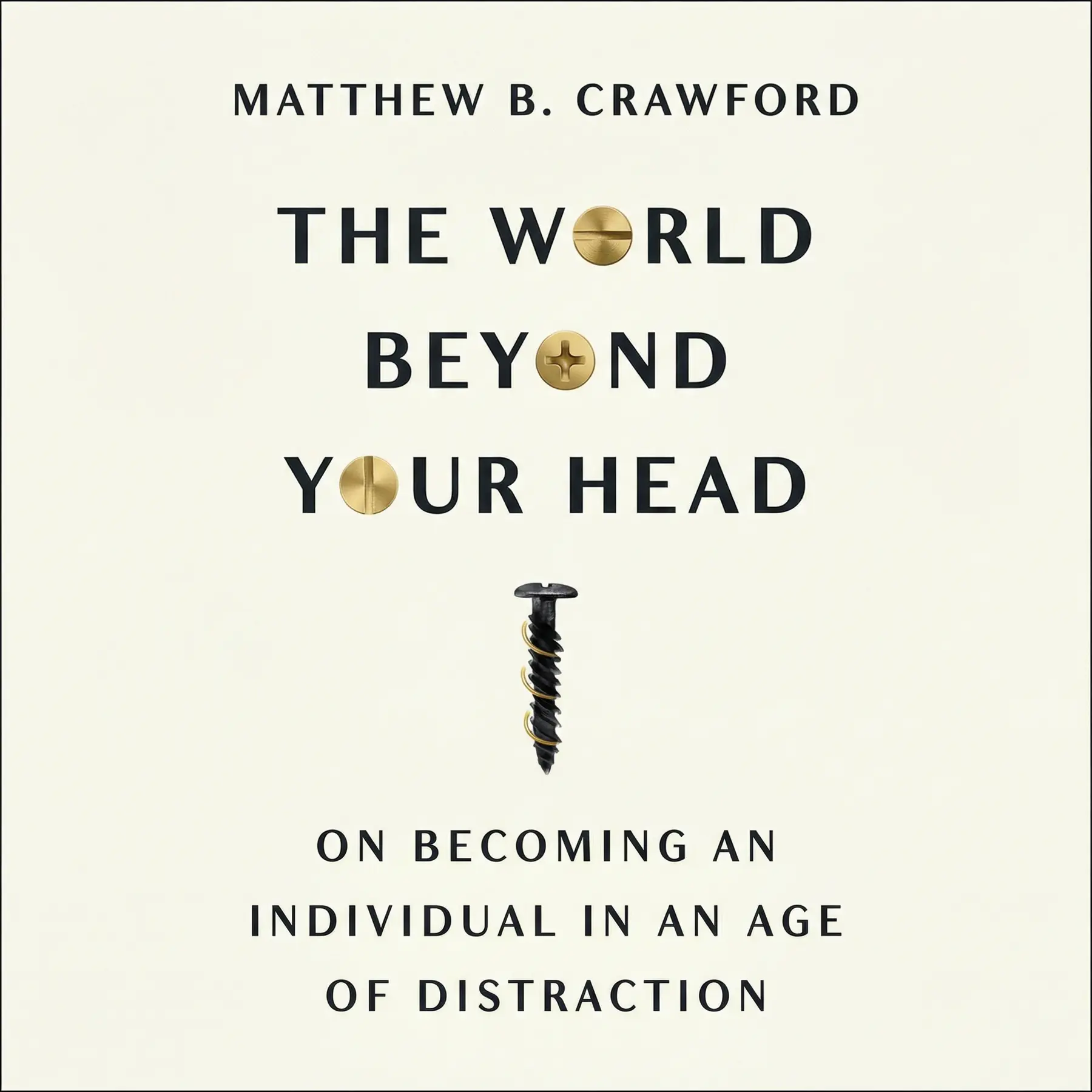
In the modern era, we are living through a quiet, pervasive crisis. You’ve likely seen it—and felt it—every day. It’s the sight of a crowded sidewalk where every person is hunched over a glowing screen, seemingly oblivious to the physical world around them. It’s the feeling of sitting down to work, only to find your mind jumping from tab to tab, notification to notification, until an hour has vanished with nothing to show for it. We often talk about this as a simple lack of willpower, but what if the problem is much deeper? What if our very environment has been engineered to shatter our focus and keep us trapped inside our own heads?
In The World Beyond Your Head, Matthew B. Crawford explores the philosophical and practical consequences of our age of distraction. He suggests that our ability to pay attention isn’t just a personal resource; it’s the foundation of our individuality. When we lose control over where we look and what we think about, we lose our connection to reality. We become passive, easily manipulated, and increasingly isolated.
This summary will take you on a journey out of that mental isolation. We will look at how our biological survival instincts are being hijacked by big data and clever marketing. We’ll explore why the most high-tech, user-friendly devices might actually be making us more miserable by dulling our senses. Most importantly, we’ll see how the solution isn’t just to ‘disconnect,’ but to re-engage with the physical world through skilled practice, manual work, and meaningful social hierarchies. By the end, you’ll understand how to step out of the digital fog and back into the world beyond your head.
2 min 08 sec
Our ancient survival instincts, once used to spot predators, are now being hijacked by a constant barrage of digital alerts and notifications.
1 min 44 sec
Our decisions are rarely as independent as we think; the way options are presented to us often determines our final choice.
1 min 49 sec
Craftsmen use a technique called ‘mise en place’ to stay focused, showing us how we can design our own spaces to resist distraction.
1 min 56 sec
Our brains don’t work in isolation; they rely on our physical movements and tools to truly understand and navigate the world.
1 min 58 sec
Technology designed to be ‘user-friendly’ often distances us from reality, making us more passive and less capable.
1 min 54 sec
Working with machines and physical materials provides an antidote to the feelings of helplessness that define modern office life.
1 min 57 sec
The unpredictability of other people and the physical world can be frightening, leading us to seek solace in controlled, digital environments.
1 min 59 sec
Our sense of who we are is built through the recognition of others, especially within communities of experts and shared skills.
2 min 00 sec
Self-centeredness makes it harder to cope with life’s frustrations and can even lead us to prefer robots over human relationships.
2 min 11 sec
A fear of causing offense has led to ‘colorless cohesion’ where strong opinions are replaced by vague, corporate jargon.
1 min 59 sec
True learning requires accepting authority and external limits, which is the only way to eventually achieve genuine talent.
1 min 34 sec
In the end, the message of The World Beyond Your Head is a call to come home to reality. We are living in a time when our attention is the most valuable commodity on earth, and everyone from tech giants to advertisers is trying to harvest it. If we don’t take active steps to protect our focus, we risk spending our lives as passive observers of a digital world that doesn’t actually care about us.
The path to reclaiming your individuality isn’t found in more ‘user-friendly’ technology or in a life of perfect, frictionless comfort. It is found in the resistance of the physical world. It is found in the workshop, the kitchen, the garden, and the music room. By developing manual skills, we bridge the gap between our minds and our bodies. We learn that we are not just ‘heads’ floating in a sea of information, but physical beings capable of mastering our surroundings.
To become an individual in an age of distraction, you must embrace the friction. Seek out tasks that demand your full attention. Don’t shy away from the frustration of a broken machine or the difficulty of a complex craft. Look for communities of experts who will hold you to a high standard. And most importantly, have the courage to step outside your own head and engage with the world as it actually is—messy, unpredictable, and wonderfully real. When you do, you’ll find that the world beyond your head is far more interesting and satisfying than any screen could ever be. Now, take that first step. Put down the device, pick up a tool, and start making your mark on the world.
The World Beyond Your Head is a deep dive into the crisis of attention in the modern age. It examines how our daily environments—saturated with digital distractions and seamless technology—actually distance us from reality and strip away our sense of agency. Matthew B. Crawford argues that we have become passive consumers, retreating into our own heads to avoid the unpredictability of the physical and social world. The book offers a roadmap for becoming a true individual again. By looking at the lives of craftsmen, musicians, and repairmen, Crawford shows that the path to fulfillment lies in mastering the material world. He explores the connection between our bodies and our brains, the importance of expert communities, and why a bit of social friction is necessary for personal growth. Ultimately, the promise of this summary is a new perspective on how to live a more grounded, focused, and meaningful life in an era of constant noise.
Matthew Crawford is a philosopher and motorcycle mechanic. He’s also a contributing editor at The New Atlantis and a senior fellow at the University of Virginia’s Institute for Advanced Studies in Culture.
Matthew B. Crawford
Listeners describe the work as both influential and mentally stimulating, with one listener noting how it links philosophical concepts to diverse career paths. Additionally, the book earns praise for its novel outlook on political themes and individualism, and one listener suggests it is a worthy inclusion for university and seminary libraries. However, reactions to the book's logic and accessibility are more divided; some find the text hard to navigate, and another listener points out its particularly dense and intricate style.
Matthew Crawford has written something truly refreshing that challenges the very foundations of modern individualism. Most books on distraction tell you to just "put your phone down," but Crawford goes much deeper by looking at how our very concept of freedom is broken. I was fascinated by his take on "heteronomy"—the idea that we actually find ourselves through engagement with things outside our heads, rather than just through internal choice. The section on the organ maker’s shop was a beautiful illustration of how tradition and skill create a different kind of person. While it’s quite an intricate read that requires a lot of mental heavy lifting, the payoff is huge. This belongs in every university and seminary library because it offers a rare, grounded alternative to the shallow liberalism we're usually fed.
Show morePicked this up on a whim and ended up underlining almost every other page. As a craftsman myself, Crawford’s description of "jigs"—both physical and mental—spoke to me on a deep level. We aren't just "brains in buckets"; our environment shapes who we are. His critique of the "Mickey Mouse Clubhouse" style of parenting was hilarious and spot-on, showing how we protect children from reality until they become impotent adults. The book is incredibly thought-provoking and provides a much-needed defense of expertise and tradition in a world that values "freedom" above all else. Yes, the language is intricate and the reasoning can be dense, but that’s the point—you have to pay attention. It’s a book that demands the very thing it seeks to protect. Truly impactful work.
Show moreAs someone who spends more time looking at a screen than at real objects, this book felt like a necessary slap in the face. Crawford argues that our attention is a resource being strip-mined by corporate interests, and frankly, he’s right. The way he ties motorcycle maintenance and organ building into a critique of Kantian philosophy is nothing short of masterful. I loved the "psychic blow job" quote regarding luxury cars; it perfectly captures that feeling of being insulated from the world. However, there were stretches where the academic jargon felt like a thick fog. You really have to focus to get through the middle sections where he goes deep into epistemology. It’s not an easy Sunday read, but it’s an important one for anyone feeling the "drain" of the digital age.
Show moreThe chapter on machine gambling in Las Vegas alone makes the entire purchase worth it. Crawford does a terrifyingly good job of explaining how technology is designed to bypass our agency and turn us into passive consumers. I also appreciated his breakdown of how modern cars—like the Mercedes—are designed to remove the driver from the experience of driving. It’s a bit of a "circle of oblivion" where the more we seek comfort, the more we lose our connection to reality. Look, the book is dense, and you definitely need your "A-game" to follow some of the more abstract logical leaps. But the way he connects manual skill to mental health is something I haven't seen elsewhere. It’s a provocative look at why we feel so disconnected and miserable despite having so many choices.
Show moreAfter hearing so much about the "attentional commons," I finally dove into this philosophical deep-end. Crawford’s argument is that our environment is being engineered to distract us, and our only defense is to engage in skilled practices that demand our presence. I loved the comparison between old-school Mickey Mouse and the new version; it really highlighted how we’ve traded agency for easy abstractions. Gotta say, the section on the motorcycle racer taking a bend was incredibly vivid and helped make the philosophy more concrete. While I found some of the critiques of the Enlightenment a bit repetitive, the overall message is powerful. It’s a book that makes you want to go out and build something with your hands just to feel like a real person again.
Show morePersonally, I found the connection between abstract political philosophy and the visceral act of riding a motorcycle to be the book’s strongest suit. Crawford is a PhD who can actually fix things, which gives him a unique perspective on how we interact with the world. He argues that we only become individuals by submitting to the "intractable ways" of real objects. This is such a refreshing take compared to most self-help books that focus purely on internal mindset. My only real gripe is that he occasionally indulges in unnecessarily difficult phrasing that feels like it’s trying too hard to be profound. In my experience, the best parts are when he sticks to the shop floor and the organ maker’s studio. Those chapters are where his thesis really comes alive.
Show moreFinally got around to finishing this, and I’m still processing the implications of Crawford’s "jigs" concept. The book is a heavy-duty defense of why we need a "situated self" rather than an autonomous one. He makes a compelling case that our obsession with choice has actually made us easier to manipulate by advertisers. The way he discusses David Foster Wallace and the "bliss of boredom" was particularly moving and worth the price of admission alone. It’s an intricate, dense, and at times frustrating read, but the perspective it offers on our relationship with reality is indispensable. If you’re looking for a quick fix for your phone addiction, this isn't it. But if you want to understand the cultural forces that made you that way, give it a shot.
Show moreIs it possible for a book to be both brilliant and maddeningly dense at the same time? Crawford’s central thesis about reclaiming our attention from the "attentional commons" is vital, but the delivery is frequently bogged down by academic pretension. Truth is, I found myself skimming the heavy-duty critiques of Enlightenment thinkers just to get back to the practical examples. The chapter on the Las Vegas gambling industry was absolutely chilling and easily the highlight of the book. It showed how "player-centric design" is essentially a trap for the soul. Yet, for every moment of clarity, there’s a ten-page detour into Kant that felt like a slog. It’s a great 200-page book trapped inside a 300-page one. If you aren't into philosophy, you might struggle.
Show moreTo be fair, Crawford is a brilliant thinker, but I often found myself wishing he had a more aggressive editor. There are moments of absolute genius, especially when he’s talking about the "psychic blow jobs" of modern technology, but the book feels like it was "blown too soon," as another reviewer put it. He covers so much ground—from hockey players to organ builders to short-order cooks—that the overarching structure starts to feel a bit thin. The transition from gambling addicts to Kantian ethics was a bit of a stretch for me. It’s a 3.5-star experience because the readability is so uneven. I’d recommend it for the insights on attention, but be prepared for some very dry sections on political philosophy that might make your eyes glaze over.
Show moreNot what I expected after the hype surrounding his previous work. While Shop Class as Soulcraft felt grounded and accessible, this latest effort feels like a series of disconnected essays that never quite coalesce into a unified argument. The "hard philosophy" feels more like a barrier to entry than a helpful framework. To be fair, the author spends so much time attacking Kant and Descartes that he loses the thread of his own narrative. I wanted more about the actual world beyond my head and less about the internal squabbles of 18th-century thinkers. The writing is often haughty and the phrasing unnecessarily complex, making it a chore to finish. There are some good insights about virtual reality and addiction buried in here, but you have to dig through too much academic detritus to find them.
Show more
William B. Irvine
Nigel Warburton
John Rawls
Martin Heidegger
Friedrich Nietzsche
AUDIO SUMMARY AVAILABLE
Get the key ideas from The World Beyond Your Head by Matthew B. Crawford, plus 5,000+ more titles in English and Thai.







