

PostCapitalism: A Guide to Our Future
Paul Mason
Stop Walking on Eggshells offers essential guidance for those in relationships with individuals suffering from Borderline Personality Disorder, providing tools to reclaim personal stability, set firm boundaries, and understand the complex roots of BPD behavior.

1 min 45 sec
Have you ever felt like you were navigating a minefield in your own living room? Perhaps you find yourself rehearsing every sentence before you speak, terrified that a single misplaced word might trigger an explosion of anger or a wave of inconsolable despair. If you are in a relationship with someone who has Borderline Personality Disorder, or BPD, you likely know exactly what it means to live in a state of constant hyper-vigilance. It is the feeling of walking on eggshells, where the ground beneath you is always shifting and the rules of engagement change without warning.
In this exploration of Paul T. Mason and Randi Kreger’s insights, we are going to look at the reality of BPD from the perspective of the people standing on the sidelines—the partners, children, and friends who are often the unintended targets of this emotional turbulence. The goal here isn’t just to explain a clinical diagnosis; it’s to provide you with a survival kit for your own emotional well-being. We will dive into why people with BPD act the way they do, but more importantly, we will focus on the one person in this equation you actually have the power to change: yourself.
Over the course of this summary, we’ll see how understanding the mechanics of this disorder can help you stop taking the attacks personally. We will look at how to set boundaries that actually stick, and how to identify the subtle ways you might be unintentionally enabling the very chaos you’re trying to avoid. By the end, you’ll see a path toward a life that isn’t defined by someone else’s crisis. It’s about moving from a place of constant reaction to a place of intentional action, allowing you to engage with your loved one with love, but without losing your soul in the process. Let’s begin by looking at what is actually happening behind the curtain of a BPD diagnosis.
2 min 08 sec
Uncover the psychological roots of the volatile behavior often seen in BPD, moving beyond the surface-level anger to the deep-seated fear that drives it.
2 min 03 sec
Explore the evolution of the term ‘borderline’ and why this specific label remains one of the most misunderstood and stigmatized in modern psychology.
1 min 54 sec
Learn why direct labels can backfire and how to approach the topic of professional help without triggering a defensive explosion.
1 min 55 sec
Discover how to move from porous or rigid boundaries to a healthy middle ground that protects your peace while maintaining a connection.
1 min 49 sec
Look inward to understand your own role in the relationship dynamic and why you might be drawn to the ‘caretaker’ role.
1 min 42 sec
Learn why the ultimate path to stability involves shifting your focus away from the disorder and back toward your own goals and passions.
1 min 35 sec
Navigating a relationship with someone who has Borderline Personality Disorder is one of the most taxing emotional experiences a person can endure. It requires a level of patience, self-awareness, and fortitude that few other situations demand. We have explored how the BPD mind works—the terror of abandonment, the black-and-white thinking of splitting, and the desperate search for an identity. We have also seen how the history of the diagnosis and the stigma surrounding it can complicate the path to recovery.
But the most important takeaway from this journey is the realization that you cannot control the person with BPD. You cannot love them into health, you cannot argue them into logic, and you cannot fix their internal fractures by sacrificing your own well-being. The only person you have the power to change is yourself. By setting firm, compassionate boundaries, refusing to enable destructive behaviors, and addressing your own tendencies toward codependency, you can step off the eggshells and onto solid ground.
As you move forward, remember that your primary obligation is to maintain your own emotional health and identity. Find support in others, engage with a therapist if you need to, and never stop pursuing the things that bring you individual happiness. Whether your loved one finds their way to recovery or continues to struggle, you deserve a life of stability and self-respect. You are now equipped with the understanding and the tools to make that life a reality. The first step toward a healthier future starts with choosing yourself.
This summary explores the intricate world of Borderline Personality Disorder, or BPD, through the lens of those who live and work with those affected. It breaks down the hallmark traits of the disorder—such as the intense fear of abandonment, the tendency to see people in black-and-white terms, and the volatile emotional shifts that can leave loved ones feeling exhausted and confused. The core promise of this guide is to move beyond mere survival into a place of personal empowerment. Rather than focusing solely on the person with the diagnosis, the narrative shifts the spotlight back to you. It provides actionable strategies for communication, explains the psychological mechanism of splitting, and offers a blueprint for establishing boundaries that protect your own mental health. By understanding the origins of these behaviors and learning to stop enabling destructive cycles, you can transform a chaotic relationship into one defined by clarity and self-respect. It is a roadmap for regaining your identity while maintaining compassion without getting lost in someone else's storm.
Paul T. Mason serves as the vice president of clinical services at Wheaton Franciscan Healthcare. In this role, he leads the development of mental health and addiction treatment programs specifically designed for those dealing with borderline personality disorder. His research on the subject has been featured in the Journal of Clinical Psychology. Randi Kreger is a best-selling author and publisher who has dedicated her career to borderline personality disorder education. She is the author of The Essential Family Guide to Borderline Personality Disorder and manages the resource site stopwalkingoneggshells.com.
Paul Mason
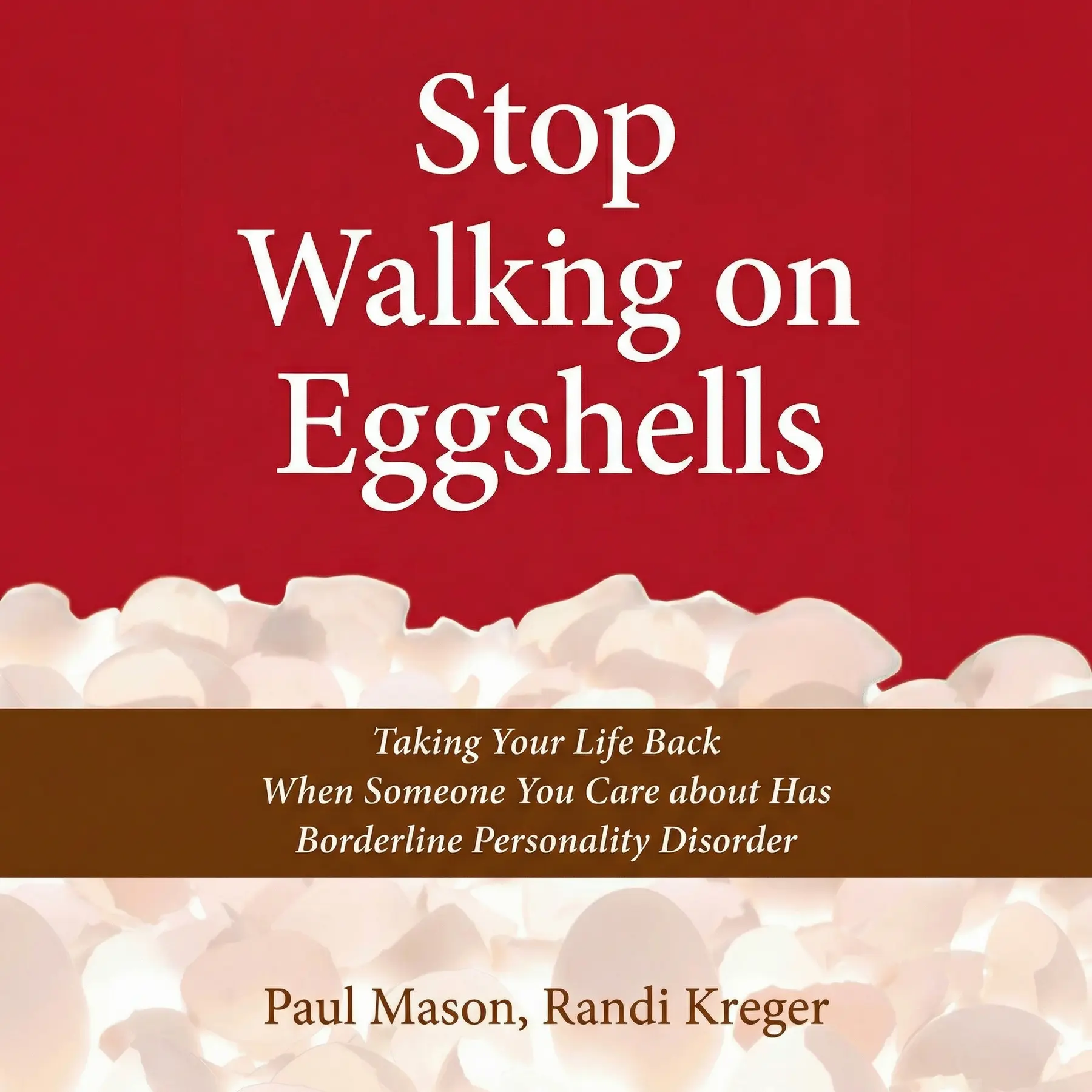
Listeners find this guide exceptionally beneficial for grasping borderline personality disorder and praise the accessible, clearly composed writing. Furthermore, the content earns acclaim for its thoroughness, as one listener points out it addresses both chosen and unchosen situations, and another emphasizes its remarkable perspectives on narcissism and the complexities of mental health. Additionally, listeners appreciate how the work assists in managing interpersonal connections, offers a sense of companionship, and delivers practical methods for achieving inner calm.
Finally, I feel like I'm not the crazy one in this situation. For years, I struggled to understand why every conversation with my sister felt like navigating a minefield, yet this book gave me the terminology I desperately needed. Mason and Kreger offer an incredibly easy-to-read breakdown of high-conflict dynamics that truly validates the exhaustion of the 'non-BPD' partner or family member. Truth is, the sections on personal peace and reclaiming your own life are what saved my sanity during our last blow-up. I especially appreciated how it covers both chosen and unchosen relationships, because you can't always just walk away from family. It makes you feel significantly less alone in the chaos. If you are tired of the constant tension and superficial small talk, this is the toolkit you need to start breathing again.
Show moreThis should be required reading for anyone dealing with a high-conflict personality in their workspace or home life. The way it explains the 'FOG'—fear, obligation, and guilt—hit me like a ton of bricks because I realized how much of my life was dictated by those three things. Not gonna lie, I was skeptical about a self-help book, but the insights into narcissism and mental health dynamics are top-tier. It provides a much-needed lifeline for people who are at the end of their rope. You’ll find yourself nodding along to the stories, feeling a wave of relief that someone else finally understands the 'eggshells' phenomenon. It’s comprehensive, compassionate toward the caretaker, and very well-written. Truly, it’s about taking your life back from the chaos.
Show moreEver wonder why you feel like you're constantly bracing for an explosion that never quite makes sense? This book was my bible during my divorce, providing a level of validation that I couldn't find anywhere else. The authors manage to take complex psychiatric concepts and turn them into easy-to-understand life lessons for the average person. I found the chapter on 'Damage Control' and choosing the right lawyer to be surprisingly practical and grounded in reality. It doesn’t just offer platitudes; it gives you a roadmap for navigating the fallout of a relationship that has lost all safety and intimacy. My therapist recommended this to me, and I will be forever grateful for the clarity it provided. It really makes you realize that you aren't the one who is crazy.
Show moreThe authors do an exceptional job of breaking down the complex interplay between fear, obligation, and guilt that keeps people trapped in unhealthy cycles. I’ve read a lot of psych books, and this is one of the few that provides actual, concrete phrases to use during a conflict. It helps you distinguish between an abusive episode and the person you love, which is a line that often gets blurred in the heat of the moment. The sections on protecting children and setting physical limits were particularly impactful for my situation. To be fair, it’s a tough read emotionally, but the sense of relief you feel when your experience is finally put into words is worth it. It’s a comprehensive resource that covers everything from communication skills to legal ramifications. A must-have for your mental health shelf.
Show morePicked this up on the advice of a therapist to help manage a high-conflict family dynamic that was draining my spirit. The book is an exceptional primer for boundary setting, which is something I have historically been terrible at maintaining. Look, the '3 C's'—I didn’t cause it, I can’t control it, and I can’t cure it—became my daily mantra almost immediately. I do think the authors focus a bit too much on the most extreme, severe cases, which might scare off people dealing with milder traits. However, the concrete communication exercises like the DEAR technique are incredibly practical for de-escalating arguments. It’s not a perfect scientific manual, but as a survival guide for your own mental health, it’s remarkably effective and insightful. It helped me find a path toward personal peace without the constant guilt.
Show moreAs someone who has struggled with mental health myself, I found this to be a bit of a double-edged sword. On one hand, the advice on boundary setting is brilliant and necessary for anyone's survival in a toxic environment. On the other hand, the book sometimes paints those with the disorder as inherently manipulative and 'downright mean,' which feels a bit insensitive. To be fair, the authors do distinguish between accepting a person and accepting their behavior, which is a vital distinction to make. I appreciated the specific strategies for handling black-and-white thinking and suicidal ideation without losing yourself in the process. It’s a quick, insightful read that provides real tools, even if the portrayal of BPD feels a little sensationalized at times. Definitely worth reading for the coping mechanisms alone.
Show moreNot gonna lie, the content here is heavy, but the writing style makes it very accessible and surprisingly fast to get through. The authors do a great job of explaining how boundary setting isn't about anger, but rather about self-love and long-term stability. I found the '4 D's' of how to respond to criticism—don't defend, deny, counterattack, or withdraw—to be a total game changer in my daily interactions. My only real gripe is that it treats 'curing' BPD as a finality, which feels a bit unrealistic for a chronic personality disorder. Regardless, the tools provided for personal peace are excellent. It helped me move away from the strained silences and toward a more honest way of living. This book offers a comprehensive look at narcissism and high-conflict dynamics that is very eye-opening.
Show moreAfter years of trying to be the perfect partner, I realized through these pages that I was fighting a losing battle against a condition I couldn't fix. The book is very helpful for identifying patterns, but it can be quite depressing because it almost implies that these individuals aren't worth the effort. It’s billed as a guide for 'those you care about,' yet it often feels like it's encouraging you to just get out while you still can. I found some of the 'out-of-the-box' coping ideas, like visiting an art gallery to decompress, a bit simplistic for the level of trauma being discussed. Still, the information on identifying triggers is solid. It’s a good starting point, but I’d recommend pairing it with more compassionate, recovery-focused literature to get a balanced view.
Show moreWhile the anecdotal evidence is plentiful, the book leans heavily into armchair psychiatry rather than rigorous clinical science. Frankly, it feels like a catch-all manual where any difficult behavior is suddenly labeled as a personality disorder without much regard for actual evidence-based diagnosis. If the person does X, it’s BPD; if they do the opposite, it’s still BPD. To be fair, the authors succeed in painting a picture of abandonment fears, but the lack of predictable, treatable behaviors makes it feel more like a vent session for angry exes than a medical guide. It represents a lot of what is frustrating about the DSM. I found the tone to be quite judgmental toward the sufferers themselves. It’s a fast read, but take the 'diagnostic' sections with a massive grain of salt.
Show moreThe presentation here is fundamentally insensitive and seems to be written from a place of deep bitterness. If you actually have BPD, this book will make you feel like a monster that everyone should flee from at the first opportunity. It demonizes the sufferer as a 'burden' and focuses entirely on the 'ordeal' of the people around them rather than offering any real empathy. Frankly, it’s disgusting how it encourages people to armchair diagnose their family members with such a serious label. It erases those who struggle with quiet BPD and instead focuses on the most 'maddening' examples to sell books. If you actually care about someone with this disorder, please look for work by Marsha Linehan instead. This book is just judgmental and avoids the actual science of treatment.
Show more
Leanne Maskell

Alcoholics Anonymous World Services
Steven C. Hayes
AUDIO SUMMARY AVAILABLE
Get the key ideas from Stop Walking on Eggshells by Paul Mason, plus 5,000+ more titles in English and Thai.







