

19 min 18 sec
PostCapitalism: A Guide to Our Future
By Paul Mason
PostCapitalism explores the inevitable decline of the market-driven status quo, arguing that information technology and collaborative networks are creating a new economic system that prioritizes sharing over profit and scarcity.
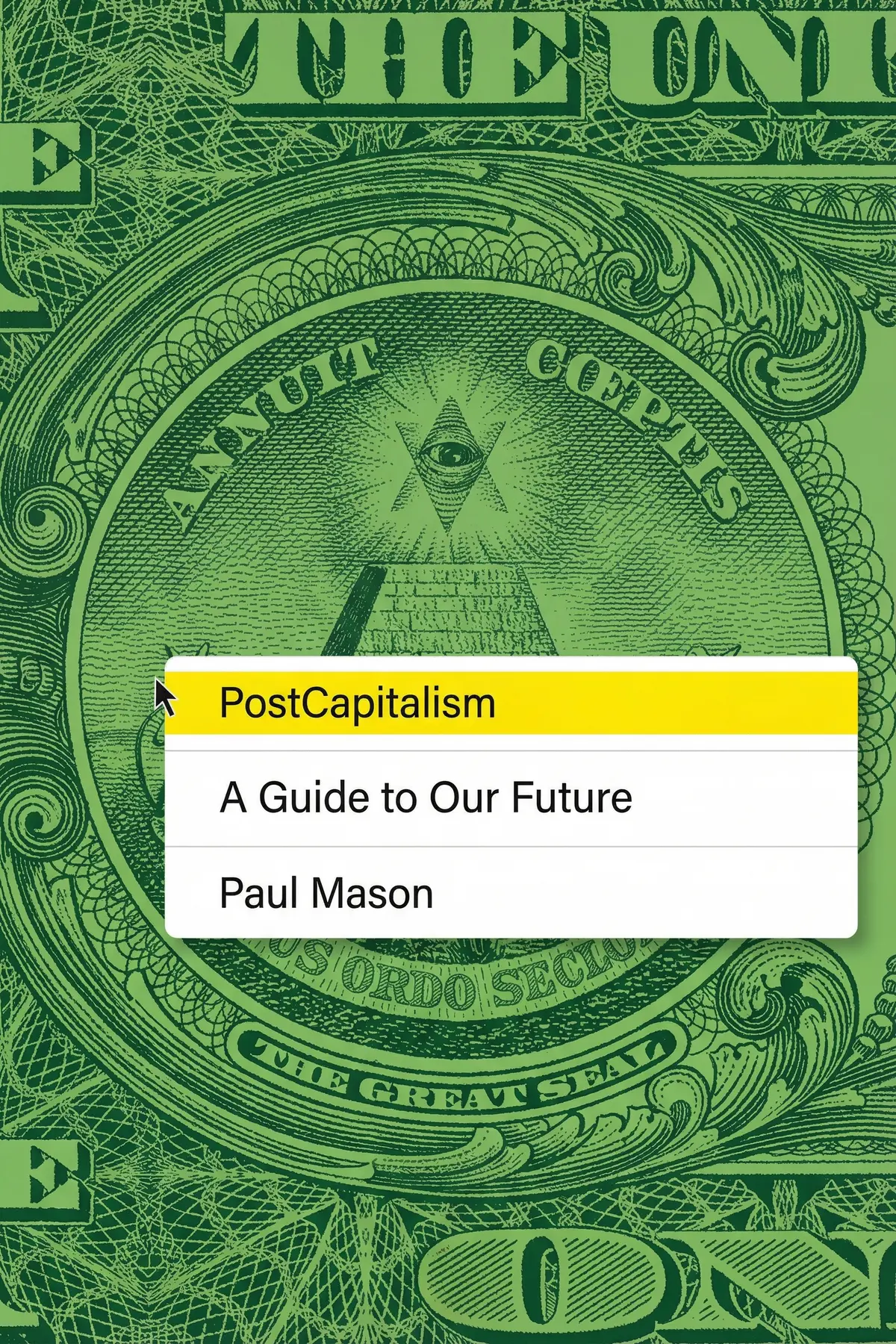
Table of Content
1. Introduction
1 min 43 sec
Imagine a world where the very foundation of how we trade, work, and value our time is beginning to dissolve. For two centuries, capitalism has been the undisputed operating system of the globe, built on the idea that self-interest and free markets are the most efficient ways to distribute resources. But as we move deeper into the twenty-first century, that operating system is starting to glitch. The tools we’ve built—the internet, massive data networks, and collaborative platforms—don’t actually play by the rules of the market. They are based on sharing, not scarcity; on cooperation, rather than competition.
In this exploration of Paul Mason’s work, we are going to look at the transition from our current state into something called postcapitalism. This isn’t just about a temporary financial slump or a political shift; it is about a fundamental change in how human life is organized. We will dive into why the neoliberal model is failing to sustain itself, how information technology is making the old laws of economics obsolete, and why we might be on the cusp of a shift as profound as the move from the Middle Ages into the industrial era.
Throughout this journey, we’ll see that the future isn’t just something that happens to us—it’s something being built right now by millions of people sharing information for free. We are going to look at the historical patterns that brought us here and the practical steps we can take to ensure the next system is more sustainable, more equitable, and more suited to the digital age. Let’s begin by looking at the cracks in the current foundation.
2. The Structural Failure of Neoliberalism
2 min 22 sec
Explore why the current economic model is stumbling under the weight of debt and imaginary money, creating a gap between real value and financial figures.
3. Global Trade Imbalances and the Tech Shock
2 min 18 sec
Understand how the flow of goods between nations and the rise of digital tools are fundamentally undermining the stability of the global market.
4. The Cyclical Nature of Capitalism and Its Limits
2 min 10 sec
Discover the long-term historical waves that govern economic life and why the current transition might be the last one the system can handle.
5. How Information Goods Defy Market Logic
2 min 08 sec
Learn why the digital world is breaking the traditional rules of supply and demand, paving the way for a non-capitalist future.
6. Applying Labor Theory to a Digital Age
2 min 09 sec
Examine the evolution of value and why the modern working class looks very different from the revolutionaries of the past.
7. Parallels Between Feudalism and PostCapitalism
2 min 21 sec
Look at the slow death of the feudal system to understand how our current economic transition will unfold over time.
8. The State’s Role in Designing the Future
2 min 23 sec
Find out how government policy can actively support a move toward a fairer, collaborative economy through radical changes in income and ownership.
9. Conclusion
1 min 44 sec
As we look back at the journey we’ve taken, the throughline is clear: the economic system that has defined the last two centuries is no longer compatible with the technology we have created. We are living in a moment of profound tension, where the old logic of scarcity and private property is clashing with a new reality of abundance and shared networks. The cracks in the neoliberal model—the crushing debt, the instability of fiat money, and the rising inequality—are not just temporary problems; they are signs that the system itself is reaching its natural conclusion.
But the end of capitalism is not the end of the world. In fact, it is the beginning of a new era of human collaboration. By embracing the potential of information technology, we can move toward a society where the necessities of life are cheaper and easier to produce, and where our time is spent on things that truly matter. We have the historical blueprint of previous transitions to guide us, and we have the tools of the network economy to build the future.
The shift to postcapitalism is a collective effort. It happens every time someone contributes to an open-source project, every time a community organizes to share resources, and every time we demand policies like Universal Basic Income that prioritize people over profit. The future is a collaborative project, and it is one that we are all already participating in. The path forward is to acknowledge that the old ways are fading and to step confidently into a world where technology serves humanity, rather than the other way around.
About this book
What is this book about?
The current economic landscape is undergoing a transformation unlike any we have seen in centuries. In this exploration of our shifting world, we look at the core reasons why the traditional capitalist model—specifically neoliberalism—is beginning to fracture under its own weight. We examine how the rise of information technology has disrupted the basic laws of supply and demand, creating goods that are virtually free to reproduce and impossible to own in the traditional sense. This summary provides a roadmap for the transition into what comes next: a postcapitalist society. By looking at historical economic cycles, the limitations of fiat money, and the power of collaborative production like Wikipedia, we see a vision of a future where wage labor is no longer the central pillar of human existence. The promise here is one of liberation—a society that can address global challenges like climate change and aging populations by embracing a new logic of abundance and social cooperation.
Book Information
About the Author
Paul Mason
Paul Mason is a prominent voice in modern economic discourse, who previously served as the economics editor for Channel 4 News. Throughout his career, he has focused on the intersection of global finance and social movements. His written work includes influential titles such as Meltdown: The End of the Age of Greed and Why It’s Kicking Off Everywhere: The New Global Revolutions. In addition to his books, Mason contributes his analysis to respected news outlets like The Guardian and The New Statesman.
Ratings & Reviews
Ratings at a glance
What people think
Listeners describe the work as deeply researched and intellectually stimulating, while one individual highlights its presentation of a lucid historical background. Furthermore, the caliber of the writing is well-regarded, and listeners view the experience as a valuable use of their time. On the other hand, opinions vary regarding the clarity and length of the core arguments, as one listener characterizes the material as a demanding read.
Top reviews
Julian
Paul Mason manages to make complex economic cycles feel incredibly urgent and accessible. His journalistic background really shines through here, transforming what could have been a dry academic slog into a narrative that flows with surprising speed. I was particularly fascinated by his deep dive into Kondratieff waves and how they explain our current stagnation. He argues that the information economy, with its zero marginal costs, is fundamentally at odds with traditional capitalism. While some might find the heavy reliance on Marx’s Grundrisse a bit much, it provides a solid theoretical backbone for his claims. It’s a bold, optimistic look at how technology like Wikipedia and open-source software might be the seeds of a new world. Even if you don't agree with every conclusion, the historical context provided is worth the price of admission alone. Truly thought-provoking stuff.
Show moreRiley
Wow, I didn't expect a book about economics to be this readable. Paul Mason has a knack for taking big, scary concepts like 'demographic timebombs' and 'climate catastrophe' and weaving them into a coherent narrative. He doesn't just complain about the status quo; he analyzes the structural weaknesses of the free market with the precision of a surgeon. The way he describes information as a 'virus' that is currently eating capitalism from the inside is a total game-changer for me. It explains why copyright battles feel so futile in the age of digital piracy. This book is a must-read for anyone who feels like the current economic model is reaching its breaking point. It’s bold, it’s controversial, and it will definitely change the way you look at your smartphone.
Show moreTong
This is a rare left-wing perspective that doesn't just wallow in despair. Instead of mourning the death of the old working class, Mason celebrates the rise of the 'networked individual.' He suggests that the very tools used to exploit us—social media, big data, constant connectivity—are the keys to our eventual escape. I loved the way he tied together the Black Death, the printing press, and the modern web to show how transitions between economic systems actually happen. It's a huge, sprawling, ambitious book that covers everything from international debt to the history of the steam engine. While it’s a bit of a challenging read, the payoff is immense. It gave me a sense of hope that I haven't felt in a long time. Highly recommended.
Show moreOat
Picked this up because I wanted a deeper understanding of why the current system feels so broken. Mason’s core argument about the 'information revolution' is brilliant. He explains how digital goods—which cost almost nothing to reproduce—shatter the traditional relationship between supply and demand. This creates a massive contradiction that neoliberalism simply cannot resolve. To be fair, the book is quite a challenging read in places, especially when he starts stitching together disparate theories from the last two hundred years. You have to be prepared for some dense paragraphs. However, his writing style remains engagingly journalistic throughout, which helps pull you through the more theoretical chapters. It’s the first time I’ve seen a writer effectively use Marx to talk about the Internet of Things. Definitely a book that demands your full attention.
Show moreMingkwan
After hearing so much buzz about the 'collaborative commons,' I finally dove into Mason’s take. It’s a refreshing change of pace from the typical doom-and-gloom leftist literature. Mason is a rare optimist who sees automation and big data not as threats, but as tools for liberation. He argues that we are currently in a 'stalled' fifth wave of innovation because the old capitalist structures are desperately trying to monetize things that should be free. I loved the examples of Linux and Wikipedia as proof that people will work for the common good without a profit motive. However, the transition he describes seems a bit too easy, almost inevitable, which feels naive given the power of modern monopolies. Still, his critique of neoliberal ideology is biting and accurate. It’s a well-researched piece of work that actually dares to imagine something better.
Show moreYanin
Ever wonder why digital goods are so hard to price? This book provides the most satisfying answer I’ve found yet. Mason explores the 'zero marginal cost' phenomenon in a way that makes perfect sense. If it costs nothing to copy a song or a design, why are we still paying for them? He argues that we are living through a slow-motion collapse of the price mechanism itself. I found the section on the 'Internet of Things' particularly interesting, even if Mason himself seems a bit skeptical of the hype. The book can be a bit meandering, and I wish he’d spent more time on the role of the state in managing this transition. Nevertheless, it’s a deeply researched and important contribution to the conversation about our collective survival.
Show moreJib
Not what I expected, as it leans much more heavily into Marxist theory than the marketing suggests. I appreciate the effort Mason puts into refuting the 'End of History' narrative, but the prose can be incredibly dense at times. One minute he's talking about the 24-hour news cycle, and the next he's deep into the labor theory of value. It feels like he’s trying to do too much in 400 pages. My biggest gripe is the relative omission of democracy; he touches on the state withering away but ignores how we actually make collective decisions in this new collaborative utopia. The chapter on Kondratieff waves was a highlight, though, and it really helped me visualize the long-term patterns of capitalism. It’s a solid 3-star read—great for the ideas it sparks, but let down by its occasional lack of clarity.
Show moreIsaiah
Look, the historical analysis here is absolutely top-notch, but the 'Postcapitalism' part of the book feels like a leap of faith. Mason does a great job explaining how we got to this point of extreme inequality and stagnant wages. He tracks the shift from industrial production to financialization with incredible detail. But when he starts talking about the future, the rigors of his historical work seem to evaporate into vague generalities. He envisions a world of basic income and shared information, yet he brushes over the resistance we’d see from the likes of Amazon or Google. Is access to information really enough to dismantle global power structures? I have my doubts. It’s a thought-provoking read, and the writing is high-quality, but it feels more like a dream than a blueprint.
Show morePan
To be fair, Mason is asking all the right questions, even if he doesn't have the blueprints. I appreciated the deep dive into the 1970s 'profit squeeze' and the rise of neoliberalism as a response to it. It’s a fantastic history lesson. However, as the book progressed, I found myself wanting more concrete policy proposals. He talks about 'socializing finance' and 'green energy' but keeps things at a very high level. The prose is engagingly journalistic, which is a plus, but the lack of academic rigour in the final chapters is noticeable. It’s a good starting point for a discussion, but it’s certainly not the final word on what comes next. If you're looking for a clear-cut guide on how to change the world tomorrow, you might be disappointed.
Show moreOm
The subtitle 'A Guide to Our Future' feels like a bit of a bait-and-switch when you actually get into the weeds of the text. Frankly, Mason spends way too much time looking in the rearview mirror, rehashing 19th-century labor history and Soviet economists like Bogdanov. While the historical analysis is well-researched, the actual 'guide' part of the book is frustratingly vague and underdeveloped. He posits that collaborative networks will naturally replace market hierarchies, but he never explains the transition mechanics. How do we actually pay for the 'free stuff' while we're still stuck in the current system? There is a glaring lack of attention paid to Western imperialism as well. It’s an interesting intellectual exercise, but as a practical roadmap, it falls completely flat. I left feeling more confused about the 'how' than when I started.
Show moreReaders also enjoyed
A Splendid Exchange: How Trade Shaped the World
William J. Bernstein

Adults in The Room: My Battle With Europe’s Deep Establishment
Yanis Varoufakis
21 Lessons for the 21st Century
Yuval Noah Harari
AUDIO SUMMARY AVAILABLE
Listen to PostCapitalism in 15 minutes
Get the key ideas from PostCapitalism by Paul Mason, plus 5,000+ more titles in English and Thai.
- 5,000+ titles
- Listen as much as you want
- 7-day free trial
- Cancel anytime







