
The Conquest of Happiness
Bertrand Russell
A profound exploration of the fundamental questions that define human existence, challenging our perceptions of reality, the limits of certain knowledge, and the enduring value of questioning the world around us.
1 min 27 sec
Have you ever paused in the middle of a mundane moment and felt a sudden, unsettling doubt about the world around you? Perhaps you were looking at a simple object, like a wooden chair or a patch of sunlight on the floor, and you wondered if it truly exists exactly as you see it. Most of us push these thoughts aside to get on with our day, but for the philosopher, these moments are the starting point of everything.
In this exploration of Bertrand Russell’s landmark work, we are stepping into a world where the most basic assumptions are put under the microscope. This isn’t just a dry academic exercise; it’s an invitation to see the world with fresh, albeit skeptical, eyes. Russell’s throughline is simple yet staggering: the things we take for granted are often the most mysterious. He moves us from the sensory experiences of our immediate surroundings to the high-level logic of mathematics and the abstract nature of truth itself.
By the end of this journey, you may not have a list of definitive answers—in fact, Russell would argue that’s not the point. Instead, the goal is to expand the boundaries of your mind. We will look at why our senses might be deceiving us, how we can possibly predict the future based on the past, and why the simple act of wondering is one of the most important things a human being can do. Prepare to challenge your common sense and embrace the uncertainty that leads to true wisdom.
2 min 09 sec
Discover why the simple objects in your room might not be what they seem and how your senses provide data rather than direct truth.
2 min 12 sec
Examine the debate between those who believe the world is only in our minds and those who argue for a reality that survives our absence.
1 min 56 sec
Explore why our most basic expectations about tomorrow are based on habit rather than logical proof.
1 min 54 sec
Understand how the human mind can know certain truths—like those in math and logic—without needing to test them in the real world.
2 min 07 sec
Consider the existence of qualities like ‘whiteness’ or ‘justice’ that aren’t physical objects but are still undeniably real.
2 min 07 sec
Discover why the goal of philosophy isn’t to find final answers, but to liberate the mind from narrow-mindedness and custom.
1 min 53 sec
We began this journey by questioning the very table in front of us, and we have traveled through the deep waters of perception, induction, and abstract universals. Bertrand Russell’s ‘The Problems of Philosophy’ doesn’t leave us with a neat set of facts to memorize. Instead, it leaves us with a new way of being in the world.
The throughline of this work is the pursuit of ‘knowledge’ while acknowledging its immense difficulty. We’ve learned that our senses are messengers, not direct mirrors of reality. We’ve seen that our belief in the future is a matter of probability, not logic. We’ve explored the idea that there are timeless truths in mathematics and universals that exist outside of space and time.
But the most important takeaway is the ‘why’ behind the ‘what.’ Philosophy is about breaking down the walls of our own certainty. It is an antidote to the arrogance of thinking we have it all figured out. In your daily life, this means looking at a disagreement not as a clash of two ‘correct’ people, but as two different sets of sense-data and interpretations. It means approaching the news, your work, and your relationships with the humility to say, ‘I might be seeing only the appearance, not the reality.’
Carry this spirit of questioning with you. When you find yourself stuck in the ‘tyranny of custom’—doing things just because that’s how they’ve always been done—remember the farmer and the chicken. Don’t let your mind be a small village; let it be a vast landscape. As Russell reminded us, the beauty of the mind is found in its ability to wonder. Keep asking the big questions, not because you expect to solve them today, but because the act of asking is what keeps your world wide, vibrant, and free.
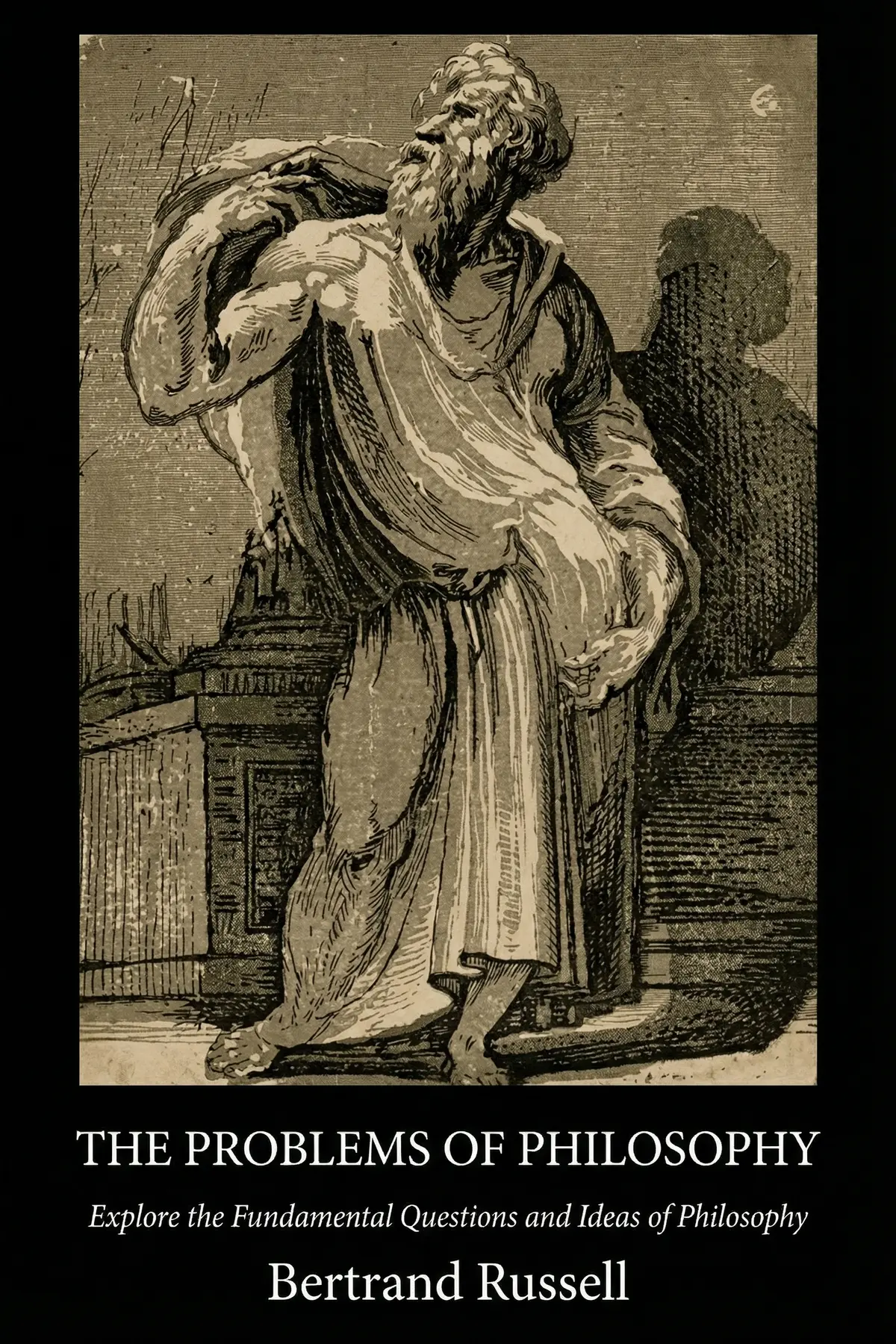
The Problems of Philosophy serves as a foundational guide to the landscape of philosophical inquiry. It addresses the deep-seated mysteries that often go unexamined in our daily lives, beginning with the unsettling gap between how the world appears to our senses and what it might actually be. Through a series of logical progressions, the text examines whether we can truly prove the existence of an external world or if we are merely trapped within our own perceptions. Beyond the nature of reality, the work promises to clarify how we come to know anything at all. It distinguishes between the truths we learn through experience and the certainties of logic and mathematics that seem to exist independently of the physical realm. By investigating the problem of induction and the reality of universal concepts, it offers a framework for critical thinking. Ultimately, the book promises to show that while philosophy may not provide final answers, the act of asking these questions is essential for intellectual freedom and a deeper connection to the universe.
Bertrand Russell (1872-1970) was a British philosopher, logician, and social critic who made significant contributions to mathematical logic, analytic philosophy, and political theory. He co-authored the influential Principia Mathematica and wrote numerous books including A History of Western Philosophy. In 1950 he was awarded the Nobel Prize in Literature for his diverse, significant work championing humanitarian ideals and freedom of thought.
Bertrand Russell
Listeners find that perspectives differ regarding how accessible the work is for novices, as some listeners feel the heavy jargon and nuanced differences can be difficult to get through. Nevertheless, many enjoy Russell’s clear writing style and his talent for distilling intricate arguments into short, profound overviews. Furthermore, they prize the piece as a thought-provoking gateway to logic that fosters an expanded perspective, with one listener observing that the book effectively "removes the somewhat arrogant dogmatism" of daily existence. They also point to the concluding chapter as a standout moment; additionally, listeners feel the narrative "sparkles with subtlety and charm."
The chapter on the value of philosophy should be mandatory reading for every human being alive. I was blown away by how Russell manages to compress centuries of debate into such a slim volume. His writing sparkles with a rare kind of clarity, even when he's tackling something as abstract as the principle of induction. You can tell he truly believes in the liberating power of doubt. By dismantling our 'arrogant dogmatism,' he opens up a universe of possibilities that most of us ignore in our daily lives. Not gonna lie, some of the logic toward the middle gets heavy, but the payoff is immense. It's a foundational text that feels as relevant now as it did a hundred years ago.
Show moreEver wonder if the table in front of you actually exists when you leave the room? Russell starts with the most mundane objects and uses them to pull the rug out from under your common sense. It’s a thrilling ride through the history of thought. His prose is a 'logical machine,' as some say, but there is a hidden warmth in how he describes the 'strangeness and wonder' lying just below the surface of daily life. I particularly loved the section on inductive reasoning—the example of the chicken expecting food but getting its neck wrung is a perfect illustration of the limits of experience. This book doesn't just give you facts; it gives you a whole new lens to view reality.
Show moreFew books have the power to make you feel both incredibly small and vastly significant at the same time. Russell is a master of the short-form explanation. He takes the daunting 'Problems' of the title and turns them into a series of puzzles that the reader feels invited to solve. His critique of 'common sense' is sharp, yet he never feels condescending toward the reader. To me, the book felt like a conversation with a very patient, very brilliant mentor. The prose is elegant and moves with a steady, rhythmic logic that is deeply satisfying to follow. It’s a gem of a book that manages to be both a rigorous exercise in thought and a poetic defense of the intellect.
Show morePicked this up on a whim after realizing my knowledge of epistemology was basically non-existent. Russell's prose is famous for a reason; it is clean, surgical, and he rarely wastes a word. However, as a 'primer,' I think it assumes the reader is already comfortable with 1912-era academic vocabulary. I struggled with the distinction between sense-data and physical objects at first, but once the logic clicks, the world looks different. The highlight is definitely the closing chapter. It reminds us that philosophy isn't about finding a single 'right' answer, but about escaping the prison of our own prejudices. It’s a short read, but you’ll find yourself re-reading pages just to grasp the subtle distinctions.
Show moreAfter hearing so much about analytic philosophy, I finally decided to tackle the source. It’s fascinating to see how Russell treats the mind like a laboratory. He moves from sense-data to universals with a precision that makes you realize how messy our everyday thinking really is. The book is remarkably lucid, but don't let the size fool you into thinking it's a quick afternoon read. You need to sit with his definitions. Personally, I found his critique of Berkeley’s idealism to be a masterclass in philosophical takedowns. My only gripe is that he occasionally gets bogged down in his own excitement, leaving the beginner a bit stranded in the weeds of his complex sub-clauses.
Show moreWow, the final essay in this book is worth the price of admission alone. While the technical chapters on the laws of thought can be a bit of a slog, the conclusion ties everything together beautifully. Russell argues that the point of philosophy isn't to reach a final destination, but to keep the mind growing. His style is incredibly refined—gentlemanly, even—and he handles complex ideas with a lightness of touch that is rare. I did find some of the distinctions between 'universals' and 'particulars' to be quite subtle and difficult to hold onto. Still, it’s an essential piece of intellectual history that encourages a much broader, less dogmatic worldview for anyone willing to put in the effort.
Show moreFinally got around to reading this classic and it definitely lived up to the hype, for the most part. There’s a certain charm to Russell’s writing that makes even the most abstract concepts feel tangible. He has this knack for compressing massive debates into just a few paragraphs without losing the core essence of the argument. That said, the terminology can be a bit of a hurdle. You really have to focus to distinguish between his own theories and those of the philosophers he is summarizing. It’s not exactly a beach read. In my experience, it’s best taken in small doses so you can actually digest the nuances. A brilliant, if occasionally taxing, introduction to the analytical tradition.
Show moreIs Russell a genius? Yes. Is he a great teacher for the average person? I’m not so sure. This book is frequently recommended as the ultimate entry point into the subject, but the terminology is incredibly dense. Frankly, the way he navigates through Berkeley and Kant felt like a mental marathon. I appreciated the logical rigor, yet the sentences are often so convoluted that I lost the thread of the argument halfway through. To be fair, his passion for the 'wonder' of the world is infectious. It’s just that the barrier to entry is higher than the slim page count suggests. It feels more like a historical survey than a modern guidebook for the uninitiated.
Show moreAs someone coming from a science background, I appreciated the focus on logic over flowery metaphysics. There's a lot of value here regarding how we categorize knowledge and truth. Russell’s attempt to bridge the gap between rationalism and empiricism is noble, even if it’s a bit dry at times. However, the age of the book shows in the sections regarding the nature of matter. Some of these arguments feel like they belong to a different era entirely. I've gotta say, I found the middle chapters on 'knowledge by acquaintance' far more interesting than the historical summaries of Leibniz or Hegel. It’s a solid read: intellectually stimulating but occasionally showing its grey hairs and outdated scientific assumptions.
Show moreLook, I really wanted to like this, but I found it nearly impenetrable as a 'beginner' guide. Everyone says Russell is clear, but clear for a 20th-century logician is not the same as clear for a regular reader today. The jargon is relentless. Terms like 'a priori' and 'synthetic' are tossed around before they are fully explained, making the experience feel like a chore. Truth is, I spent more time searching for definitions than actually reading the text. While I can appreciate the brilliance behind the logic, the delivery feels dated and overly academic. If you’re looking for a friendly introduction to help you understand the world, this might just leave you more confused than when you started.
Show more
William B. Irvine
Nigel Warburton
John Rawls
Robert Nozick
Nassim Nicholas Taleb
John Milton
AUDIO SUMMARY AVAILABLE
Get the key ideas from The Problems of Philosophy by Bertrand Russell, plus 5,000+ more titles in English and Thai.







