
14 min 55 sec
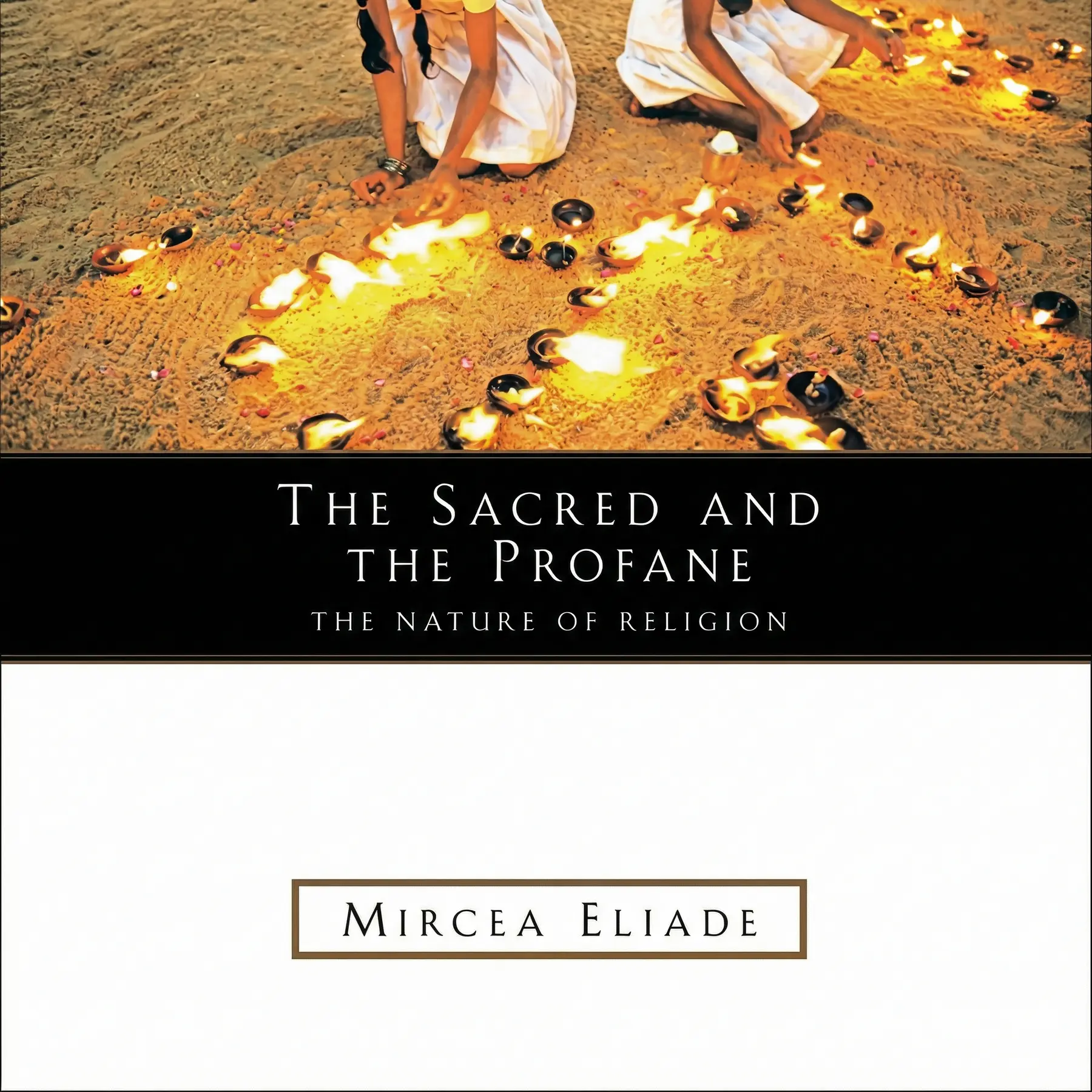
The Sacred and the Profane: The Nature of Religion
Explore the fundamental divide between spiritual and secular life. This summary examines how sacred spaces, cyclical time, and natural symbols provide orientation and profound meaning in a seemingly chaotic world.
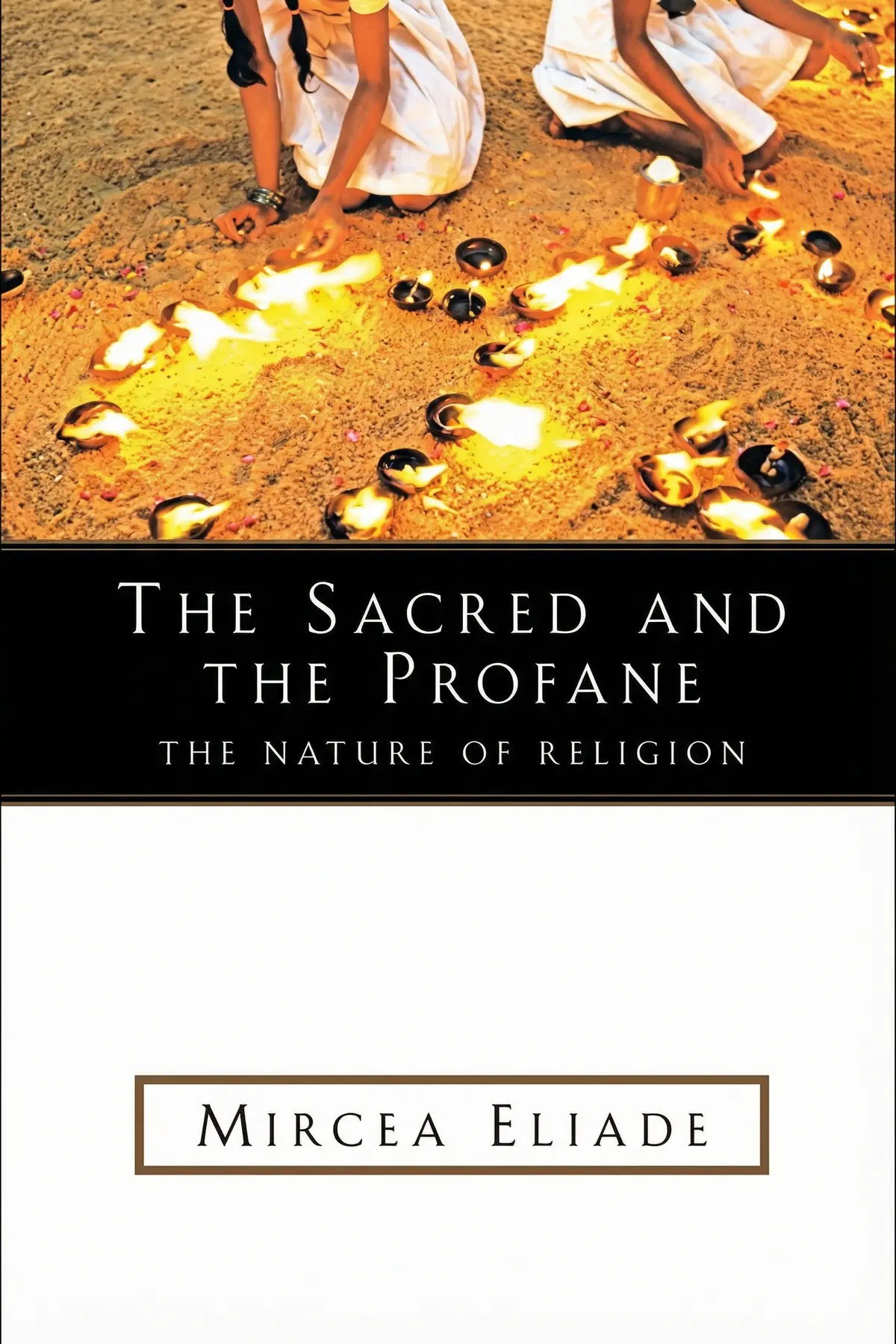
Table of Content
1. Introduction
1 min 44 sec
Have you ever considered that the ground you walk on, the walls of your home, or even the passage of the hours might hold a significance far deeper than their physical utility? To the modern, secular mind, the world is often a flat expanse—a collection of atoms and minutes that we navigate to get things done. But for the vast majority of human history, the world was perceived in a radically different way. It was split into two distinct realms: the sacred and the profane.
In this exploration of Mircea Eliade’s seminal work, we are going to journey into the mind of ‘homo religiosus’—the religious human. This isn’t just about theology or specific gods; it’s about the very structure of human experience. We will see how the discovery of a ‘sacred’ space acts like a compass, providing a fixed point of orientation in an otherwise chaotic and meaningless void. We will discover how time, for the religious soul, is not a straight line marching toward an end, but a beautiful, repeating circle that allows us to return to the moment of creation itself.
Through this throughline, we’ll understand that the sacred is not something added to the world from the outside; rather, it is the perception of the world’s true, ultimate reality. By the end of this journey, you may find that the ‘disenchanted’ modern world still carries the quiet, hidden echoes of these ancient truths. We’ll look at how every threshold we cross and every seasonal change we celebrate connects us to a human lineage that sought to live as close to the divine source as possible. Let’s begin by looking at how we decide what space is truly ‘real.’
2. Establishing a Center in the Void
3 min 13 sec
Discover how the manifestation of the divine creates a fixed point of reality, transforming a chaotic, uniform world into a meaningful home for human life.
3. The Rhythm of the Eternal Return
2 min 41 sec
Explore a world where time is not a fading line but a repeating circle, allowing humanity to participate in the original acts of creation.
4. Nature as a Divine Language
2 min 44 sec
Learn how the sky, water, and earth are seen not as mere resources, but as powerful symbols that reveal the structure of the sacred universe.
5. The Human Being as a Sacred Microcosm
2 min 57 sec
Discover how human life, from birth to death, is modeled after the universe, and why modern secularism hasn’t fully erased our spiritual roots.
6. Conclusion
1 min 36 sec
As we close our exploration of Mircea Eliade’s insights, we can see that the divide between the sacred and the profane is one of the most fundamental structures of the human experience. Whether we consider ourselves religious or secular, we are all heirs to a history where the world was seen as a divine tapestry, full of signs and centers of meaning.
We have learned that sacred space provides us with a ‘North’ in the chaos of existence, and that sacred time offers us a way to renew our spirits by returning to our origins. We’ve seen that nature is not a silent backdrop, but a profound language that teaches us about transcendence and rebirth. And finally, we’ve recognized that our own lives—our homes, our transitions, and our very identities—are deeply influenced by the ancient impulse to live in harmony with the cosmos.
The ‘actionable’ takeaway here isn’t necessarily to adopt ancient rituals, but to recognize our own need for ‘centers’ and ‘thresholds.’ In a world that often feels flat and fragmented, we can seek out those spaces and moments that feel ‘real’ to us—the places where we feel a sense of orientation and the times when we feel connected to something larger than ourselves. By acknowledging the ‘sacred’ within the ‘profane,’ we can begin to re-enchant our own lives, finding the hidden depth and beauty that has always been the birthright of the human spirit. The sacred, it seems, is never truly gone; it is simply waiting for us to look at the world with new eyes.
About this book
What is this book about?
The Sacred and the Profane offers a deep philosophical and historical examination of how religious individuals experience the world compared to those in modern, secular societies. It introduces the concept that for the religious mind, the world is not just a collection of matter, but a vessel for divine revelation. Through the exploration of 'hierophanies'—moments where the sacred breaks into the ordinary—the text reveals how humans have historically used sacred sites, ritualistic time, and the symbolism of nature to find their place in the universe. This summary provides a bridge between ancient spiritual practices and modern existential needs. It promises to transform your understanding of how a simple doorway, a new year, or a starry sky can represent much more than their physical reality. By diving into the 'Eternal Return' and the 'Axis Mundi,' readers will discover the structural framework that gave ancient lives their sense of purpose and order, and see how these echoes still reside in the human psyche today.
Book Information
About the Author
Mircea Eliade
Mircea Eliade was a Romanian historian of religion, fiction writer, philosopher, and professor at the University of Chicago. Renowned for his comprehensive study of religious practices and beliefs, he is best known for his works such as Myth of the Eternal Return and History of Religious Ideas. His extensive research and publications have significantly influenced the study of religion and mythology, establishing him as a leading figure in these academic fields.
Ratings & Reviews
Ratings at a glance
What people think
Listeners find the work stimulating, with one listener highlighting how it unites the sacred impulse of humanity, and many view it as a foundational study of religion that investigates the divide between the sacred and the profane. Opinions on the translation are varied; some find it simple to follow while others find it challenging. The depth of information and the pacing also garner divided reactions. Listeners value the clear reasoning and find the material engaging, with one listener pointing out how impressively the text has held up over time.
Top reviews
Andrei
Mircea Eliade manages to articulate a feeling I’ve had for years but couldn’t quite name. This book isn't just a dry academic study; it's a profound exploration of how we orient ourselves in a world that often feels devoid of meaning. The concept of the axis mundi—the center of the world—is particularly striking and helps explain why certain places feel "charged" or significant. While some of the anthropological examples get dense, the core argument about the "homo religiosus" vs. the modern man is absolutely essential for anyone interested in philosophy. It’s a lucidly written text that somehow remains relevant decades after it was published. Truth is, I found myself looking at my own city through a different lens after finishing this. A must-read for anyone trying to understand the persistent human impulse toward the divine.
Show moreOscar
After hearing so much about Eliade in my philosophy circles, I finally dove into this short but powerful volume. What struck me most was his description of "ontological thirst"—that deep-seated human need for a reality that is grounded in something more than just the everyday. He explains with such clarity how the sacred man tries to live as close to the "real" as possible through myth and ritual. Even if you aren't religious, the way he analyzes human nature is fascinating. The prose is surprisingly accessible for a mid-century academic text, though it still demands your full attention. It’s one of those rare books that completely changes the way you perceive the layout of a room or the passage of a year.
Show moreSomkid
Finally got around to reading this and I’m kicking myself for waiting so long. Eliade has this incredible ability to draw together humanity’s sacred impulses into a single, understandable framework. He makes a strong case that even the most secular modern person still lives by "crypto-religious" behaviors. The way he defines hierophany—the act of something sacred showing itself—really opened my eyes to how we imbue objects with meaning. The book is short, which is a plus, but it is incredibly dense with information. You can't just skim this one. If you're interested in the history of ideas or the philosophy of religion, this is a primary source you absolutely need on your shelf.
Show moreWipawan
Picked this up for a class on the phenomenology of religion and it ended up being my favorite book of the semester. Eliade’s exploration of the "ontological thirst" of the human mind is simply brilliant. He manages to explain complex theological concepts using examples that feel grounded and real. While some critics say his arguments are circular, I found his approach to be more of a spiral—coming back to the same themes with deeper insight each time. The distinction between the archaic man’s meaningful world and the modern man’s desacralized universe is haunting. It’s a lucid, challenging, and ultimately rewarding book that remains the definitive word on the subject. I highly recommend it for any serious student of history or religion.
Show moreJin
Ever wonder why modern life feels so hollow compared to the rituals of our ancestors? Eliade tackles this head-on by contrasting the sacred and the profane experiences of space and time. He argues that for the "archaic man," the entire world was capable of becoming a hierophany, or a manifestation of the sacred. My only real gripe is that the book gets a bit repetitive in the middle sections. He tends to pile on anthropological examples to prove a point that was already quite clear. However, his insights into how "profane" man still unknowingly mimics sacred patterns are brilliant. The translation I read was mostly smooth, though some passages required a second pass to fully digest the nuance. It is an insightful survey, even if it feels a bit dated in its terminology.
Show moreKoi
Honestly, I found the sections on sacred time to be the most compelling part of the whole work. Eliade explains how festivals allow us to step out of "linear" time and back into the "primordial" time of creation. It’s a beautiful concept, even if the writing is a bit dry in places. My main criticism is that he doesn't fully explain how the modern man managed to lose this connection so completely—it’s treated as a given rather than a process. Still, the book is a foundational text for a reason. It bridges the gap between theology and sociology in a way few other writers have managed. It’s definitely worth the effort, but be prepared for some very academic terminology and repetitive examples.
Show moreChee
The chapter on sacred space alone is worth the price of admission here. Eliade explores how we create "centers" in our lives to avoid the chaos of a purely profane existence. It’s a definitive look at religion that avoids being preachy or overly mystical. Instead, it’s a sober look at the human psyche. I did find the translation a little clunky in the later chapters, which made the pacing feel off. There are moments where his arguments seem a bit dated, especially in his sweeping generalizations about "primitive" cultures. However, the core thesis about our inherent need for the sacred has held up remarkably well over time. It’s a thought-provoking piece of history that stays with you.
Show morePla
Not what I expected from an "introductory" text, but a rewarding experience nonetheless. I’ll admit I struggled with some of the more technical passages where he dives deep into specific tribal rites. It felt like I was reading a textbook at times. But once you grasp the overarching theme—that religion isn't just about belief, but about a specific way of being in the world—it all clicks. To be fair, Eliade’s tone is a bit nostalgic, almost as if he’s mourning the loss of the sacred world he describes. This adds a layer of emotional weight to the scholarship that I didn't anticipate. It’s a solid read for anyone willing to put in the mental work.
Show moreNing
To be fair, this is a heavy slog if you aren't already deep into religious studies or anthropology. I appreciated the initial distinction Eliade makes between the sacred and the profane, but the argument felt increasingly circular as I progressed through the chapters. It seems like the sacred is defined mostly by what it isn't, which left me wanting a more rigorous philosophical deconstruction. The book is undoubtedly a classic, and I respect the scholarship, but I found myself zoning out during the long lists of tribal customs. It’s an important historical survey, but as a casual reader, I found the pacing frustratingly slow. If you’re looking for a quick, engaging intro, this might be a bit too academic for your tastes.
Show moreErn
I really wanted to like this book because the premise is so intriguing, but I just couldn't stay awake. I think I fell asleep three different times trying to get through the chapter on the symbolism of houses and temples. The arguments are buried under a mountain of anthropological data that felt more like a list than a cohesive narrative. While the "sacred vs. profane" distinction is a great starting point, the book just keeps hitting that one note over and over again without evolving. Frankly, it felt like a chore to finish. It’s clearly an important work of scholarship, but for someone looking for an engaging read, it’s just too dull. I found the arguments more circular than insightful.
Show moreReaders also enjoyed
A Force for Good: The Dalai Lama's Vision for Our World
Daniel Goleman
A New Earth: Awakening to Your Life’s Purpose
Eckhart Tolle
A Return to Love: Reflections on the Principles of a Course in Miracles
Marianne Williamson
Abundance: The Inner Path to Wealth
Deepak Chopra
Aflame: Learning from Silence
Pico Iyer
Alcoholics Anonymous
Alcoholics Anonymous World Services

All My Knotted-Up Life: A Memoir
Beth Moore
Autobiography of a Yogi
Paramahansa Yogananda
AUDIO SUMMARY AVAILABLE
Listen to The Sacred and the Profane in 15 minutes
Get the key ideas from The Sacred and the Profane by Mircea Eliade, plus 5,000+ more titles in English and Thai.
- 5,000+ titles
- Listen as much as you want
- 7-day free trial
- Cancel anytime







