Doppelganger: A Trip into the Mirror World
Naomi Klein
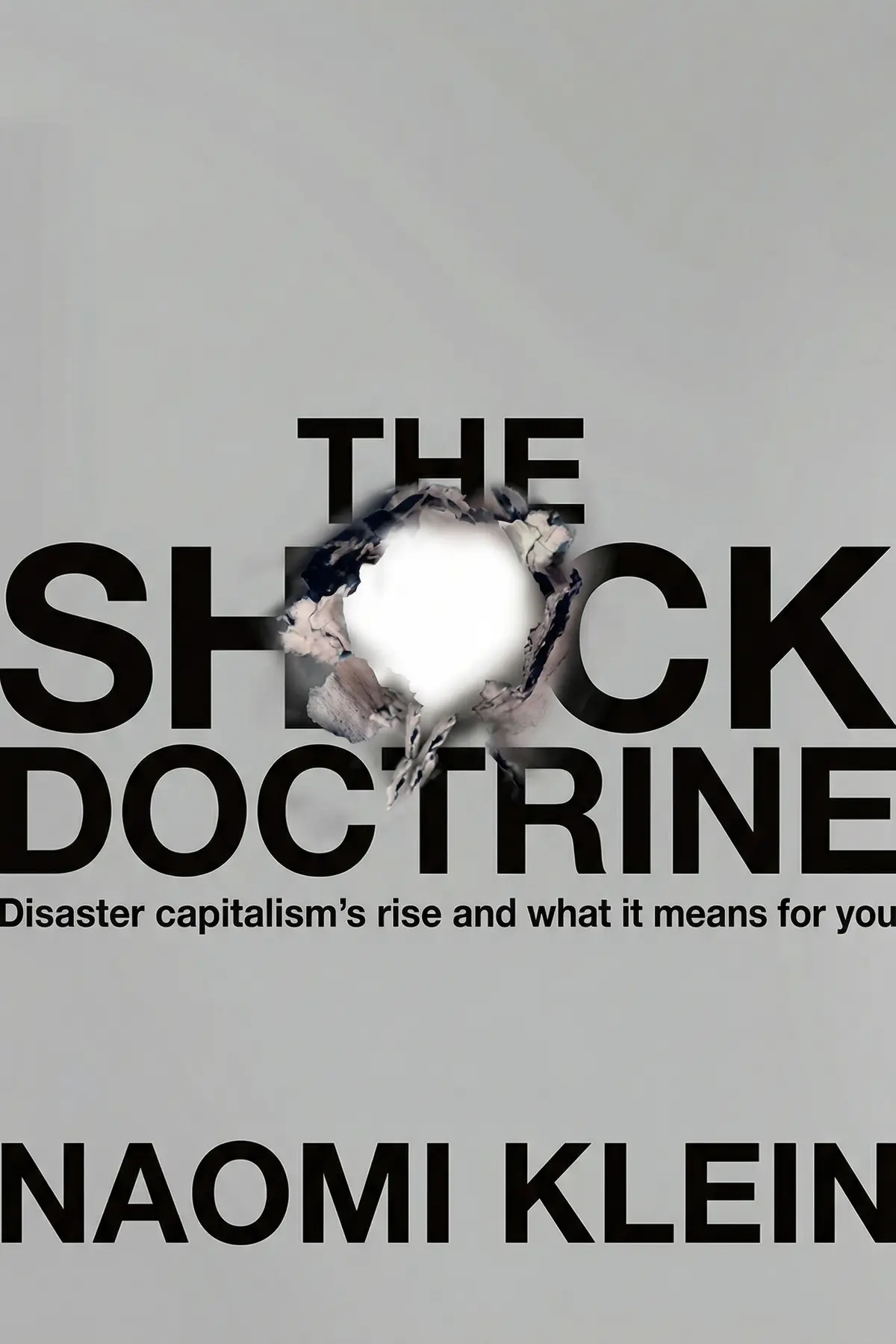
The Shock Doctrine explores the controversial rise of disaster capitalism, revealing how political and corporate elites exploit large-scale crises to push through radical free-market policies that the public would otherwise reject.
1 min 50 sec
When we look at a world map today, we see a landscape often defined by sudden, violent shifts. We see economies that seem to change overnight, natural disasters that leave entire regions vulnerable, and wars that leave countries in ruins. Usually, we view these events as tragedies that we must simply endure. But what if these moments of extreme crisis were actually part of a deliberate strategy? In The Shock Doctrine, we are invited to look behind the curtain of global economics to see a recurring pattern known as ‘disaster capitalism.’
The core idea is as simple as it is chilling: while a population is in a state of shock—reeling from a hurricane, a terrorist attack, or a financial crash—they are unable to resist radical changes that would normally be seen as unacceptable. In this vulnerable window, political and corporate interests move in to implement a ‘blank slate’ approach, erasing old social safety nets and installing a rigid, free-market system that benefits a tiny elite at the expense of the majority.
This isn’t just a theory about modern politics; it’s a history of how our world was built. From the secret laboratories of psychological experiments to the brutal dictatorships of South America and the privatized reconstruction of the Middle East, we will trace the lineage of this strategy. Our throughline today is the connection between the psychological concept of ‘shock’ and the economic reality of the ‘free market.’ We will explore how those in power have learned to treat entire nations like patients on an operating table, using the chaos of crisis to perform radical surgery on the very fabric of society. By the end of this summary, you’ll see the news headlines differently. You’ll begin to recognize the difference between a genuine recovery and an opportunistic land grab, and you’ll understand why the most turbulent times in history are often the most profitable for those who know how to exploit the shock.
2 min 21 sec
Discover the disturbing origins of shock tactics in secret psychological experiments designed to erase a person’s identity and start from scratch.
2 min 14 sec
Learn how a group of radical economists turned a fringe theory into a global blueprint for using crises to force unpopular reforms.
2 min 09 sec
Explore the first major laboratory of the Shock Doctrine, where economic ‘freedom’ was imposed through a brutal military dictatorship.
2 min 07 sec
See how international financial institutions like the IMF use debt as a weapon to force developing nations into the shock doctrine cycle.
2 min 07 sec
Analyze how the 2003 invasion of Iraq served as the ultimate laboratory for a ‘hollow state’ where war and reconstruction were turned into corporate profit.
2 min 10 sec
Understand how the mechanics of shock and fear are used to paralyze political opposition and control the public narrative.
2 min 03 sec
As we look back at the journey we’ve taken through the history of disaster capitalism, a clear and sobering pattern emerges. The Shock Doctrine is not a conspiracy theory; it is a blueprint for power. It is a strategy that relies on the exploitation of our most vulnerable moments to push through an agenda that would never survive the light of a calm, democratic day. From the torture cells of the Cold War to the boardrooms of modern multinational corporations, the goal has remained remarkably consistent: to use the ‘blank slate’ of a crisis to rewrite the rules of society in favor of the few.
However, understanding this doctrine is the first step toward breaking its cycle. The power of the shock depends entirely on our disorientation. When we don’t understand what is happening to us, we are easily led. But when we recognize the tactics—when we see that a sudden push for privatization after a disaster is a calculated move rather than an emergency necessity—the shock loses its power.
The throughline we’ve followed shows us that memory is our greatest defense. The Shock Doctrine thrives on ‘year zero’ thinking—the idea that the past is gone and we must start from scratch. By holding onto our history, by remembering the value of the social protections we’ve built, and by recognizing the patterns of those who profit from our pain, we can resist the next wave of ‘reforms.’
So, as you go forward, keep these lessons in mind. When the next major crisis hits—and it will—look for the profiteers. Ask yourself: who is moving fast while everyone else is still in shock? What long-standing protections are being quietly dismantled under the cover of the emergency? By staying alert and refusing to accept the ‘blank slate’ narrative, we can protect the foundations of our society and ensure that the next disaster is met with genuine community recovery, rather than another calculated shock to the system. The future doesn’t have to be a series of exploited crises; it can be a story we write together, in the clear light of day.
Have you ever noticed how radical economic shifts often follow in the wake of a massive catastrophe? Whether it’s a natural disaster, a coup, or a financial collapse, Naomi Klein argues that these moments of collective trauma are precisely when the most unpopular economic policies are forced upon a population. This is the heart of the 'shock doctrine.' In this exploration, you will learn how the ideology of the Chicago School of Economics, led by Milton Friedman, found its way from the halls of academia into the bloodstained reality of 1970s Chile and the war-torn streets of modern Iraq. The promise of this book is a sobering look at the mechanics of power. It uncovers a recurring pattern where systemic shocks are used to 'clear the slate' of old social protections, allowing for a hyper-privatized, corporate-led reconstruction. By understanding these tactics, listeners can better recognize the opportunistic maneuvers that occur during times of public distress and learn why the most vulnerable often pay the highest price for 'reform.'
Naomi Klein is a bestselling author and political activist who has received the Warwick Prize for Writing and the National Business Book Award. In addition to writing the critically acclaimed nonfiction works The Shock Doctrine and No Logo, she also contributed to a number of film productions, such as The Take and The Corporation.
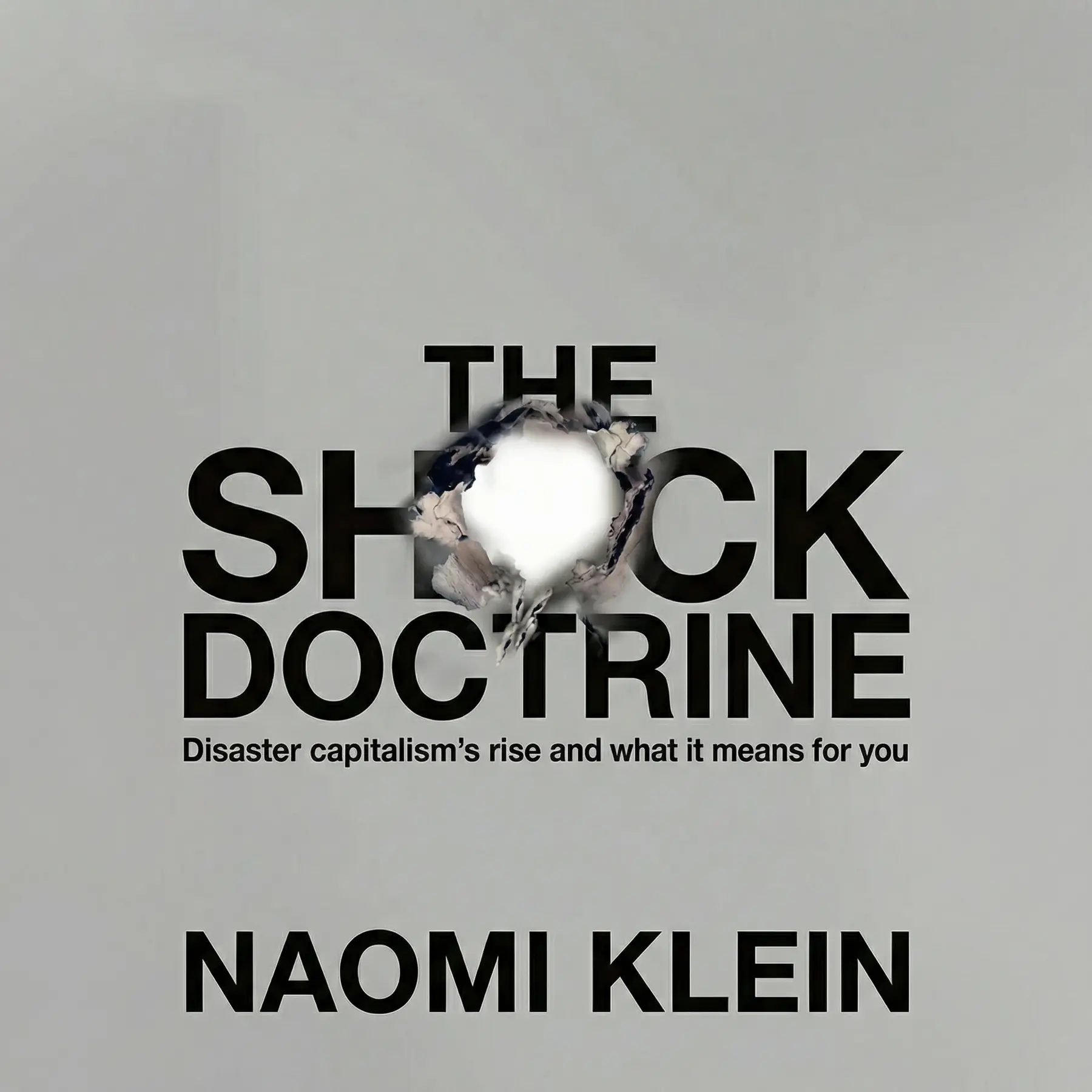
Listeners characterize this work as being exceptionally well-researched and educational, noting a gripping narrative style that feels similar to an NPR program. They view it as an essential political resource for clarifying modern global affairs, while one listener points out how it helps contextualize past historical shifts. The book elicits varying responses regarding its intensity; some treat it like a fast-paced thriller, while others find the subject matter quite disturbing. Although the material is lauded for being both eye-opening and sobering, listeners remain split over its critique of capitalism.
This book is essentially a horror story disguised as an economic treatise. Klein’s central thesis—that radical free-market policies are often pushed through while populations are reeling from collective trauma—is as convincing as it is deeply disturbing. Her measured, public-radio-style prose makes the descriptions of CIA-funded sensory deprivation and the 'shock therapy' applied to Chile and Iraq feel even more clinical and terrifying. It is a heavy lift for the soul. However, the rewards are immense for anyone trying to understand the current shift toward corporate power at the expense of the electorate. You might find yourself wanting to turn off the news and hide, but the truth is that we can no longer afford to look away from how greed has been rebranded as a universal good.
Show moreEver wonder why certain national crises seem to trigger a massive sell-off of public assets rather than a strengthening of social safety nets? Klein connects the dots between the psychological experiments of Ewen Cameron and the economic doctrines of Milton Friedman in a way that is utterly eye-opening. The reporting on the 'Free Fraud Zone' in Iraq is particularly revealing. It exposes the sheer waste and predatory nature of modern privatization efforts. Gotta say, the parallels between electroshock therapy and the economic dismantling of state structures are brilliantly drawn, even if the content is hard to stomach at times. This isn't just a political book; it’s a necessary autopsy of the last forty years of global history. It completely changed how I view the concept of 'reform' in the wake of disasters.
Show moreWow, Naomi Klein has a way of connecting dots that I didn't even know existed. I was particularly struck by the history of the 'Chicago Boys' and how they exported an ideology of unmitigated greed to Latin America under the cover of military coups. It is a chilling account of how people are intentionally kept in a state of disorientation so that their natural resources can be plundered by foreign corporations. The book is well-researched and incredibly informative, reading almost like a high-stakes thriller but with the weight of devastating reality. Personally, I found the section on New Orleans to be the most upsetting because it showed how these predatory tactics are applied even to a country's own citizens during their most vulnerable moments. If you want to understand the modern world, you have to read this book.
Show moreFinally got around to reading this massive tome, and frankly, my worldview will never be the same again. Klein exposes the lie that free markets and democracy go hand-in-hand. In reality, she shows that these radical policies usually require the suspension of democracy to be implemented successfully. The descriptions of torture are graphic and difficult to read, but they are essential to her argument that this system relies on the physical and social destruction of the individual. I appreciated how she didn't just focus on the US, but looked at Poland, China, and South Africa too. It is a dense book, yet the narrative flow keeps you moving through the darker chapters. This is required reading for anyone who suspects that our current economic system is fundamentally rigged against the working class.
Show moreKlein’s writing style is incredibly compelling—it reads like a high-stakes political thriller but with the weight of academic research. She takes the reader on a journey through the darkest corners of the 20th century, revealing how trauma has been weaponized by those in power. The way she links Milton Friedman’s theories to actual human suffering is both brilliant and heartbreaking. This isn't just about money; it’s about the soul of our society and the erosion of our collective dignity. I found the book to be a call to action as much as a history lesson. It challenges the reader to wake up and stop accepting the 'inevitability' of corporate dominance. While it is deeply disturbing, it also provides a sense of clarity that is hard to find in mainstream media today.
Show morePicked this up after seeing it on so many must-read lists, and it definitely lives up to the hype for the most part. Klein’s ability to weave together disparate events like the Falklands War, the 2004 tsunami, and the aftermath of Hurricane Katrina into a single narrative is impressive. To be fair, some of the sections felt a bit repetitive, and I think she occasionally stretches the metaphor of psychological torture a little thin to make her point. Regardless, the core message about how the world has conflated democracy with free-market radicalism is vital. The writing is sharp and evocative, making complex economic shifts feel personal and urgent. It’s a sobering reminder that our democratic rights are often the first thing on the chopping block when a crisis hits. Definitely worth the time despite the grim subject matter.
Show moreAs someone who follows politics closely, I thought I knew most of this history already, but Klein’s depth of research proved me wrong. She meticulously documents how 'Economic Rationalism' serves as a tool for dismantling social achievements like healthcare and labor laws. The writing style is compelling and very accessible, reminiscent of a long-form investigative documentary. My only minor gripe is that the book can be so bleak that it feels almost paralyzing. Look, it’s a long read, and you might need to take breaks to process the sheer scale of the corruption she describes. However, the insight into how the World Bank and IMF operate behind the scenes is invaluable for anyone who cares about global justice. It is an important, sobering piece of work that demands a lot from the reader but gives back even more.
Show moreThe chapter on the 2004 tsunami and the subsequent displacement of fishing communities really hit home for me. It’s infuriating to see how luxury hotels were prioritized over the lives of survivors who were told they couldn't return to their homes for 'safety' reasons. Klein’s prose is polished and her arguments are well-supported, though she is clearly writing from a very specific ideological perspective. Truth is, even if you don't agree with every single one of her conclusions, the facts she presents about privatization in Iraq and Russia are undeniable and deeply troubling. The book does a fantastic job of explaining why the public often feels so powerless in the face of rapid economic change. It’s a gripping read, even if it leaves you feeling a bit cynical about the state of global leadership. Truly informative stuff.
Show moreAfter hearing about 'disaster capitalism' for years, it was enlightening to see the actual documentation behind the phrase. Klein does a stellar job of showing how crises like 9/11 are used as a smokescreen for radical policy shifts that would never pass in normal times. Not gonna lie, I felt like I needed a shower after reading about the 'Corporate raping of Iraq.' The book is exceptionally well-researched, though I think she occasionally downplays the internal failures of the states she discusses in favor of blaming external economic pressure. That said, her critique of the neoliberal 'blank slate' theory is spot on. It’s a very revealing and important read that puts many current events into a much clearer context. It’s definitely not a light summer read, but it’s one that sticks with you long after the final page.
Show moreNot what I expected given the glowing recommendations from my social circle. While Klein is clearly a talented writer with a flair for the dramatic, I found the book to be overly conspiratorial and one-sided. She draws very long bows between psychiatric torture and complex macroeconomic policies that don't always hold up under scrutiny. To be fair, she highlights some genuine corporate abuses, but the tone is so relentlessly alarmist that it becomes exhausting to read after a while. I was hoping for a more balanced analysis of capitalism's failures, but this felt more like a manifesto than a nuanced history. If you're looking for a gripping, scary story about the world, you'll love it, but I found myself questioning the objectivity of her research more than once. It’s an interesting perspective, just take it with a grain of salt.
Show more
Tracy Rosenthal
Jessica Valenti
Yuval Noah Harari
Pankaj Mishra
Jacinda Ardern
Anthony Pratkanis
Andrew Ross Sorkin
AUDIO SUMMARY AVAILABLE
Get the key ideas from The Shock Doctrine by Naomi Klein, plus 5,000+ more titles in English and Thai.