
On the Edge: The Art of Risking Everything
Nate Silver
A deep dive into the world of forecasting, Nate Silver’s work explains why most experts fail to see the future clearly and how we can use probability to find the truth within vast amounts of data.
1 min 49 sec
We live in an age of information overload. Every day, the world generates more data than it did in the previous century. You would think that with all this information at our fingertips, we would be getting better at seeing what’s coming around the corner. But as it turns out, the opposite is often true. We are drowning in data, yet we are still remarkably bad at making predictions. Whether it’s the next economic recession, the outcome of a major election, or even just whether it’s going to rain on your parade, the experts we rely on are frequently wrong. And what’s worse is that they are often incredibly confident while being wrong.
This brings us to the core challenge of the modern world: the struggle to separate the ‘signal’ from the ‘noise.’ The signal is the meaningful information, the underlying truth that helps us understand the world and predict its future. The noise, on the other hand, is everything else—the random fluctuations, the coincidences, and the sheer volume of irrelevant data that distracts us from the truth. In this summary, we are going to look at the work of Nate Silver, a man who has made a career out of finding the signal in some of the most competitive fields imaginable.
Throughout this journey, we’ll explore why the most confident voices on television are usually the least accurate. We’ll look at the hidden mechanics of the 2008 financial crash and see how a simple mathematical formula from the eighteenth century might be our best tool for navigating the twenty-first century. This isn’t just about numbers and charts; it’s about a fundamental shift in how we think. By the end of this, you’ll see why having more data doesn’t automatically mean having more answers, and how you can develop a ‘fox-like’ mindset to make better decisions in your own life. Let’s dive into the fascinating world of probability and find out why some predictions fail while others succeed.
2 min 11 sec
Discover why economists are consistently wrong about the future and why their precise numbers often mask a deep, underlying uncertainty about the state of the world.
2 min 13 sec
Explore the intricate web of factors that make the global economy so difficult to predict, from natural disasters to the way our own behavior changes based on the news.
1 min 55 sec
Learn about the dangers of relying on pure data without human context, and why a famous Super Bowl ‘rule’ for the stock market eventually fell apart.
2 min 05 sec
Uncover the forecasting errors that led to the global financial crisis, from the blind spots of rating agencies to the over-leveraged bets of major banks.
1 min 41 sec
Discover a powerful mathematical tool for updating your beliefs and why your intuition about probability is often wrong.
2 min 05 sec
Contrast the two main styles of thinking and see why the humble, flexible approach of the ‘fox’ consistently outperforms the ‘hedgehog.’
2 min 05 sec
Understand why beating the stock market is so difficult and why professional traders often have a hidden incentive to ignore financial bubbles.
2 min 22 sec
Compare the challenges of climate modeling and counter-terrorism, and learn why sometimes the simplest models are the most accurate.
1 min 49 sec
As we wrap up our look at Nate Silver’s exploration of predictions, the most important takeaway is a sense of intellectual humility. We live in a world that craves certainty. We want our leaders, our economists, and our experts to tell us exactly what is going to happen next. But the reality is that the world is far more complex and random than we like to admit. The difference between a successful forecaster and a failure isn’t that the successful one has a crystal ball; it’s that they understand the limits of their own knowledge.
Separating the signal from the noise requires a constant effort to filter out the distractions. It means being wary of people who are too confident and being willing to look at the world through the eyes of a ‘fox’ rather than a ‘hedgehog.’ It means embracing the Bayesian approach—always being ready to update your beliefs when new evidence comes along, but never forgetting the baseline reality you started with. We have to resist the urge to see patterns where none exist and be brave enough to admit when the data simply isn’t clear enough to make a call.
In your own life, you can apply these principles by becoming more comfortable with probability. Instead of thinking in terms of ‘yes’ or ‘no,’ start thinking in terms of percentages. Ask yourself, ‘How sure am I really?’ and ‘What information would it take to change my mind?’ By doing this, you protect yourself from the ‘noise’ of your own biases and the overconfidence of others. The goal isn’t to be perfect; it’s to be slightly more accurate today than you were yesterday. In the end, finding the signal isn’t just about math—it’s about the pursuit of truth in a world that is increasingly full of noise. If you can master that, you’ll be well on your way to making better decisions and seeing the future just a little bit more clearly.
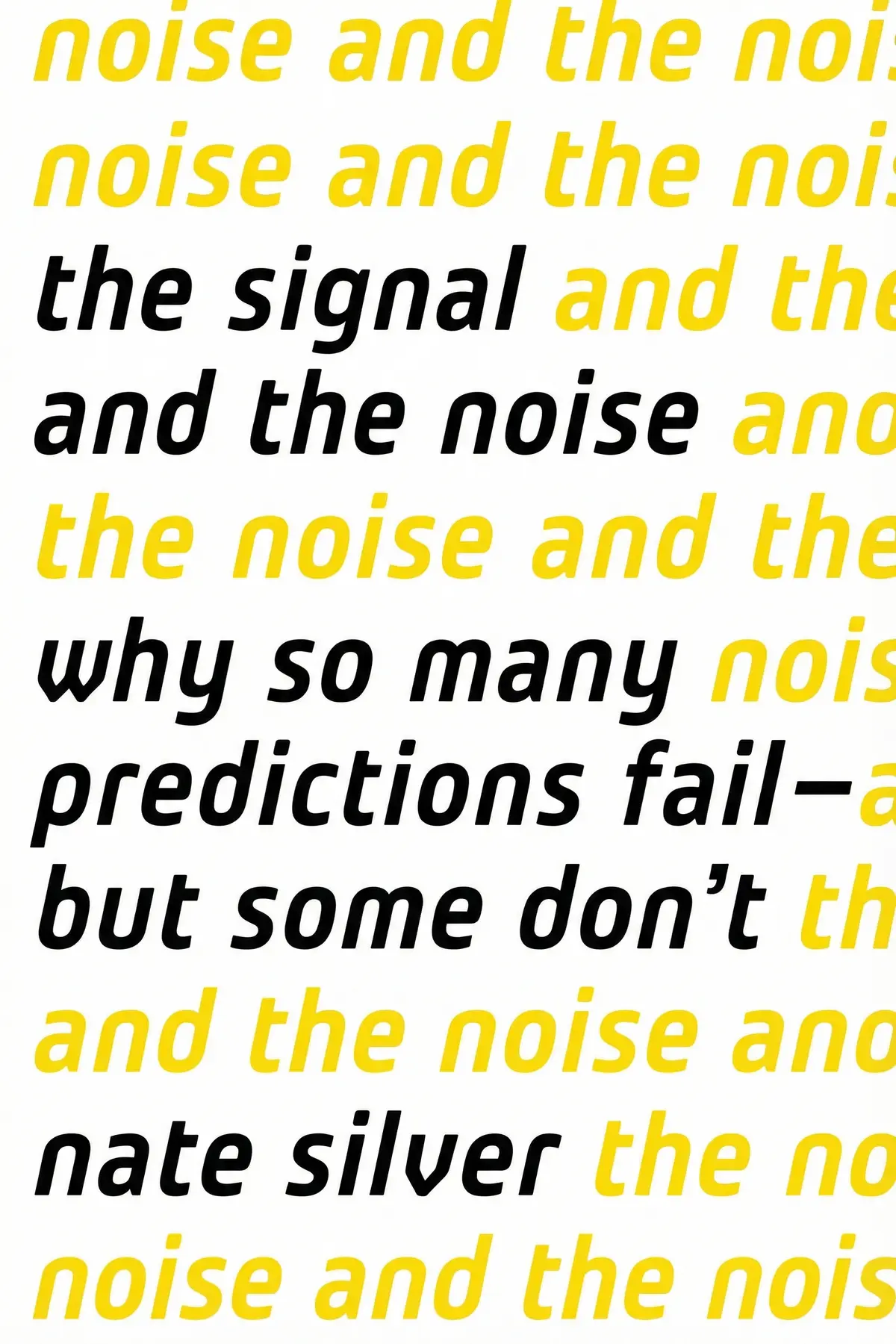
The Signal and the Noise explores the critical distinction between information and knowledge. In an era where data is being generated at an exponential rate, our ability to make accurate predictions has not necessarily improved. Nate Silver argues that we are often blinded by 'noise'—irrelevant data that looks like a pattern but is actually just a coincidence. This book is a masterclass in probability, examining everything from why economists missed the 2008 financial crisis to why weather forecasts are more reliable than political pundits. By moving through diverse fields like sports betting, climate science, and high-stakes poker, the book promises to sharpen your critical thinking. It offers a framework for understanding uncertainty and explains how a more humble, probabilistic approach—based on Bayes' Theorem—can help us navigate a complex world. The ultimate goal is to move away from the false confidence of 'experts' and toward a more accurate, data-driven reality.
Nate Silver is a statistician and writer who specializes in analyzing baseball and elections. He is perhaps most famous for correctly predicting the result of the 2008 US presidential election for 49 out of 50 states.
Nate Silver
Listeners find this book both captivating and educational, commending the vast depth of research and its multifaceted approach to the science of prediction. Furthermore, the prose is skillfully written with a personal touch, and listeners appreciate how it breathes life into otherwise tedious statistics. Beyond that, the work is intellectually stimulating, encouraging Bayesian thinking and helping listeners better grasp the various concepts presented.
Picked this up after following Nate’s work during the election cycles, and I was genuinely impressed by the breadth of research. Silver manages to take dry, intimidating statistics and turn them into a compelling narrative about how we perceive truth. The way he distinguishes between the 'signal' and the 'noise' is a vital lesson for our information-saturated age. I especially appreciated the deep dives into baseball and weather forecasting, where the human element often clashes with raw data. It’s a thought-provoking read that encourages a more humble, probabilistic way of looking at the world. Highly recommended for anyone who wants to sharpen their decision-making skills.
Show moreSilver’s prose has a unique way of making complex algorithms and dry statistical concepts feel like an engaging conversation. I’ve always been intimidated by heavy math, but the explanation of Bayes’ theorem here was a total revelation for me. It’s not just about numbers; it’s about a fundamental shift in how we update our beliefs when new evidence emerges. The research is incredibly thorough, touching on everything from earthquake patterns to the nuances of professional poker. You can tell the author is passionate about his craft, and that energy is infectious throughout the entire book. It’s easily one of the most thought-provoking things I’ve read this year.
Show moreAfter hearing Nate Silver on various podcasts, I finally decided to tackle this massive volume on the science of prediction. The amount of research involved is honestly breathtaking, covering everything from the 2008 economic meltdown to the complexities of global terrorism. Silver’s personal style makes the statistics come to life, proving that data isn't just numbers on a page—it's the story of our world. I found the sections on the housing bubble particularly enlightening, as they highlight how easy it is to ignore the signal when the noise is so loud. It’s a must-read for anyone who wants to understand the hidden patterns governing our lives.
Show moreNot gonna lie, I expected a dry textbook but ended up with a fascinating exploration of human error and mathematical triumph. The way the author explains how to apply Bayesian thinking to real-world problems is both practical and deeply philosophical. It encourages you to stop looking for certainties and start thinking in terms of probabilities, which is a total game-changer. Whether he’s talking about chess engines or the unpredictability of earthquakes, the writing remains sharp and engaging. There are moments where the technical details get a bit thick, but the payoff is always worth the effort. This book truly helps you better understand the chaotic world we live in.
Show moreEver wonder why the experts get it so wrong, from the 2008 financial crash to the local weather forecast? This book dives deep into the science of prediction and offers a sobering look at our own cognitive biases. Silver is a master at weaving together disparate topics like baseball scouting and political polling into a cohesive argument. While the baseball section was a bit of a slog for a non-fan like me, the insights on 'foxes versus hedgehogs' were brilliant. We live in an era of Big Data, but more information often just leads to more distraction. This book helps you find the truth amidst the clutter.
Show moreAs someone who has always been fascinated by the 'why' behind major events, this book offered plenty of food for thought. Silver’s exploration of the 'fox' vs. 'hedgehog' mentality provides a great framework for understanding why some pundits are always wrong. I particularly enjoyed the chapters on poker and the stock market, where the stakes of a bad prediction are immediately apparent. The writing style is personal and approachable, even when the subject matter gets into the weeds of complex algorithms. My only minor gripe is that some chapters feel a bit long-winded, but the insights are generally worth the extra pages. It’s an informative and genuinely engaging read.
Show moreMy favorite part of this book was the surprising look at how weather forecasters actually operate behind the scenes. It turns out that those TV 'weather personalities' often bias their data to keep people watching, which is a fascinating example of noise. Silver does an excellent job of showing how human judgment adds value to computer models rather than just replacing them. The book is filled with these little nuggets of wisdom that make you question the 'certainty' we see on the news. Some of the math went over my head, but the overall themes remained very accessible. It’s a solid 4-star read for anyone interested in the logic of risk.
Show moreThe density of information in this book is truly staggering, though it occasionally feels like it’s drowning in its own data. I came for the political insights from 538 but found myself wading through endless chapters on seismic activity and infectious diseases. To be fair, Silver is a clear writer, but the sheer volume of charts and diagrams can be overwhelming at times. I appreciated the core message about probabilistic thinking, yet I wish the book had more actionable advice. It’s a great intellectual exercise, but expect to put in some serious work to get through the middle sections. It’s good, just very heavy.
Show moreThis volume was a massive letdown given the hype surrounding Nate Silver’s work at 538. While it attempts a grand survey of prediction, much of the content feels like a rehash of better books like Moneyball or A Random Walk. I was particularly jarred by the author’s dismissal of David Hume as 'daft,' which suggests a lack of depth in his philosophical research. The book dabbles in everything from poker to climate change but fails to offer truly unique insights. It's clear he wanted to capitalize on his blog's popularity, but the result is a bit of a slog. If you want a rigorous statistical background, you are better off looking elsewhere.
Show moreFrankly, I found this to be a collection of useless platitudes wrapped in an intimidating amount of data. It’s one thing to say we need to be careful of herd mentality, but it’s another to actually explain how to avoid it. The author relies heavily on his own success in sports betting and political forecasting, which at times feels nauseatingly self-aggrandizing. While the Bayesian explanation in chapter 8 is decent, the rest of the book struggles to stay focused. I spent hours reading this only to realize the advice boils down to 'trust your own taste-buds.' It’s not an awful read, but it is certainly a waste of time for anyone looking for actionable technical skills.
Show more
Niall Kishtainy
William J. Bernstein

Yanis Varoufakis
Andrew Ross Sorkin
AUDIO SUMMARY AVAILABLE
Get the key ideas from The Signal and the Noise by Nate Silver, plus 5,000+ more titles in English and Thai.







