

23 min 26 sec
The Social Leap: The New Evolutionary Science of Who We Are, Where We Come From, and What Makes Us Happy
The Social Leap explores how our ancestors' transition from the rainforest to the African savannah forged the unique social psychology that defines human nature, cooperation, and our pursuit of modern happiness.
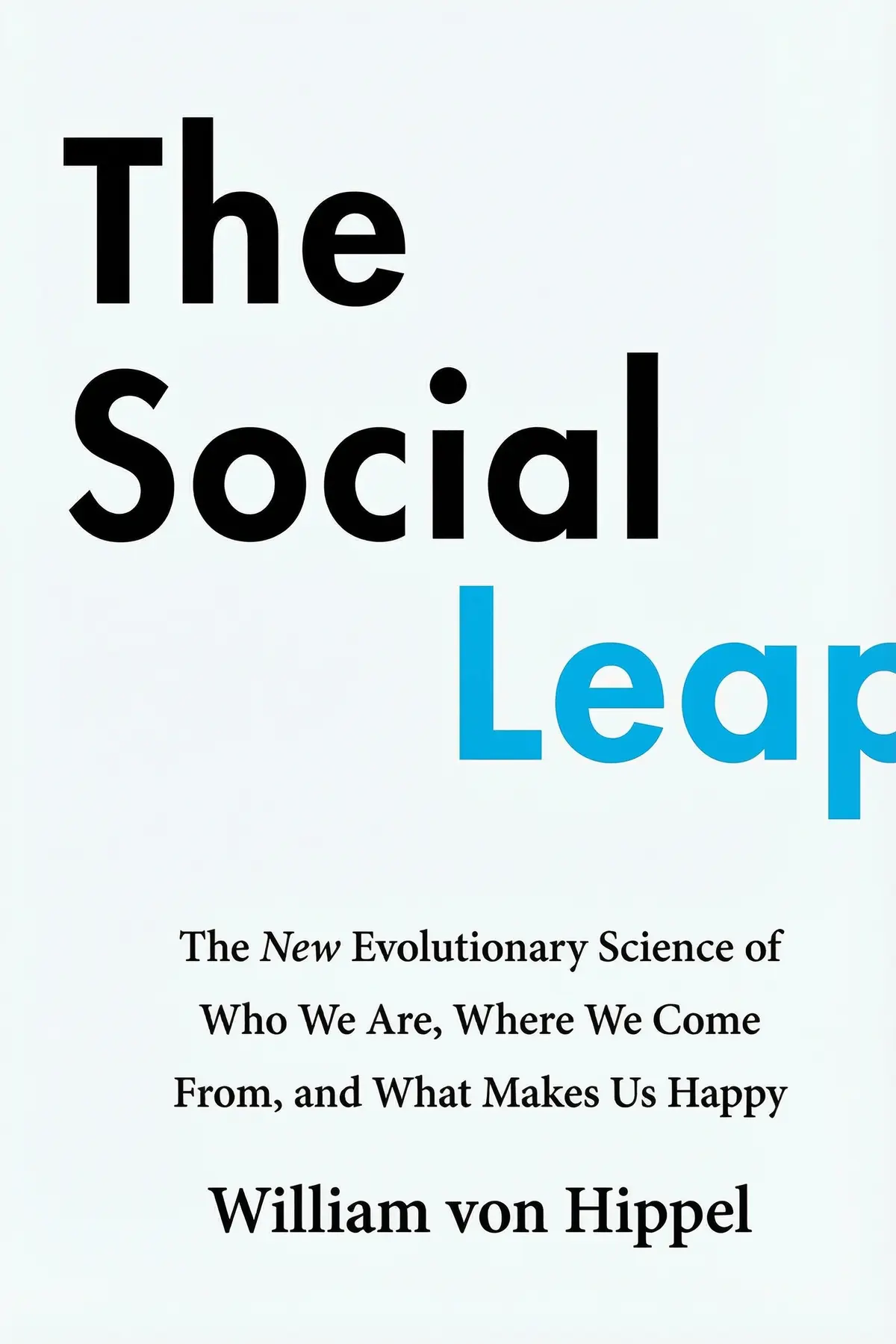
Table of Content
1. Introduction
1 min 27 sec
Have you ever paused to wonder why humans are such a walking contradiction? We are a species capable of the most profound acts of self-sacrifice and altruism, yet we are also capable of breathtaking selfishness and tribalism. We crave connection, yet we suffer from deep-seated social anxieties. To understand these complexities, we have to look much further back than our childhoods or even our cultural history. We have to look back millions of years to a pivotal moment in our evolutionary story.
This throughline of human existence is what evolutionary psychologist William von Hippel calls the ‘social leap.’ It is the story of how a specific change in our environment forced a massive change in our psychology. Most of the habits, hang-ups, and highlights of being human were forged in the transition from the lush, safe rainforests of Africa to the perilous, wide-open savannah. This change wasn’t just physical; it was deeply psychological and social.
In this exploration, we are going to look at how that leap shaped everything from our brain size to our political systems. We’ll see how the demands of the savannah turned us into the most cooperative creatures on earth, but also how those same demands created the seeds of inequality and conflict. We’ll delve into why we find happiness so fleeting and why we are so obsessed with what other people think of us. By the end of this journey, you’ll have a new lens through which to view your own behavior and the world around you, grounded in the ancient science of who we are and where we came from.
2. The Environmental Shift to the Savannah
2 min 40 sec
Discover how a changing climate forced our ancestors out of the trees and into a dangerous new world where cooperation became the only path to survival.
3. The Evolutionary Loop of Brain Power
2 min 38 sec
Trace the incredible growth of the human brain and see how social complexity acted as a powerful engine for our cognitive development.
4. The Hidden Costs of the Agricultural Revolution
2 min 30 sec
Uncover how the shift from wandering to farming fundamentally changed human society, giving birth to wealth, status, and material inequality.
5. Why We Are Hardwired for Social Connection
2 min 28 sec
Explore the biological roots of our need for intimacy and how sharing emotions and stories became a vital survival tool on the African plains.
6. The Dominance of Social Innovation
2 min 27 sec
Learn why the most important human ‘inventions’ aren’t gadgets or machines, but the invisible social systems that allow us to function as a society.
7. Cooperation, Conflict, and the Common Enemy
2 min 35 sec
Examine the dual nature of human behavior and see how the context of our environment dictates whether we act with kindness or aggression.
8. Happiness as an Evolutionary Carrot
2 min 31 sec
Understand why the brain isn’t designed for permanent bliss and how the fleeting nature of happiness keeps us striving and surviving.
9. Aligning Modern Life with Ancient Instincts
2 min 35 sec
Find the path to genuine fulfillment by prioritizing physical health, deep social bonds, and personal mastery over material status.
10. Conclusion
1 min 35 sec
As we wrap up our look into the ‘social leap,’ the most important takeaway is that we are not separate from nature. Every thought we think, every emotion we feel, and every social structure we build has its roots in the long, difficult journey our ancestors took across the African grasslands. We are the descendants of the survivors—the ones who learned how to throw stones together, how to share their fears, and how to build complex tribes.
Understanding our evolutionary history isn’t just an academic exercise; it’s a practical guide for living. It explains why we struggle with inequality, why we are obsessed with status, and why we feel so much better after a long talk with a close friend. It reminds us that our greatest strength isn’t our individual intelligence, but our collective ability to coordinate and cooperate.
In a modern world that often feels isolating and overwhelming, the lesson of the social leap is one of hope and connection. It tells us that we are built for cooperation and that our deepest satisfaction comes from our relationships and our contributions to the group. By leaning into our social instincts—by being helpful, by staying connected, and by continuing to learn—we aren’t just surviving; we are honoring the very things that make us human. The next time you feel the urge to connect, to share a story, or to help a neighbor, remember that you are participating in a six-million-year-old tradition that allowed our species to conquer the world.
About this book
What is this book about?
The Social Leap takes us on a journey through six million years of human history to explain why we think and act the way we do. It argues that the defining moment for our species wasn't the invention of fire or the wheel, but rather a dramatic 'social leap' that occurred when our ancestors left the safety of the trees for the dangerous open grasslands of the savannah. This shift forced us to cooperate in ways no other animal does, leading to the development of our massive brains, our complex social hierarchies, and our unique capacity for both extreme kindness and calculated cruelty. By examining the intersection of evolutionary biology, psychology, and anthropology, the book promises to reveal the hidden logic behind our modern behaviors. You will discover why material wealth doesn't lead to permanent satisfaction, how our ancestors' survival strategies created the foundations of modern inequality, and why our greatest innovations are often social rather than technical. Ultimately, the book provides a roadmap for finding genuine fulfillment by aligning our modern lives with the ancient social instincts that allowed us to survive and thrive.
Book Information
About the Author
William von Hippel
William von Hippel is an internationally-renowned professor of psychology based at Australia’s University of Queensland. His research and writing have gained global recognition, having been featured in prominent publications such as the New York Times, the Economist, Le Monde, and the Australian.
Ratings & Reviews
Ratings at a glance
What people think
Listeners find this title stimulating and immersive, characterizing it as a total page turner. They further value how accessible the material is, with one listener describing the book as a fun-filled romp through prehistory. Additionally, the work is commended for its high-caliber information, specifically as a primer on evolutionary psychology, and listeners admire the quality of the writing.
Top reviews
Champ
After hearing von Hippel on a podcast, I knew I had to grab this. It’s a genuinely fun-filled romp through prehistory that manages to make complex evolutionary psychology feel accessible. The way he describes our ancestors moving from the safety of the trees onto the dangerous savannah is gripping. I was particularly struck by the idea that our biggest cognitive leap wasn't about building tools, but about learning to cooperate with one another. Truth is, I haven’t enjoyed a non-fiction book this much in years because the narrative flow is just so smooth. It's an absolute page-turner that forces you to rethink your own social behaviors. While some of the conclusions might feel a bit fast and loose to a hardcore scientist, for the average reader, it’s brilliant. You’ll walk away with a much better understanding of why we crave connection and how we survived against much larger predators. Highly recommended for anyone curious about the roots of human nature.
Show moreWoramet
Ever wonder why humans are so obsessed with what everyone else is doing? The Social Leap answers this by diving deep into our past as Australopithecus and beyond. Von Hippel has a gift for taking dense academic research and turning it into a story that feels like a conversation over coffee. His explanation of the 'sclera'—the whites of our eyes—and how they evolved to foster cooperation was a total lightbulb moment for me. It’s rare to find a science book that is also such a page-turner. The pacing is perfect, and the chapters on happiness in the modern world provide a very grounded perspective. Frankly, I think this should be required reading for anyone interested in why we act the way we do in groups. It’s eye-opening, educational, and most importantly, it's incredibly fun to read. I’ve already bought two more copies to give away as gifts to my family.
Show moreWichai
Finally got around to reading this and it was exactly what I needed. The central premise—that our intelligence evolved to solve social problems rather than technical ones—is just brilliant. It makes so much sense when you look at our modern world of gossip, social media, and tribalism. Von Hippel’s writing is incredibly clear, and he manages to avoid the dry, textbook tone that usually plagues this genre. I particularly enjoyed the discussion on how we use self-deception to better deceive others. It’s a bit of a cynical take, but it’s explained so logically that it’s hard to argue with. This book is a joy to read and provides a new perspective on almost every human interaction. You’ll find yourself highlighting something on nearly every page. It’s easily one of the most engaging science books I have read in a very long time. It really is a superb delivery of our species' story.
Show morePiyanart
The chapter on the evolution of cooperation alone is worth the price of admission. I’ve read a lot on this topic, but von Hippel brings a fresh perspective that feels both new and intuitive. He explains how our ancestors' shift to the savannah forced a level of teamwork that eventually led to our complex social structures. The way he ties this back to why we feel the need to be better than our rivals at sports or chess is fascinating. It’s an absolute journey through our past that keeps you hooked from the first page to the last. Not gonna lie, I was skeptical about how much new ground could be covered here, but I was pleasantly surprised. The book is readable, insightful, and genuinely funny in parts. It’s the kind of book that makes you want to stop people on the street and tell them what you just learned. Five stars for making science this entertaining.
Show moreLaor
Wow, what an absolute journey through our prehistoric past. This book elegantly combines psychology and evolution into a narrative that is impossible to put down. I loved learning about how our physical changes, like standing upright, were so closely tied to our social development. Von Hippel’s writing style is superb; it’s punchy, clear, and very direct. He doesn't get bogged down in unnecessary jargon, which makes the complex ideas easy to digest for a non-specialist. Each chapter felt like it was opening a new door into understanding my own behavior. I especially liked the insights into why we ruminate on social situations so much. It turns out our brains are just doing what they evolved to do six million years ago! This is definitely one of the best books I’ve picked up this year. It cuts through the fog of human history and delivers the truth in a way that is both entertaining and profound.
Show moreEvelyn
This book provides a fascinating, albeit sometimes speculative, look at how our ancestors' transition to the savannah shaped our current minds. Von Hippel argues persuasively that bipedalism and the ability to throw stones were the catalysts for everything that followed. I found the sections on how we evolved to detect freeloaders within our social groups especially thought-provoking. The writing style is crisp and engaging, which makes it a very quick read despite the heavy subject matter. However, I felt some of the personal anecdotes used to support major evolutionary theories were a bit thin. Look, it’s hard to prove what happened six million years ago with absolute certainty, but he makes a very compelling case. It serves as an excellent introduction to evolutionary psychology for those who want a readable entry point. Even if you don't agree with every single conclusion, you will definitely see your coworkers differently after finishing this.
Show moreApichat
As someone who typically finds evolutionary biology a bit dry, von Hippel's writing was a breath of fresh air. He focuses on the 'Social Leap'—that pivotal moment when cooperation became our primary survival strategy. The book is filled with interesting studies, though I wish some had more citations provided in the text. I was especially fascinated by the connection between stone throwing and the development of our social brains. It turns out that being able to hurl rocks collectively changed the game for our ancestors. My only minor gripe is that the last few chapters on modern happiness felt a little disconnected from the rest of the book. Still, the information quality is high and the tone is perfectly balanced between intellectual and casual. It’s a great read if you want to understand the evolutionary basis for our modern psychology. Definitely worth the time for anyone who likes a thought-provoking narrative.
Show moreMarco
To be fair, many of the theories presented here are still being debated in the halls of academia, but that doesn't make the book any less compelling. Von Hippel has a way of making you feel the danger of the African savannah through his words. I found his take on the 'fatalistic' nature of evolution—that we were victims of environmental shifts—to be much more realistic than the usual 'heroic' narrative. The discussion on how leaders become more exploitative when they can monopolize resources was especially relevant to today’s world. While he occasionally leans into conjecture, the overall framework he builds is very persuasive. It’s a page-turner for sure, and it really sticks with you after you put it down. I’d recommend it to anyone who enjoyed Sapiens but wants something a bit more focused on the psychological side of things. It’s a solid, thought-provoking read for the curious mind.
Show moreIngrid
While I found the prose engaging and the narrative flow quite smooth, I struggled with some of the author’s more sweeping generalizations. He is a fantastic writer, no doubt, but some of the evidence presented felt like it was being shoehorned into a specific narrative. For example, his take on chimpanzee hunting and food sharing rules seems to contradict a lot of other research I've encountered. It’s a decent book for a general introduction, but don't expect a high level of academic rigor throughout. Some of the personal stories used to illustrate evolutionary instincts felt more like filler than actual data. To be fair, it is a very entertaining read and he does highlight aspects of human evolution that others often ignore. If you’re looking for a fun romp through prehistory, this is it. Just keep a skeptical mind when he starts using his own childhood memories to explain human instincts.
Show moreClara
Not what I expected based on the glowing praise I’ve seen elsewhere. The author is clearly knowledgeable, but he relies far too heavily on personal anecdotes to prove scientific points. The story about him throwing rocks at dogs to prove an evolutionary instinct felt entirely contrived and lacked any real scientific backing. Furthermore, he makes some claims about primate biology, like the absence of sclera in chimps, that are easily debunked with a quick search. It feels like he’s building a house of cards where the theories are interesting but the foundation of evidence is shaky at best. I use a red highlighter for suspect writing, and my copy of this book is looking very red right now. While it’s written in an engaging style, I can't look past the cherry-picked data. If you want a fun story, read it. If you want rigorous science, you might want to look elsewhere.
Show moreReaders also enjoyed



A Life Decoded: My Genome: My Life
J. Craig Venter

59 Seconds: Change Your Life in Under a Minute
Richard Wiseman

A Planet of Viruses
Carl Zimmer

A Short History of Nearly Everything
Bill Bryson

A Thousand Brains: A New Theory of Intelligence
Jeff Hawkins
AUDIO SUMMARY AVAILABLE
Listen to The Social Leap in 15 minutes
Get the key ideas from The Social Leap by William von Hippel, plus 5,000+ more titles in English and Thai.
- 5,000+ titles
- Listen as much as you want
- 7-day free trial
- Cancel anytime







