
17 min 50 sec
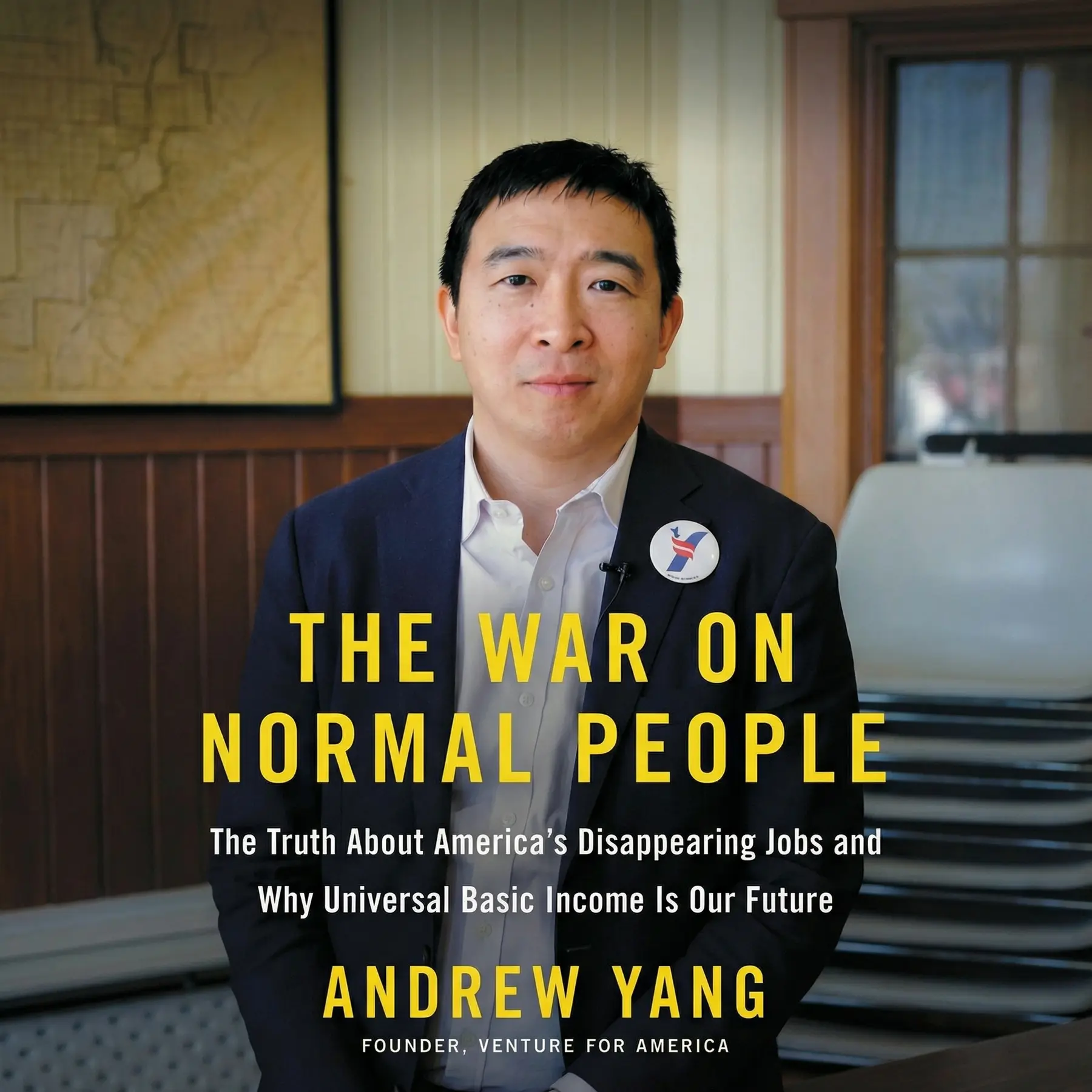
The War on Normal People: The Truth About America's Disappearing Jobs and Why Universal Basic Income Is Our Future
By Andrew Yang
An urgent examination of how automation and artificial intelligence are reshaping the American economy, threatening millions of jobs, and why a universal basic income may be the only path forward for society.
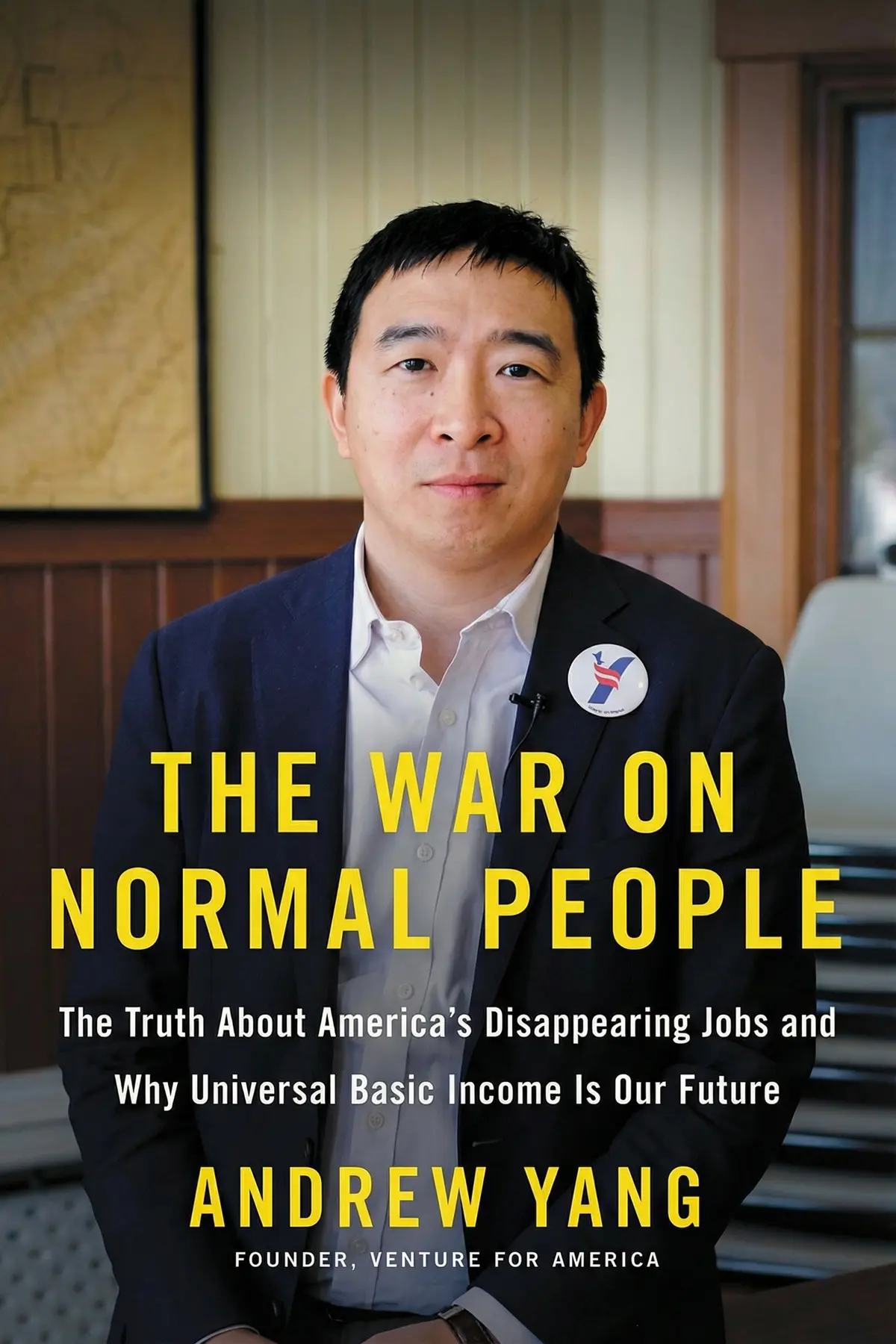
Table of Content
1. Introduction
1 min 40 sec
Imagine standing at the edge of a massive shift in human history, one that rivals the industrial revolutions of the past, but moves at a speed we are barely prepared to handle. For many of us, the world of high-tech innovation feels like a distant landscape of progress, efficiency, and shiny new gadgets. But for the vast majority of people living outside the bubbles of Silicon Valley or Manhattan, the reality of the modern economy looks much grimmer. It looks like closed storefronts, disappearing factory floors, and a growing sense of desperation.
Andrew Yang, through his work with the nonprofit Venture for America, spent years traveling through the heart of the country—places like Detroit, Baltimore, and Cleveland. What he saw wasn’t just a temporary economic slump, but a fundamental breaking of the social contract. He realized that the technology we celebrate is also the very force that is making ‘normal’ work obsolete for millions of Americans. We are entering an era where the market-driven capitalism we have long relied on is no longer aligned with the needs of human beings.
In this summary, we are going to explore the throughline of this crisis. We will look at why the jobs we once thought were secure are vanishing, how this displacement is tearing at the fabric of our communities, and why traditional solutions like retraining programs aren’t enough. Most importantly, we will examine a bold proposal for a new kind of economy—one that puts human value at the center and ensures that every citizen has the floor they need to survive and thrive. This is a journey through the hard truths of the present and a roadmap toward a more hopeful future.
2. The Great Displacement and the Market’s Indifference
1 min 55 sec
Traditional capitalism prioritizes efficiency over human livelihoods, leading to a massive exit of workers from the labor force as machines take over.
3. The Ripple Effect of Economic Decay
1 min 51 sec
The loss of a single major employer or a local mall can trigger a downward spiral that destroys the social and financial health of an entire town.
4. The Psychological Toll of Financial Scarcity
1 min 45 sec
Constant financial pressure isn’t just stressful; it actually reduces cognitive capacity and pushes people toward desperate survival measures.
5. A Nation Divided by Geography and Opportunity
1 min 42 sec
Wealth is concentrating in a few elite hubs, leaving the rest of the country behind and creating a volatile environment for political unrest.
6. The Case for the Freedom Dividend
2 min 00 sec
Universal Basic Income is a practical, historical, and affordable solution to ensure every American can survive the age of automation.
7. Proven Benefits of Guaranteed Income
1 min 47 sec
Real-world examples from Canada to Alaska show that providing citizens with cash doesn’t make them lazy; it makes the community stronger.
8. Fixing a Broken Healthcare System
1 min 35 sec
True healthcare reform requires changing the incentives for doctors so that patient outcomes are prioritized over corporate profits.
9. The Shift Toward Human Capitalism
1 min 51 sec
We must transition to a system where our markets serve human values like health, engagement, and community rather than just capital gains.
10. Conclusion
1 min 44 sec
As we look toward the future, it is clear that the ‘normal’ we once knew is not coming back. The technological forces that are reshaping our world are powerful and inevitable. However, we have a choice in how we respond to them. We can continue down our current path, allowing the market to displace millions of workers while we ignore the rising tide of despair and social decay. Or, we can choose a new direction—one that acknowledges the reality of the digital age and adapts our institutions to meet it.
The throughline of this journey is the recognition that human value must be decoupled from economic utility. In an era where machines can do the work, being a productive citizen should not be the only way to earn a right to a decent life. By implementing a Freedom Dividend, we can provide the stability that people need to navigate a changing world. By reforming healthcare and embracing Human Capitalism, we can ensure that our society’s resources are used to improve our well-being rather than just pad corporate bottom lines.
The transition will not be easy. It will require us to rethink our deeply held beliefs about work, worth, and the role of government. But as we have seen, the alternative is a future of increasing inequality and potential upheaval. The stories of cities like Youngstown and the success of experiments like those in Alaska and Manitoba show us that a better way is possible. It’s time to build an economy that finally values normal people as much as it values profit. The tools are within our reach; all we need is the courage to use them.
About this book
What is this book about?
The American labor landscape is undergoing a silent but seismic shift. As technology advances at an exponential rate, traditional roles in manufacturing, retail, and transportation are being replaced by algorithms and robotics. In this deep dive, we explore the reality that millions of workers are already being displaced, leading to a cascade of social and economic crises in communities across the country. This isn't just a story of lost wages; it is a story of disappearing hope, rising substance abuse, and the breakdown of the traditional American Dream. The book serves as both a warning and a blueprint. It moves beyond the diagnosis of a broken system to propose a radical yet historically grounded solution: the Freedom Dividend. By providing every adult citizen with a guaranteed monthly income, we can decouple survival from traditional employment and transition toward a more humane form of capitalism. It challenges listeners to rethink the value of work and the responsibility of the government in an era where the market no longer prioritizes the well-being of normal people. The promise is a future where technology serves humanity, rather than leaving it behind.
Book Information
About the Author
Andrew Yang
Andrew Yang is an entrepreneur, lawyer, and philanthropist who has spent much of his career focusing on job creation and economic development. He is the founder of Venture for America, a nonprofit dedicated to training entrepreneurs and revitalizing American cities. Yang gained national prominence as a Democratic candidate in the 2020 United States presidential election, where his advocacy for universal basic income became a central part of the national conversation.
Ratings & Reviews
Ratings at a glance
What people think
Listeners find this work highly informative and well-documented, especially for professionals in vocational fields, and view it as essential reading for the nation’s future. The text features strongly backed data, with the author proposing realistic fixes for modern challenges. Listeners value the insightful breakdown and feel motivated by its hopeful perspective. The content highlights the necessity of human connection and community growth, even though some consider the material alarming and discouraging.
Top reviews
Sam
Wow. This isn't just another dry political manifesto filled with empty promises. Yang dives deep into the logic of the "Freedom Dividend," and while the name sounds a bit like "freedom fries" at first, the actual data behind it is rock solid. I was particularly moved by the section on how technology is eroding our sense of community. It’s frightening to see the statistics on how many people are just one paycheck away from total disaster. The data is heavily supported, yet it doesn't feel like a textbook because the author keeps the focus on real human beings. My only minor gripe is that it can be a bit depressing to realize how far gone some of our rural towns are. Still, it’s a must-read if you want to understand the 21st-century economy and find a bit of hope in the darkness.
Show moreSelin
After hearing Yang on several podcasts, I knew I had to read the full source material to see if the hype was real. The way he discusses the "invisible" suffering of young men—falling into a cycle of video games and opioid addiction because they've lost their sense of purpose—is absolutely heartbreaking. It’s a powerful argument that goes beyond just money. He’s talking about the very fabric of our social relationships and the loss of dignity in work. The book is well-researched and surprisingly accessible for an economics-heavy title. Truth is, we are living in two different nations right now. If we don’t find a way to bridge the gap between the "bubble" insiders and everyone else, we are headed for a very dark place. This is an essential guide for anyone who cares about the future of this country.
Show morePop
As a vocational counselor, I see the "war on normal people" every single day in my office. Yang isn't just blowing smoke; he uses a mountain of data to show why traditional job training programs are failing. The "Usual Objections" chapter is probably the most useful part of the book, as it systematically dismantles the myths we tell ourselves about the "resilient" American worker. He emphasizes that the automation wave isn't just coming for blue-collar workers, but for accountants, paralegals, and bookkeepers too. It’s a practical, no-nonsense look at why we need a new version of capitalism—one that actually values people instead of just efficiency and bottom-line margins. This book is a massive wake-up call for anyone in the professional sector who thinks their degree makes them safe from AI.
Show morePhu
Finally got around to reading this, and it’s a total game-changer for how I view the future of work. Yang manages to make "human capitalism" sound like a viable, hopeful path forward rather than just a socialist pipe dream. The book is incredibly data-heavy, but it never loses sight of the human element and the importance of community building. I loved the discussion on how we need to start measuring our success through health and life expectancy rather than just GDP. It’s a radical shift, but one that feels absolutely necessary given the current state of the world. Even if you don't agree with every solution, you can't deny that the problems he identifies are real and urgent. It’s the first book in a long time that made me feel like there might actually be a way out.
Show morePetch
The chapter on how AI will gut the middle class really hit home for me as someone working in the legal field. We often think of "disruption" as something that happens to factory workers, but Yang proves that white-collar jobs are just as vulnerable to the coming wave of automation. The book is tight, well-paced, and manages to mix humor with some pretty grim realities. I found his description of "Life in the Bubble" to be a spot-on critique of how the elite are disconnected from the rest of the country. It’s a frightening read, but also strangely inspiring because it offers a concrete plan rather than just complaining. If we want to avoid total societal collapse and civil unrest, we need to take these ideas seriously right now.
Show moreJong
What struck me most wasn't the economic data, but the profound sense of empathy Yang has for those left behind by the new economy. He talks about the "geography of poverty" in a way that feels deeply personal, highlighting the loss of dignity that comes with de-industrialization. The "Freedom Dividend" isn't just about money; it's about giving people the floor they need to build a meaningful life. I was surprised by how much I appreciated the focus on community building and the importance of local social hubs. It’s a thoughtful analysis that doesn't just look at numbers, but at how we feel and interact as humans. This is a must-read for anyone who wants to see a more compassionate version of America emerge from this crisis.
Show morePrae
This book provides a sobering look at the "jobs apocalypse" that most politicians are too scared to address directly. Yang starts with what he calls a "catalogue of despair," detailing how the median American is falling behind despite the overall wealth of the country. I found his analysis of the "frictionless" job market particularly insightful; he proves that you can't just retrain a middle-aged truck driver to be a software engineer overnight. To be fair, some of the solutions like "time banking" and "social credits" feel a bit like science fiction. It’s hard to imagine the current US government implementing something so radical without a total system collapse. However, the sheer amount of research makes it impossible to ignore his warnings. It left me feeling both enlightened and incredibly anxious about the next decade of automation.
Show moreSaovapa
Picked this up because I wanted to understand the "median American" Yang keeps talking about in his interviews. It turns out that person is struggling a lot more than those of us in the coastal bubbles realize. The book is a fascinating blend of memoir and economic commentary. I appreciated how he wasn't afraid to get into the "toxic masculinity" aspect of why men struggle to transition into "pink-collar" service jobs that are currently available. Look, some of the chapters feel a bit rushed, and the tone shifts from comedic to dire pretty quickly. But the core message—that we need to decouple income from traditional labor—is the most interesting idea I’ve encountered in years. It’s a heavy read that demands you rethink everything you thought you knew about the American Dream.
Show moreMarasri
Ever wonder if we're just rearranging deck chairs on the Titanic? Yang does a great job of diagnosing the problem, but I’m not entirely sold on his "Freedom Dividend" being the silver bullet he claims it is. He makes the point that technology replaces jobs faster than we can create them, which is terrifyingly well-documented here. But his proposed funding through a VAT seems like a massive hurdle in our current political climate. I also found the section on "social credits" to be a little too close to an episode of Black Mirror for my personal comfort. Personally, I think he oversimplifies the complexity of human behavior when he assumes everyone will use the $1000 for productive community building. It’s a thought-provoking read with practical data, but it leaves many questions unanswered about the actual implementation.
Show moreMaya
Frankly, this felt like an extended brochure for a presidential run that never quite took off. While I agree that automation is a massive issue, Yang’s writing style is a bit too smug for my liking, much like the interviewers on the podcasts he frequents. He paints a picture of "normal people" that feels a little condescending at times, as if they are all just helpless victims waiting for a government handout to survive. I was also disappointed that he didn't address the stagnant wages of the "silent majority" who still have jobs but are barely scraping by. The whole thing felt like a catalogue of despair without a realistic roadmap for political passage. It’s informative if you’ve never thought about AI before, but it lacks the depth needed for such a massive societal shift.
Show moreReaders also enjoyed
1929: Inside the Greatest Crash in Wall Street History--and How It
Andrew Ross Sorkin
23 Things They Don’t Tell You About Capitalism
Ha-Joon Chang
A Little History of Economics
Niall Kishtainy
A Splendid Exchange: How Trade Shaped the World
William J. Bernstein
AUDIO SUMMARY AVAILABLE
Listen to The War on Normal People in 15 minutes
Get the key ideas from The War on Normal People by Andrew Yang, plus 5,000+ more titles in English and Thai.
- 5,000+ titles
- Listen as much as you want
- 7-day free trial
- Cancel anytime







