
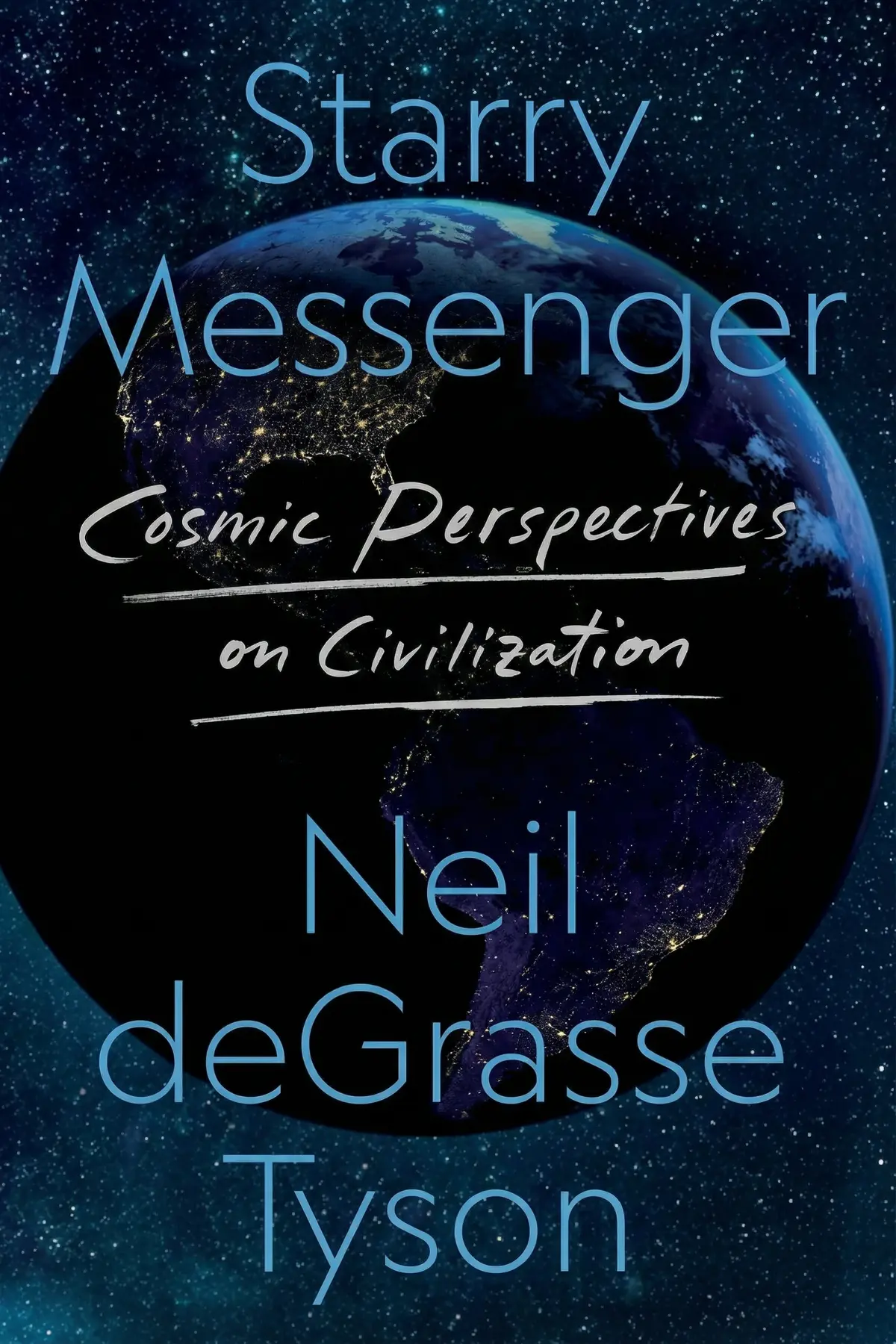
Starry Messenger: Cosmic Perspectives on Civilization
Neil deGrasse Tyson
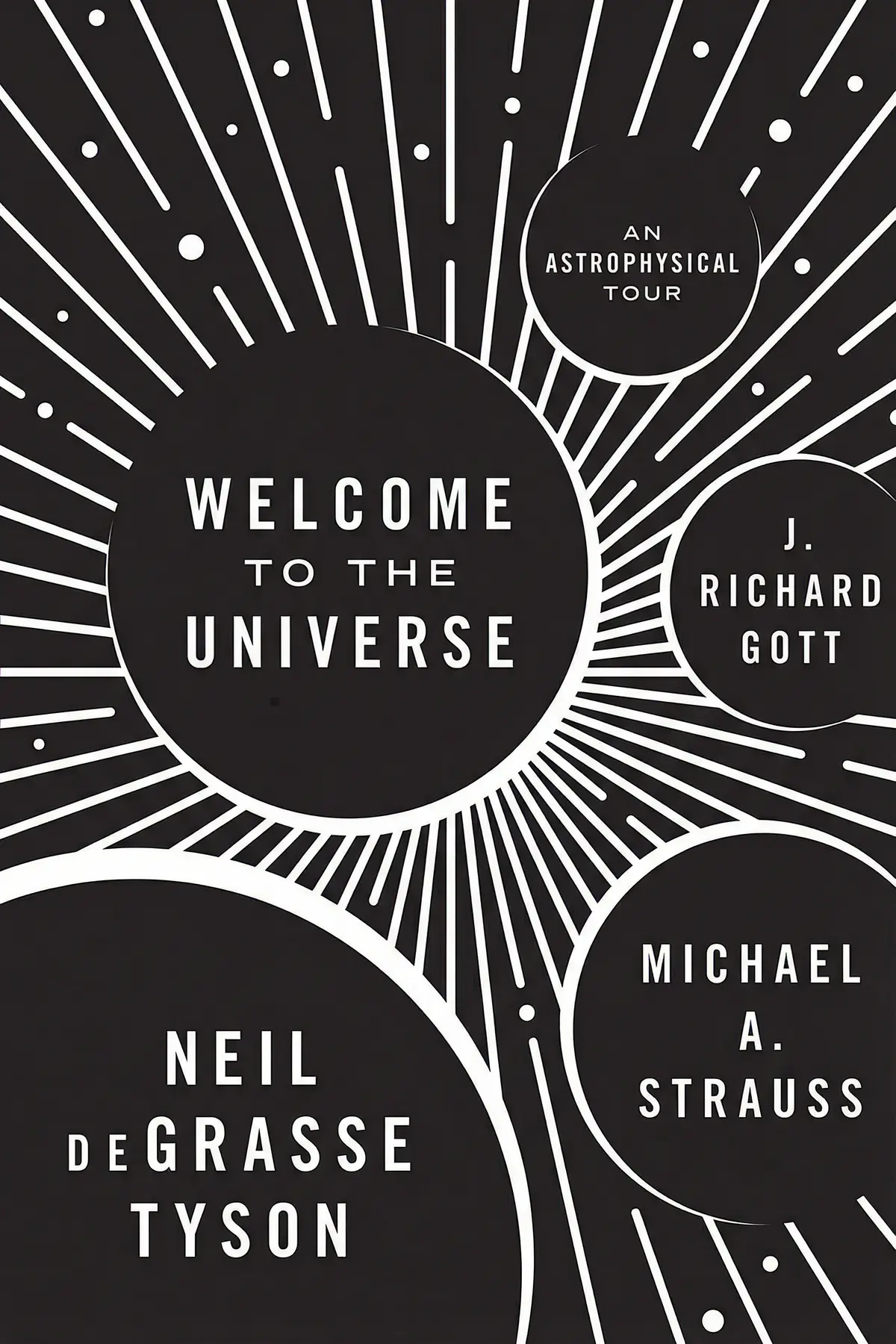
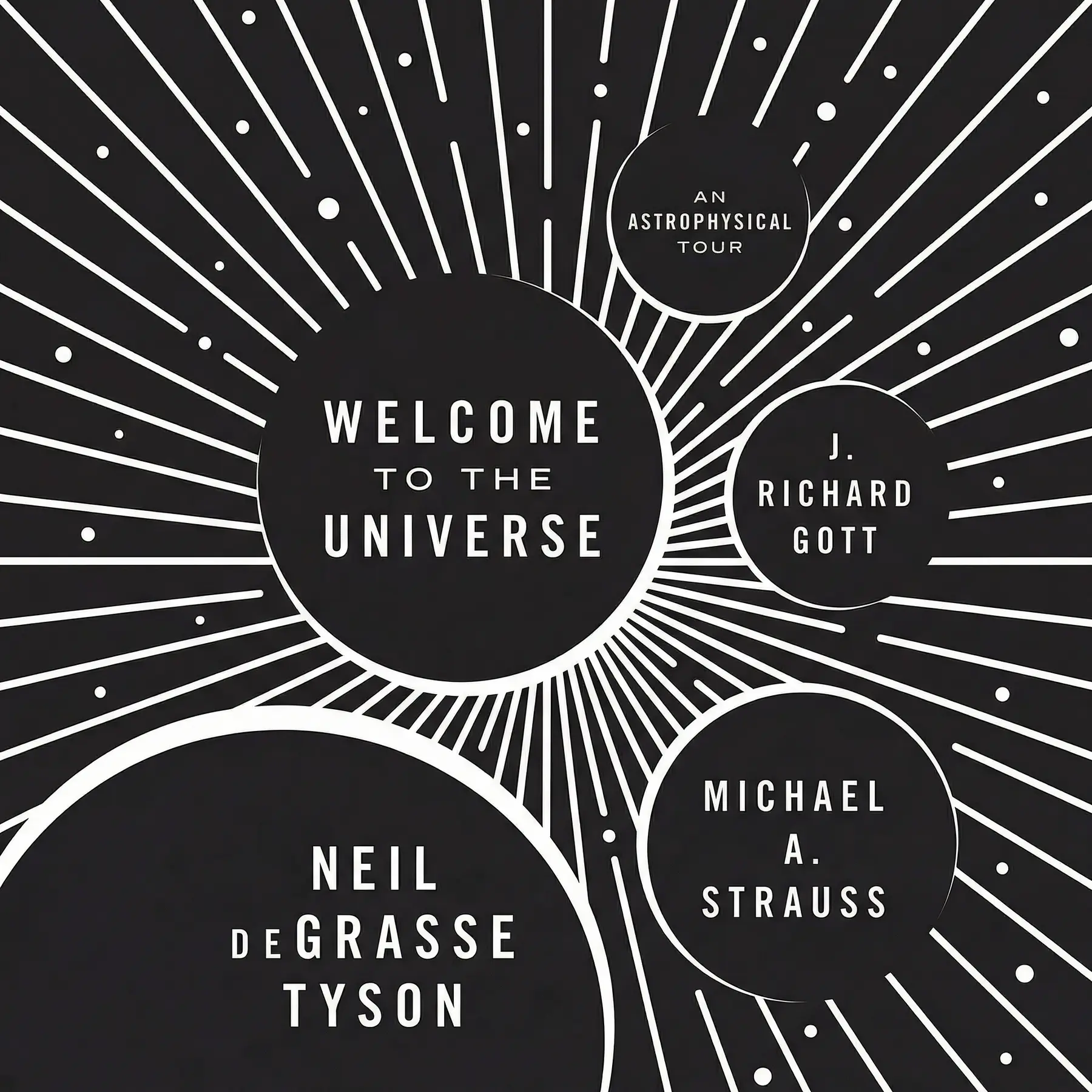
An expansive and accessible guide to the cosmos, this summary explores the mechanics of planets, the life cycles of stars, the mysteries of black holes, and the theoretical possibilities of time travel.
2 min 09 sec
Imagine for a moment that the entire history of our universe—all thirteen point eight billion years of it—is compressed into the length of a single American football field. As you stand at one end zone, representing the very beginning, every single stride you take forward carries you through fifty million years of cosmic evolution. You walk past the formation of the first stars, the swirling assembly of galaxies, and the slow cooling of the vacuum. You traverse almost the entire length of the field, and it is only when you are inches from the opposite end zone that our sun and Earth even appear. Then, at the very final edge, within the width of a single human hair, the entire span of human history exists.
This perspective is the starting point for our journey. We often move through our lives feeling as though we are the center of the story, yet science reveals a different reality. We are residents of a small, rocky planet orbiting an average star in the suburbs of a common galaxy. While that realization might make us feel small, it also invites us into a grander narrative. This summary serves as your personal spacecraft, designed to take you from the familiar soil of Earth to the most extreme environments in existence. Over the course of this exploration, we will move through the mechanics of our solar system, the life and death of stars, the terrifying physics of black holes, and the theoretical shortcuts through time itself.
Through the eyes of leading astrophysicists, we will see that the universe is not just a collection of distant objects, but a dynamic, evolving system governed by laws that we are only beginning to decipher. We will look at why our perception of the night sky is shaped by the tilt of our planet, how the light we see today is actually a ghost from the distant past, and what the ultimate fate of the universe might be as it continues its relentless expansion. By the time we return to Earth, you will see the stars not just as points of light, but as part of a vast, interconnected history that we are lucky enough to witness. So, prepare for liftoff as we begin our tour of the universe.
2 min 31 sec
Discover how our home planet is a constantly moving spacecraft, where the change of seasons and the stars we see are dictated by a permanent tilt.
2 min 40 sec
Explore the inner workings of our sun, from the white light it truly emits to its eventual transformation into a red giant and white dwarf.
2 min 35 sec
Take a tour from the rocky inner planets to the distant gas giants and learn the real reason Pluto was reclassified.
2 min 16 sec
Understand why looking at the night sky is equivalent to looking into the past and how light carries hidden information across the spectrum.
2 min 23 sec
Journey into the Milky Way to see how stars congregate in clusters and why most of the universe’s mass is invisible to us.
2 min 07 sec
Step toward the event horizon to learn about the nature of gravity’s ultimate trap and the strange phenomenon of spaghettification.
2 min 19 sec
Visualize the growth of space through the raisin bread analogy and explore the different models for how the universe might end.
2 min 15 sec
Investigate the theoretical shortcuts of wormholes and cosmic strings that might allow for journeys into the past.
2 min 27 sec
Examine the requirements for life to emerge on other worlds and learn how the Drake equation helps us estimate our cosmic neighbors.
2 min 22 sec
As we conclude our tour and prepare to land back on the familiar ground of Earth, it’s worth reflecting on the vast landscape we’ve traversed. We began by looking at our own world, a small blue sphere tilted on its axis, and moved outward to witness the fiery life cycles of stars. We’ve seen how galaxies are held together by the invisible hand of dark matter and how the fabric of space itself is being stretched by an expansion that began at the dawn of time. We’ve explored the dark heart of black holes where time stands still and peered into the mathematical possibility of shortcuts through the cosmos.
The overarching theme of this journey is one of perspective. In the grand timeline of the universe, our lives and even the entirety of human civilization are fleeting moments. Yet, we are the part of the universe that has developed the capacity to look back at itself. By using light as a window into the past and mathematics as a map for the unknown, we have turned a cold and indifferent vacuum into a story of origin and evolution.
What does this mean for us? It suggests that while we are physically insignificant in terms of size, our ability to understand the cosmos is a testament to the power of curiosity and scientific inquiry. The universe is much weirder, hotter, and more complex than we can easily imagine, but it is also a place governed by rules that we can learn. As we continue to refine equations like the Drake formula or peer deeper into the event horizons of distant black holes, we are not just collecting facts; we are coming to understand our own heritage.
The universe is still expanding, stars are still being born in the spiral arms of the Milky Way, and somewhere out there, the light from a distant civilization may be making its long journey toward our telescopes. The tour doesn’t truly end here. Every time you look up at the night sky, you are continuing the exploration. The stars are no longer just distant points of light; they are white-hot furnaces, potential suns for alien worlds, and markers of a history that spans billions of years. Keep looking up, because the more we learn about the universe, the more we learn about the miracle of our own existence within it.
This exploration serves as an all-encompassing tour of the physical and theoretical universe. It begins with our immediate neighborhood—the solar system—before expanding into the complex architecture of the Milky Way and the distant reaches of deep space. The promise of this journey is a fundamental shift in perspective. By examining the massive scales of time and distance that define existence, listeners gain a deeper understanding of where humanity fits into the grand cosmic design. From the birth of stars in celestial nurseries to the mind-bending physics of event horizons and wormholes, it bridges the gap between complex astrophysics and the curiosity of the everyday observer.
Neil deGrasse Tyson is an astrophysicist and the director of the Hayden Planetarium, widely recognized as the host of the StarTalk podcast and the television show NOVA ScienceNow. Michael A. Strauss serves as a professor of astrophysics at Princeton University, specializing in star evolution and the mapping of galaxies. J. Richard Gott is also a professor of astrophysics at Princeton, known for his theoretical work on time travel, general relativity, and cosmology.
Neil deGrasse Tyson
Listeners find this astronomy guide captivating and expertly crafted, offering lucid breakdowns of intricate theories and fundamental cosmic principles. They enjoy the prose, with one listener highlighting its conversational tone, and view it as essential reading for fans of astrophysics. The work gains praise for the caliber of its authors and is regarded as an excellent choice for a gift. Although some listeners like that it avoids burdensome math, others mention that it contains significant mathematical material.
Finally finished this behemoth of a book, and it’s a total trip. Tyson’s early chapters are pure joy, especially his quirky ways of explaining the vastness of the cosmos using stacks of hamburgers. However, don’t let the conversational tone fool you because this thing gets dense fast. By the time Strauss and Gott take over, you’re knee-deep in equations and the curvature of space-time. It’s based on a Princeton course, and you can really feel that academic rigor pulsing through the pages. I appreciated the deep dive into black holes and the Big Bang, even if I had to reread some paragraphs twice to grasp the nuances. It is essentially an introductory textbook masquerading as a coffee table book. Get the Kindle version unless you want a workout, as the physical copy is surprisingly heavy. Overall, it's a must-read for any true space enthusiast who isn't afraid of a little algebra.
Show morePicked this up because I’ve always been a fan of Tyson, but I stayed for the incredible depth provided by Strauss and Gott. This isn't your average pop-sci summary; it is a comprehensive distillation of a Princeton introductory course. I particularly enjoyed the technical explanations of how we use the light spectra of stars to determine their composition. It’s fascinating to see the actual work behind the discoveries rather than just the conclusions. Some of the speculation toward the end—like the bits on time travel and string theory—is definitely out there, but it’s grounded in enough physics to keep it from feeling like science fiction. Frankly, it’s one of the best books I’ve found for bridging the gap between 'I like space' and 'I understand how the universe works.' The hardcover is beautifully produced, though quite a weight to carry around. A definitive 5 stars for the sheer amount of knowledge packed into these pages.
Show moreWow, what an incredible journey through space-time. If you’ve ever wanted to truly understand Einstein’s theories without getting a PhD, this is probably your best bet. Richard Gott’s section on relativity and the possibility of time travel is mind-bending but logically sound. I loved the level of detail regarding how black holes are formed and the role dark energy plays in the expansion of the universe. The book doesn't treat the reader like they're incapable of understanding complex ideas, which I really appreciated. Instead of just saying 'the universe is expanding,' they show you the Hubble constant and explain how we arrived at that number. It’s dense, yes, but that’s because the universe is complicated! The authors have a way of making you feel like you're sitting in on one of their Princeton seminars. This is an essential addition to any science lover’s library, providing both historical context and cutting-edge research.
Show moreAfter hearing so many good things about this, I finally sat down with it and I wasn't disappointed. The authors manage to take the most complex topics in the universe—quasars, string theory, and the cosmic background radiation—and make them feel tangible. I especially liked the focus on the history of astronomy; seeing where Laplace and Hubble got things right (and wrong) gives you a great perspective on how science evolves. The book is very detailed, covering parsecs, light-years, and the physics of star death with impressive clarity. It’s one of those rare books that you can use as a reference for years to come. Even the more speculative chapters on the multiverse were grounded in actual physical principles. It’s definitely not a 'light' read, but it is a deeply satisfying one. If you want to know how we know what we know about the stars, this is the book to get. Just be prepared for some math!
Show moreLooking for a book that treats you like a smart adult rather than a kid? This is it. Tyson, Strauss, and Gott have created a masterpiece that spans the entire history and future of our universe. The writing is conversational yet authoritative. I loved the breakdown of how we detect dark matter and the explanation of how the universe can be infinitely dense yet infinitely large at the same time. It’s heavy on the math, but the authors take the time to explain the formulas so you don't feel lost. The section on the LIGO experiment and gravitational waves was particularly timely and well-explained. It’s a beautiful book, both in its physical presentation and the ideas it contains. It’s the kind of book that makes you look up at the night sky with a completely different perspective. Perfect for anyone who wants a serious, in-depth look at the wonders of astrophysics. Highly recommended!
Show moreEver wonder how big the universe really is? This book tries to tell you, and it doesn't pull any punches. I loved the section where Tyson explains the scale of the universe using McDonald's hamburgers—it makes the 'billion' and 'trillion' numbers actually mean something. But be warned: the 'Astrophysical Tour' subtitle is literal. This isn't just pretty pictures and light anecdotes; there is real math here. I found the shift between the three authors a bit clunky, with Tyson being the hype-man and Gott being the hardcore professor. The chapters on Einstein’s relativity were the hardest to get through, but also the most rewarding. My only gripe is that it sometimes feels like two different books stapled together. One minute you're learning about Pluto's demotion, and the next you're calculating the Schwarzschild radius. Still, it’s a brilliant resource for anyone who wants to go beyond the basics of popular science.
Show moreAs someone who hasn't touched a physics equation in years, I found this book both intimidating and deeply rewarding. The authors do a great job of explaining what the various Greek letters mean—I finally understand the difference between 'v' and 'nu' in an astrophysical context! The book covers everything from the Big Bang to the eventual heat death of the universe. I liked that it didn't shy away from the history of science, either. Learning about how Rømer estimated the speed of light using Jupiter’s moons was a highlight for me. However, the section on general relativity was a slog. It felt like I was back in a lecture hall, and not always in a good way. The text can be a bit dry in the middle sections, and the change in writing styles between the three authors is very noticeable. It’s a great reference piece, but maybe not something you can breeze through in a single weekend.
Show moreNot what I expected, but I mean that in a good way. I thought this would be a light 'tour' of the stars, but it’s actually a deep dive into the mechanics of the cosmos. The conversational manner of the writing makes the complex theories about dark matter and black holes digestible, even if the math requires a pencil and paper to fully follow. I found the chapter on exoplanets particularly fascinating. It’s amazing how much we’ve learned about the Kuiper Belt just in the last few years. The book is very up-to-date, mentioning recent gravitational wave experiments. My main issue is the physical size of the thing; it's a massive tome that’s hard to read comfortably in bed. Also, some of the analogies are a bit long-winded, making you wait several pages before the authors finally get to the point. Regardless, it’s a stellar achievement in science communication for those who want a challenge.
Show moreThis book suffers from a bit of an identity crisis, in my opinion. It starts off very accessible with Neil deGrasse Tyson’s typical ebullient flair, but it quickly descends into a thicket of equations that might alienate the casual reader. While it’s marketed as a popular science book, it frequently feels more like a first-year college textbook. The inclusion of a random chapter on why Pluto isn't a planet felt like a weird vanity project that didn't quite fit the broader cosmological theme. Strauss provides a solid bridge regarding galaxies, but Gott’s section on relativity is incredibly heavy lifting. To be fair, the production quality is high and the diagrams are clear, but the tone is just too inconsistent. If you’re a physics student, you’ll probably love the depth. If you’re just a fan of 'Cosmos' looking for a light bedtime read, you might find yourself bogged down by the Greek letters and the math-heavy descriptions.
Show moreTruth is, I think the authors forgot who their audience was with this one. I came for the Neil deGrasse Tyson charm but found myself trapped in a textbook by the halfway mark. There are just too many equations for what is supposed to be a mainstream science book. While I can appreciate the effort to be thorough, it often feels like the authors are talking to other physicists rather than the general public. The transition from Tyson’s ebullience to Strauss’s dry descriptions of galaxies was a bit of a letdown. I also didn't care much for the speculative 'bullshit' sections at the end about multiple dimensions—it felt a bit too much like guessing. To be fair, the book is incredibly well-made and the illustrations are helpful. But if you don't have a strong background in algebra, you're going to struggle to get through the second half. It’s a 3-star read for me, mostly for being a bit too inaccessible for its own good.
Show more

J. Craig Venter
Carl Zimmer
Bill Bryson
Jeff Hawkins
AUDIO SUMMARY AVAILABLE
Get the key ideas from Welcome to the Universe by Neil deGrasse Tyson, plus 5,000+ more titles in English and Thai.







