
20 min 12 sec
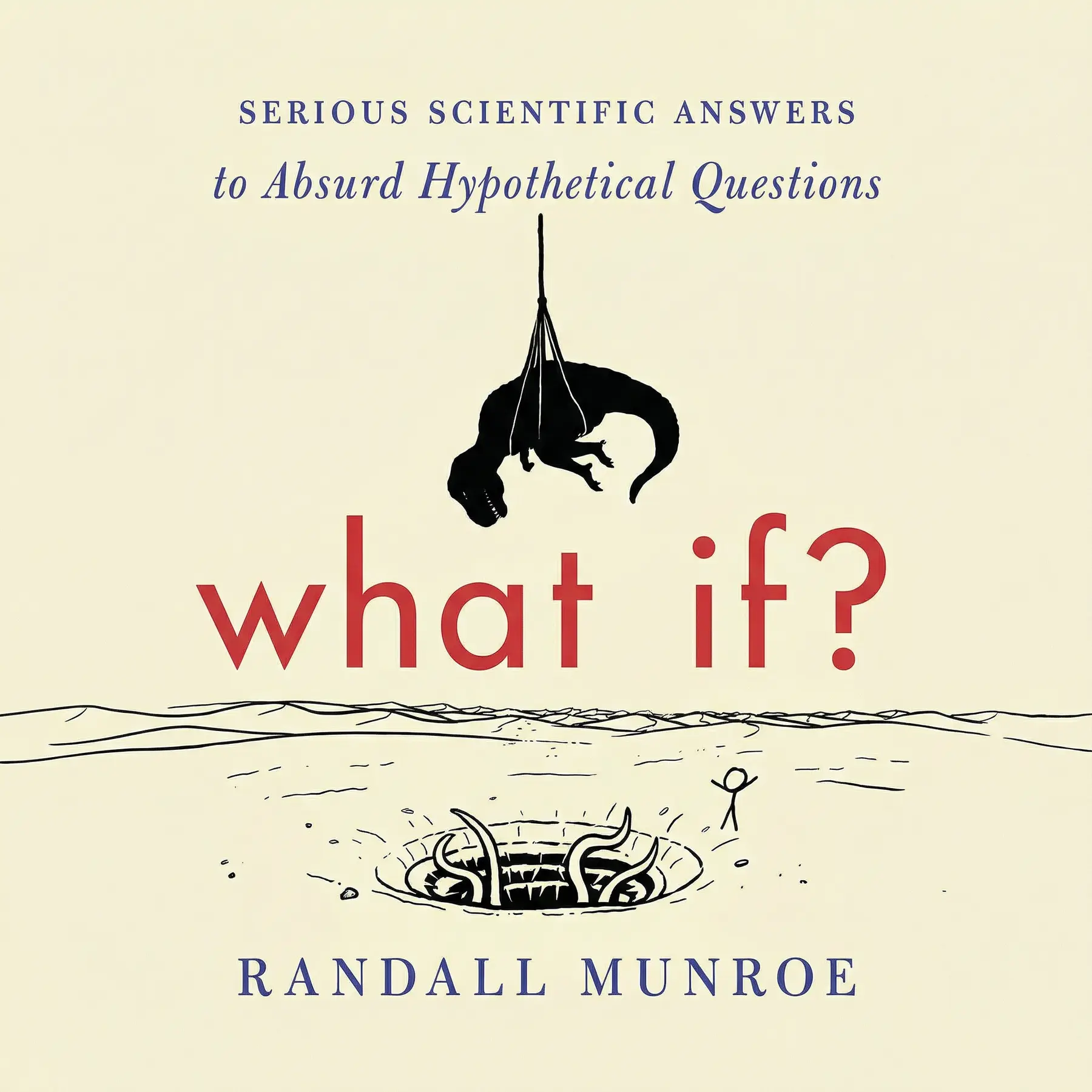
What If?: Serious Scientific Answers to Absurd Hypothetical Questions
What If? applies rigorous scientific principles to the most ridiculous questions imaginable, revealing the fascinating physics and math behind everything from intergalactic travel to the digital graveyard of social media.
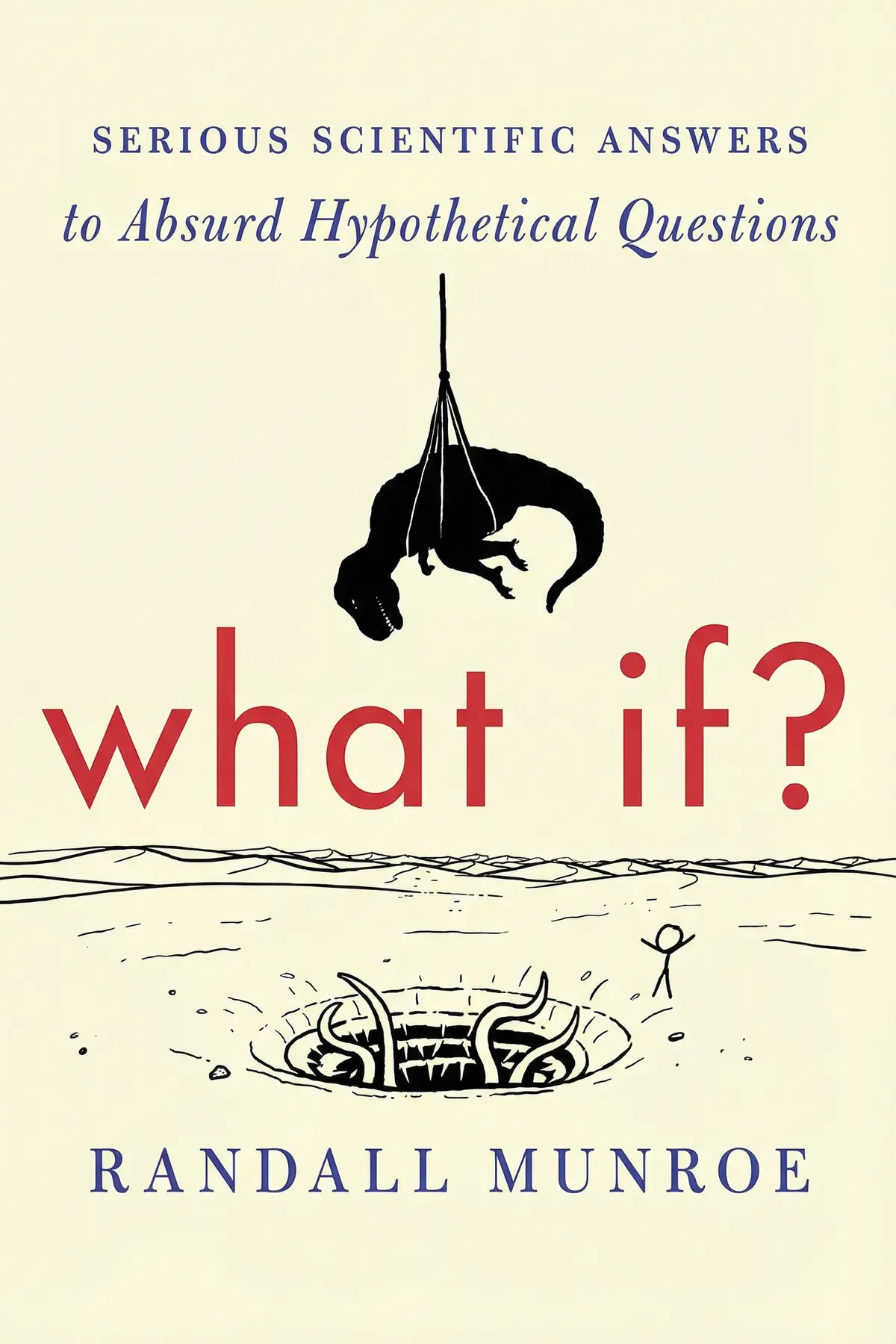
Table of Content
1. Introduction
1 min 31 sec
We are often told that there is no such thing as a stupid question, but Randall Munroe takes that sentiment to its absolute limit. In the world of ‘what-iffing,’ we usually find ourselves in one of two camps: the daydreamer imagining impossible feats, or the person trying to solve a practical problem. What happens when you combine those two? You get a rigorous, scientific exploration of the absurd.
This summary dives into the strange and wonderful thought experiments that define this approach. We aren’t just looking for a simple ‘yes’ or ‘no.’ Instead, we are peeling back the layers of how the universe actually functions by pushing its laws to the breaking point. Whether it’s contemplating a world without a sun or calculating the physical requirements of printing the internet, the goal is to use the ridiculous as a gateway to the remarkable.
Throughout these segments, we will explore the throughline of this work: that curiosity, no matter how outlandish, is the primary engine of human knowledge. By the end, you’ll see the world through a more analytical—and perhaps more playful—lens. You will understand how gravity affects a tiny planet, why the common cold is harder to beat than it looks, and why your smartphone is a computational titan. Prepare to look at the ‘impossible’ and find the math hiding right underneath the surface. Let’s begin our journey into the hypothetical.
2. The Hidden Upside of a Dark Sun
2 min 17 sec
What if the sun simply vanished? While the ultimate fate of Earth would be frozen and dark, the immediate scientific and economic shifts might surprise you.
3. Physics on the Little Prince's Asteroid
2 min 15 sec
Imagine living on a planet so small you could run off of it. The gravity of a tiny, dense world creates some very strange physical sensations.
4. The Logistics of a Paper Wikipedia
2 min 04 sec
Is it possible to keep a printed version of Wikipedia up to date? The answer lies in the surprising ratio between human edits and printer speed.
5. A Biological Solution to the Common Cold
2 min 00 sec
Could we eradicate the common cold by simply ignoring each other? The math works, but the social cost would be a total collapse of civilization.
6. The Statistical Impossibility of Soulmates
2 min 09 sec
What if everyone had exactly one soulmate? The mathematical reality is that you would likely never even make eye contact with them.
7. The Brain vs. the Smartphone
2 min 15 sec
In a head-to-head math battle, a basic phone destroys the combined power of humanity. But in other ways, the human brain remains the ultimate supercomputer.
8. The Cosmic Odds of Guessing the SAT
2 min 03 sec
What if you decided to guess every single answer on the SAT? The probability of a perfect score is so low it defies human comprehension.
9. The Digital Graveyard of Facebook
2 min 01 sec
Will Facebook eventually become a virtual cemetery? The crossover point where dead profiles outnumber the living is closer than you think.
10. Conclusion
1 min 37 sec
As we wrap up our exploration of these absurd hypotheticals, a clear pattern emerges. Science is not just a collection of facts found in textbooks; it is a tool for exploring the boundaries of the possible. By asking ‘What if?’, we have traveled from the freezing darkness of a sunless Earth to the high-gravity surface of a tiny asteroid. We have seen how the laws of probability make the SAT a fortress and how the common cold could be defeated if we were willing to sacrifice civilization.
What this really means for you is that curiosity should never be stifled, no matter how ridiculous it seems. The same physics that explains why you can’t run off the Earth explains why a moon mission is so difficult. The same math that tells us we won’t find a soulmate on a webcam tells us how to optimize global logistics. Every silly question is an opportunity to practice the ‘Fermi problem’ style of thinking—breaking a massive, unknown challenge into smaller, solvable pieces.
The throughline of this journey is that the world is a deeply logical place, even when the scenarios we imagine are not. The next time you find yourself wondering about something completely outlandish, don’t just laugh it off. Use it as an excuse to do a little math or look up a law of physics. When you engage with the world this way, you turn the entire universe into your laboratory. Curiosity is a muscle; the more you use it to answer the absurd, the stronger it becomes for solving the real problems in your life. Stay curious, keep asking the ‘wrong’ questions, and you’ll keep finding the right answers.
About this book
What is this book about?
Have you ever wondered what would happen if the sun suddenly vanished, or if everyone on Earth pointed a laser pointer at the moon at the same time? What If? takes these bizarre, often hilarious hypothetical scenarios and subjects them to serious scientific scrutiny. Using physics, biology, and chemistry, the book provides evidence-based answers to questions that range from the mildly curious to the totally apocalyptic. Beyond the humor, the promise of this work is a masterclass in critical thinking and problem-solving. By stripping away the constraints of everyday reality, we are forced to look at the fundamental laws of the universe in a new light. You will learn about the sheer power of modern computing, the fragility of the human immune system, and the mind-bending realities of orbital mechanics. It is a journey that proves that even the most nonsensical curiosity can lead to a deeper understanding of the world we live in.
Book Information
About the Author
Randall Munroe
Randall Munroe is a former NASA roboticist who transitioned into the world of webcomics and popular science writing. He is the creator of xkcd, a widely beloved webcomic known for its mix of romance, sarcasm, math, and language. His unique ability to blend high-level scientific concepts with stick-figure humor has earned him a dedicated global following. In 2013, his contributions to science communication were recognized by the International Astronomical Union, which officially named asteroid 4942 Munroe after him.
Ratings & Reviews
Ratings at a glance
What people think
Listeners find this book highly amusing and funny, with many experiencing moments of genuine laughter while listening. The work is thoroughly researched and full of information, delivering comprehensive explanations for ridiculous hypothetical scenarios in a clear, digestible manner. Listeners value its quality as a mind-stretching educational tool and frequently recommend it as an ideal gift for clever individuals, highlighting its particular popularity with pre-teen boys. Written in a simple yet captivating style, the material is easily accessible to all age groups.
Top reviews
Prinya
Finally got around to reading this after seeing the xkcd comics for years. Randall Munroe takes the most ridiculous inquiries—like everyone on Earth jumping at once—and applies actual physics to them. The Rhode Island apocalypse scenario was both terrifying and side-splittingly funny. It’s rare to find a book that treats "stupid" questions with such rigorous intellectual respect. Frankly, it makes science feel like a playground rather than a lecture hall. The stick-figure illustrations add that perfect touch of deadpan humor. If you want to know how a steak gets cooked when dropped from space, this is your bible. A must-read for anyone who still has a sense of wonder.
Show moreSamart
Ever wonder what would happen if the moon just vanished? This book provides the answers you didn't know you needed. Munroe uses his NASA background to explore the logistical nightmares of absurd scenarios with terrifying precision. The section on astatine—and why you should never, ever go near it—had me laughing out loud in a public cafe. It’s the perfect gift for that "smart" person in your life who is hard to buy for. The truth is, it’s just pure, unadulterated fun. It turns the world into a giant physics simulation where anything can happen. I’ve already bought two more copies for my nephews.
Show moreNoah
Wow, I didn't think a book about physics would make me cry-laugh. Munroe’s deadpan delivery is the secret sauce here. When he talks about the sudden stop at the end of a fall or the sheer danger of certain elements, it’s just gold. The chapter on finding your soulmate through pure probability was a highlight for me because it was so bleak yet mathematically sound. It’s informative, hilarious, and deeply satisfying for anyone who likes to ask "why?" until it breaks. Truth be told, I learned more about kinetic energy from the steak-dropping chapter than I did in all of high school. Five stars, no question.
Show moreBig
Frankly, it's a breath of fresh air in the non-fiction world. Too often, science books are either too dry or too "dumbed down," but Munroe hits the sweet spot. He treats questions about cheese-cutting wires and wind turbines with the same level of detail you'd expect from a scientific journal, but with ten times the wit. The deadpan "NO" on the astatine safety sheet is probably my favorite joke in a book this year. It’s an entertaining ride from start to finish. If you’ve ever wondered about the limitations of wax as an adhesive (poor Icarus!), you need this on your shelf immediately.
Show moreSupranee
As someone who isn't exactly a math whiz, I was worried this might go over my head. To be fair, a few sections about relativistic speeds felt a bit dense, but Munroe’s writing style is incredibly accessible. He has this gift for simplifying complex orbital mechanics into something a layman can chuckle at. I particularly loved the "weird and worrying" section where he just lists questions he refused to answer, like the one about the cheese-cutting wire. It’s informative without being dry. My only minor gripe is that the pacing can feel a bit repetitive if you try to read it all in one sitting. It’s better as a "dip-in-and-out" coffee table book.
Show moreMadison
Picked this up for my thirteen-year-old son, but I ended up stealing it from his bedside table for a week. It’s a fantastic mind-expanding thought stimulator that makes learning feel like a secret you’re being let in on. The way Munroe calculates the power output of Yoda compared to a nuclear reactor is exactly the kind of thing that gets kids (and adults) interested in STEM. The writing is simple, engaging, and never talks down to the reader. My only complaint is that I wanted even more of the "unanswered" questions because they were so bizarre. Definitely a great addition to any library.
Show moreGor
The chapter on what would happen if the Earth stopped spinning but the atmosphere kept moving was genuinely haunting. Munroe has a way of taking a silly premise and following it to its most catastrophic, logical conclusion. I loved the balance between the hilarious stick-figure drawings and the actual, heavy-duty research. It's a quick read, but you'll find yourself thinking about it for days afterward. My experience was that it’s best consumed in small chunks rather than wolfing it down. Some of the math can get a little "whoosh" over your head, but the punchlines always land. A solid 4-star read for any curious mind.
Show moreArjun
After hearing my friends rave about xkcd, I finally picked this up. It’s an absolute blast. The hypothetical about draining the oceans through a portal was fascinating, especially the part about the Netherlands. Munroe is clearly a genius, but he writes in a way that feels like a conversation at a bar with a very smart friend. Some of the more technical pages on hair dryers or specific math problems were a bit much for me, but the humor always pulled me back in. It's a great "gift book" because almost anyone can find something to laugh at. Very glad I gave it a chance!
Show moreCamila
Look, the science is obviously brilliant, but the charm wore off for me about halfway through. Some of the hypotheticals, like the hair dryer in a box, felt like they were dragging on for pages when a shorter answer would have sufficed. I’m a fan of xkcd, but the transition from a three-panel comic to a full chapter can feel a bit thin at times. Personally, I enjoyed the shorter, weirder questions more than the long-form analysis of draining the oceans. It’s a clever concept and definitely well-researched, but it got a bit "samey" after a while. Still worth a look if you love trivia and physics, but maybe borrow it from a friend first.
Show moreNook
Not what I expected based on the hype. I found the tone a bit too smug at points, like a front-row student constantly trying to show off. Some questions were genuinely interesting, like the global jump, but others felt totally pointless. The bits where he skips questions entirely, like the turkey transformation, felt like a cop-out. I wanted more answers and less of the "I'm too smart to answer this" vibe. If you’re already a huge fan of the webcomic, you’ll probably love it, but for a casual reader, it’s a bit disjointed. It just didn't click for me.
Show moreReaders also enjoyed
A Life Decoded: My Genome: My Life
J. Craig Venter
A Planet of Viruses
Carl Zimmer
A Short History of Nearly Everything
Bill Bryson
A Thousand Brains: A New Theory of Intelligence
Jeff Hawkins
AUDIO SUMMARY AVAILABLE
Listen to What If? in 15 minutes
Get the key ideas from What If? by Randall Munroe, plus 5,000+ more titles in English and Thai.
- 5,000+ titles
- Listen as much as you want
- 7-day free trial
- Cancel anytime







