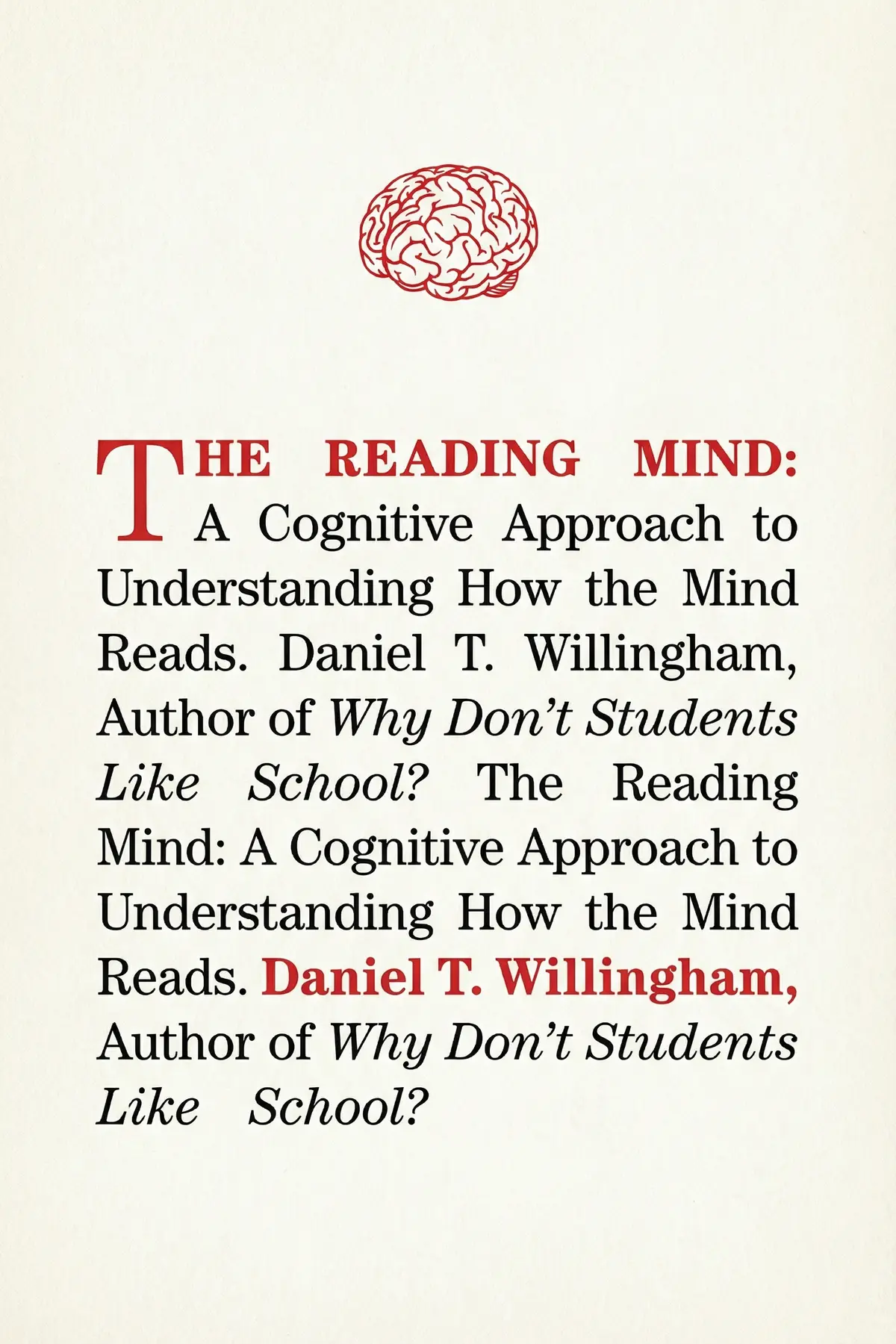
The Reading Mind: A Cognitive Approach to Understanding How the Mind Reads
Daniel T. Willingham
Explore the cognitive science behind why traditional education often clashes with the brain's natural functions and discover evidence-based strategies to make learning more effective, engaging, and accessible for everyone.
2 min 06 sec
Every morning, in households across the globe, a familiar scene unfolds. A child groans, pulls the covers over their head, and declares that they simply do not want to go to school. For decades, we have treated this resistance as a behavioral issue or a sign of a flawed curriculum. We look at test scores, debate the merits of standardized testing, or change the syllabus in hopes of sparking a love for learning. But what if the problem isn’t the subject matter or the specific school district? What if the disconnect is much deeper, rooted in the very biology of our brains?
In this exploration of cognitive science, we are going to look at why the human mind isn’t naturally built for the kind of thinking school demands. We often assume that because we are a thinking species, our brains must crave complex problems. The reality is far more nuanced. As it turns out, the human brain has evolved to avoid unnecessary mental exertion. By understanding the quirks of our cognitive architecture—how we use memory, why we rely on patterns, and how we actually acquire new skills—we can begin to see why traditional education so often feels like an uphill battle.
Over the course of this summary, we will move past the superficial debates about education and look at the hard science of learning. We will explore the vital relationship between working memory and long-term memory, debunk persistent myths like the existence of “learning styles,” and uncover why factual knowledge is actually the secret ingredient for critical thinking. Whether you are an educator looking to reach your students more effectively, a parent trying to support your child’s development, or simply a curious learner, this journey offers a roadmap for aligning our educational systems with the way the human mind truly functions. The throughline here is simple: when we understand the brain’s limitations and strengths, we can stop fighting against nature and start working with it to create a much more powerful and enjoyable learning experience.
2 min 50 sec
Discover why our biological evolution prioritized quick reflexes and pattern spotting over the slow, energy-draining process of complex analytical problem-solving.
2 min 36 sec
Explore the critical relationship between the limited capacity of our working memory and the vast, permanent storage of our long-term memory.
2 min 34 sec
Understand why the brain struggles to process isolated facts and why providing concrete examples is the key to mastering abstract concepts.
2 min 33 sec
See how grouping small bits of information into larger ‘chunks’ can bypass the brain’s processing limits and pave the way for expert-level thinking.
2 min 39 sec
Uncover the scientific truth behind the ‘learning styles’ myth and why focusing on the content’s meaning is more effective than catering to visual or auditory preferences.
2 min 26 sec
Challenge the notion that we are born with a fixed IQ and learn how environment and sustained effort can significantly boost cognitive ability over time.
2 min 21 sec
Discover why teaching is a complex craft that requires ongoing feedback and why many instructors plateau after their first few years in the classroom.
2 min 10 sec
As we bring our look at Why Don’t Students Like School? to a close, the central message is clear: the classroom of the future must be built on the foundation of cognitive science. We have seen that the human brain is a remarkable instrument, but it’s one with very specific operating instructions. It is an organ that evolved for action and pattern recognition, not necessarily for abstract contemplation. By acknowledging the limits of our working memory and the vast power of our long-term memory, we can design educational experiences that are both more efficient and more satisfying.
We have debunked the idea that factual knowledge is obsolete and revealed that it is, in fact, the essential fuel for critical thinking. We have seen that “learning styles” are a distraction from what really matters: the clear communication of meaning. Perhaps most importantly, we have explored the idea that intelligence is not a fixed destiny but a malleable trait that can be expanded through effort and persistence. This shift in perspective—from seeing students as having fixed abilities to seeing them as having growing potential—is perhaps the most powerful tool an educator or parent can possess.
The throughline of this summary has been that when education feels like a struggle, it’s often because we are fighting against the brain’s natural design. When we provide the right context, focus on automaticity through practice, and foster a culture of feedback for both students and teachers, the struggle begins to transform into a rewarding challenge.
As a final takeaway, remember to promote the power of effort in all your interactions with learners. Whether you are helping a child with their homework or learning a new skill yourself, stay focused on the fact that mastery comes from persistence, not just innate talent. The brain is capable of incredible things, provided we give it the right environment to grow. If we align our teaching with our biology, we might just find that students—and teachers—start to love school again.
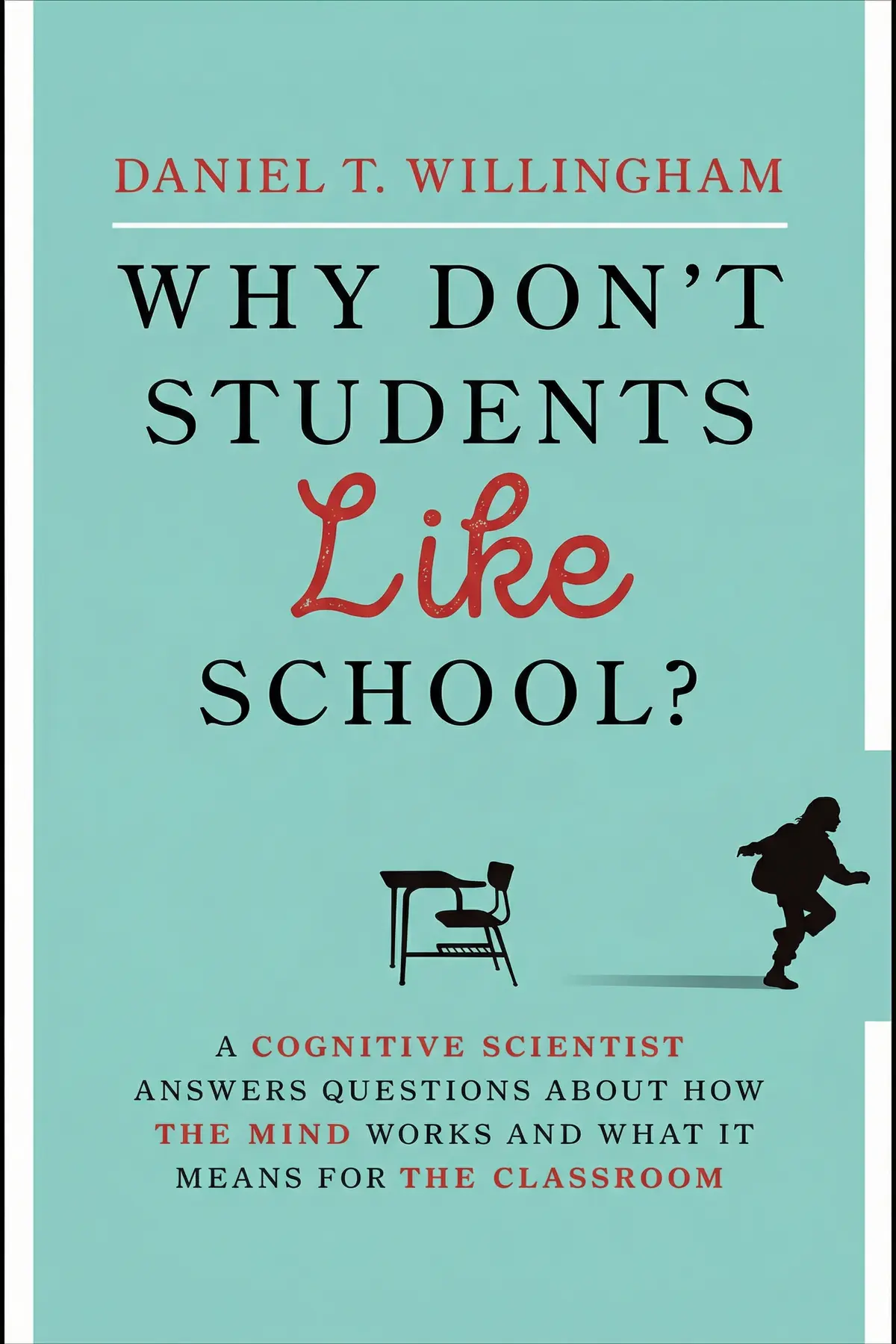
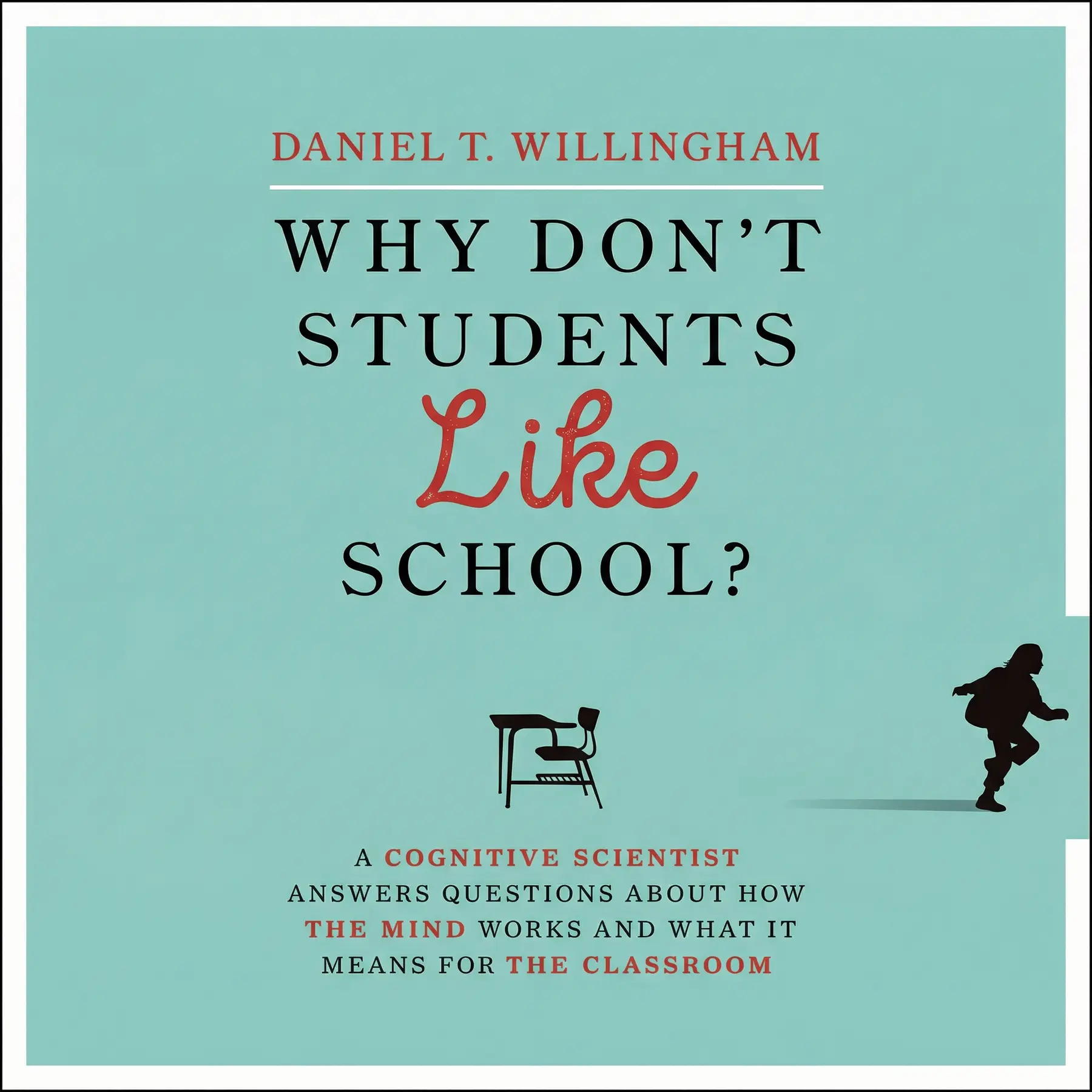
Why Don’t Students Like School? provides a deep dive into the mechanics of the human mind from the perspective of cognitive psychology. Daniel T. Willingham challenges long-held educational myths, such as the validity of learning styles and the idea of fixed intelligence, by explaining how we actually process and store information. The book promises to bridge the gap between complex laboratory research and the everyday realities of the classroom. It offers practical insights for educators and parents on how to leverage memory, context, and practice to foster genuine understanding. By aligning teaching methods with the biological strengths and limitations of the brain, the text illustrates how we can transform the learning experience from a chore into a rewarding cognitive adventure.
Daniel T. Willingham is a cognitive psychologist who is a professor in the University of Virginia’s Department of Psychology. Daniel T. Willingham earned his PhD from Harvard University and has authored numerous books related to education and psychology. These include Cognition: The Thinking Animal (2001) and Raising Kids Who Read (2015).
Daniel T. Willingham
Listeners consider this book a fantastic experience and rank it among the finest educational titles they have come across. Its approach to the learning process is highly valued; one listener notes that it provides useful insights into how we think and learn, while another listener points out that it serves as an excellent refresher for veteran teachers.
The title is a bit of a bait-and-switch, but in the best way possible. Instead of a rant against the educational system, Willingham provides a lucid explanation of how our brains actually process information. He argues that the mind isn’t actually designed for thinking; it’s designed to avoid it because thinking is slow and effortful. This was a massive 'lightbulb' moment for me as a parent. We often assume kids are being lazy, but their working memory is simply hitting a wall. The book explains how background knowledge allows for 'chunking,' which frees up mental space for higher-level analysis. It’s a quick read but stays with you long after you finish the final chapter. To be fair, some of the classroom tips at the end felt a little basic compared to the deep science in the earlier sections. Still, it’s easily the most useful education book on my shelf right now.
Show moreFinally, someone had the courage to tell the truth about learning styles. As a student teacher, I’ve been bombarded with the idea that I need to cater to 'visual' or 'auditory' learners in every single lesson. Willingham points out that the research simply doesn't support this, which is both shocking and a huge relief. He argues that we should focus on the content itself rather than trying to twist it into different 'styles.' The book is packed with practical advice, like the idea of structuring a lesson plan like a story to leverage our natural affinity for narrative. My only minor gripe is that the layout is a bit dense for a book about making things easier to process. It’s a wonderful read for anyone interested in the mechanics of the human mind. It has definitely made me more intentional about how I introduce new concepts.
Show moreThis should be mandatory reading for every single person who steps foot in a school building, period. Willingham manages to be both profoundly intellectual and incredibly practical at the same time. He doesn't sugarcoat the fact that learning is hard work, but he gives us the tools to make that work more effective. I loved the section on how 'working memory' is basically a bottleneck for our consciousness. If we don't help students build a foundation of factual knowledge, we are essentially setting them up to fail at critical thinking. This is not some angry screed against teachers; it’s a love letter to the profession that uses hard data to back up its claims. It’s insightful, down-to-earth, and surprisingly funny in places. In my experience, most educational books are either too dry or too idealistic, but this one hits the sweet spot perfectly.
Show moreGotta say, I was skeptical when Willingham argued that we need to memorize more facts to think better. In an era where everything is a Google search away, emphasizing rote knowledge feels almost regressive or old-fashioned. However, his explanation of how factual knowledge precedes skill is totally airtight and changed my mind. You can't think critically about a subject if you're constantly pausing to look up basic vocabulary or context. It’s like trying to play chess without knowing how the pieces move; you just can't do it. The writing is incredibly down-to-earth and lacks the dry, academic tone you might expect from a cognitive scientist. I did find the sections on 'malleable intelligence' a bit optimistic, especially when considering students with significant learning disabilities. Regardless, the core principles are solid and offer a much-needed reality check for modern pedagogy.
Show moreAfter fifteen years in the classroom, I didn't think a slim volume on cognitive science would change my approach. I was wrong. This book serves as a fantastic refresher for veteran teachers who might have fallen into a rut or forgotten the 'why' behind their methods. Willingham avoids the typical 'flavor of the month' education jargon. Instead, he focuses on universal cognitive principles like the limitations of working memory and the necessity of practice. Truth is, we often skip the 'drills' because we want to get to the 'fun' stuff, but without automaticity, students just get frustrated. The chapter debunking learning styles was particularly refreshing to see in print. While I don't agree with every single conclusion—his take on 'multiple intelligences' feels a bit dismissive—it's a thoughtful contribution to the field. Every new teacher should get a copy of this during their induction year.
Show moreEver wonder why your students can understand a concept in class but fail the test two weeks later? This book provides the answers through the lens of cognitive science. Willingham explains that practice isn't just about repetition; it's about moving information into long-term memory so it becomes automatic. The comparison between walking on a rocky shore and playing chess was particularly striking. We don't realize how much mental energy we save once we don't have to 'think' about the basics anymore. I found the chapter on 'malleable intelligence' quite inspiring, as it moves away from the 'you're born smart or you're not' mentality. The advice to praise effort rather than ability is something I've started implementing immediately. The book does lose a little steam toward the end, and the final chapter for teachers felt a bit tacked on. Overall, it's a solid 4-star read that offers genuine insights.
Show moreThe concept of working memory being a 'bottleneck' for learning was a total epiphany for me. I always wondered why certain students would just 'glaze over' halfway through a lecture, and now I realize I was simply overloading their cognitive capacity. Willingham shows how we can 'cheat' this limit by helping students organize information more effectively. The book is full of these kinds of 'aha' moments that make you rethink your entire approach to instruction. It's written in a very conversational style, making it much more digestible than a standard textbook. I particularly liked the emphasis on why students need background knowledge to comprehend what they read. Personally, I think parents would get just as much out of this as teachers do. It’s not a perfect book—some of the diagrams are a bit clunky—but the information is invaluable.
Show moreWillingham suggests that teachers should structure lessons like stories, and he actually follows his own advice here. Each chapter poses a central question and builds toward an answer, which kept me engaged from start to finish. I’ve read a lot of books on pedagogy, but few are as grounded in actual science as this one. The distinction between a 'novice' and an 'expert' mind was particularly helpful for my lesson planning. We often expect students to think like scientists before they even know the basic properties of matter. The truth is, expertise takes time and a lot of seemingly boring practice. I did find his take on the 'Grinch-like' rejection of learning styles to be a bit controversial, but his evidence is hard to ignore. It’s a thoughtful, well-reasoned book that avoids being preachy. If you want to understand the mechanics of the classroom, start here.
Show moreIs it a good book? Yes. Does it actually answer why kids hate sitting in a classroom for six hours? Not exactly. The title is a clever hook, but the content is really more of a 'Cognitive Psychology 101' for educators. Willingham is a great writer, and he makes complex ideas like 'chunking' and 'procedural memory' very accessible. I appreciated his point that thinking is actually a slow and uncertain process that we naturally try to bypass. However, I felt the book ignored the social and emotional factors that contribute to student disinterest. It treats the brain like a computer that just needs better programming. Frankly, a student might have perfect 'background knowledge' and still hate school because of the environment. It’s a valuable resource for instructional design, but it’s only one piece of a much larger, knottier puzzle.
Show moreLook, I appreciate the science, but the chapter on practice felt incredibly dated and unconvincing. Willingham relies heavily on the idea that expertise requires thousands of hours of repetitive drills, similar to the now-debunked '10,000 hour rule.' While I agree that some level of automaticity is necessary, he seems to undervalue the role of natural talent and intrinsic motivation. The book also takes a very dismissive tone toward the theory of multiple intelligences, which felt unnecessary. To be fair, he does provide a good explanation of why 'thinking' is such a taxing activity for the brain. But as someone with a background in education, I found many of his 'innovative' suggestions to be things good teachers have been doing for decades. It’s an easy-to-read summary of cognitive research, but it didn't offer the revolutionary insights I was hoping for based on the title.
Show moreAUDIO SUMMARY AVAILABLE
Get the key ideas from Why Don’t Students Like School? by Daniel T. Willingham, plus 5,000+ more titles in English and Thai.